Ex 6.3

 You are here
Last updated at August 25, 2026 by Teachoo
Transcript
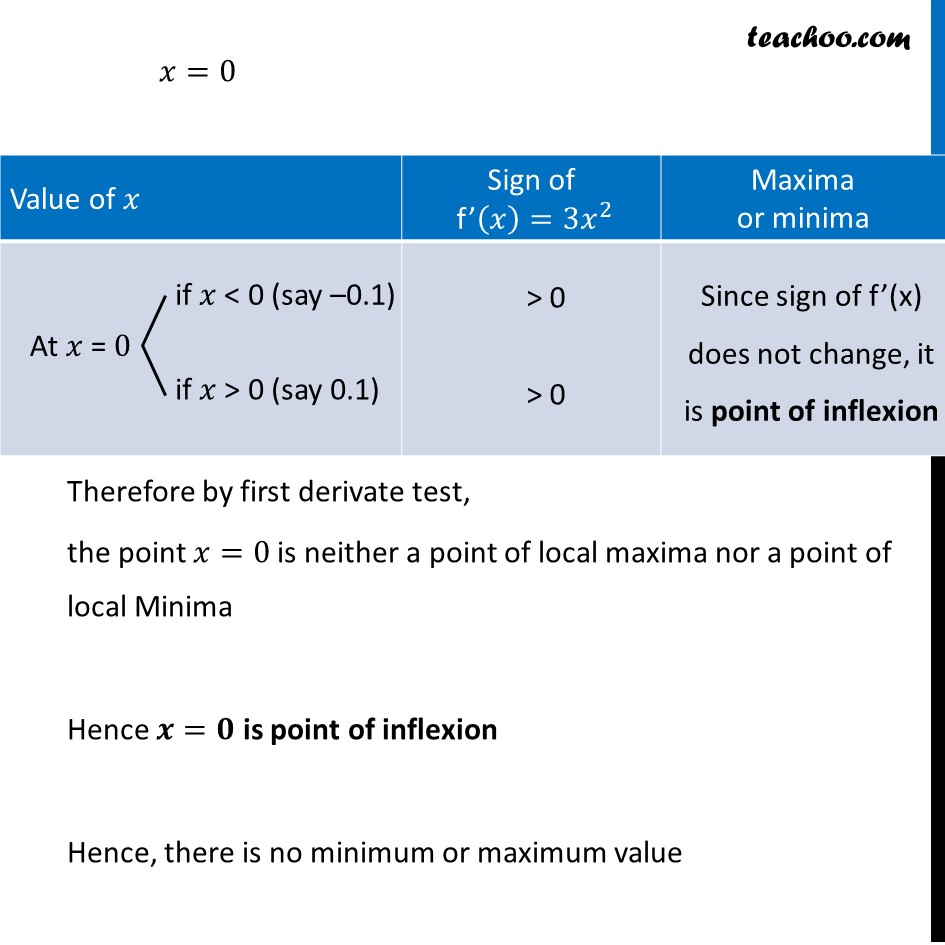
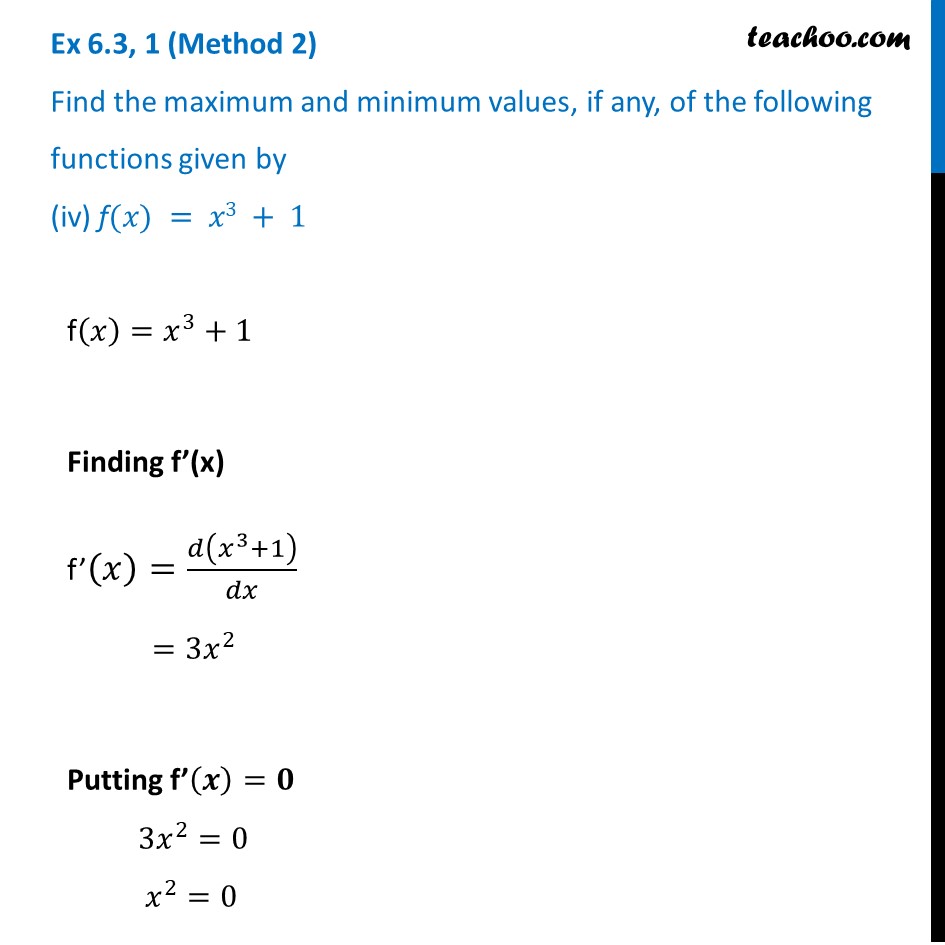
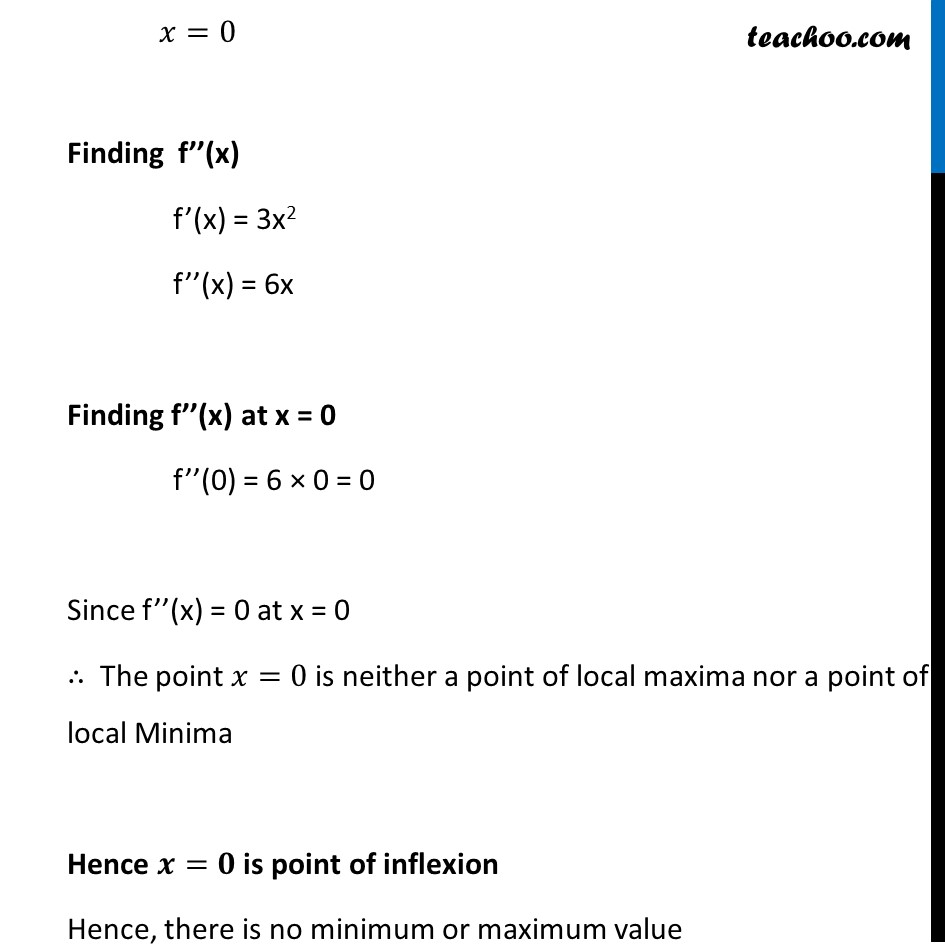
Ex 6.3,1 (Method 1) Find the maximum and minimum values, if any, of the following functions given by (iv) f(𝑥) = 𝑥3 + 1f(𝑥)=𝑥^3+1 Finding f’(x) f’(𝑥)=𝑑(𝑥^3 + 1)/𝑑𝑥 =3𝑥^2 Putting f’(𝒙)=𝟎 3𝑥^2=0 𝑥^2=0 𝑥=0 Therefore by first derivate test, the point 𝑥=0 is neither a point of local maxima nor a point of local Minima Hence 𝒙=𝟎 is point of inflexion Hence, there is no minimum or maximum value Ex 6.3, 1 (Method 2) Find the maximum and minimum values, if any, of the following functions given by (iv) f(𝑥) = 𝑥3 + 1f(𝑥)=𝑥^3+1 Finding f’(x) f’(𝑥)=𝑑(𝑥^3+1)/𝑑𝑥 =3𝑥^2 Putting f’(𝒙)=𝟎 3𝑥^2=0 𝑥^2=0 𝑥=0 Finding f’’(x) f’(x) = 3x2 f’’(x) = 6x Finding f’’(x) at x = 0 f’’(0) = 6 × 0 = 0 Since f’’(x) = 0 at x = 0 ∴ The point 𝑥=0 is neither a point of local maxima nor a point of local Minima Hence 𝒙=𝟎 is point of inflexion Hence, there is no minimum or maximum value