





End-of-Chapter Exercises

 You are here
Last updated at November 5, 2026 by Teachoo
Transcript
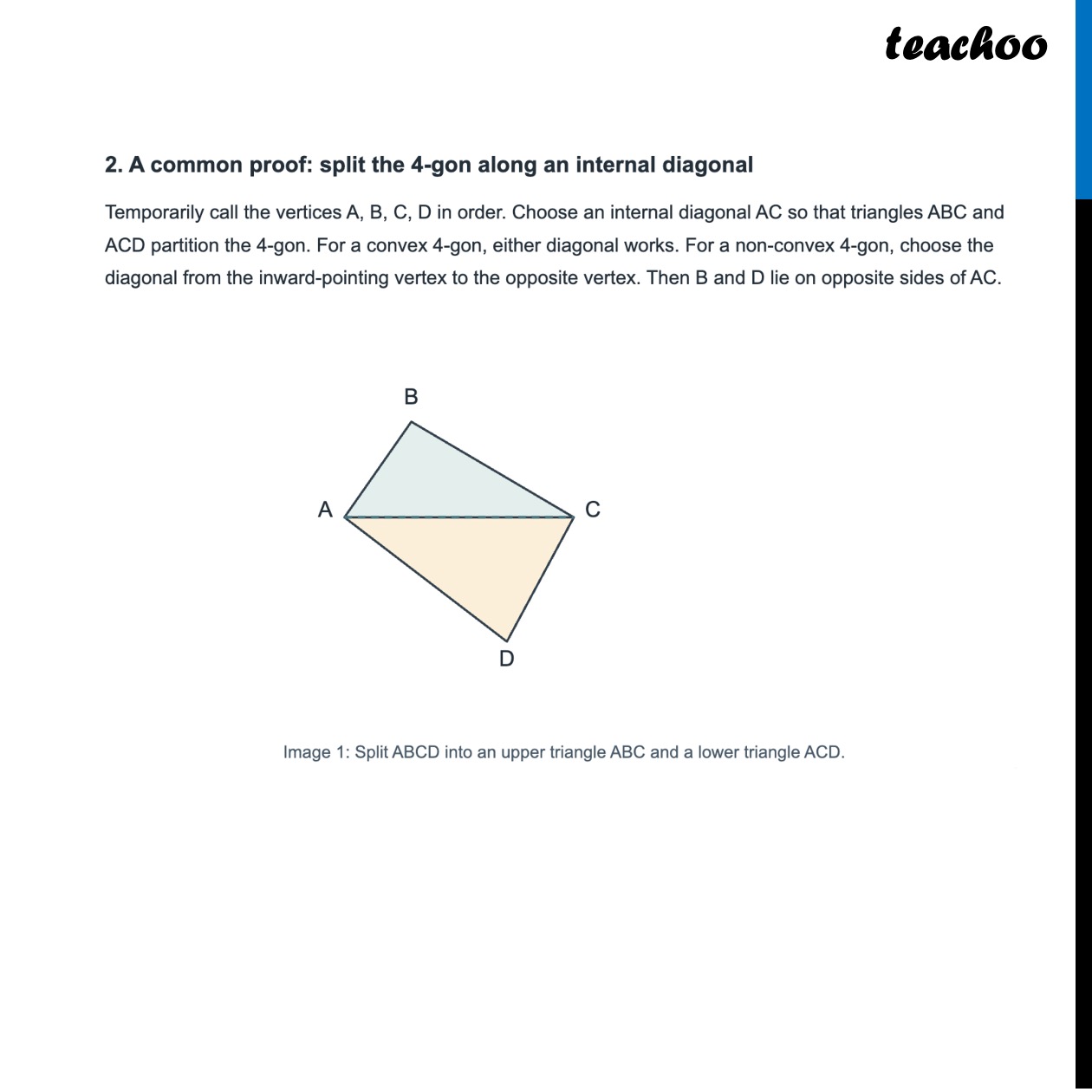
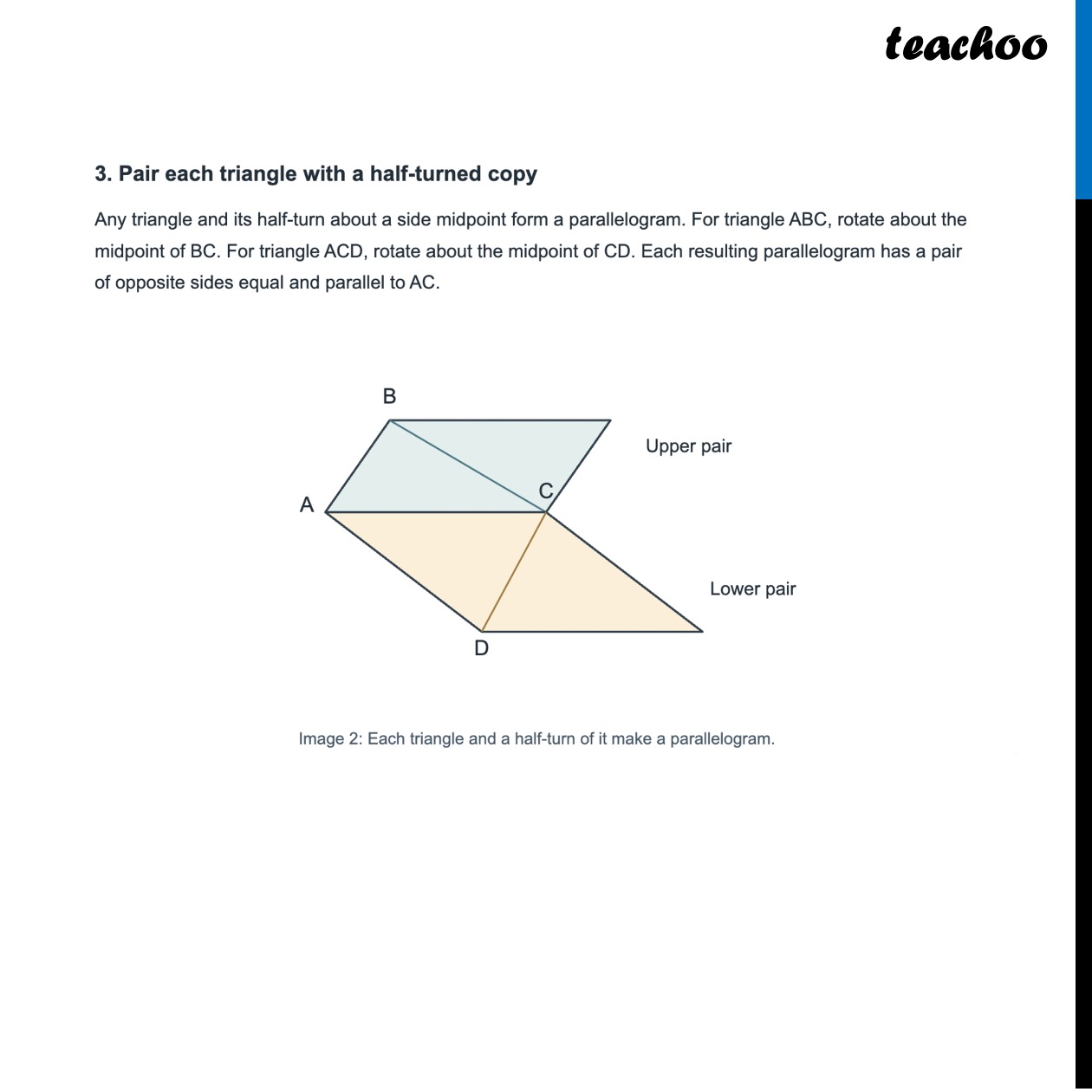
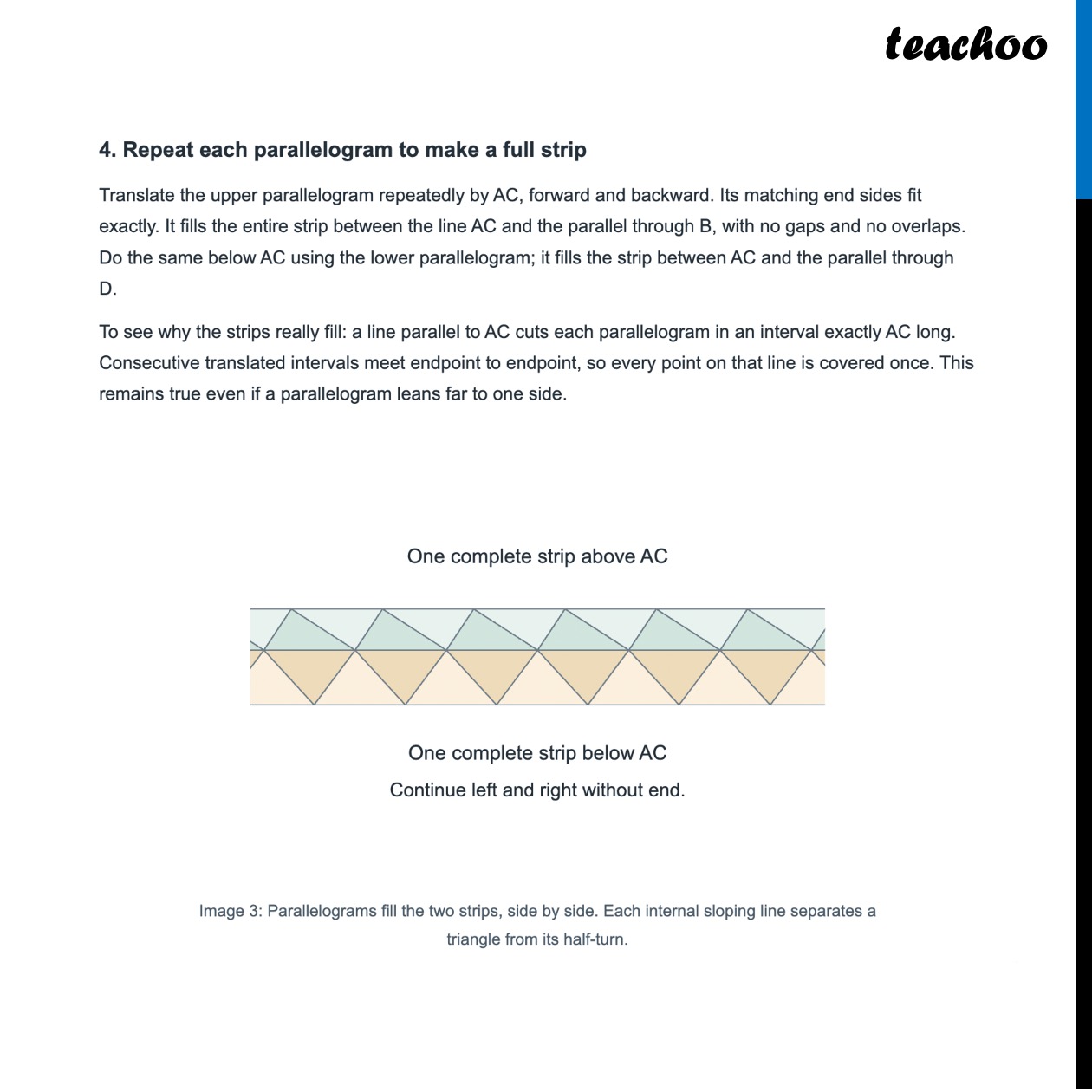
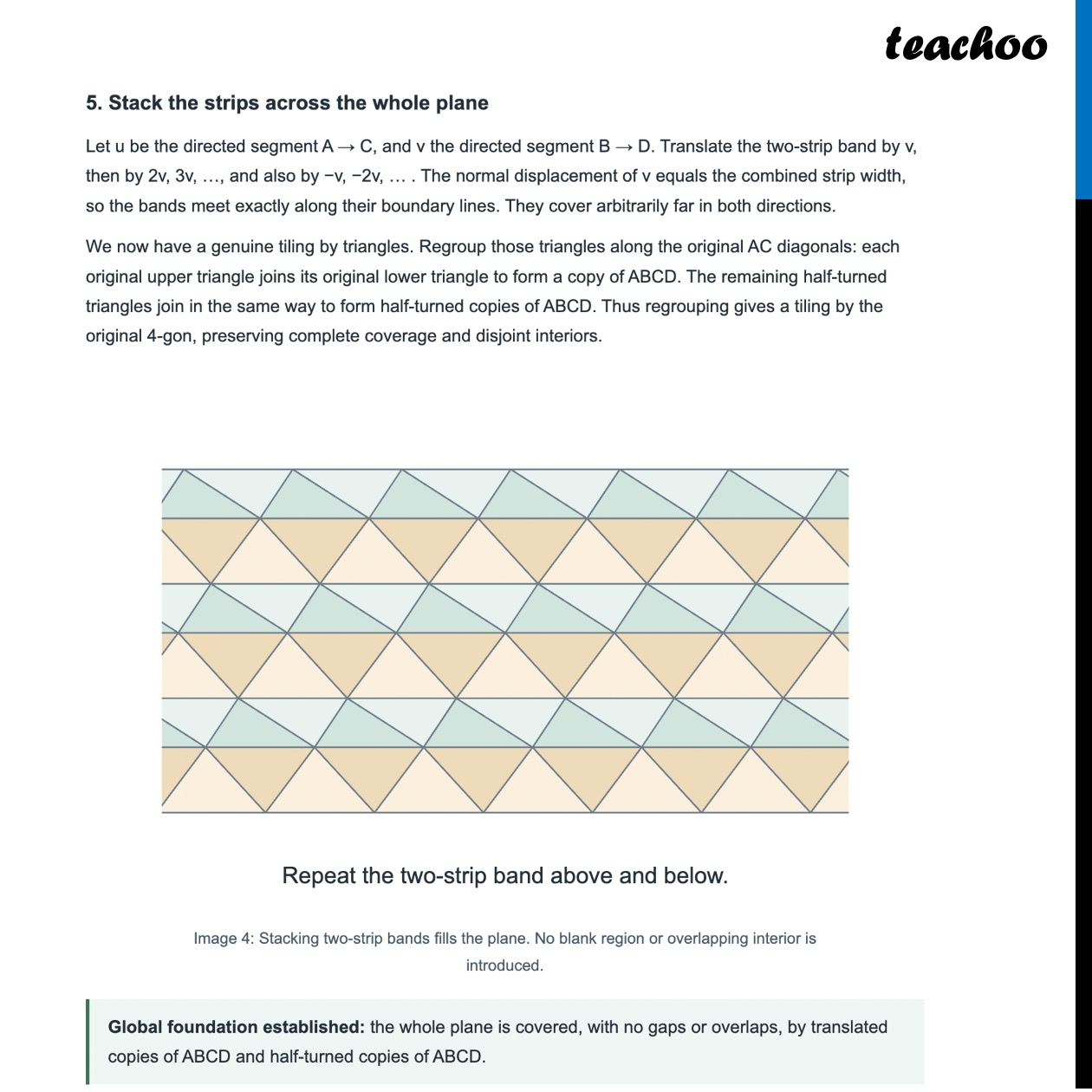
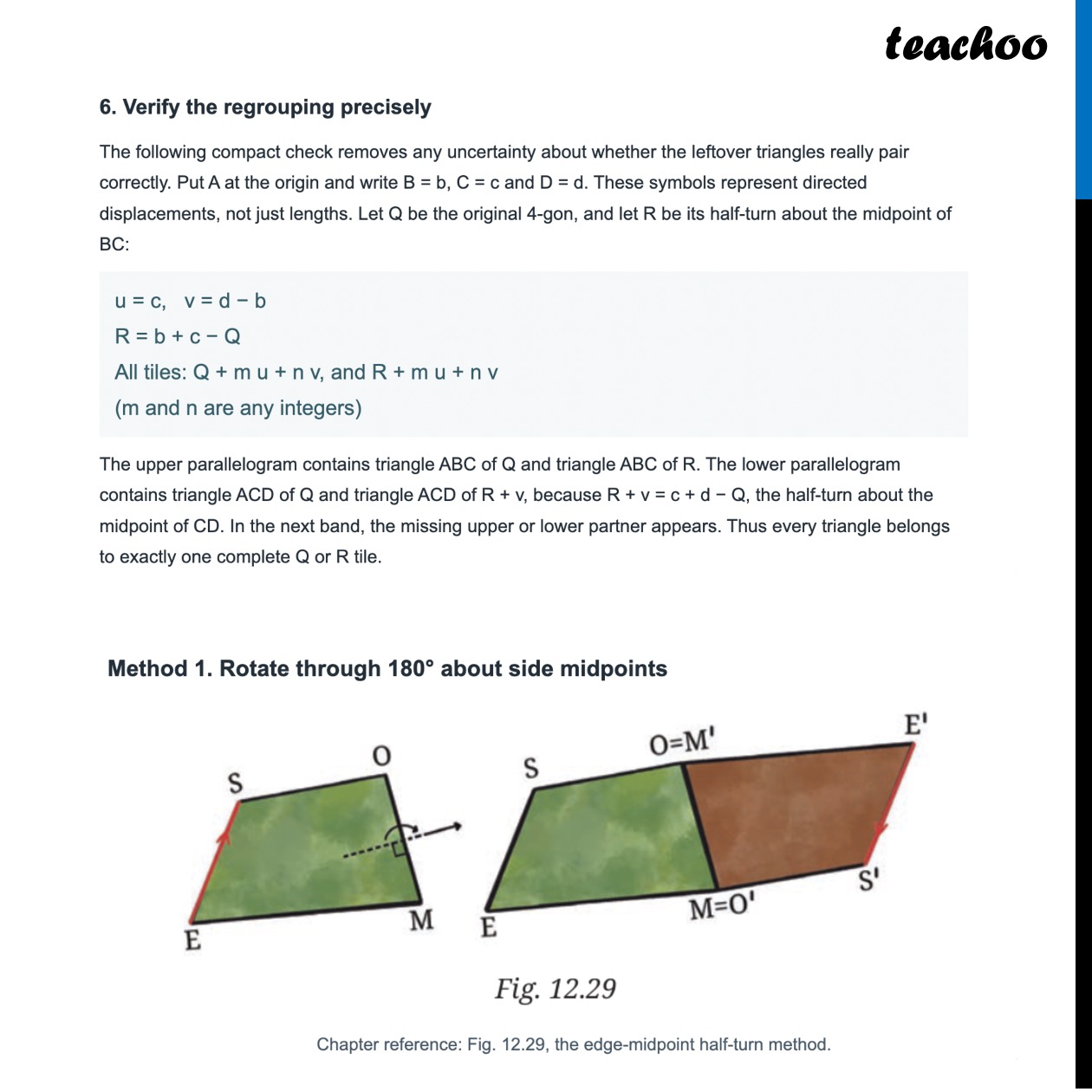
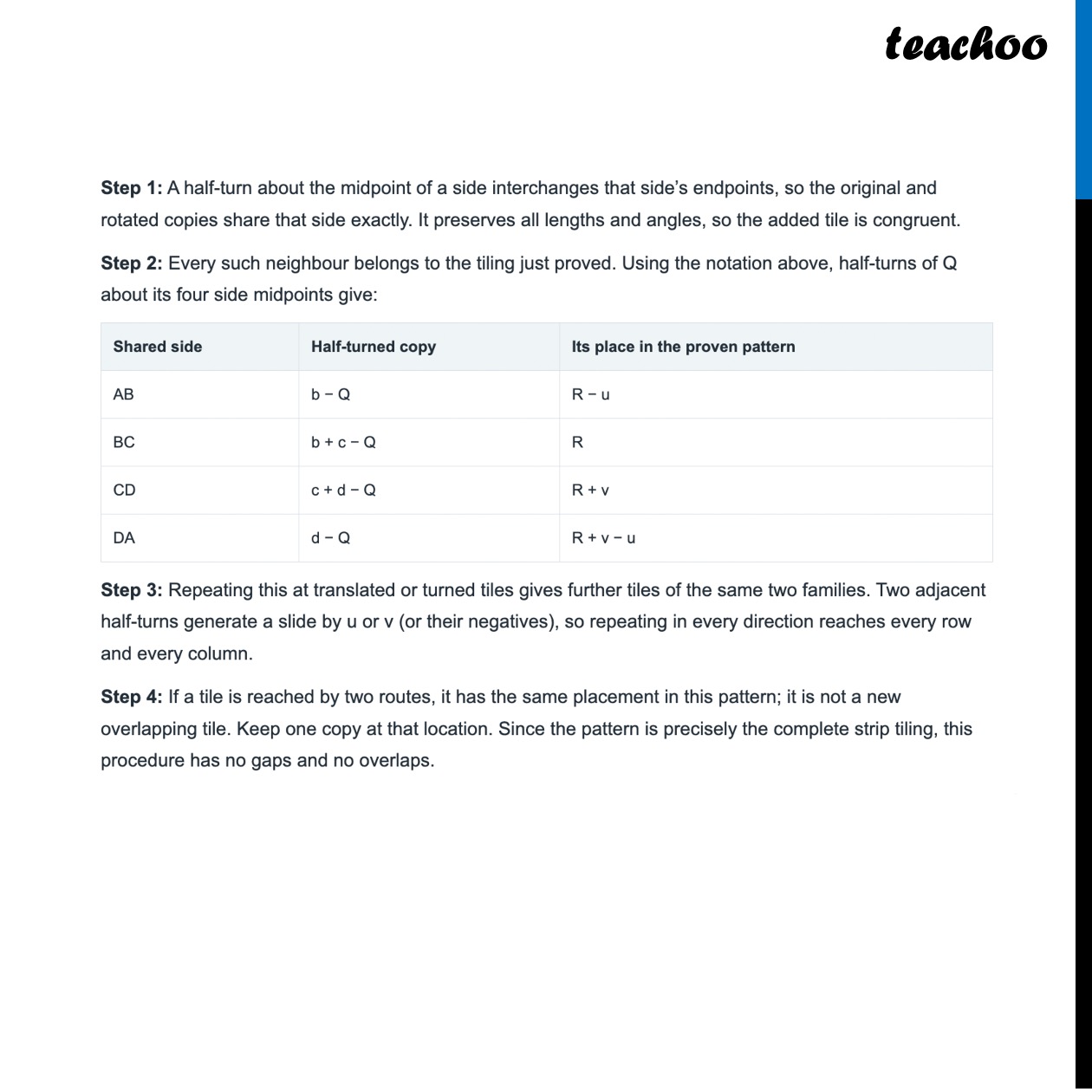
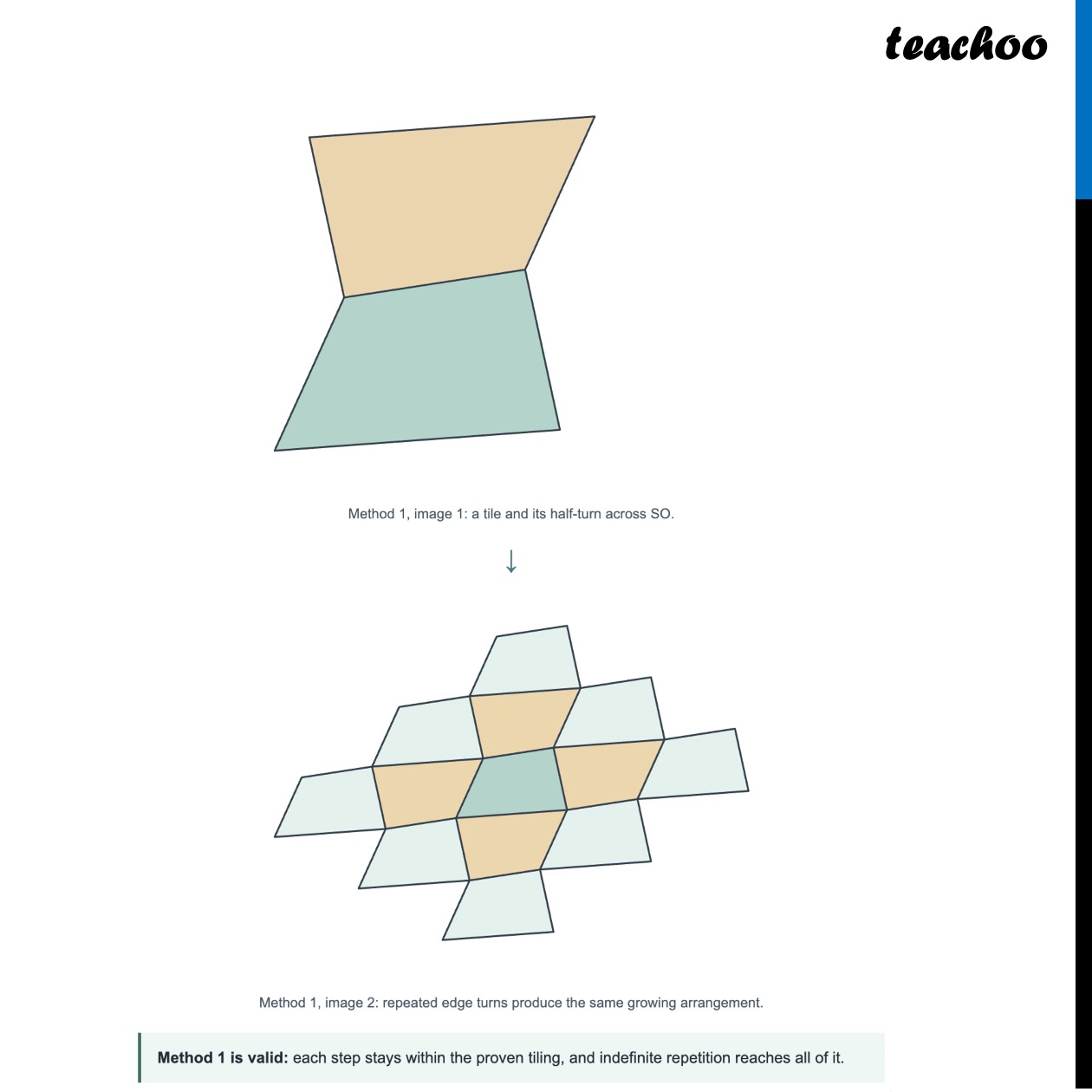
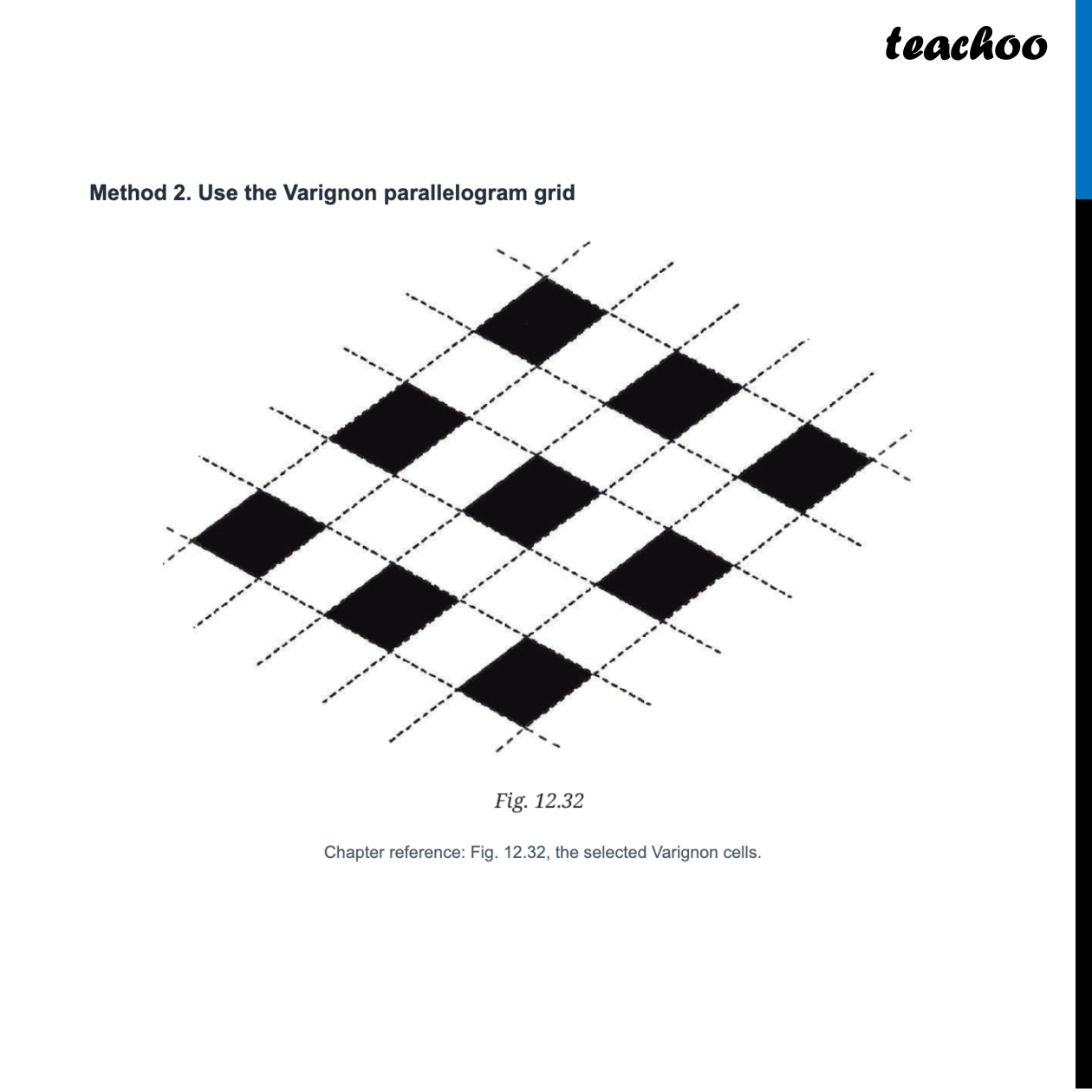
Question 23 Validity of tiling methods. Show using reasoning that each of the three tiling methods we saw produces a tiling of the plane using the given 4-gon. You have to prove that when we place new copies using any of the three procedures, the entire plane is covered with no gaps and no overlaps. First, think carefully about what it means to prove this. Then find a proof for each procedure. Answer 1. What must actually be proved? A picture of a few correctly fitted tiles is not enough. We need all three facts: 1. Congruence: every piece is a copy of the original 4-gon. 2. No overlap: interiors of distinct tiles never intersect. Sharing edges or vertices is allowed. 3. No gaps anywhere: extending the pattern indefinitely covers every point of the plane. The angle sum 360° shows that four corners can fit locally. By itself, it does not prove the last two global claims. We will first build a complete tiling from strips, then show that each of the three procedures gives exactly that tiling. 2. Acommon proof: split the 4-gon along an internal diagonal Temporarily call the vertices A, B, C, D in order. Choose an internal diagonal AC so that triangles ABC and ACD partition the 4-gon. For a convex 4-gon, either diagonal works. For a non-convex 4-gon, choose the diagonal from the inward-pointing vertex to the opposite vertex. Then B and D lie on opposite sides of AC. Image 1: Split ABCD into an upper triangle ABC and a lower triangle ACD. 3. Pair each triangle with a half-turned copy Any triangle and its half-turn about a side midpoint form a parallelogram. For triangle ABC, rotate about the midpoint of BC. For triangle ACD, rotate about the midpoint of CD. Each resulting parallelogram has a pair of opposite sides equal and parallel to AC. Upper pair Lower pair Image 2: Each triangle and a half-turn of it make a parallelogram. 4. Repeat each parallelogram to make a full strip Translate the upper parallelogram repeatedly by AC, forward and backward. Its matching end sides fit exactly. It fills the entire strip between the line AC and the parallel through B, with no gaps and no overlaps. Do the same below AC using the lower parallelogram; it fills the strip between AC and the parallel through D. To see why the strips really fill: a line parallel to AC cuts each parallelogram in an interval exactly AC long. Consecutive translated intervals meet endpoint to endpoint, so every point on that line is covered once. This remains true even if a parallelogram leans far to one side. One complete strip above AC One complete strip below AC Continue left and right without end. Image 3: Parallelograms fill the two strips, side by side. Each internal sloping line separates a triangle from its half-turn. 5. Stack the strips across the whole plane Let u be the directed segment A — C, and v the directed segment B — D. Translate the two-strip band by v, then by 2v, 3v, ..., and also by -v, -2v, ... . The normal displacement of v equals the combined strip width, so the bands meet exactly along their boundary lines. They cover arbitrarily far in both directions. We now have a genuine tiling by triangles. Regroup those triangles along the original AC diagonals: each original upper triangle joins its original lower triangle to form a copy of ABCD. The remaining half-turned triangles join in the same way to form half-turned copies of ABCD. Thus regrouping gives a tiling by the original 4-gon, preserving complete coverage and disjoint interiors. Repeat the two-strip band above and below. Image 4: Stacking two-strip bands fills the plane. No blank region or overlapping interior is introduced. Global foundation established: the whole plane is covered, with no gaps or overlaps, by translated copies of ABCD and half-turned copies of ABCD. 6. Verify the regrouping precisely The following compact check removes any uncertainty about whether the leftover triangles really pair correctly. Put A at the origin and write B = b, C = c and D = d. These symbols represent directed displacements, not just lengths. Let Q be the original 4-gon, and let R be its half-turn about the midpoint of BC: u=c, v=d-b R=b+c-Q All tiles: Q+mut+tnv,andR+mutnv (m and n are any integers) The upper parallelogram contains triangle ABC of Q and triangle ABC of R. The lower parallelogram contains triangle ACD of Q and triangle ACD of R + v, because R + v=c +d -Q, the half-turn about the midpoint of CD. In the next band, the missing upper or lower partner appears. Thus every triangle belongs to exactly one complete Q or R tile. Method 1. Rotate through 180° about side midpoints O=M' M= Fig. 12.29 Chapter reference: Fig. 12.29, the edge-midpoint half-turn method. Step 1: A half-turn about the midpoint of a side interchanges that side’s endpoints, so the original and rotated copies share that side exactly. It preserves all lengths and angles, so the added tile is congruent. Step 2: Every such neighbour belongs to the tiling just proved. Using the notation above, half-turns of Q about its four side midpoints give: Shared side Half-turned copy Its place in the proven pattern AB b-Q R-u BC b+c-Q R CD c+d-Q Rtv DA d-Q R+v-u Step 3: Repeating this at translated or turned tiles gives further tiles of the same two families. Two adjacent half-turns generate a slide by u or v (or their negatives), so repeating in every direction reaches every row and every column. Step 4: If a tile is reached by two routes, it has the same placement in this pattern; it is not a new overlapping tile. Keep one copy at that location. Since the pattern is precisely the complete strip tiling, this procedure has no gaps and no overlaps. Method 1, image 1: a tile and its half-turn across SO. { Method 1, image 2: repeated edge turns produce the same growing arrangement. Method 1 is valid: each step stays within the proven tiling, and indefinite repetition reaches all of it. Method 2. Use the Varignon parallelogram grid - a 4 a ? ad ’ at ~ * ars Pa al + Pa ¢ * ra ~ - ~ ¢ se a a Ps we Pid at ~~ ~*~ ra - =" as Wp, Pa ¢ Mg - ° s - > 4 ¢ =e - ¢ . ¢ ~ a ~ € - ~ o ~ ¢ w7 ~ “ - ~ ~ * bd ~ > ~~. on é ~ ¢ o ia ° - ° ~ = ¢ ¢ . ~ ” at Ses ~ - Pod ~ * se oe” “sy ’ wv ’ - ~ ¢ ¢ - ~ < ¢ %e - 4 af. . gh Pe ~ Pa * a oa ~ ea pt “” ~. “ Se, rad y “ ~ 4 ed Pa Sie ¢ \. * a “aL ay s* r ~ ¢ “te e ” “. ¢ ~ Z e - ¢ Me; ~ £ af “~ ri P gee = - : 3 « .¢ -” ya at Pa ~ ra a as e - Pa ge ee m ae fey ,* .°m hee ¢ ~ ¢ got *. ’ + ¢ ¢ s ~ , ~ Fig. 12.32 Chapter reference: Fig. 12.32, the selected Varignon cells. Step 1: Join the midpoints of AB, BC, CD and DA. Their parallelogram has adjacent side displacements u/2 and v/2, by the Midpoint Theorem. Repeat this parallelogram to make an ordinary parallelogram grid. Step 2: Select one cell, then every second cell in each grid direction, as in the chapter. Place the original 4- gon with its midpoints on each selected cell in the same orientation. The displacement between selected cells is u or v, so these are exactly the copies Q+mu+tnv. Step 3: Their bounded gaps are exactly the copies R + m u + n v from the proved strip tiling. Fill them with half-turned 4-gons. No unaccounted gap or overlap is possible, because the two complete families have already been proved to partition the plane. Step 4: Continue the grid in both directions without end. This reaches every translated copy and every intervening half-turned copy, hence covers the whole plane. Method 2, image 2: fill the intervening gaps with congruent half-turned tiles. The midpoint grid is a positioning guide. Do not assume that the whole 4-gon fits inside its own Varignon parallelogram; it generally does not. The proof comes from identifying the final copies with the complete tiling above. Method 2 is valid: grid placement reproduces the same two families of tiles. Method 3. Translate along the two diagonals Step 1: Use the two diagonal displacements u = A— C and v=B — D. Starting from Q, translating by both signs of each displacement gives its four neighbours of the same orientation. Step 2: Repeated slides give allQ + mu +n v. The order of the slides makes no difference: adding u then v is the same as adding v then u. So different routes to the same location agree. Step 3: Fill each bounded gap with the corresponding half-turned tile R + m u+nv. These are exactly the missing pieces of the proved strip tiling. Repeat in every direction. Method 3 is valid: translating along diagonals and filling the gaps gives the same gap-free, overlap- free tiling. For SOME, these displacements are EO and SM, exactly as in Q18. Large final image: all three methods give this pattern Final tiling patch: green copies are translations of SOME; amber copies are half-turns. Continue the pattern indefinitely beyond every edge. What about non-convex 4-gons? The strip proof still works. Choose the internal diagonal, so its two triangles lie on opposite sides; the parallelograms may lean differently, but the strip argument is unchanged. If the chosen diagonal is the other one, relabel cyclically to use an internal diagonal for the proof. The two diagonal translation directions are merely interchanged or reversed, so the same tiling procedures remain valid. No convexity assumption was used after the internal diagonal was chosen. Final conclusion: all three procedures generate congruent copies of the given simple planar 4-gon, cover every point of the plane, and have disjoint interiors. Therefore each procedure gives a valid tiling.