End-of-Chapter Exercises

 You are here
Last updated at November 5, 2026 by Teachoo
Transcript
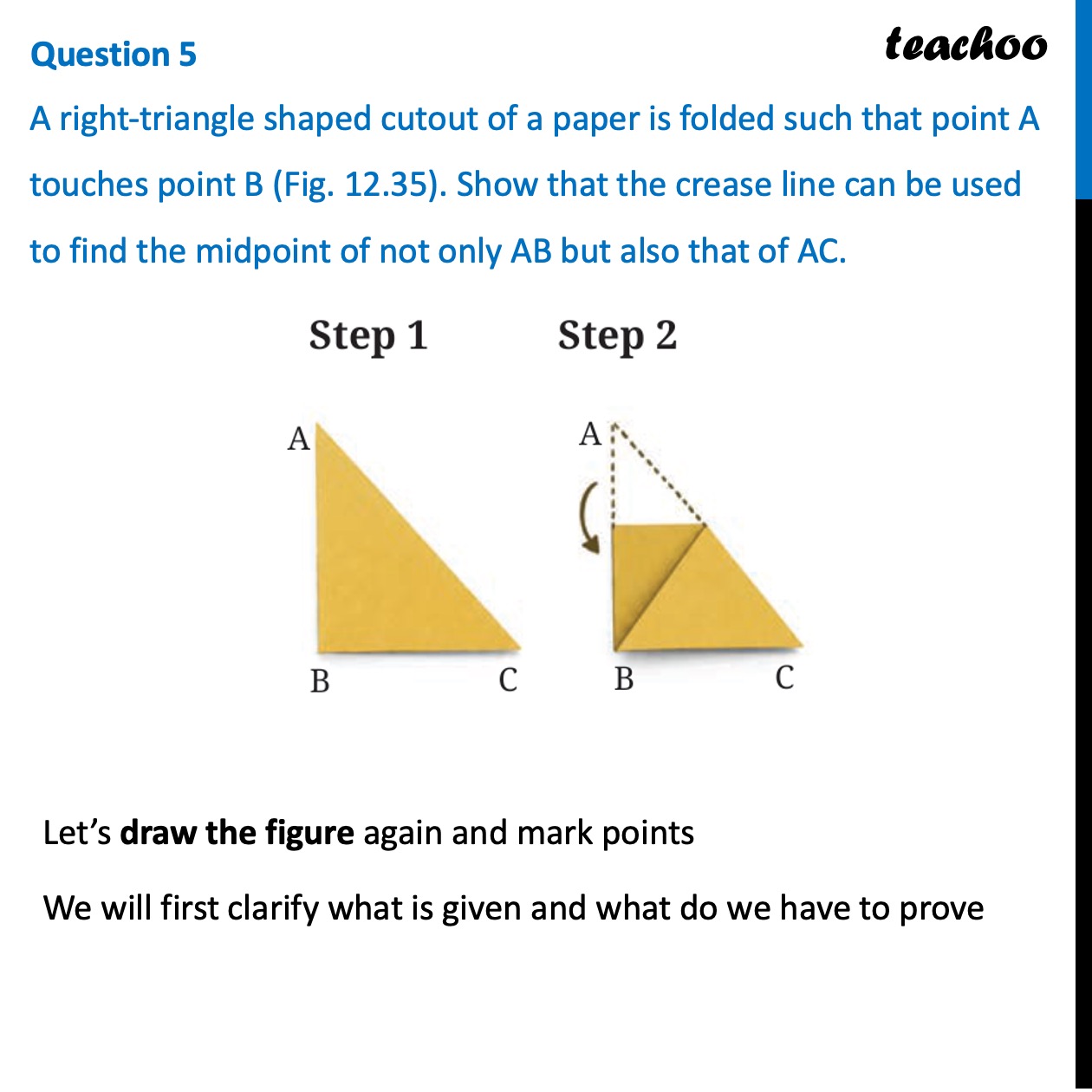
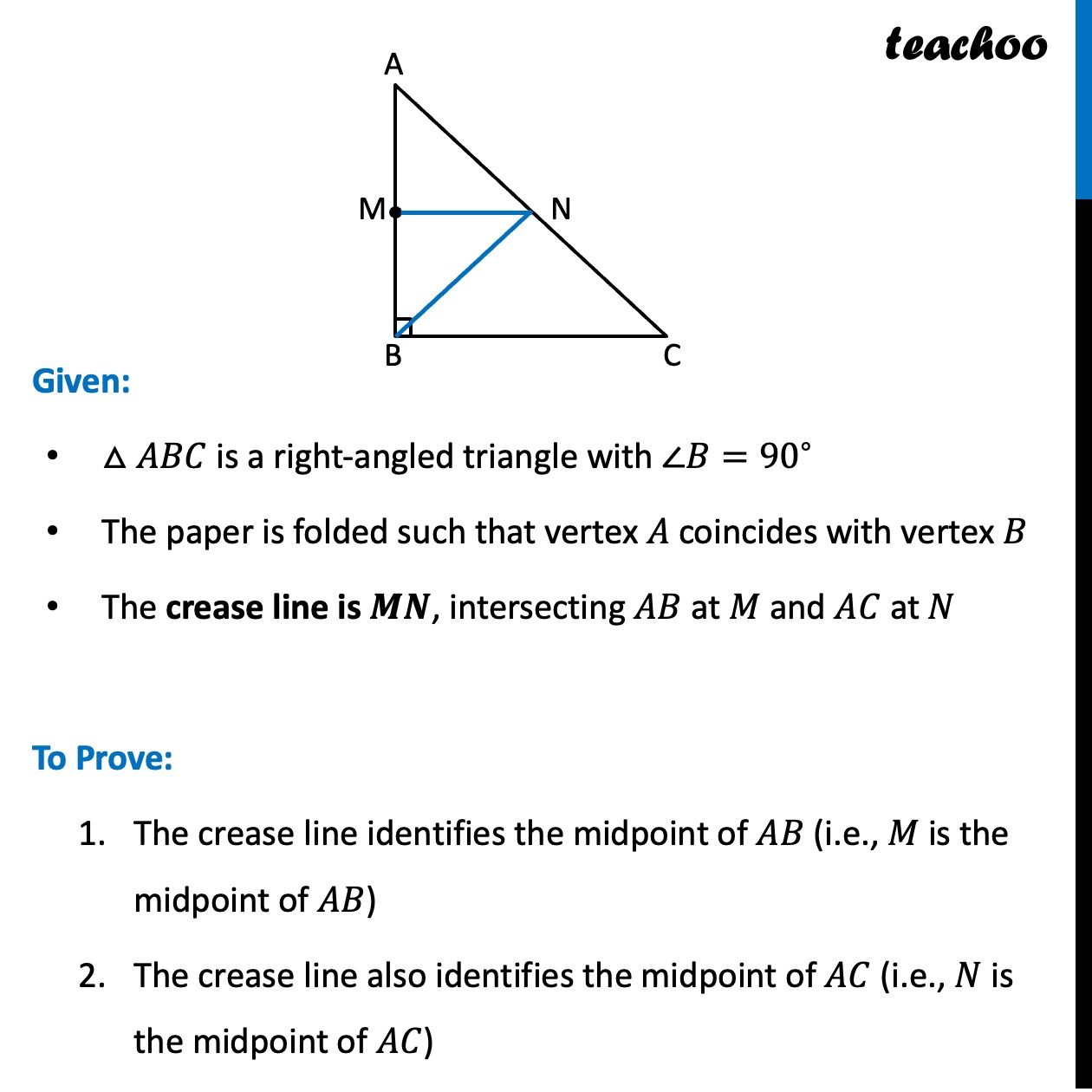
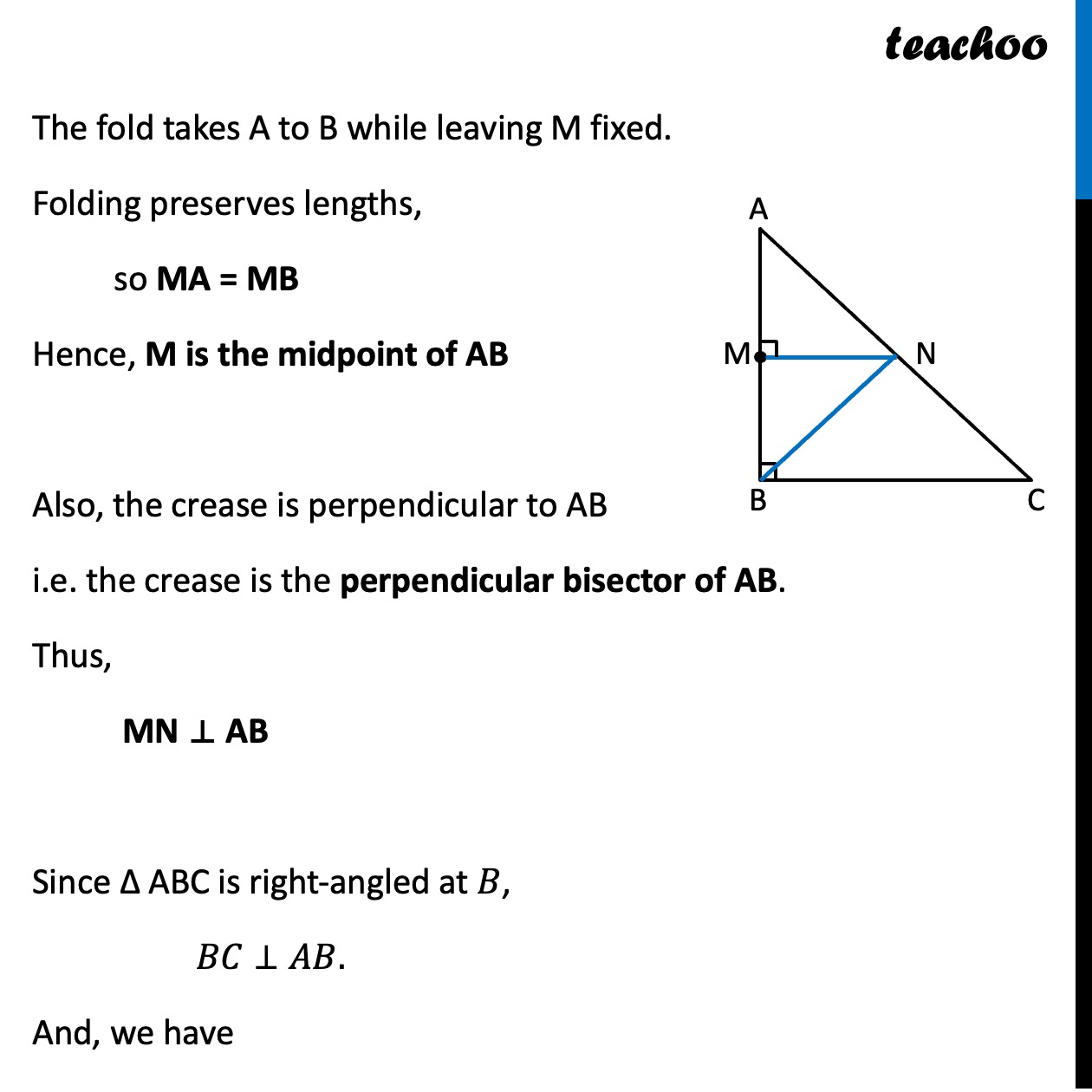
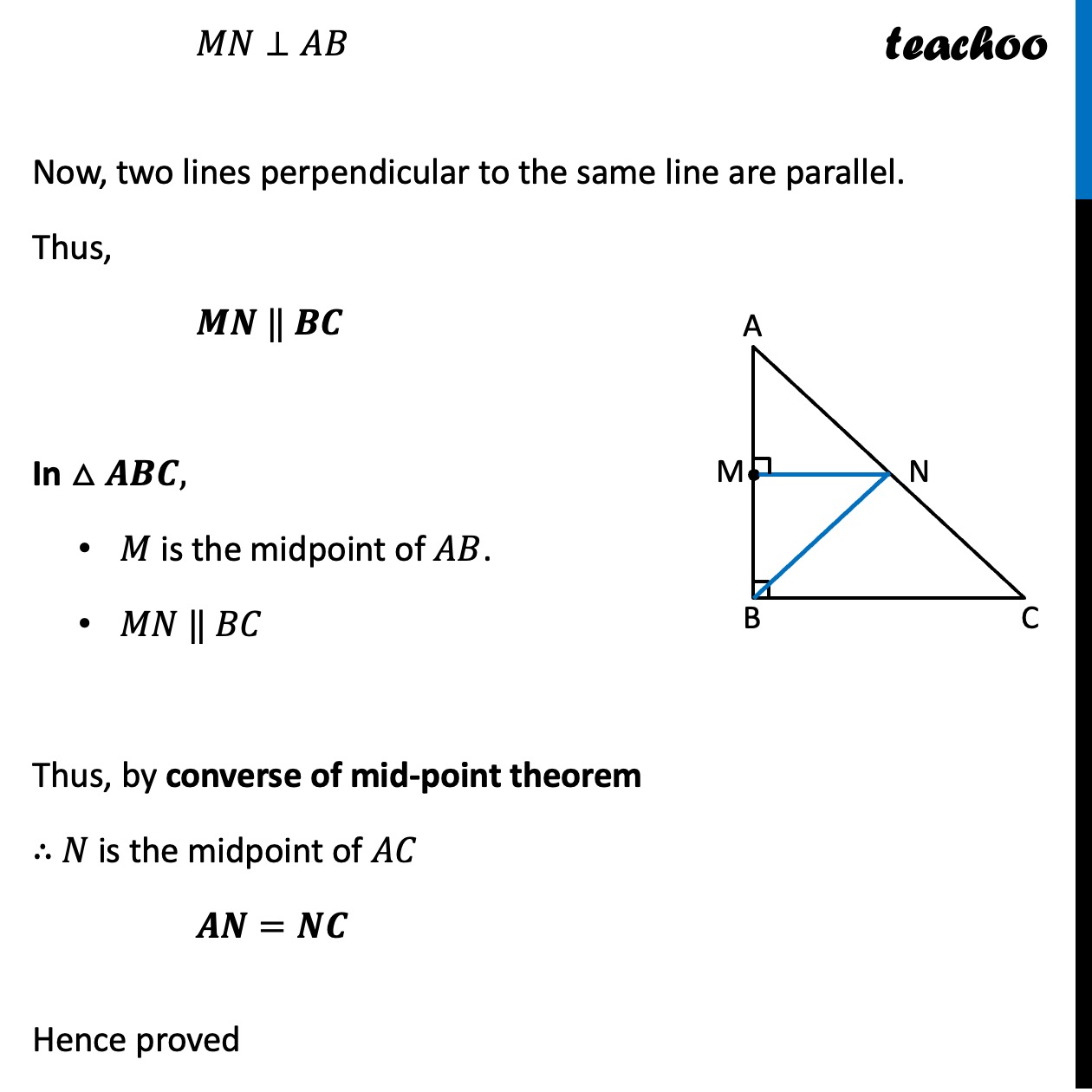
Question 5 A right-triangle shaped cutout of a paper is folded such that point A touches point B (Fig. 12.35). Show that the crease line can be used to find the midpoint of not only AB but also that of AC. Let’s draw the figure again and mark points We will first clarify what is given and what do we have to prove Step 1 Step 2 A AN Fig. 12.35 Given: △𝐴𝐵𝐶 is a right-angled triangle with ∠𝐵=90^(∘) The paper is folded such that vertex 𝐴 coincides with vertex 𝐵 The crease line is 𝑴𝑵, intersecting 𝐴𝐵 at 𝑀 and 𝐴𝐶 at 𝑁 To Prove: The crease line identifies the midpoint of 𝐴𝐵 (i.e., 𝑀 is the midpoint of 𝐴𝐵) The crease line also identifies the midpoint of 𝐴𝐶 (i.e., 𝑁 is the midpoint of 𝐴𝐶) A B C M N The fold takes A to B while leaving M fixed. Folding preserves lengths, so MA = MB Hence, M is the midpoint of AB Also, the crease is perpendicular to AB i.e. the crease is the perpendicular bisector of AB. Thus, MN ⟂ AB Since ∆ ABC is right-angled at 𝐵, 𝐵𝐶⊥𝐴𝐵. And, we have 𝑀𝑁⊥𝐴𝐵 Now, two lines perpendicular to the same line are parallel. Thus, 𝑴𝑵 ‖ 𝑩𝑪 In △𝑨𝑩𝑪, 𝑀 is the midpoint of 𝐴𝐵. 𝑀𝑁 ‖ 𝐵𝐶 Thus, by converse of mid-point theorem ∴ 𝑁 is the midpoint of 𝐴𝐶 𝑨𝑵=𝑵𝑪 Hence proved A B C M N 𝑀𝑁⊥𝐴𝐵 Now, two lines perpendicular to the same line are parallel. Thus, 𝑴𝑵 ‖ 𝑩𝑪 In △𝑨𝑩𝑪, 𝑀 is the midpoint of 𝐴𝐵. 𝑀𝑁 ‖ 𝐵𝐶 Thus, by converse of mid-point theorem ∴ 𝑁 is the midpoint of 𝐴𝐶 𝑨𝑵=𝑵𝑪 Hence proved A B C M N
