End-of-Chapter Exercises

 You are here
Last updated at November 5, 2026 by Teachoo
Transcript
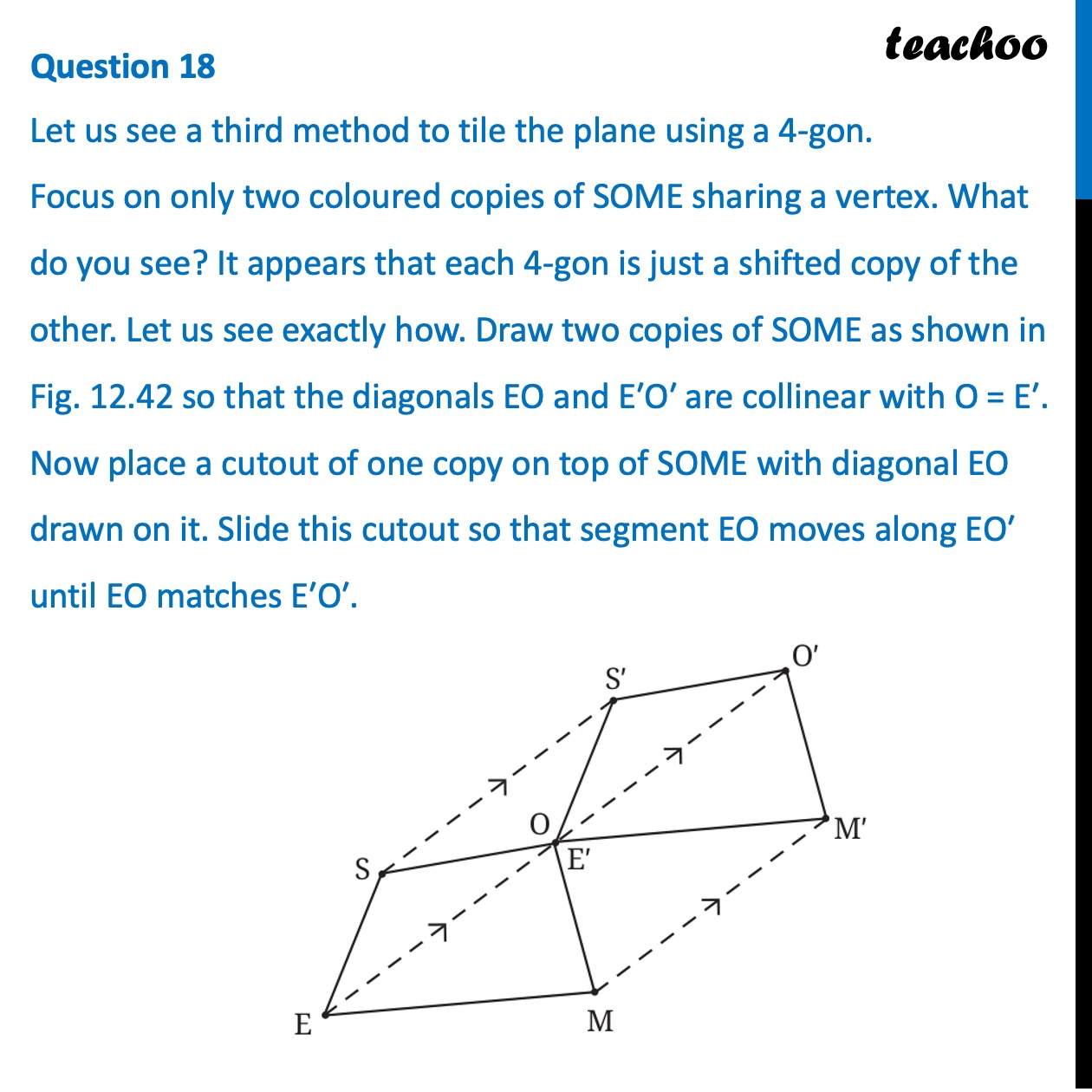
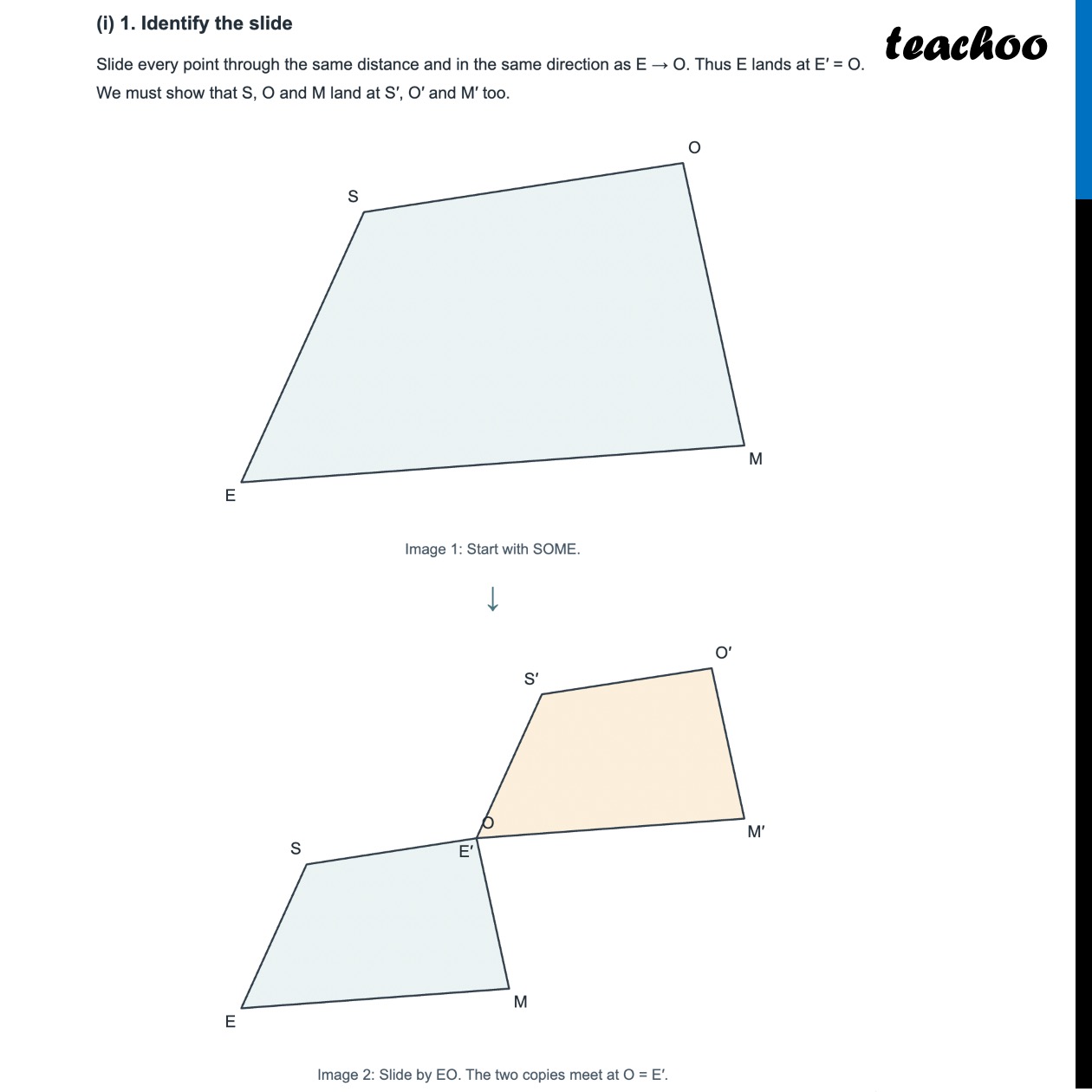
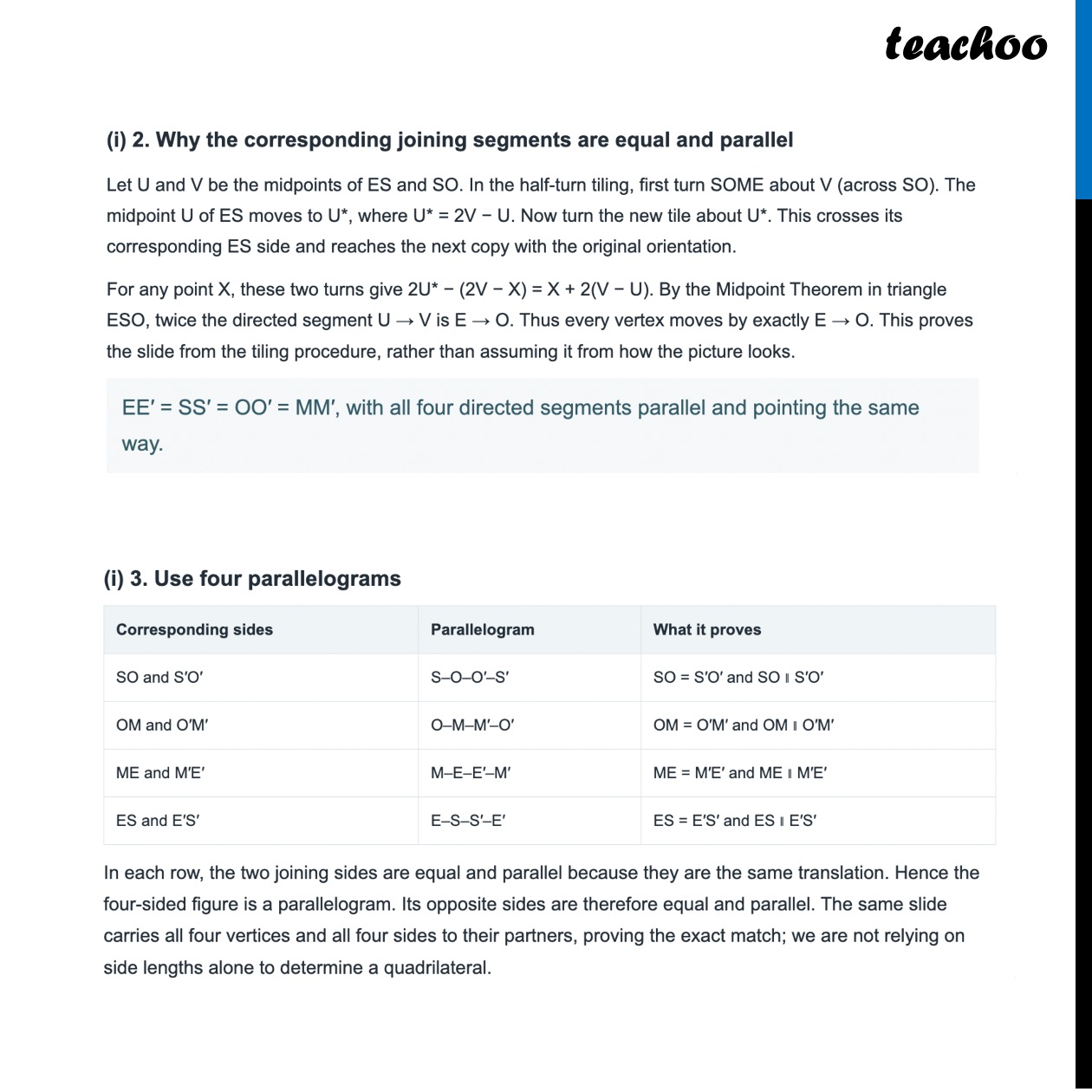
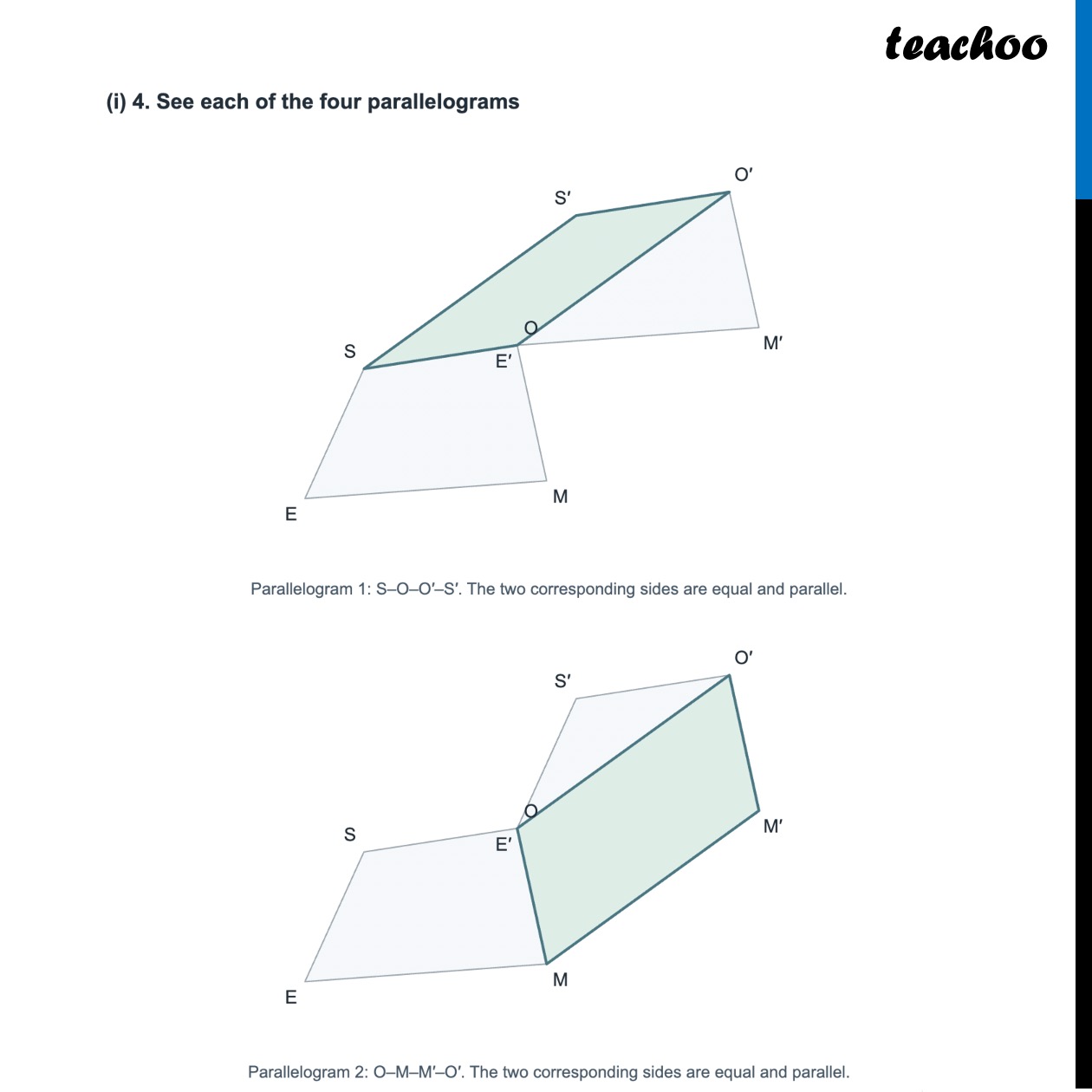
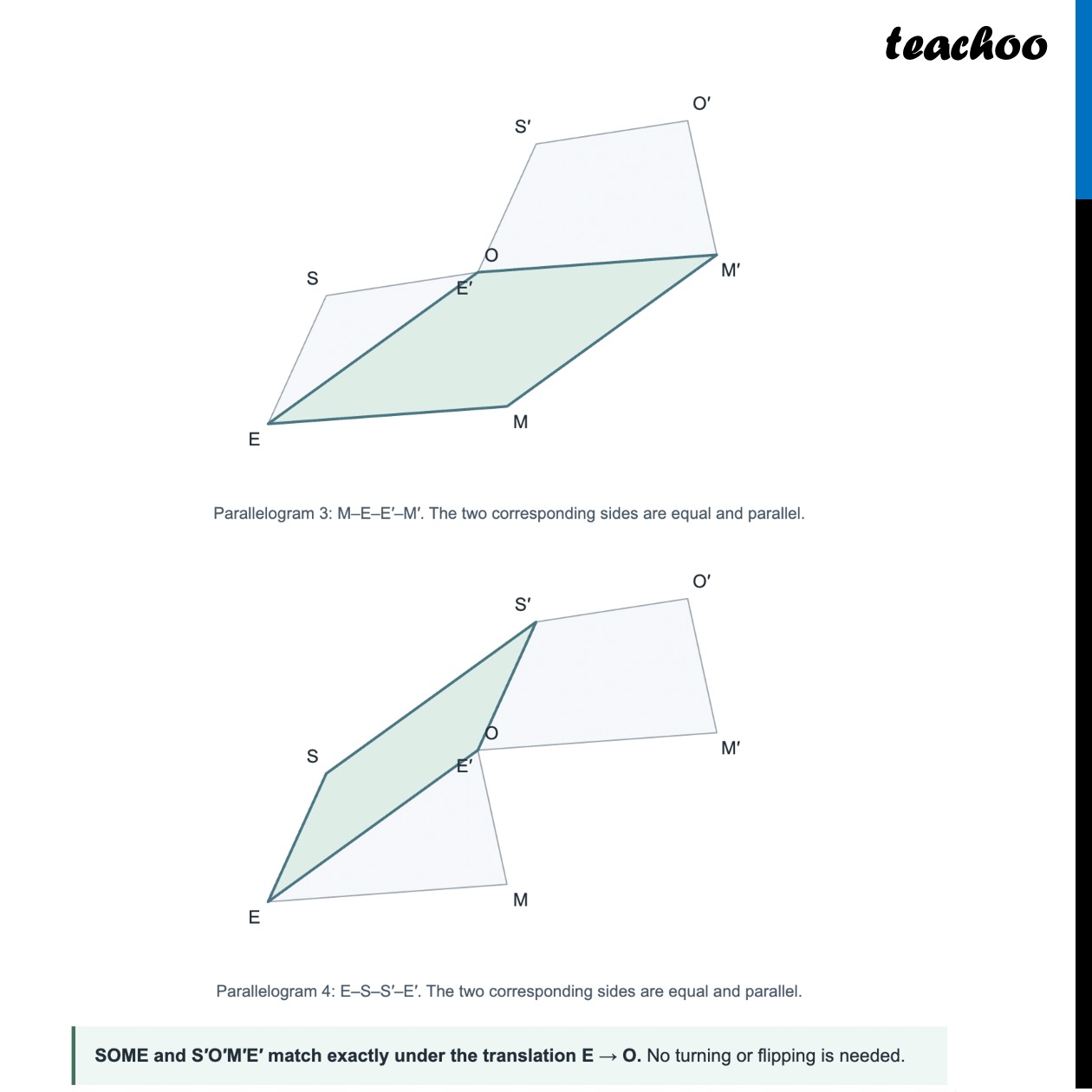
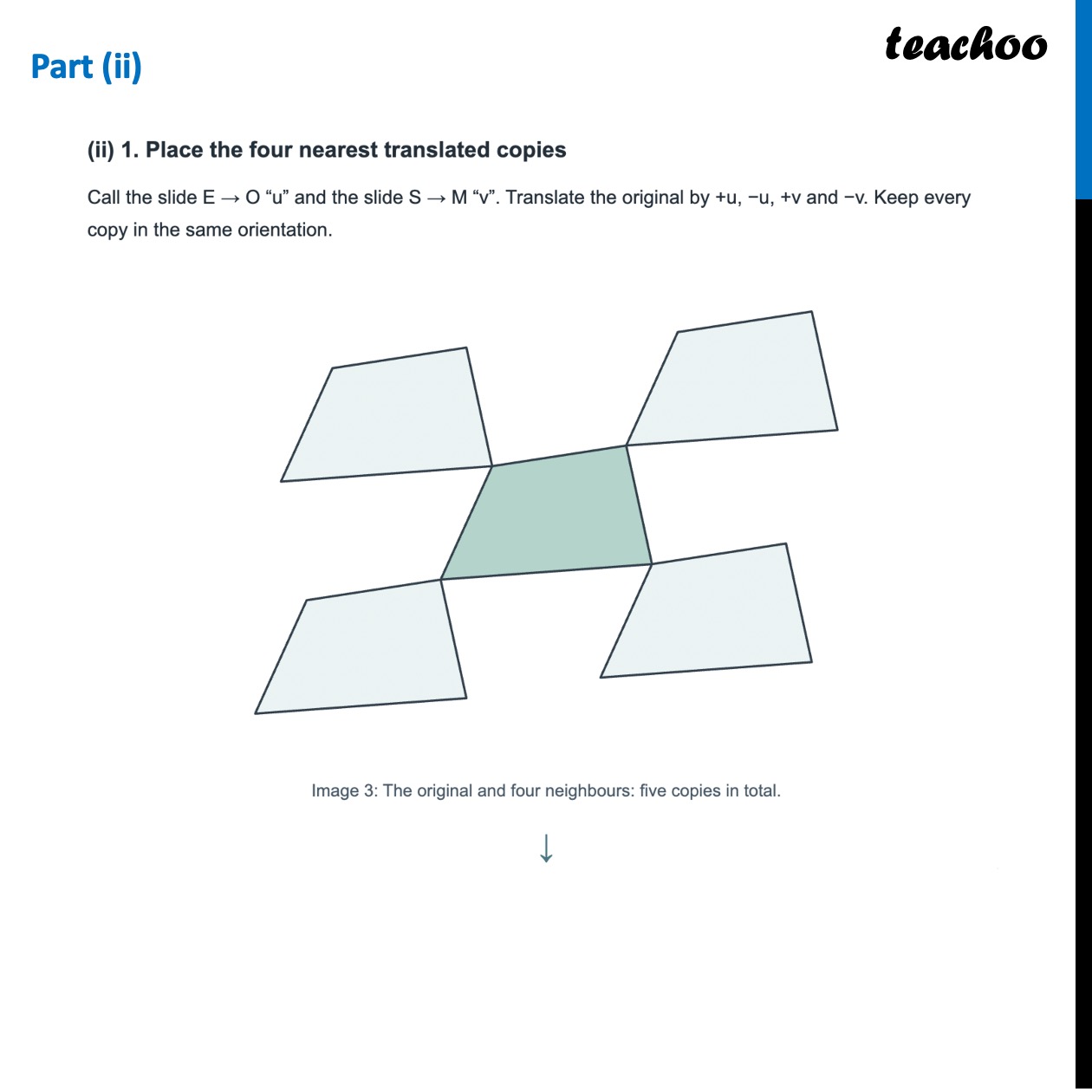
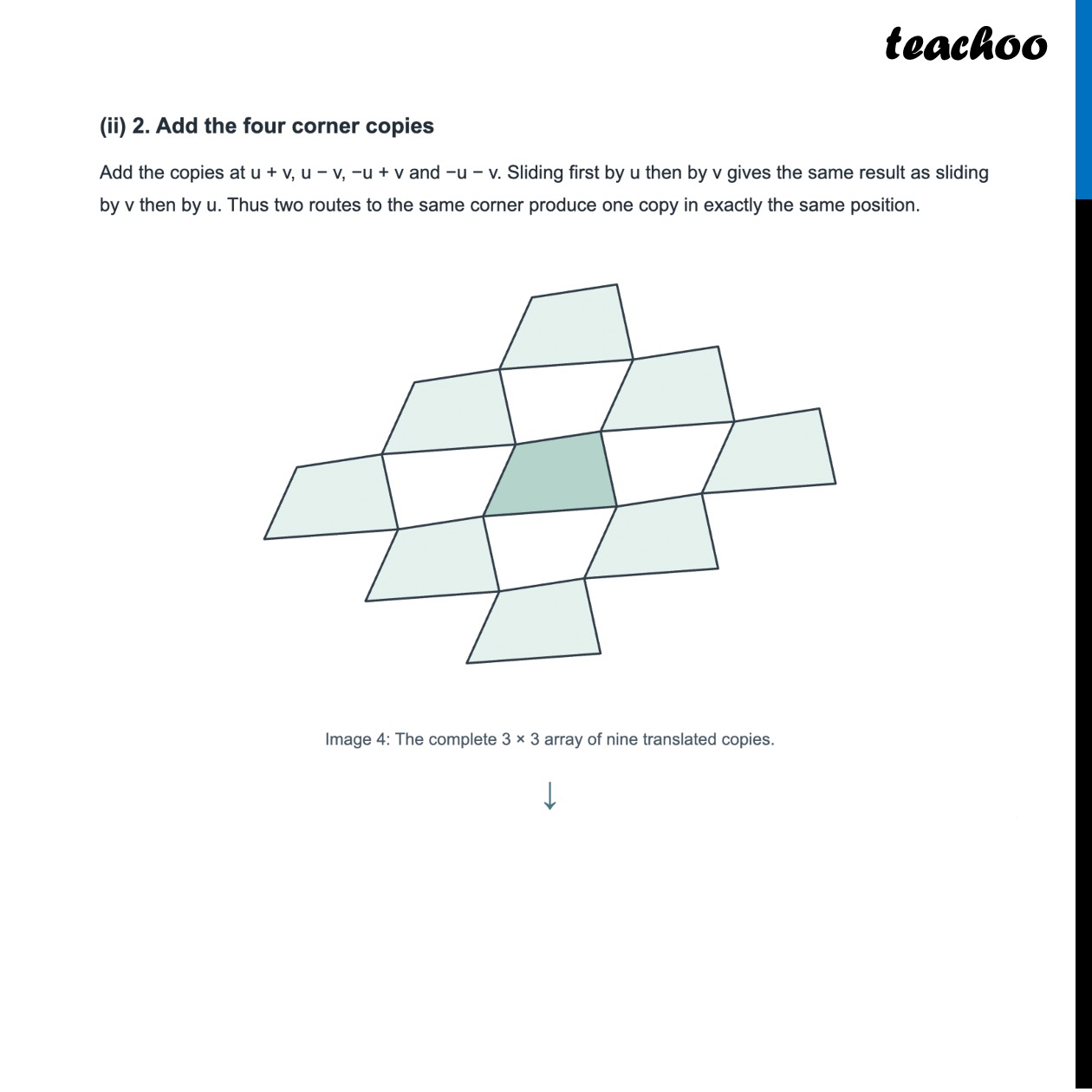
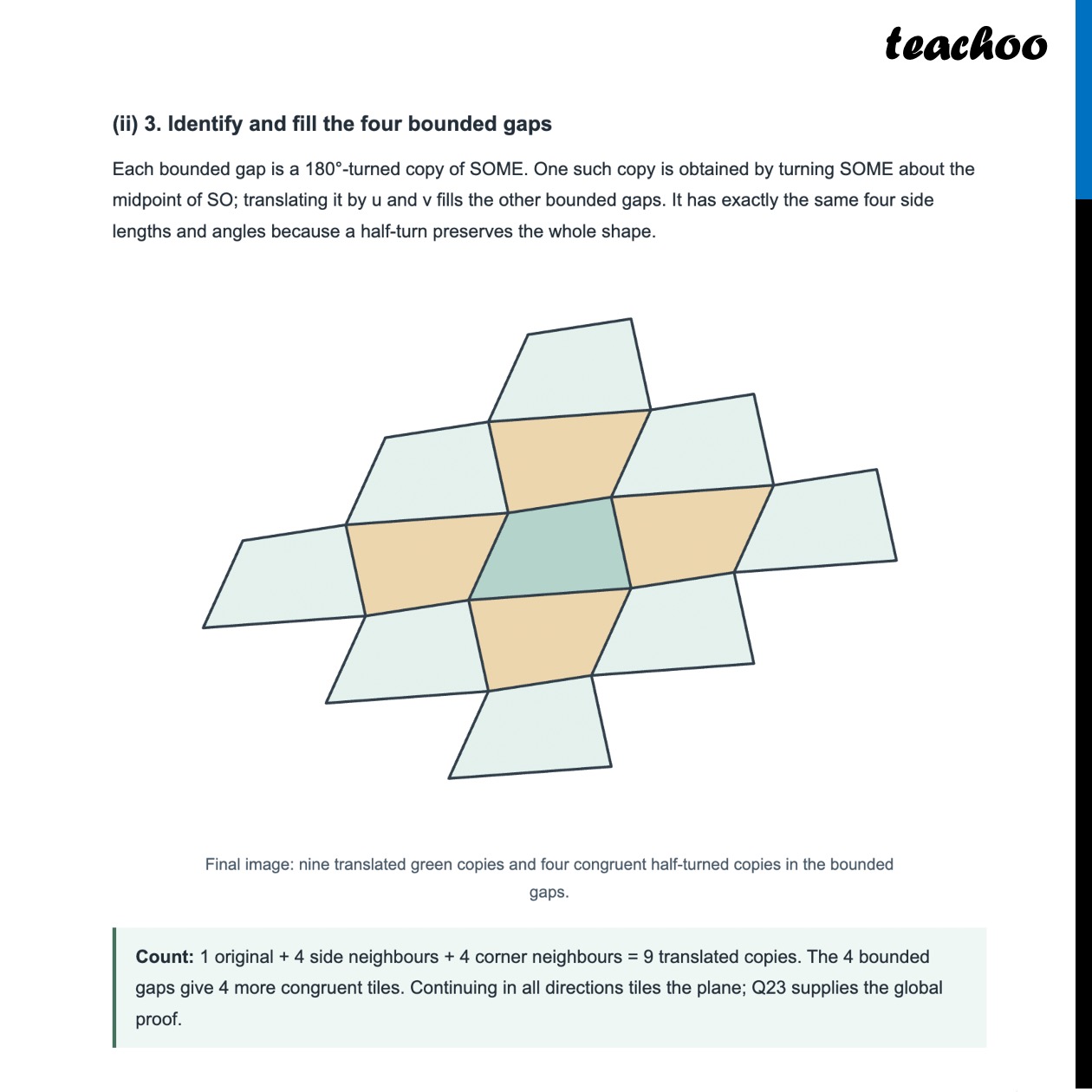
Question 18 Let us see a third method to tile the plane using a 4-gon. Focus on only two coloured copies of SOME sharing a vertex. What do you see? It appears that each 4-gon is just a shifted copy of the other. Let us see exactly how. Draw two copies of SOME as shown in Fig. 12.42 so that the diagonals EO and EʹOʹ are collinear with O = Eʹ. Now place a cutout of one copy on top of SOME with diagonal EO drawn on it. Slide this cutout so that segment EO moves along EOʹ until EO matches EʹOʹ. Fig. 12.42 (i) Verify that your cutout exactly matches SʹOʹMʹEʹ. Prove the exact match of SOME with SʹOʹMʹEʹ using four parallelograms. (ii) Follow the described procedure along each diagonal of the starting coloured 4-gon in both directions to get 4 new 4-gons. Using these 4 copies, repeat the procedure 4 more times to place 4 new copies, resulting in a 3 by 3 grid of 9 copies exactly like the 9 coloured copies in Fig. 12.42. These 9 copies meet each other only at vertices and once again the blank spaces among them also form 4-gons congruent to SOME! Let’s do one by one Part (i) (i) 1. Identify the slide Slide every point through the same distance and in the same direction as E > O. Thus E lands at E’= O. We must show that S, O and M land at S’, O’ and M' too. Image 1: Start with SOME. Image 2: Slide by EO. The two copies meet at O = E’. (i) 2. Why the corresponding joining segments are equal and parallel Let U and V be the midpoints of ES and SO. In the half-turn tiling, first turn SOME about V (across SO). The midpoint U of ES moves to U*, where U* = 2V — U. Now turn the new tile about U*. This crosses its corresponding ES side and reaches the next copy with the original orientation. For any point X, these two turns give 2U* — (2V - X) = X + 2(V — U). By the Midpoint Theorem in triangle ESO, twice the directed segment U — V is E — O. Thus every vertex moves by exactly E — O. This proves the slide from the tiling procedure, rather than assuming it from how the picture looks. EE’ = SS’ = OO'= MM’, with all four directed segments parallel and pointing the same way. (i) 3. Use four parallelograms Corresponding sides Parallelogram SO and S'O' S-O-O'-S' OM and O'M' O-M-M'-O' ME and M'E' M-E-E'-M' ES and E'S' E-S-S'-E' What it proves SO = S'O' and SO 1 S'0' OM = O'M' and OM | O'M’ ME = M'E' and ME | M'E'’ ES = E'S’ and ES 1 E'S’ In each row, the two joining sides are equal and parallel because they are the same translation. Hence the four-sided figure is a parallelogram. Its opposite sides are therefore equal and parallel. The same slide carries all four vertices and all four sides to their partners, proving the exact match; we are not relying on side lengths alone to determine a quadrilateral. (i) 4. See each of the four parallelograms Parallelogram 1: S-O—O’-S’. The two corresponding sides are equal and parallel. O' Parallelogram 2: O-M-—M’—O’. The two corresponding sides are equal and parallel. Parallelogram 3: M—E—-E’—M’. The two corresponding sides are equal and parallel. O' Parallelogram 4: E-S—S'-E’. The two corresponding sides are equal and parallel. SOME and S‘O'M’E’ match exactly under the translation E — O. No turning or flipping is needed. Part (ii) (ii) 1. Place the four nearest translated copies Call the slide E — O “u” and the slide S — M “v’. Translate the original by +u, —u, +v and -v. Keep every copy in the same orientation. Image 3: The original and four neighbours: five copies in total. i (ii) 2. Add the four corner copies Add the copies at u + v, u- v, -u + v and -u - v. Sliding first by u then by v gives the same result as sliding by v then by u. Thus two routes to the same corner produce one copy in exactly the same position. Image 4: The complete 3 = 3 array of nine translated copies. { (ii) 3. Identify and fill the four bounded gaps Each bounded gap is a 180°-turned copy of SOME. One such copy is obtained by turning SOME about the midpoint of SO; translating it by u and v fills the other bounded gaps. It has exactly the same four side lengths and angles because a half-turn preserves the whole shape. Final image: nine translated green copies and four congruent half-turned copies in the bounded gaps. Count: 1 original + 4 side neighbours + 4 corner neighbours = 9 translated copies. The 4 bounded gaps give 4 more congruent tiles. Continuing in all directions tiles the plane; Q23 supplies the global proof.