End-of-Chapter Exercises
 You are here

Last updated at November 5, 2026 by Teachoo
Transcript
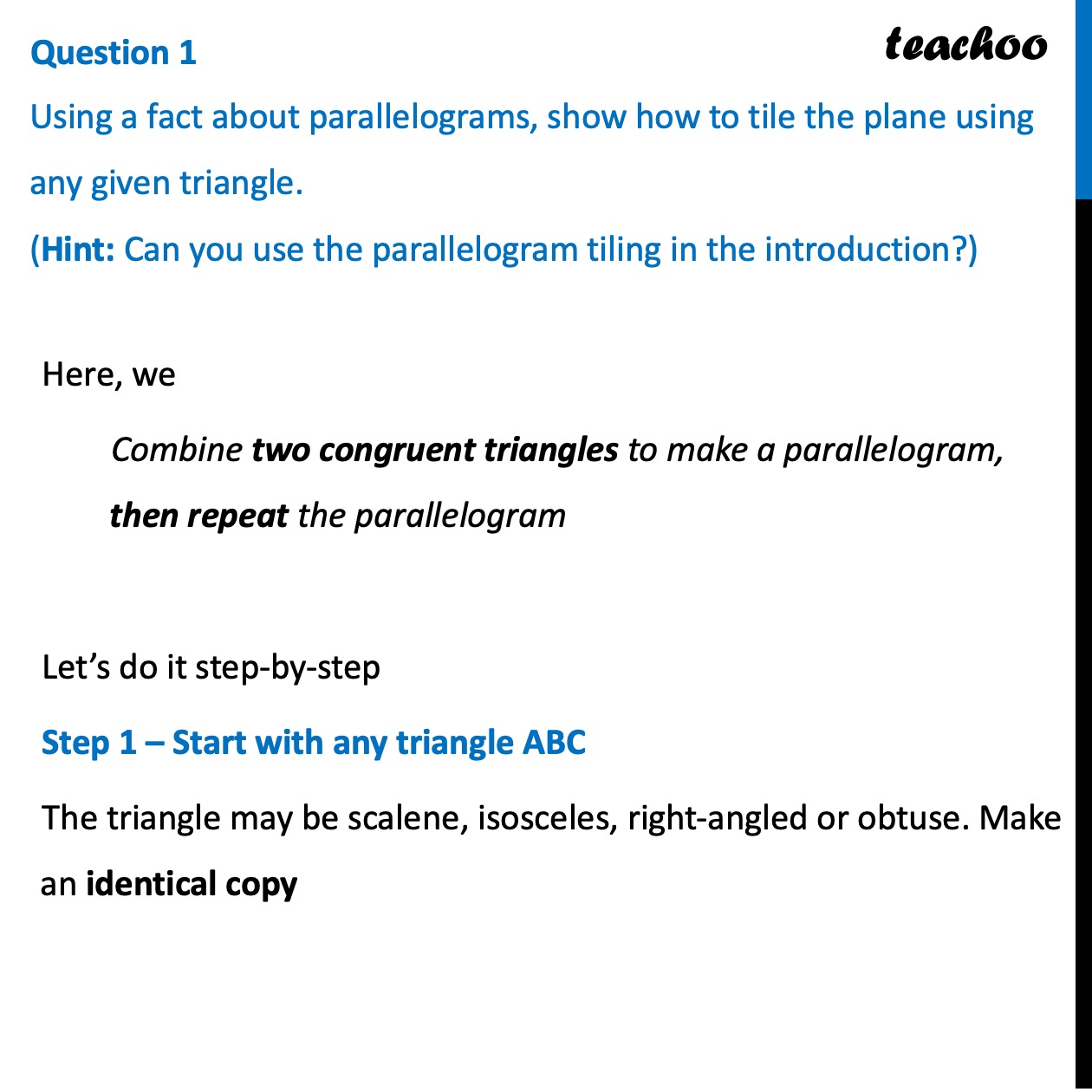
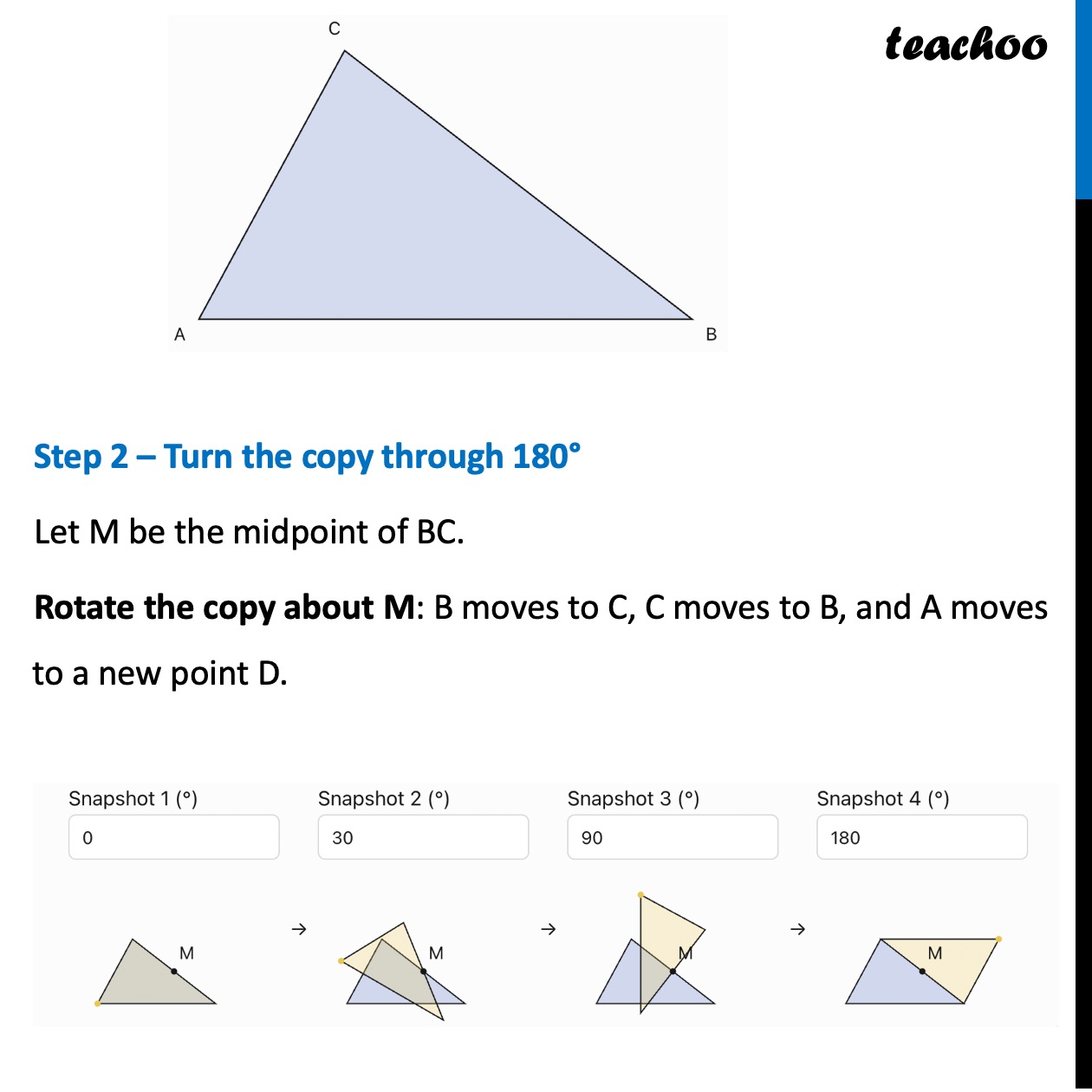
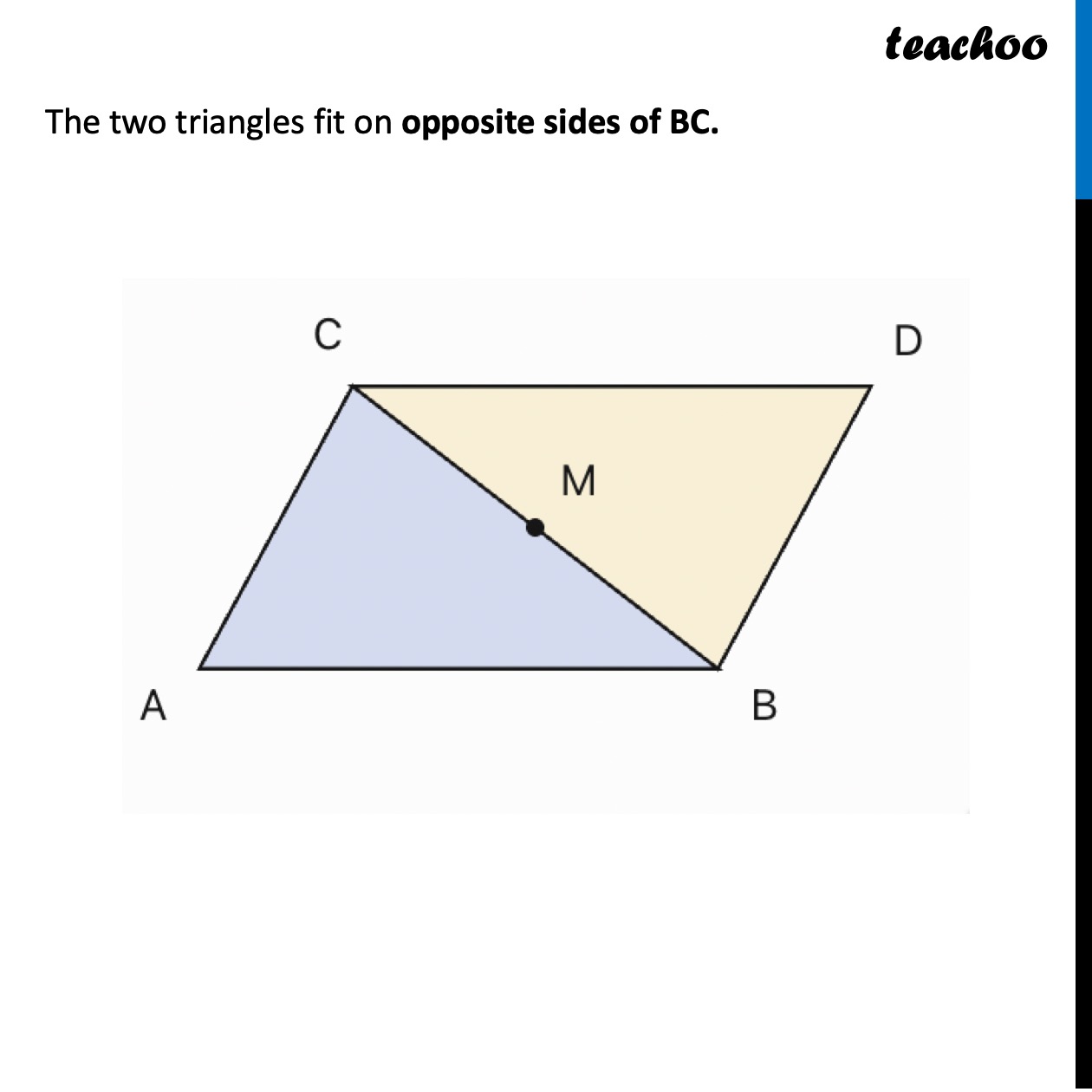
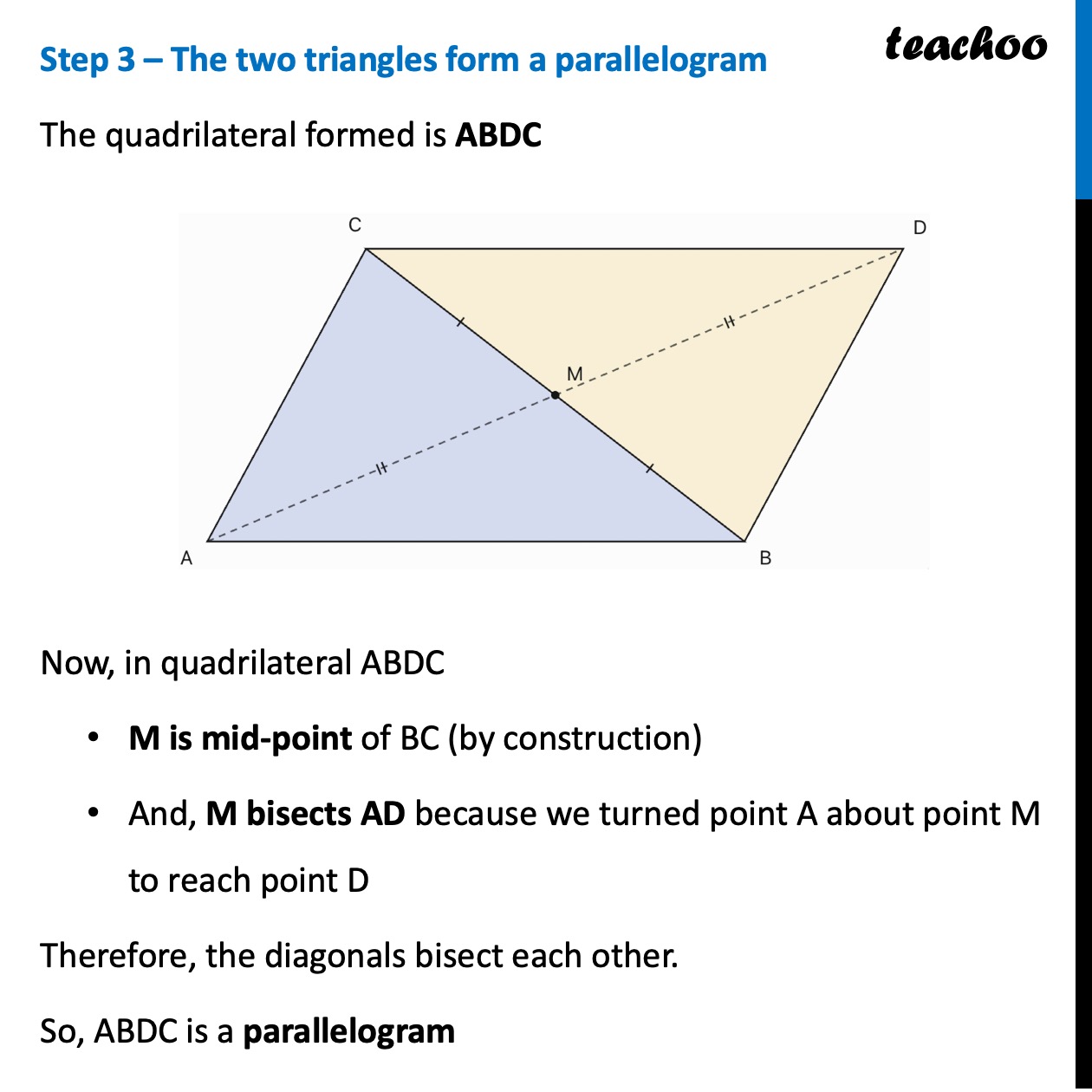
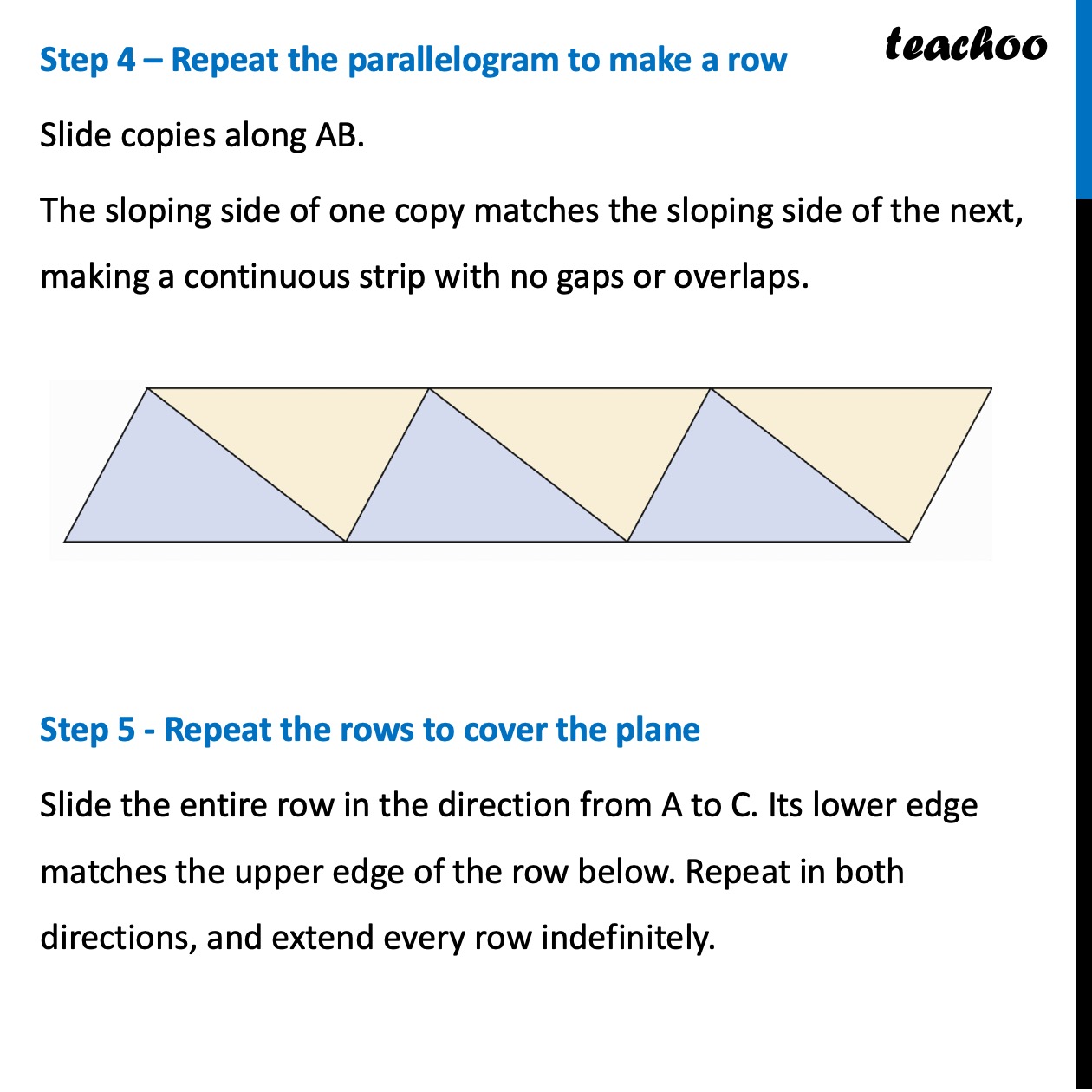
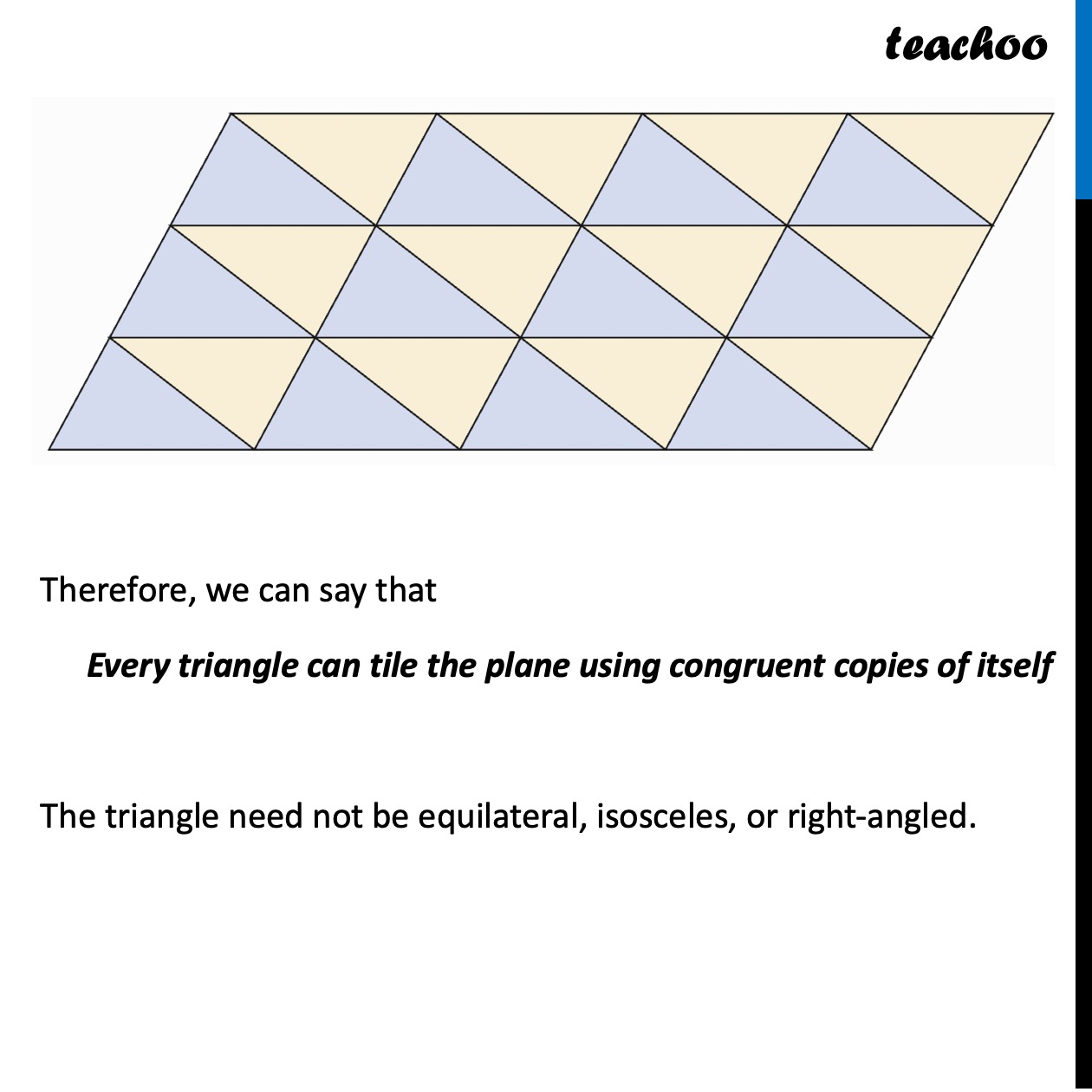
Question 1 Using a fact about parallelograms, show how to tile the plane using any given triangle. (Hint: Can you use the parallelogram tiling in the introduction?) Here, we Combine two congruent triangles to make a parallelogram, then repeat the parallelogram Let’s do it step-by-step Step 1 – Start with any triangle ABC The triangle may be scalene, isosceles, right-angled or obtuse. Make an identical copy Step 2 – Turn the copy through 180° Let M be the midpoint of BC. Rotate the copy about M: B moves to C, C moves to B, and A moves to a new point D. Rotation snapshots Snapshot 1 (°) Snapshot 2 (°) Snapshot 3 (°) Snapshot 4 (°) 0 30 90 180 & RR The two triangles fit on opposite sides of BC. Step 3 – The two triangles form a parallelogram The quadrilateral formed is ABDC Now, in quadrilateral ABDC M is mid-point of BC (by construction) And, M bisects AD because we turned point A about point M to reach point D Therefore, the diagonals bisect each other. So, ABDC is a parallelogram Step 4 – Repeat the parallelogram to make a row Slide copies along AB. The sloping side of one copy matches the sloping side of the next, making a continuous strip with no gaps or overlaps. Step 5 - Repeat the rows to cover the plane Slide the entire row in the direction from A to C. Its lower edge matches the upper edge of the row below. Repeat in both directions, and extend every row indefinitely. Therefore, we can say that Every triangle can tile the plane using congruent copies of itself The triangle need not be equilateral, isosceles, or right-angled.