End-of-Chapter Exercises

 You are here
Last updated at November 5, 2026 by Teachoo
Transcript
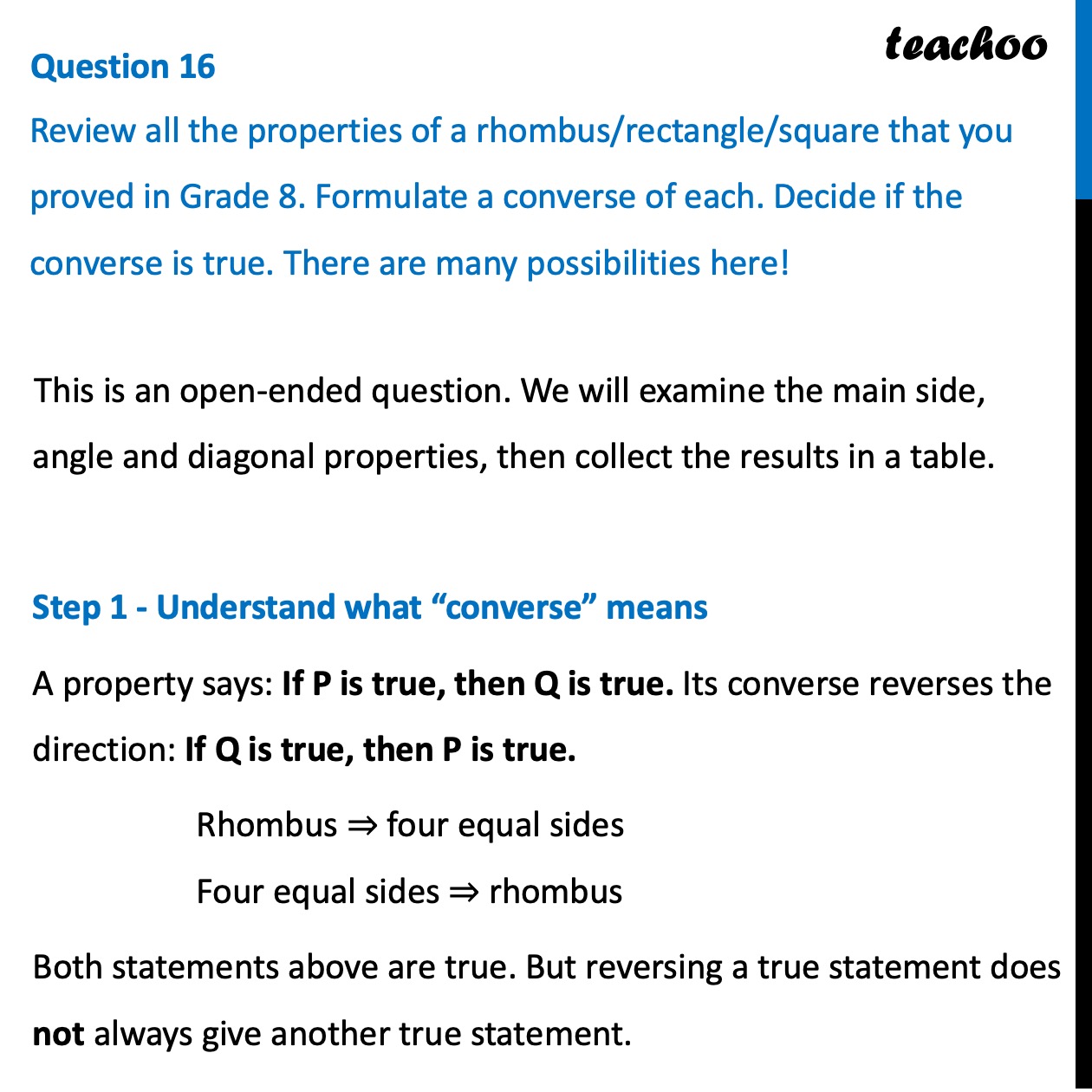
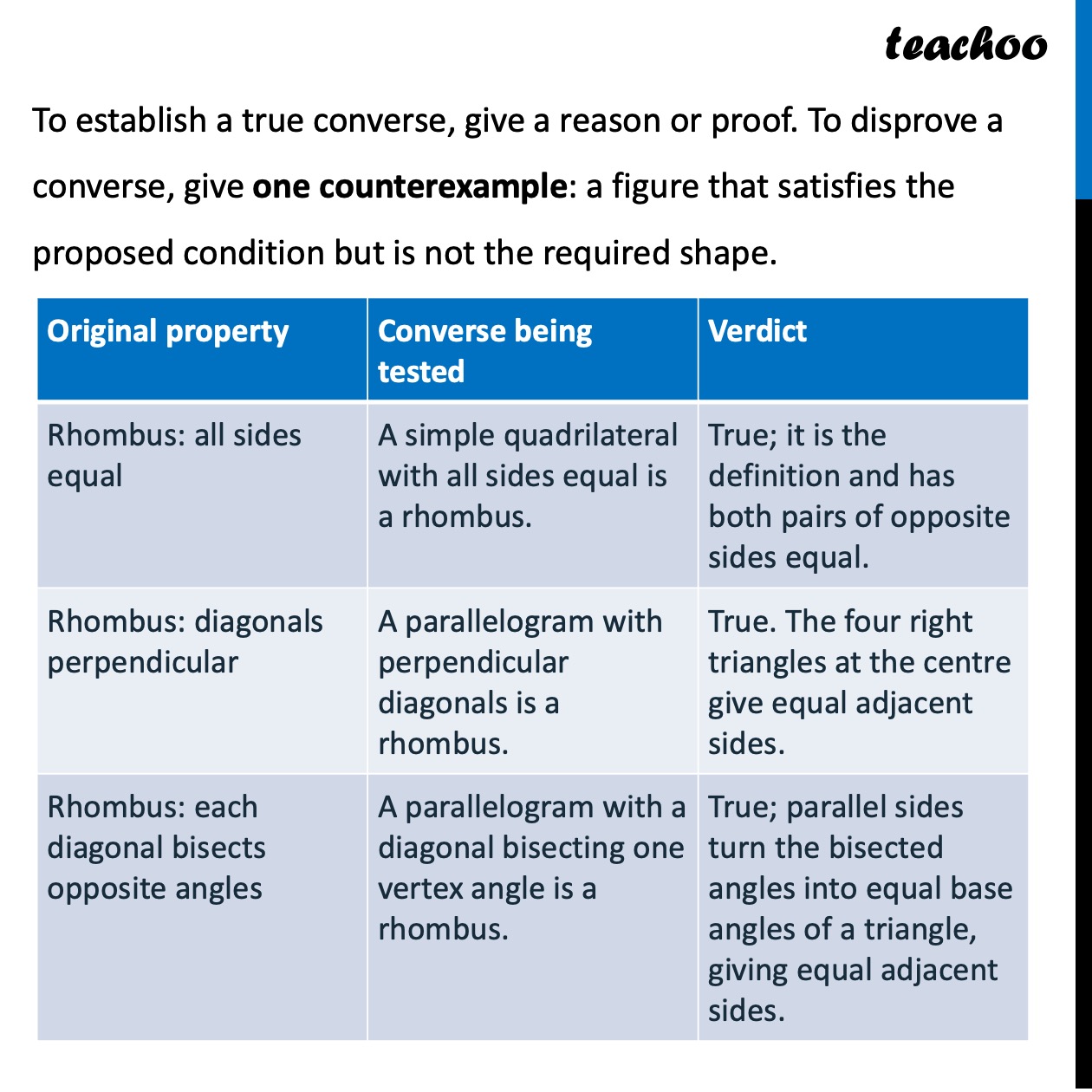
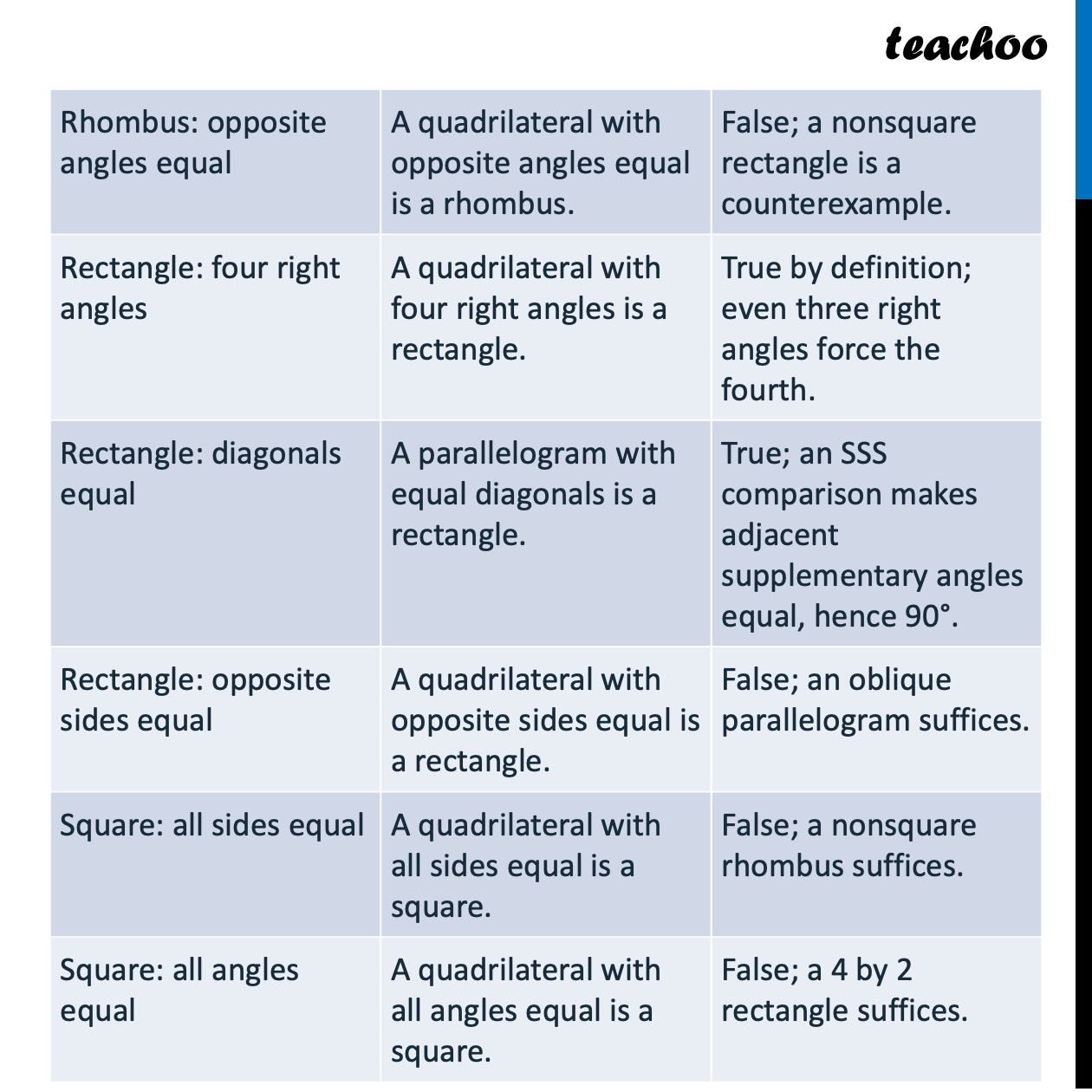
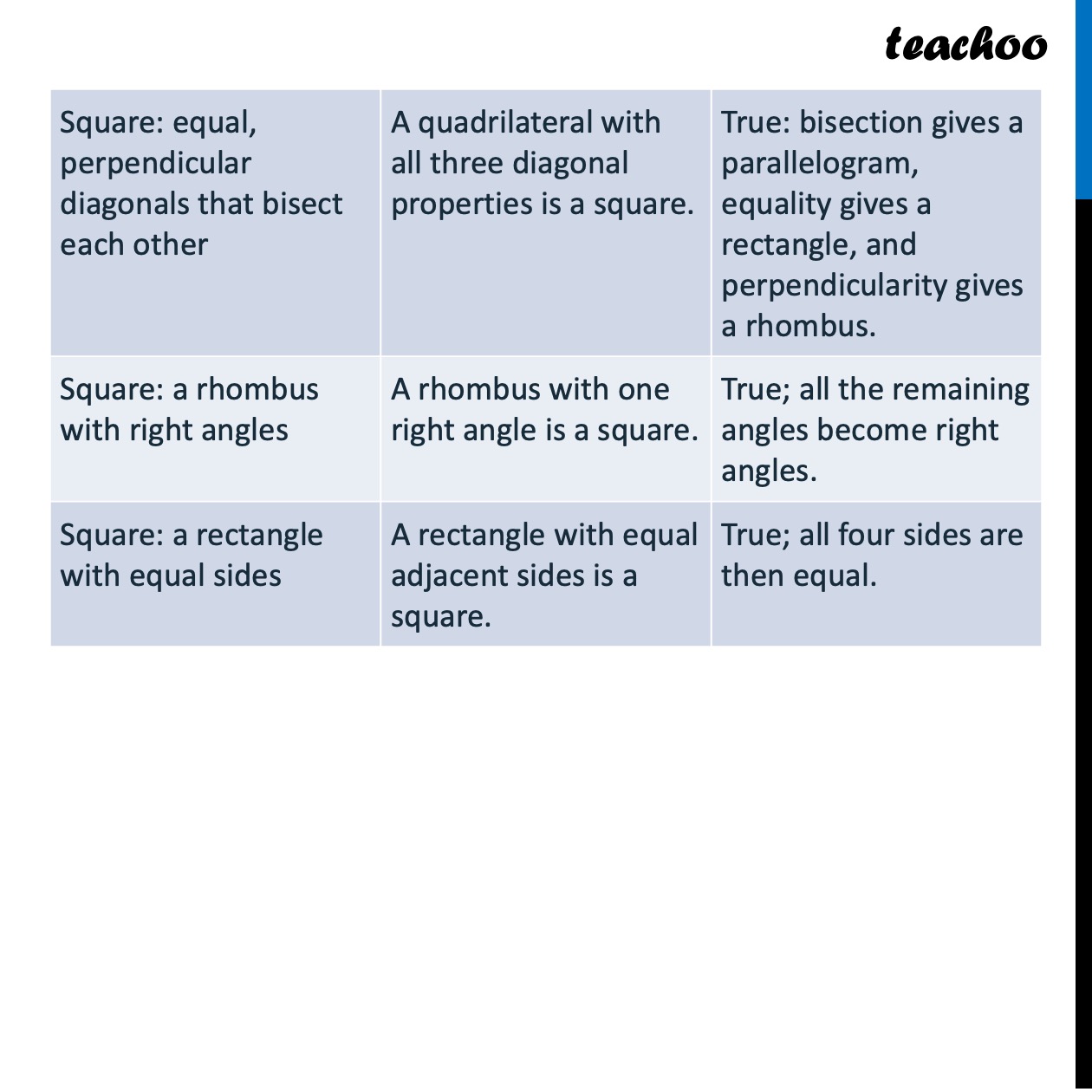
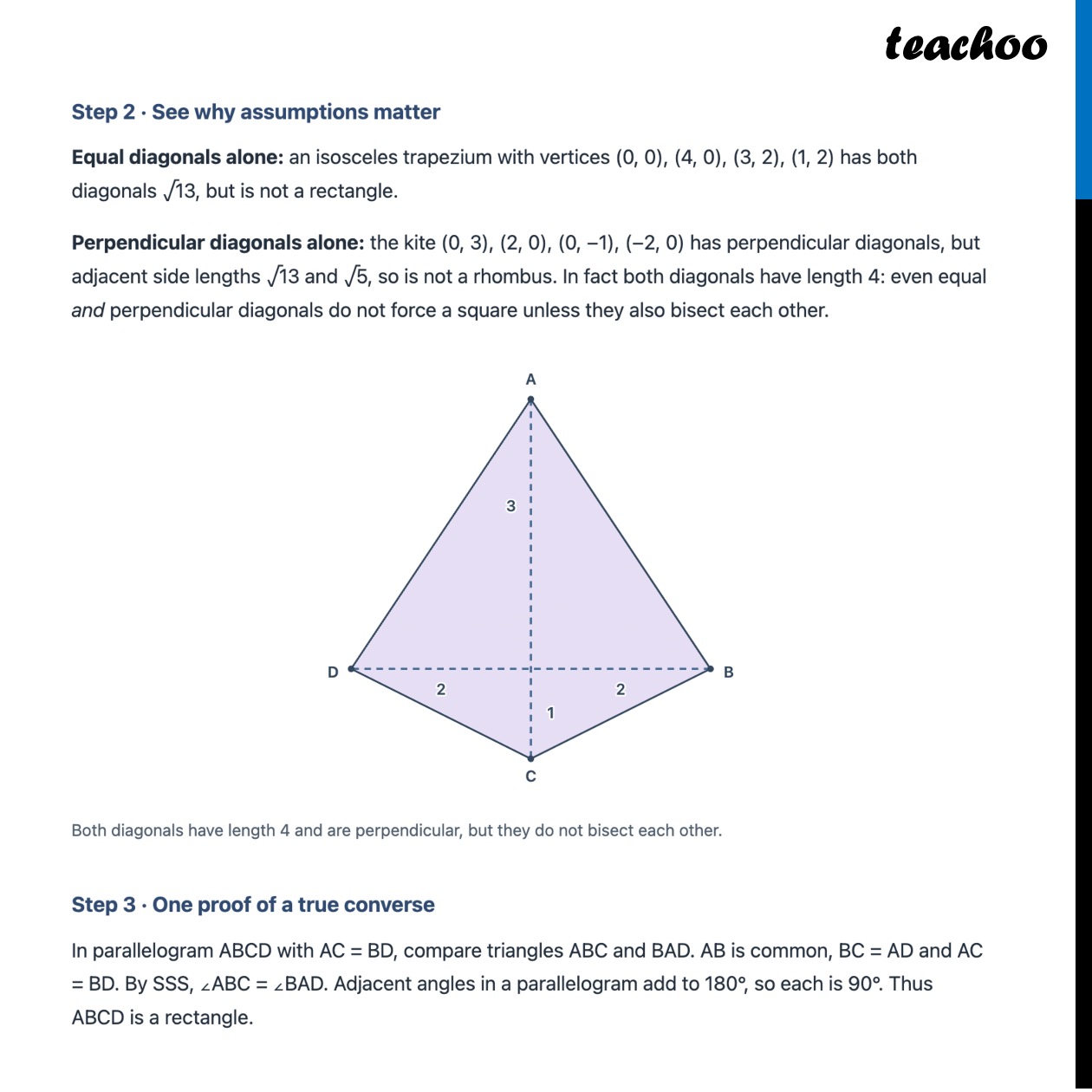
Question 16 Review all the properties of a rhombus/rectangle/square that you proved in Grade 8. Formulate a converse of each. Decide if the converse is true. There are many possibilities here! This is an open-ended question. We will examine the main side, angle and diagonal properties, then collect the results in a table. Step 1 - Understand what “converse” means A property says: If P is true, then Q is true. Its converse reverses the direction: If Q is true, then P is true. Rhombus ⇒ four equal sides Four equal sides ⇒ rhombus Both statements above are true. But reversing a true statement does not always give another true statement. To establish a true converse, give a reason or proof. To disprove a converse, give one counterexample: a figure that satisfies the proposed condition but is not the required shape. To establish a true converse, give a reason or proof. To disprove a converse, give one counterexample: a figure that satisfies the proposed condition but is not the required shape. Original property | Converse being tested | Verdict Rhombus: all sides equal | A simple quadrilateral with all sides equal is a rhombus. | True; it is the definition and has both pairs of opposite sides equal. Rhombus: diagonals perpendicular | A parallelogram with perpendicular diagonals is a rhombus. | True. The four right triangles at the centre give equal adjacent sides. Rhombus: each diagonal bisects opposite angles | A parallelogram with a diagonal bisecting one vertex angle is a rhombus. | True; parallel sides turn the bisected angles into equal base angles of a triangle, giving equal adjacent sides. Rhombus: opposite angles equal | A quadrilateral with opposite angles equal is a rhombus. | False; a nonsquare rectangle is a counterexample. Rectangle: four right angles | A quadrilateral with four right angles is a rectangle. | True by definition; even three right angles force the fourth. Rectangle: diagonals equal | A parallelogram with equal diagonals is a rectangle. | True; an SSS comparison makes adjacent supplementary angles equal, hence 90°. Rectangle: opposite sides equal | A quadrilateral with opposite sides equal is a rectangle. | False; an oblique parallelogram suffices. Square: all sides equal | A quadrilateral with all sides equal is a square. | False; a nonsquare rhombus suffices. Square: all angles equal | A quadrilateral with all angles equal is a square. | False; a 4 by 2 rectangle suffices. Square: equal, perpendicular diagonals that bisect each other | A quadrilateral with all three diagonal properties is a square. | True: bisection gives a parallelogram, equality gives a rectangle, and perpendicularity gives a rhombus. Square: a rhombus with right angles | A rhombus with one right angle is a square. | True; all the remaining angles become right angles. Square: a rectangle with equal sides | A rectangle with equal adjacent sides is a square. | True; all four sides are then equal. Step 2 - See why assumptions matter Equal diagonals alone: an isosceles trapezium with vertices (0, 0), (4, 0), (3, 2), (1, 2) has both diagonals /13, but is not a rectangle. Perpendicular diagonals alone: the kite (0, 3), (2, 0), (0, -1), (-2, 0) has perpendicular diagonals, but adjacent side lengths /13 and /5, so is not a rhombus. In fact both diagonals have length 4: even equal and perpendicular diagonals do not force a square unless they also bisect each other. Both diagonals have length 4 and are perpendicular, but they do not bisect each other. Step 3 - One proof of a true converse In parallelogram ABCD with AC = BD, compare triangles ABC and BAD. AB is common, BC = AD and AC = BD. By SSS, zABC = zBAD. Adjacent angles in a parallelogram add to 180° so each is 90°. Thus ABCD is a rectangle.