You are here

Last updated at November 5, 2026 by Teachoo
Transcript
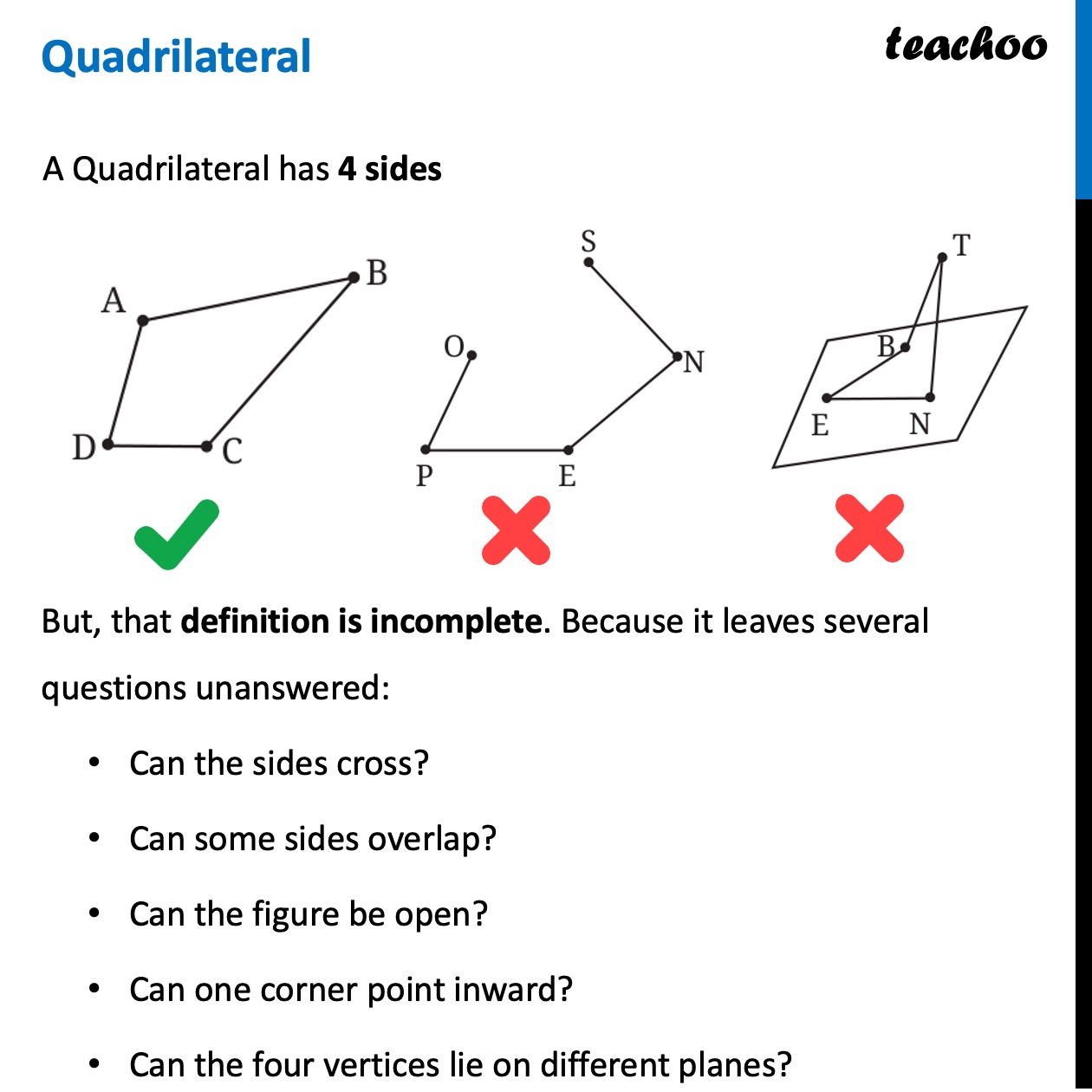
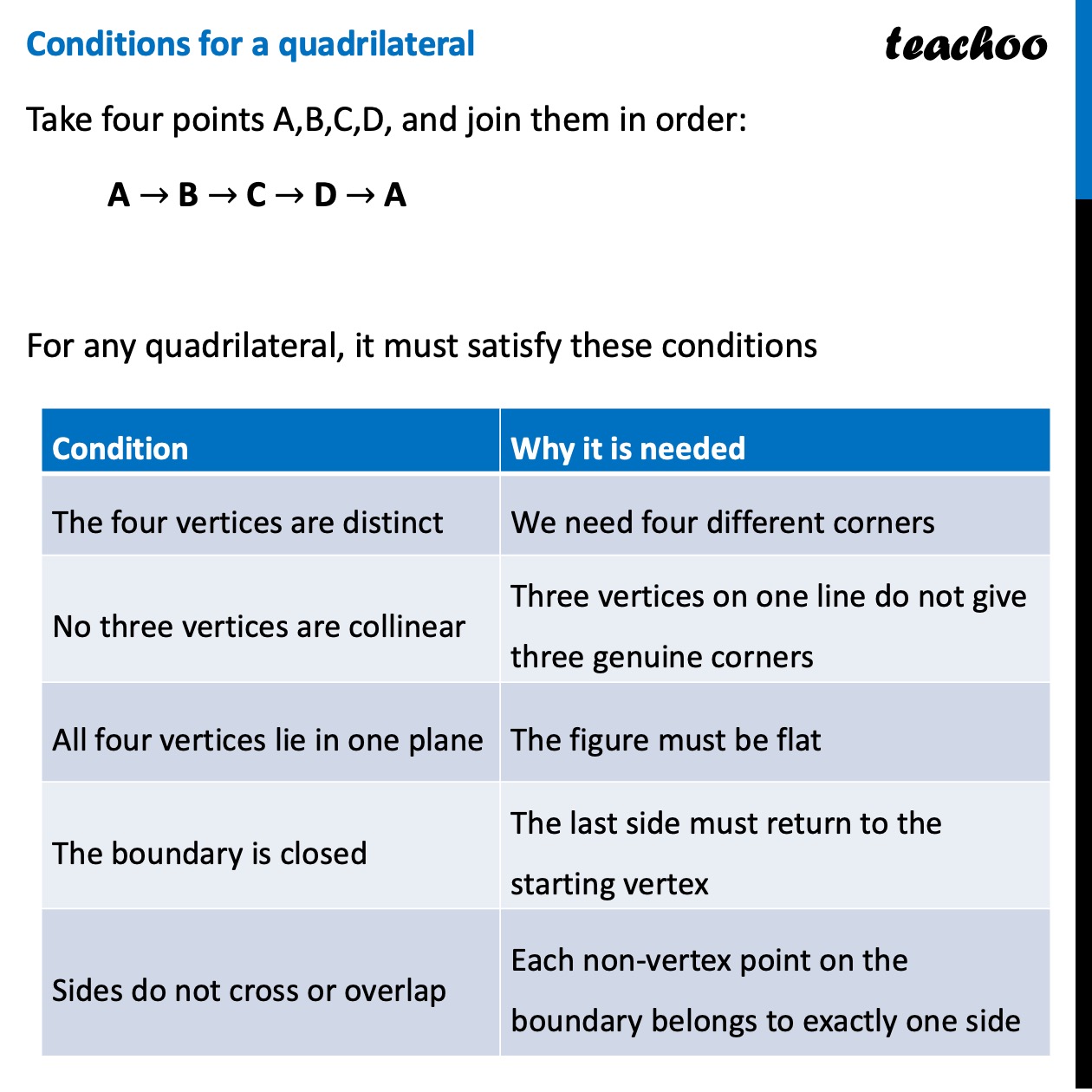
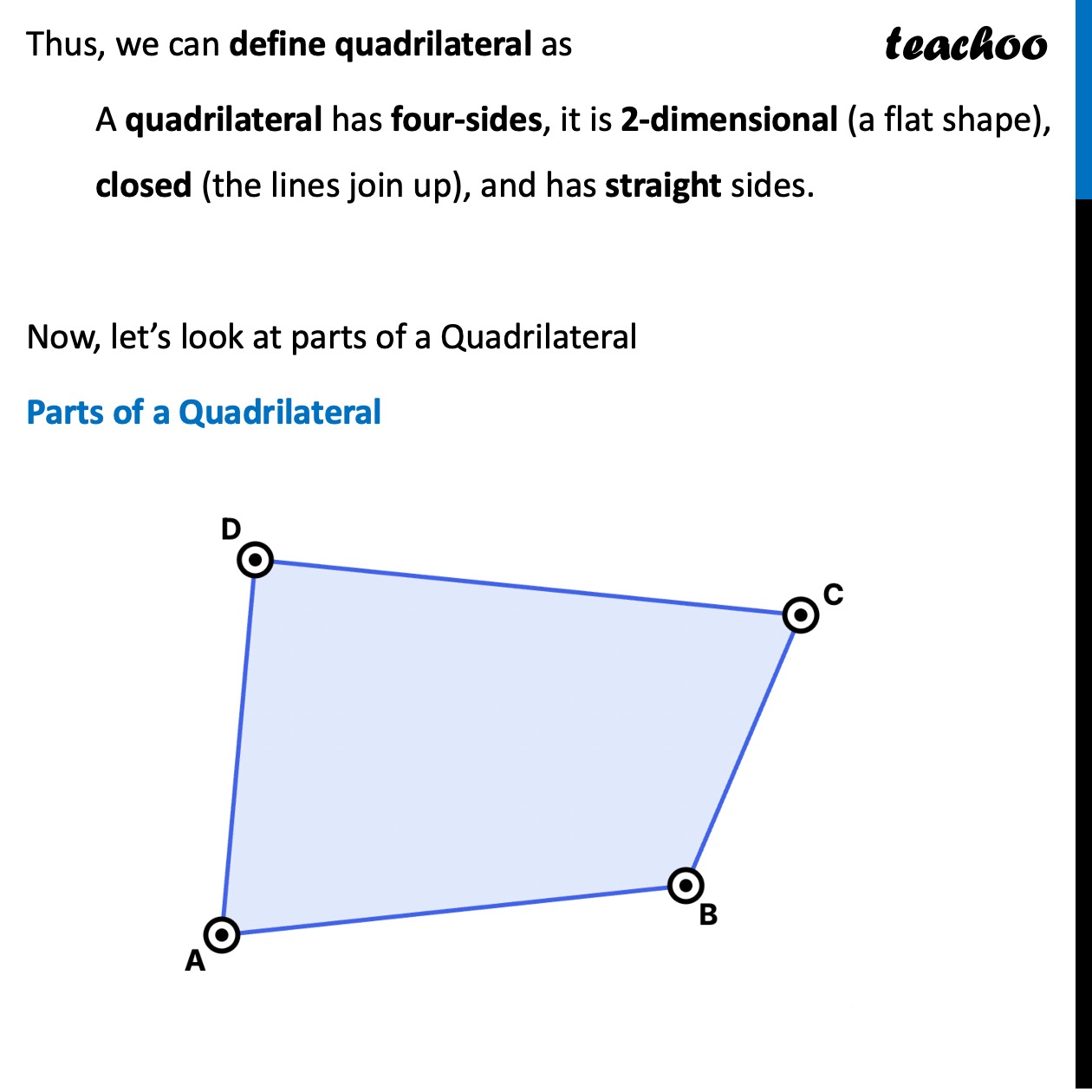
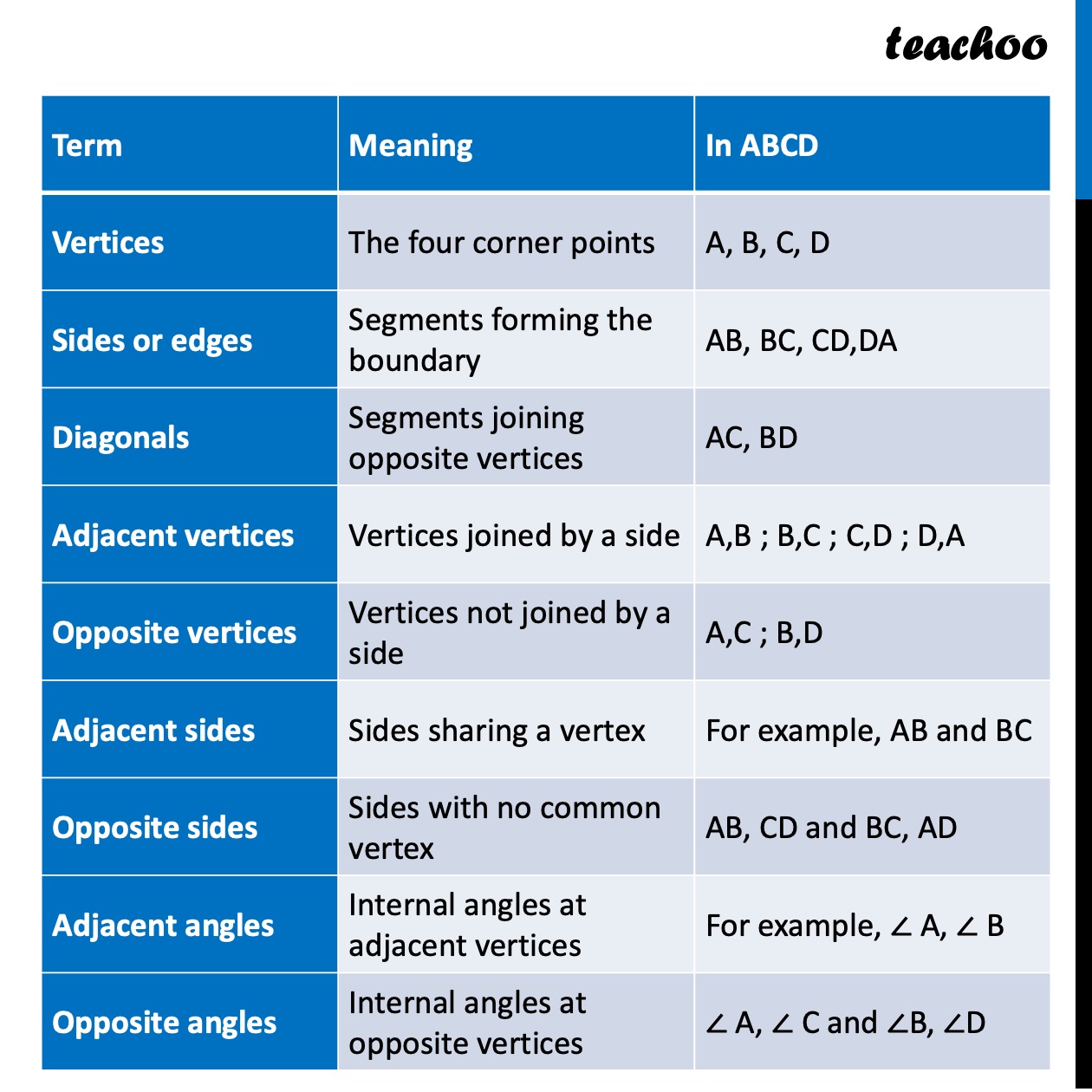
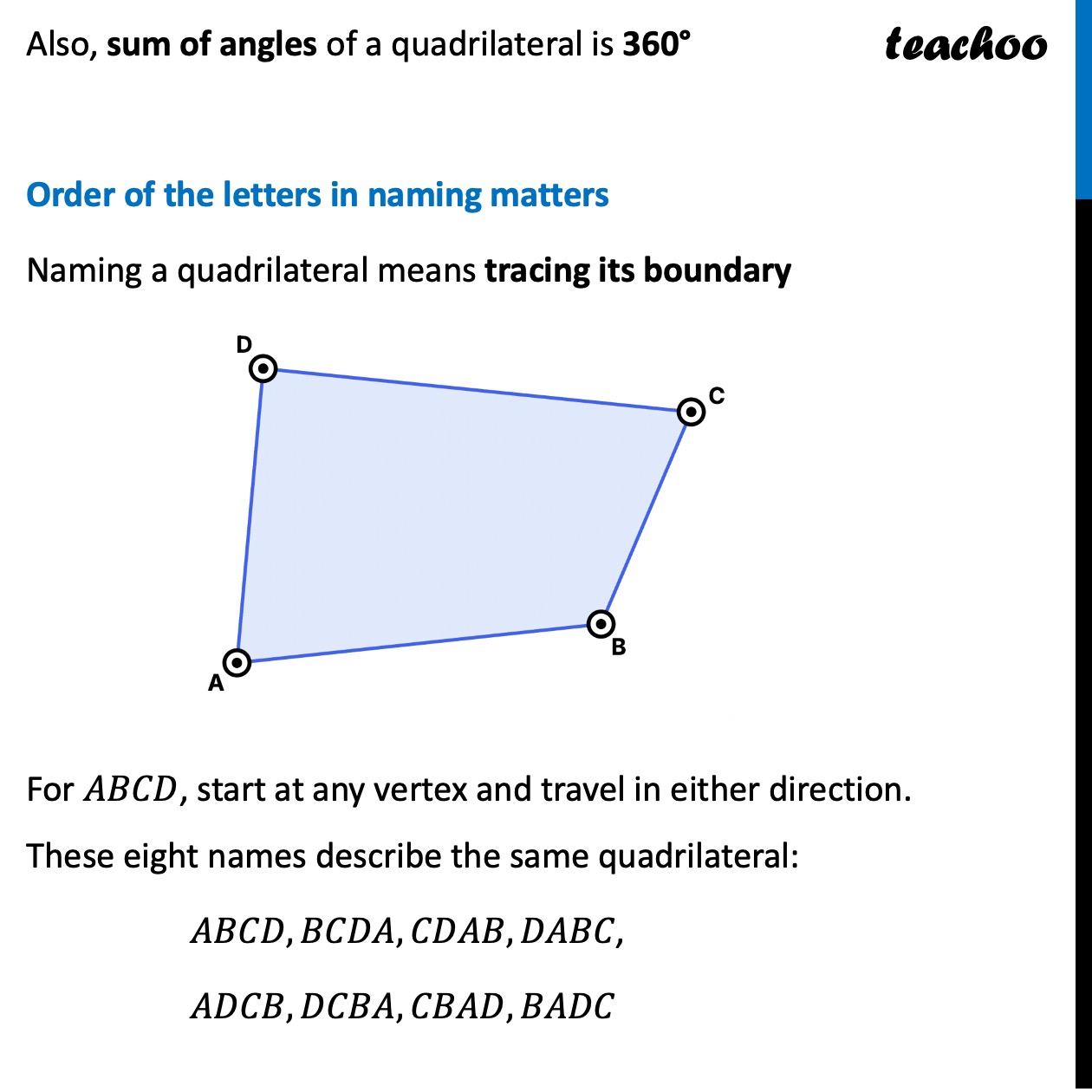
Quadrilateral A Quadrilateral has 4 sides But, that definition is incomplete. Because it leaves several questions unanswered: Can the sides cross? Can some sides overlap? Can the figure be open? Can one corner point inward? Can the four vertices lie on different planes? E Fig. 12.2 Conditions for a quadrilateral Take four points A,B,C,D, and join them in order: A → B → C → D → A For any quadrilateral, it must satisfy these conditions Condition | Why it is needed The four vertices are distinct | We need four different corners No three vertices are collinear | Three vertices on one line do not give three genuine corners All four vertices lie in one plane | The figure must be flat The boundary is closed | The last side must return to the starting vertex Sides do not cross or overlap | Each non-vertex point on the boundary belongs to exactly one side Thus, we can define quadrilateral as A quadrilateral has four-sides, it is 2-dimensional (a flat shape), closed (the lines join up), and has straight sides. Now, let’s look at parts of a Quadrilateral Parts of a Quadrilateral Term | Meaning | In ABCD Vertices | The four corner points | A, B, C, D Sides or edges | Segments forming the boundary | AB, BC, CD,DA Diagonals | Segments joining opposite vertices | AC, BD Adjacent vertices | Vertices joined by a side | A,B ; B,C ; C,D ; D,A Opposite vertices | Vertices not joined by a side | A,C ; B,D Adjacent sides | Sides sharing a vertex | For example, AB and BC Opposite sides | Sides with no common vertex | AB, CD and BC, AD Adjacent angles | Internal angles at adjacent vertices | For example, ∠ A, ∠ B Opposite angles | Internal angles at opposite vertices | ∠ A, ∠ C and ∠B, ∠D Also, sum of angles of a quadrilateral is 360° Order of the letters in naming matters Naming a quadrilateral means tracing its boundary For 𝐴𝐵𝐶𝐷, start at any vertex and travel in either direction. These eight names describe the same quadrilateral: 𝐴𝐵𝐶𝐷,𝐵𝐶𝐷𝐴,𝐶𝐷𝐴𝐵,𝐷𝐴𝐵𝐶, 𝐴𝐷𝐶𝐵,𝐷𝐶𝐵𝐴,𝐶𝐵𝐴𝐷,𝐵𝐴𝐷𝐶 There are: 4 starting vertices × 2 directions =8 names But 𝑨𝑪𝑩𝑫 does not describe the same quadrilateral. This is because the first step, 𝐴→𝐶, follows a diagonal instead of side 𝐴𝐵 or 𝐴𝐷. We have changed which points are joined as sides. The same four points can produce different figures when joined in different orders. Now, let’s look at a different type of quadrilateral – Convex Quadrilateral There are: 4 starting vertices × 2 directions =8 names But 𝑨𝑪𝑩𝑫 does not describe the same quadrilateral. This is because the first step, 𝐴→𝐶, follows a diagonal instead of side 𝐴𝐵 or 𝐴𝐷. We have changed which points are joined as sides. The same four points can produce different figures when joined in different orders. Now, let’s look at a different type of quadrilateral – Non-Convex Quadrilateral