You are here

Last updated at November 5, 2026 by Teachoo
Transcript
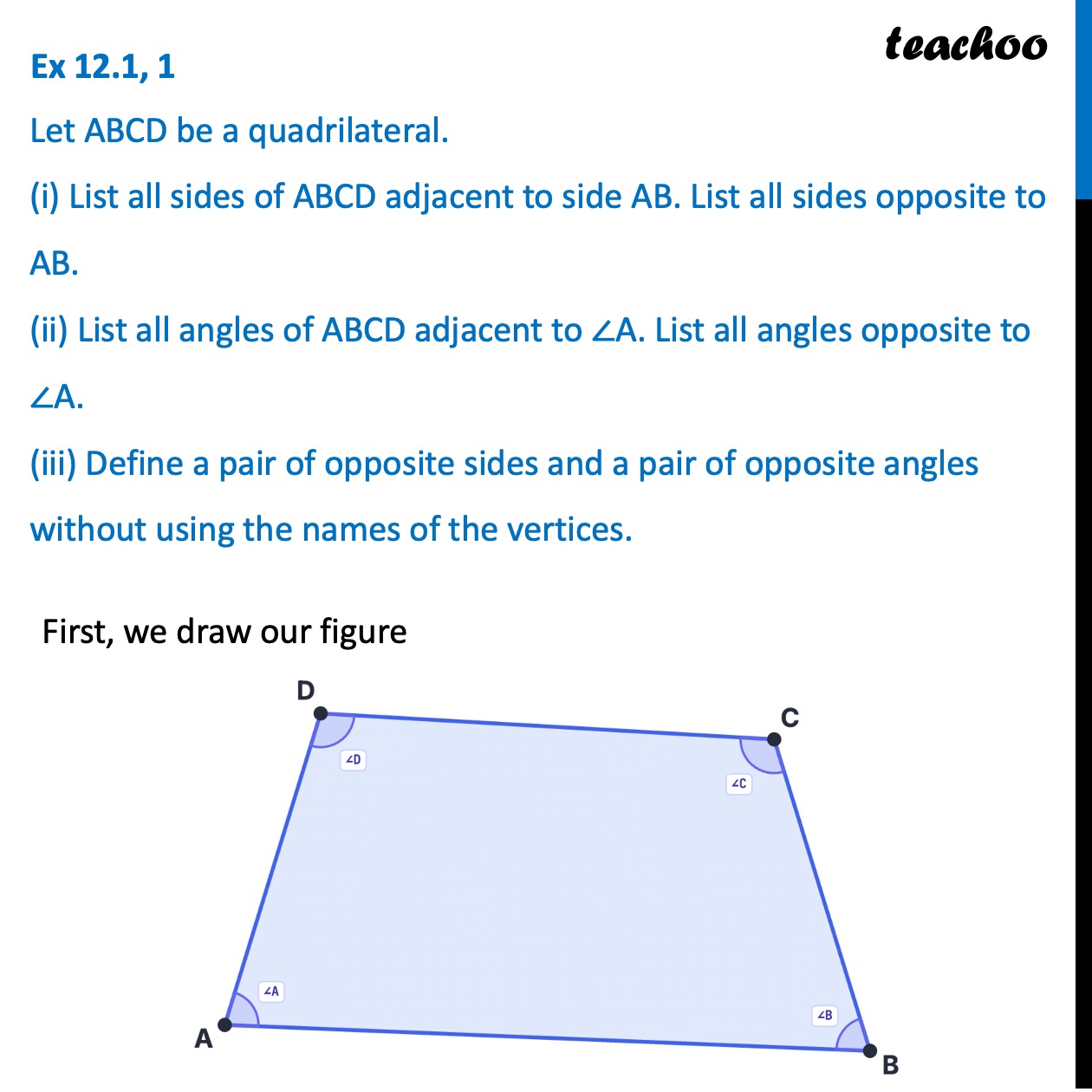
Ex 12.1, 1 Let ABCD be a quadrilateral. (i) List all sides of ABCD adjacent to side AB. List all sides opposite to AB. (ii) List all angles of ABCD adjacent to ∠A. List all angles opposite to ∠A. (iii) Define a pair of opposite sides and a pair of opposite angles without using the names of the vertices. First, we draw our figure (i) List the sides adjacent to 𝑨𝑩, and the sides opposite to 𝑨𝑩. Adjacent sides share an endpoint 𝐴𝐷 shares endpoint 𝐴 with 𝐴𝐵. 𝐵𝐶 shares endpoint 𝐵 with 𝐴𝐵. Therefore, Sides adjacent to 𝐴𝐵 are 𝑨𝑫,𝑩𝑪 Side 𝐶𝐷 has neither endpoint 𝐴 nor endpoint 𝐵. Therefore: Side opposite to 𝐴𝐵 is 𝑪𝑫 (ii) List the angles adjacent to ∠𝑨, and the angles opposite to ∠𝑨. Vertices 𝐵 and 𝐷 are joined to 𝐴 by sides. Therefore: Angles adjacent to ∠𝐴 is ∠𝑩,∠𝑫 Vertex 𝐶 is opposite to 𝐴. Therefore: Angle opposite to ∠𝐴 is ∠𝑪 (iii) Define opposite sides and opposite angles without naming the vertices. We can define it like Opposite sides are two sides of a quadrilateral with no common endpoint Opposite angles are internal angles at vertices that are not joined by a side Angles adjacent to ∠𝐴 is ∠𝑩,∠𝑫 Vertex 𝐶 is opposite to 𝐴. Therefore: Angle opposite to ∠𝐴 is ∠𝑪 (iii) Define opposite sides and opposite angles without naming the vertices. We can define it like Opposite sides are two sides of a quadrilateral with no common endpoint Opposite angles are internal angles at vertices that are not joined by a side