
 You are here
Last updated at November 5, 2026 by Teachoo
Transcript
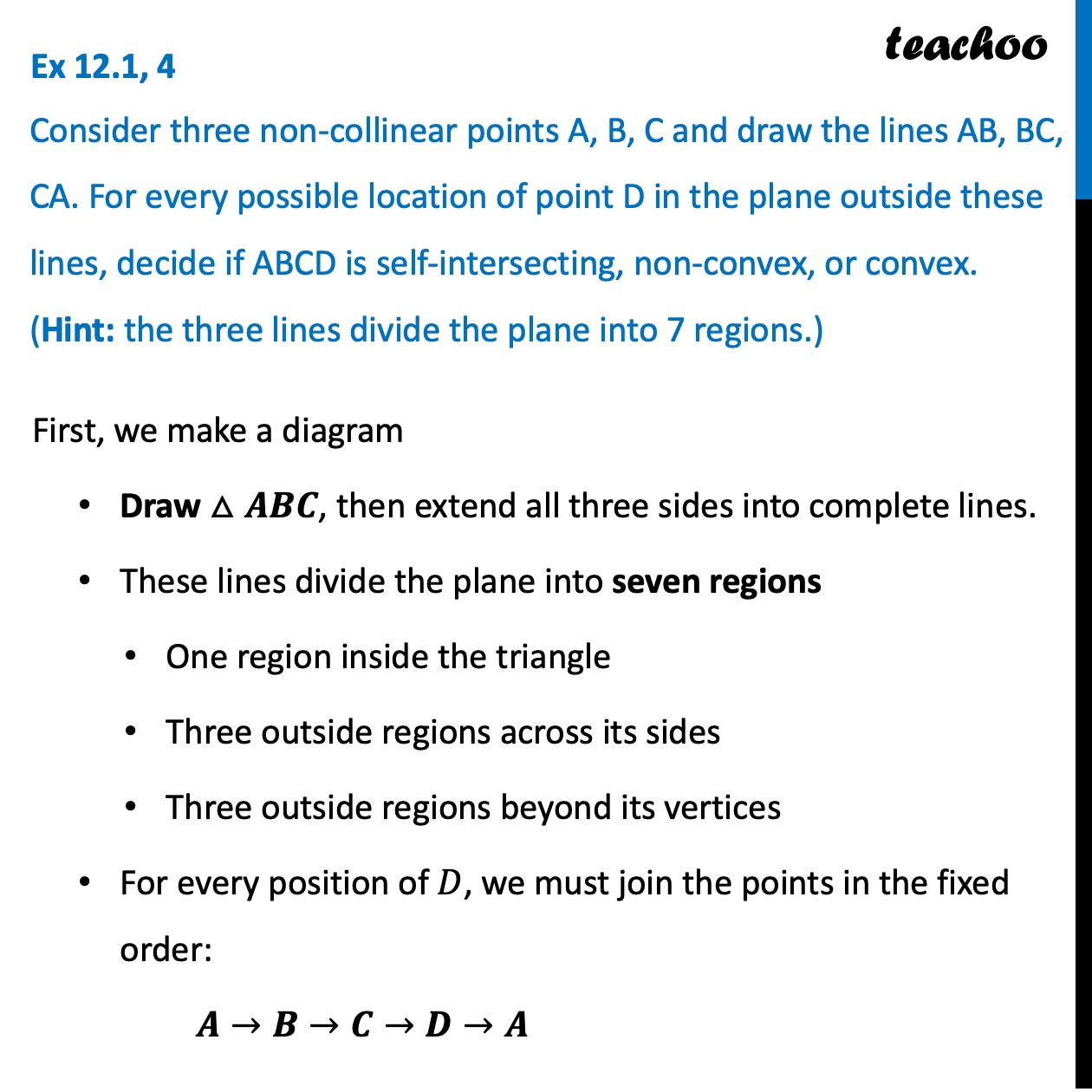
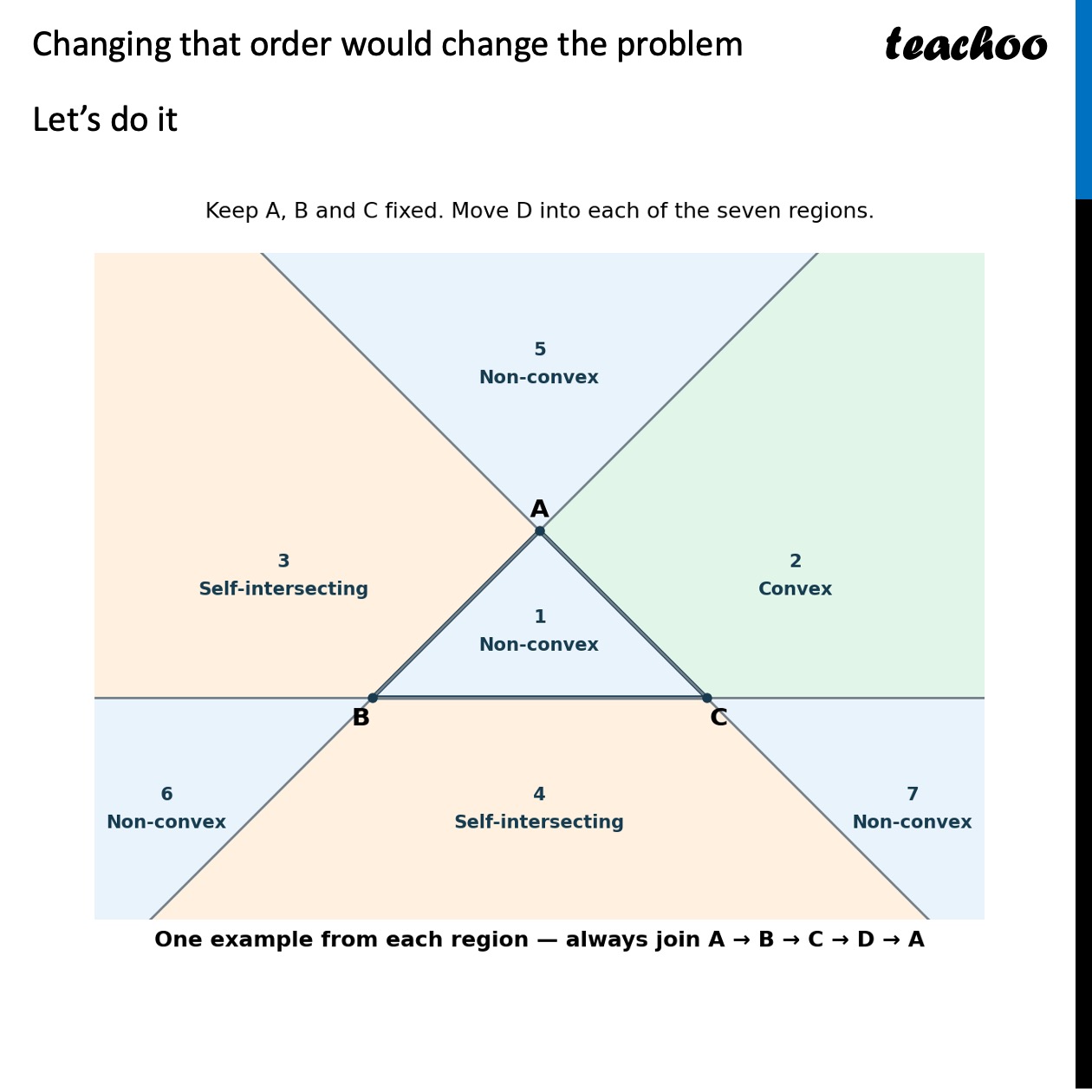
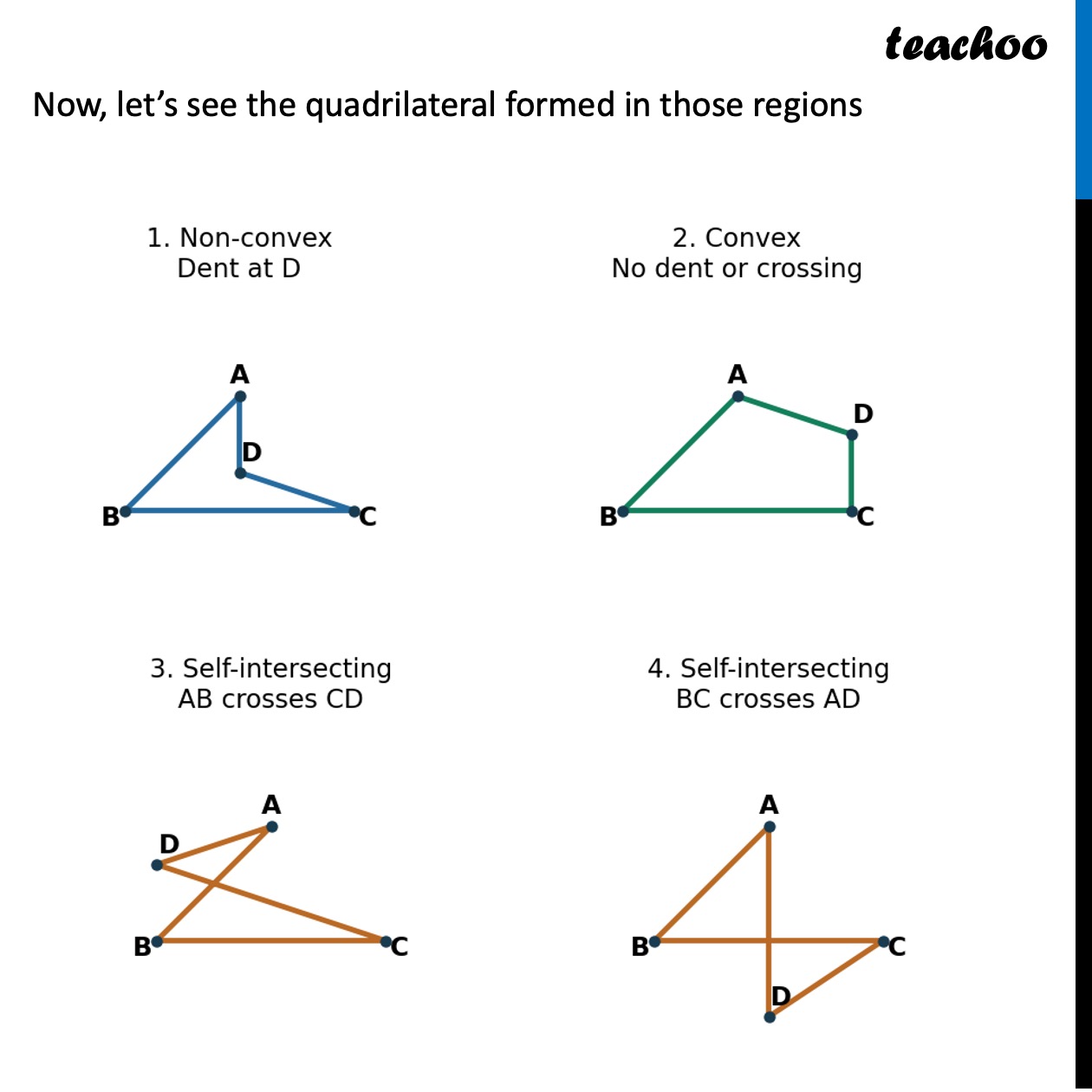
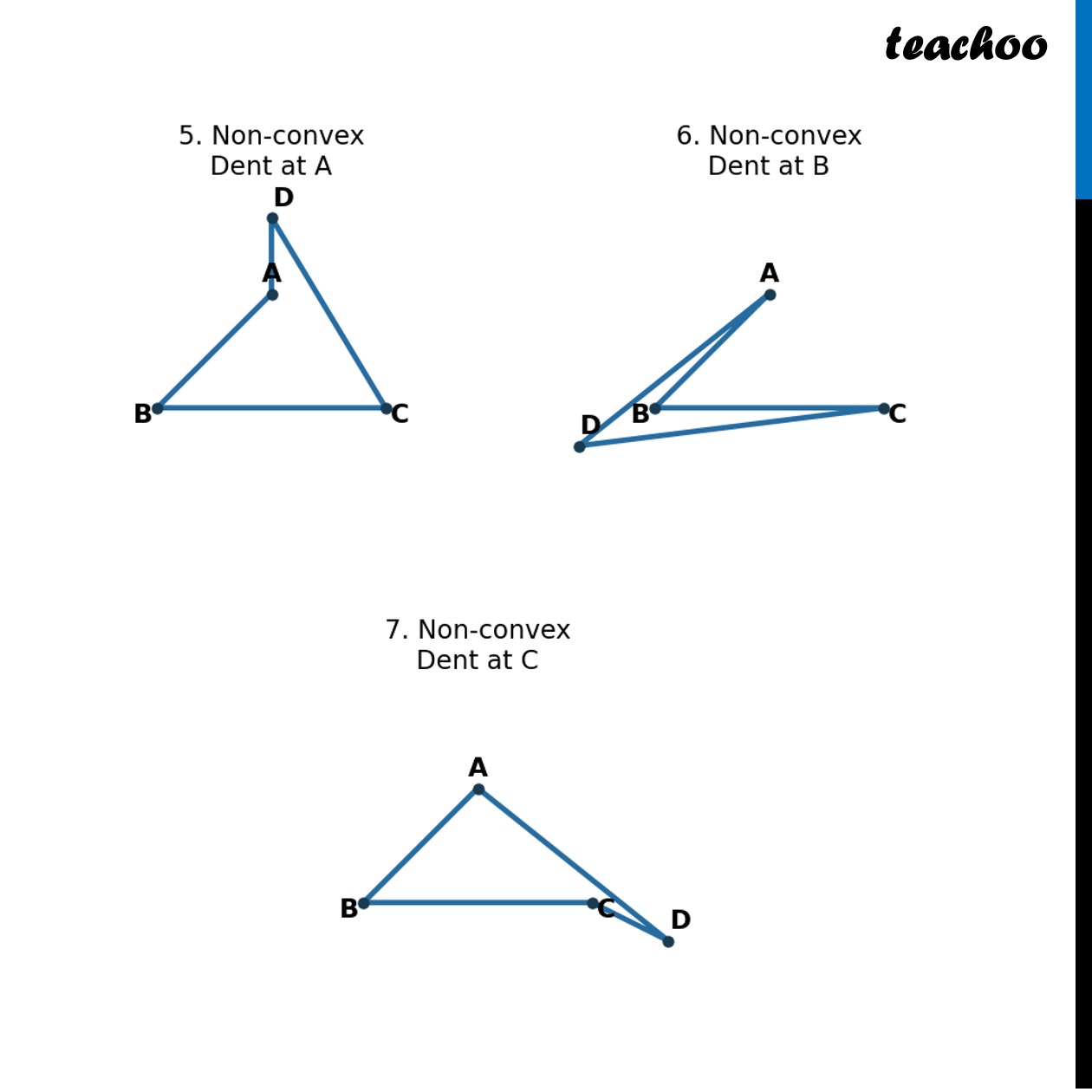
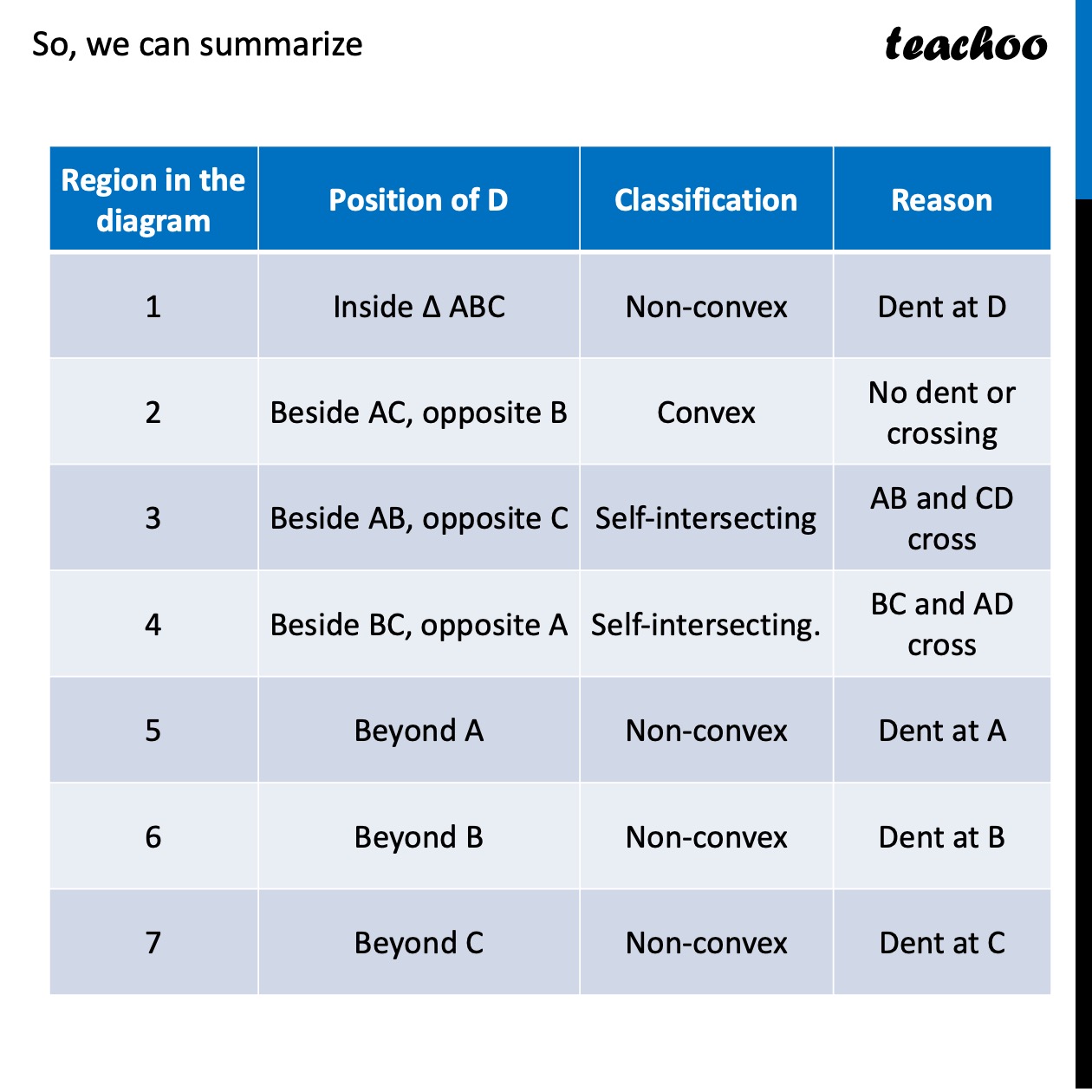
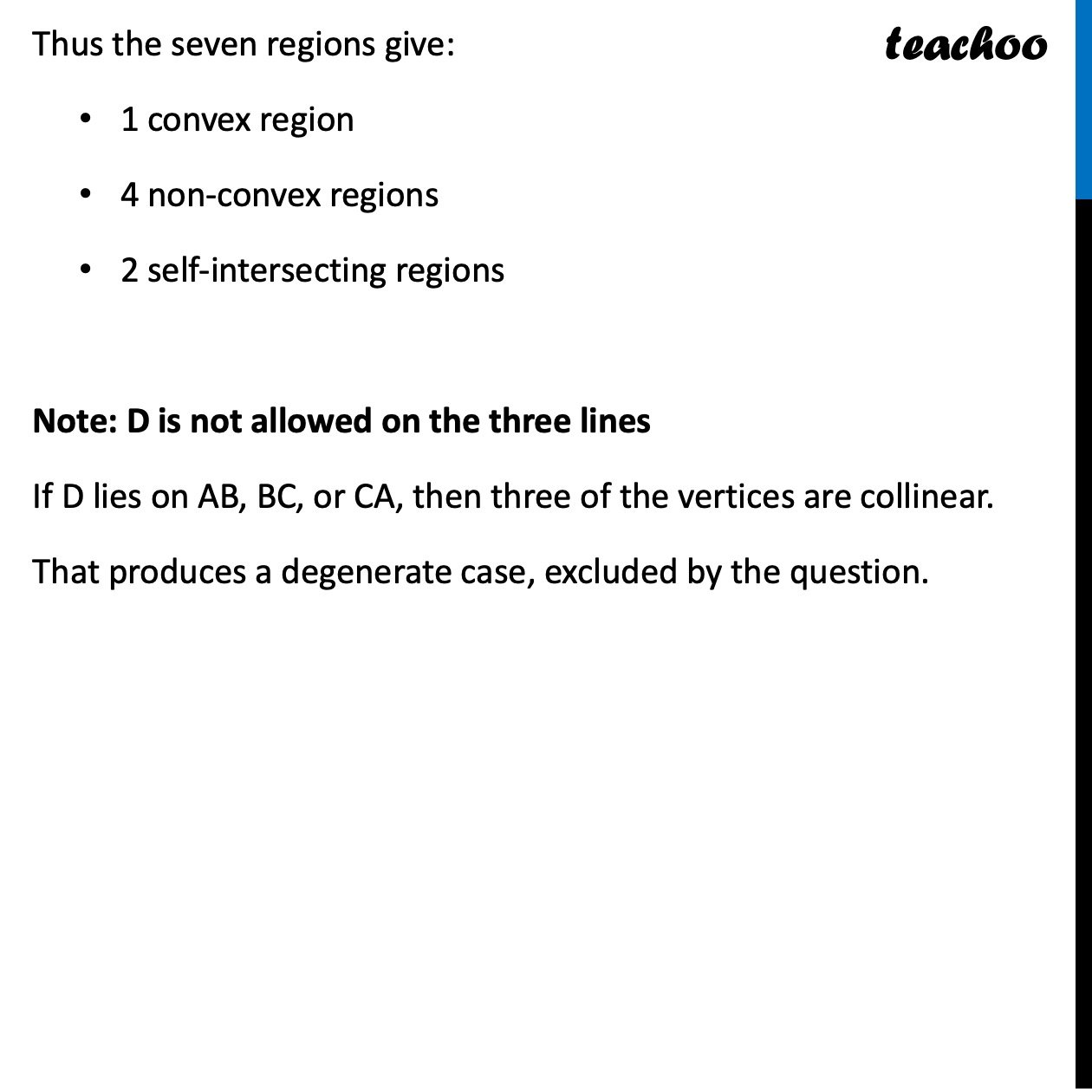
Ex 12.1, 4 Consider three non-collinear points A, B, C and draw the lines AB, BC, CA. For every possible location of point D in the plane outside these lines, decide if ABCD is self-intersecting, non-convex, or convex. (Hint: the three lines divide the plane into 7 regions.) First, we make a diagram Draw △𝑨𝑩𝑪, then extend all three sides into complete lines. These lines divide the plane into seven regions One region inside the triangle Three outside regions across its sides Three outside regions beyond its vertices For every position of 𝐷, we must join the points in the fixed order: 𝑨→𝑩→𝑪→𝑫→𝑨 Changing that order would change the problem Let’s do it Exercise 12.1 ¢« Question 4 Keep A, B and C fixed. Move D into each of the seven regions. 5 Non-convex 3 Self-intersecting 2 Convex 6 4 7 One example from each region — always joinA>B>C>-D-A 1. Non-convex 2. Convex 3. Self-intersecting 4. Self-intersecting Dent at D No dent or crossing AB crosses CD BC crosses AD A A A A D D D B B B B 5. Non-convex 6. Non-convex 7. Non-convex Dent at A Dent at B Dent at C Now, let’s see the quadrilateral formed in those regions Exercise 12.1 ¢« Question 4 Keep A, B and C fixed. Move D into each of the seven regions. 5 Non-convex 3 Self-intersecting 2 Convex 6 4 7 One example from each region — always joinA>B>C>-D-A 1. Non-convex 2. Convex 3. Self-intersecting 4. Self-intersecting Dent at D No dent or crossing AB crosses CD BC crosses AD A A A A D D D B B B B 5. Non-convex 6. Non-convex 7. Non-convex Dent at A Dent at B Dent at C Exercise 12.1 ¢« Question 4 Keep A, B and C fixed. Move D into each of the seven regions. 5 Non-convex 3 Self-intersecting 2 Convex 6 4 7 One example from each region — always joinA>B>C>-D-A 1. Non-convex 2. Convex 3. Self-intersecting 4. Self-intersecting Dent at D No dent or crossing AB crosses CD BC crosses AD A A A A D D D B B B B 5. Non-convex 6. Non-convex 7. Non-convex Dent at A Dent at B Dent at C So, we can summarize Region in the diagram | Position of D | Classification | Reason 1 | Inside ∆ ABC | Non-convex | Dent at D 2 | Beside AC, opposite B | Convex | No dent or crossing 3 | Beside AB, opposite C | Self-intersecting | AB and CD cross 4 | Beside BC, opposite A | Self-intersecting. | BC and AD cross 5 | Beyond A | Non-convex | Dent at A 6 | Beyond B | Non-convex | Dent at B 7 | Beyond C | Non-convex | Dent at C Thus the seven regions give: 1 convex region 4 non-convex regions 2 self-intersecting regions Note: D is not allowed on the three lines If D lies on AB, BC, or CA, then three of the vertices are collinear. That produces a degenerate case, excluded by the question.
