You are here
Last updated at November 5, 2026 by Teachoo
Transcript
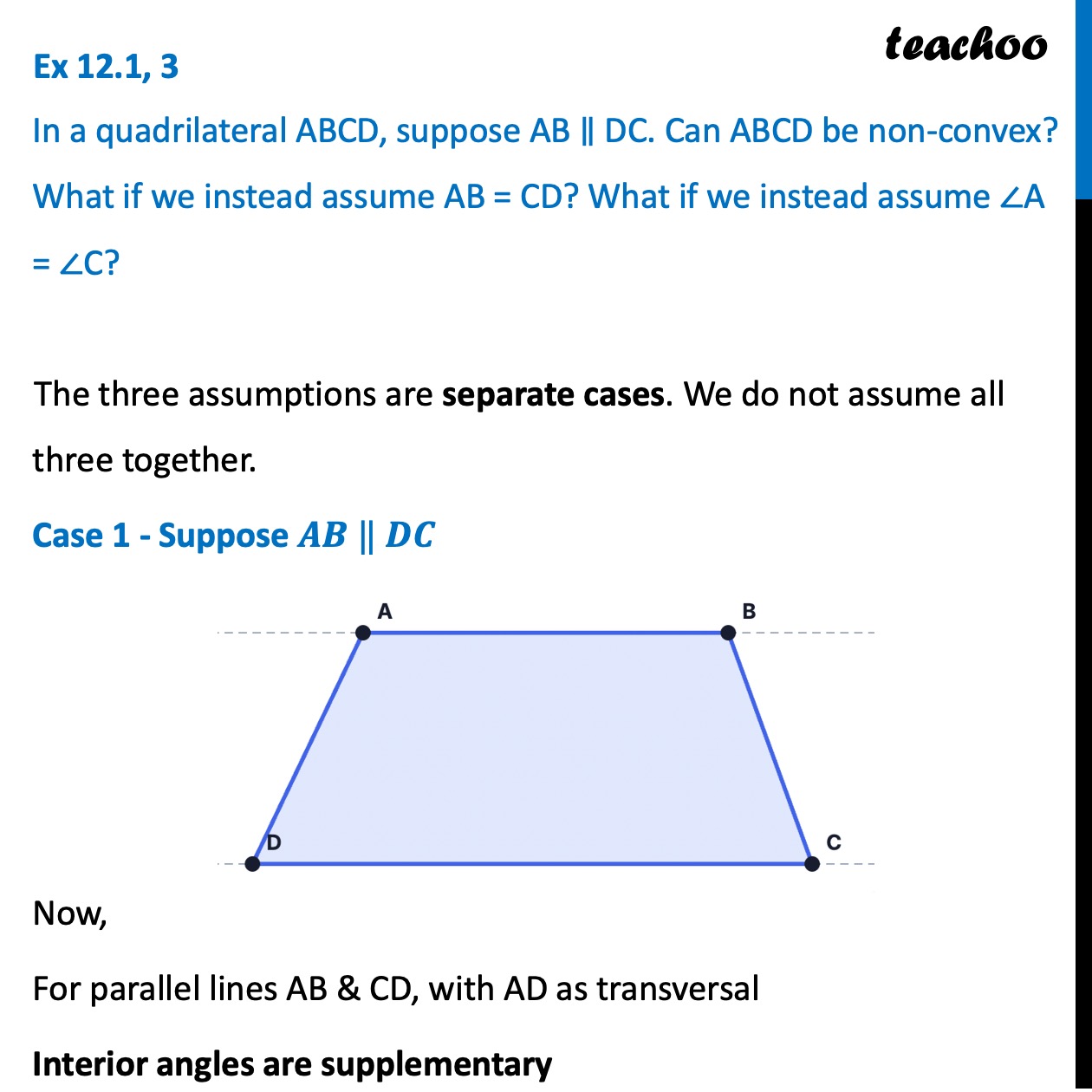
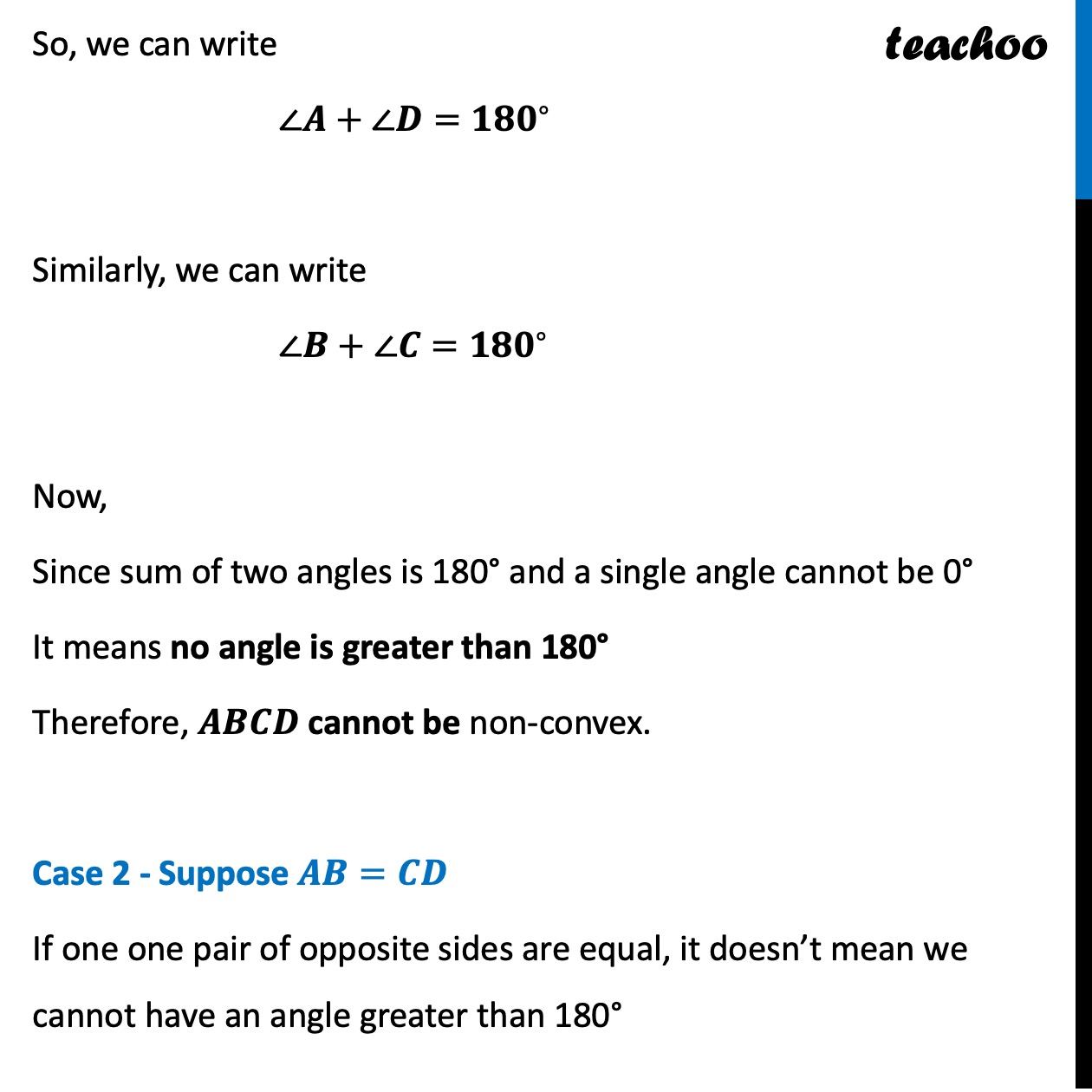
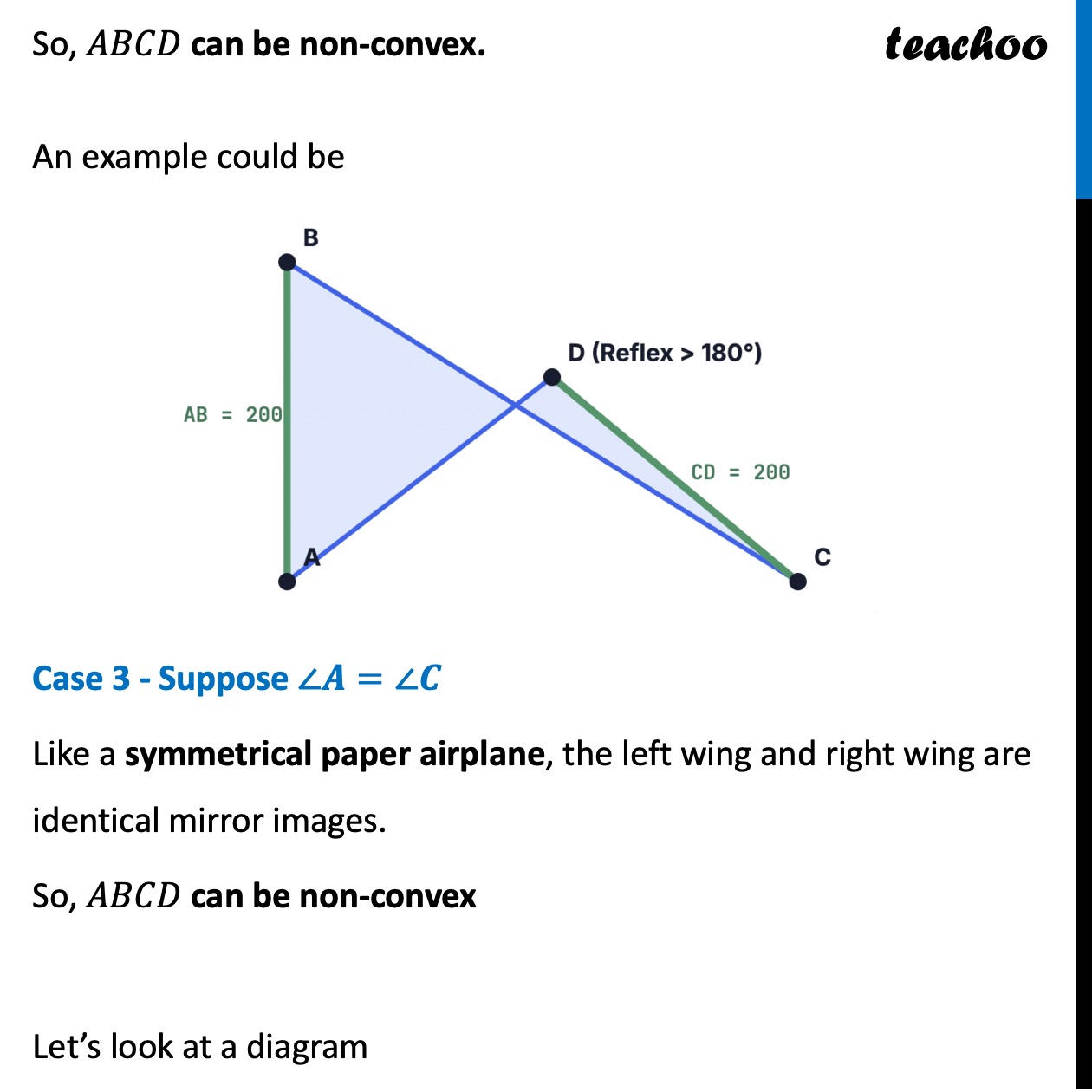
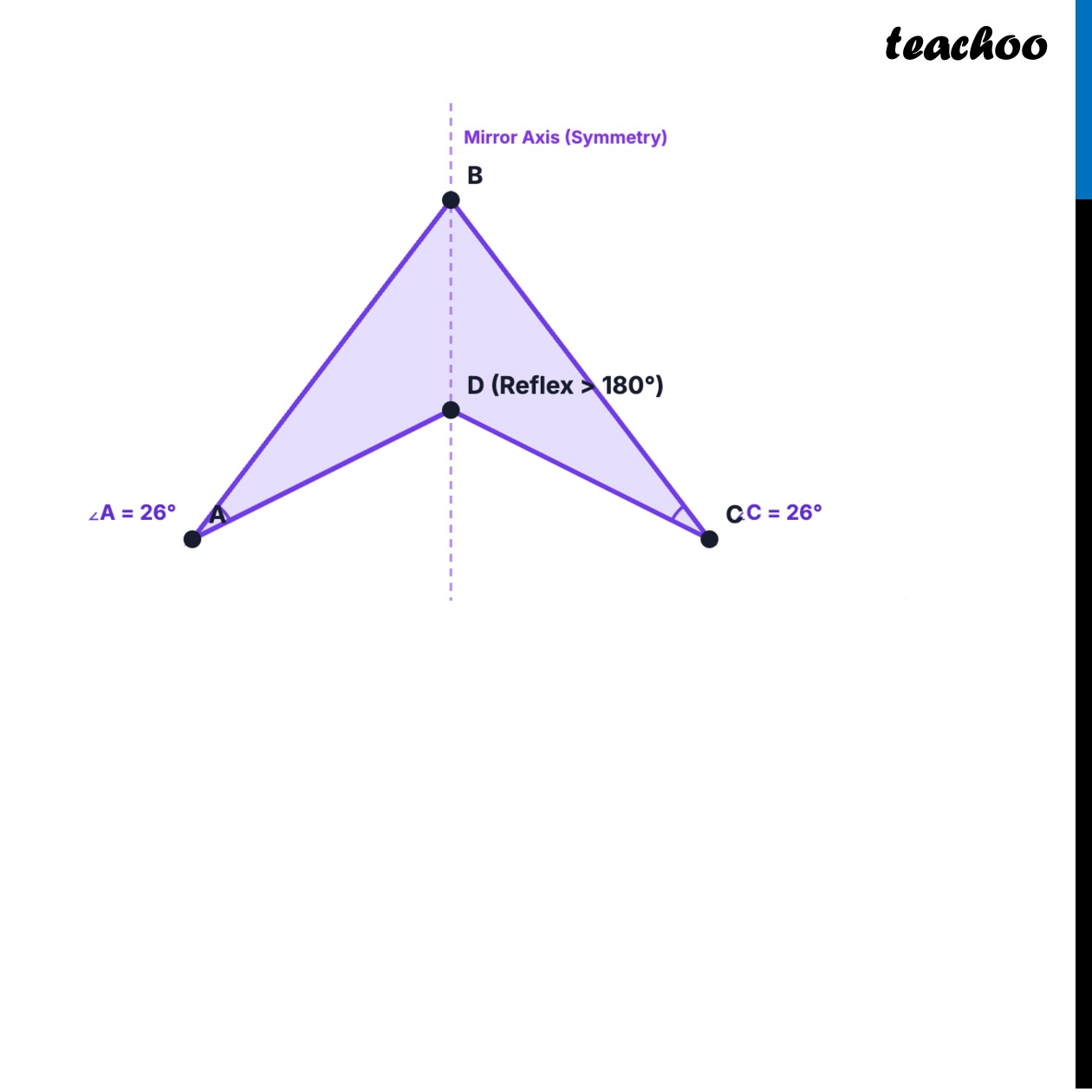
Ex 12.1, 3 In a quadrilateral ABCD, suppose AB ∥ DC. Can ABCD be non-convex? What if we instead assume AB = CD? What if we instead assume ∠A = ∠C? The three assumptions are separate cases. We do not assume all three together. Case 1 - Suppose 𝑨𝑩 ‖ 𝑫𝑪 Now, For parallel lines AB & CD, with AD as transversal Interior angles are supplementary So, we can write ∠𝑨+∠𝑫=𝟏𝟖𝟎^(∘) Similarly, we can write ∠𝑩+∠𝑪=𝟏𝟖𝟎^(∘) Now, Since sum of two angles is 180° and a single angle cannot be 0° It means no angle is greater than 180° Therefore, 𝑨𝑩𝑪𝑫 cannot be non-convex. So, we can write ∠𝑨+∠𝑫=𝟏𝟖𝟎^(∘) Similarly, we can write ∠𝑩+∠𝑪=𝟏𝟖𝟎^(∘) Now, Since sum of two angles is 180° and a single angle cannot be 0° It means no angle is greater than 180° Therefore, 𝑨𝑩𝑪𝑫 cannot be non-convex. Case 2 - Suppose 𝑨𝑩=𝑪𝑫 If one one pair of opposite sides are equal, it doesn’t mean we cannot have an angle greater than 180° So, 𝐴𝐵𝐶𝐷 can be non-convex. An example could be Case 3 - Suppose ∠𝑨=∠𝑪 Like a symmetrical paper airplane, the left wing and right wing are identical mirror images. So, 𝐴𝐵𝐶𝐷 can be non-convex Let’s look at a diagram D (Reflex > 180°) Mirror Axis (Symmetry) B D (Reflex 3180°) CC = 26°