
 You are here
Last updated at November 5, 2026 by Teachoo
Transcript
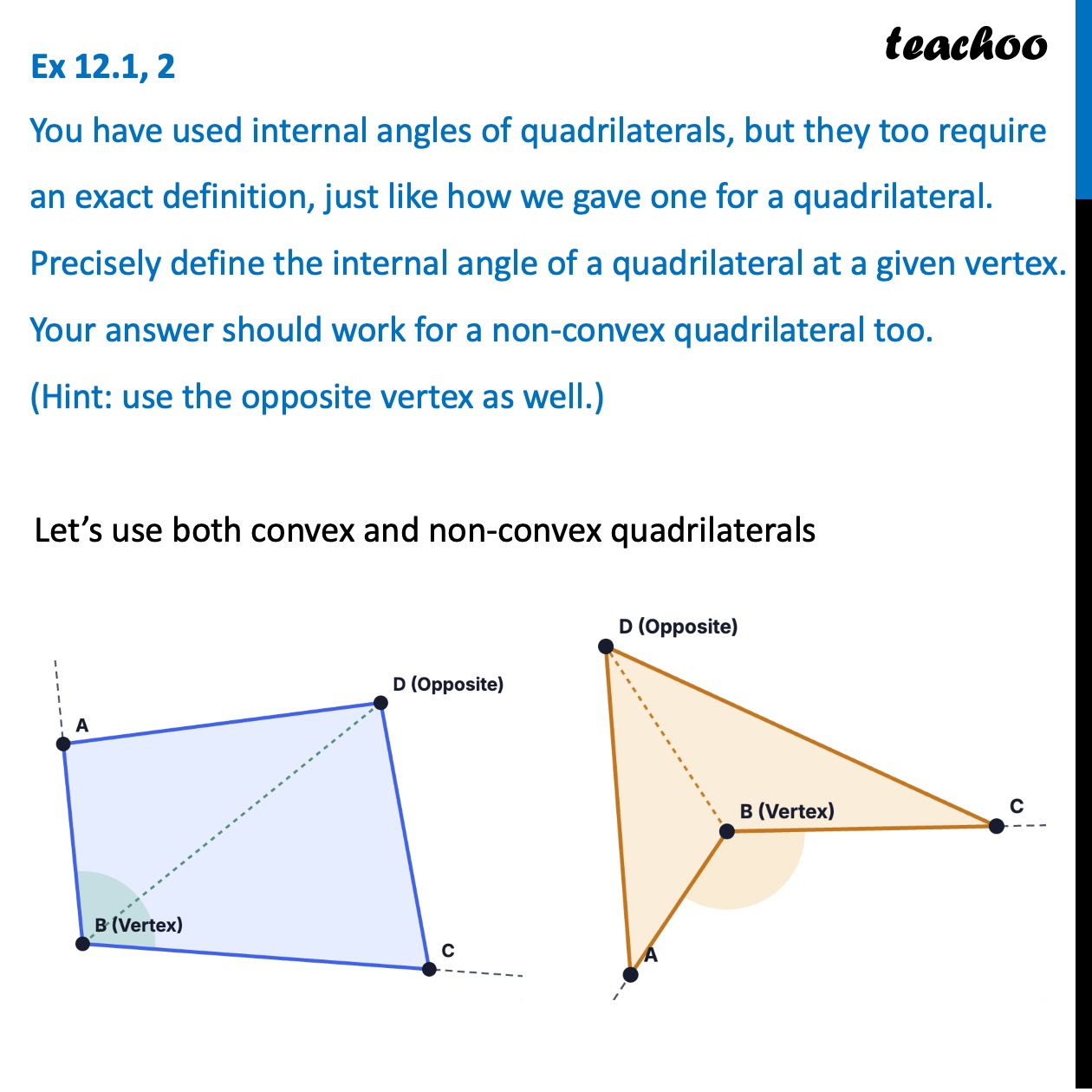
Ex 12.1, 2 You have used internal angles of quadrilaterals, but they too require an exact definition, just like how we gave one for a quadrilateral. Precisely define the internal angle of a quadrilateral at a given vertex. Your answer should work for a non-convex quadrilateral too. (Hint: use the opposite vertex as well.) Let’s use both convex and non-convex quadrilaterals D (Opposite) B (Vertex) We focus on defining ∠ B One way is Smaller angle between rays BC and BA Let smaller angle be 𝜃, the other angle is: 360^(∘)−𝜃 Now, If quadrilateral is convex, this works If quadrilateral is non-convex, this doesn’t work So, we need a definition using the other three vertices Precise definition using the other three vertices Consider the internal angle at 𝐵 in quadrilateral 𝐴𝐵𝐶𝐷. Let 𝜽 be the smaller angle between rays 𝐵𝐴 and 𝐵𝐶. Consider ∆𝑨𝑪𝑫, which includes the opposite vertex 𝑫 If 𝐵 lies inside ∆ 𝑨𝑪𝑫, then it’s a non-convex quadrilateral is the dent vertex. So, its internal angle is ∠𝐴=360^(∘)−𝜃 If 𝐵 lies outside △𝑨𝑪𝑫, then it’s a convex quadrilateral. So, its internal angle is ∠𝐴=𝜃 Because no three vertices are collinear, 𝐴 cannot lie on a side of △𝐵𝐶𝐷.
