End-of-Chapter Exercises

 You are here
Last updated at November 5, 2026 by Teachoo
Transcript
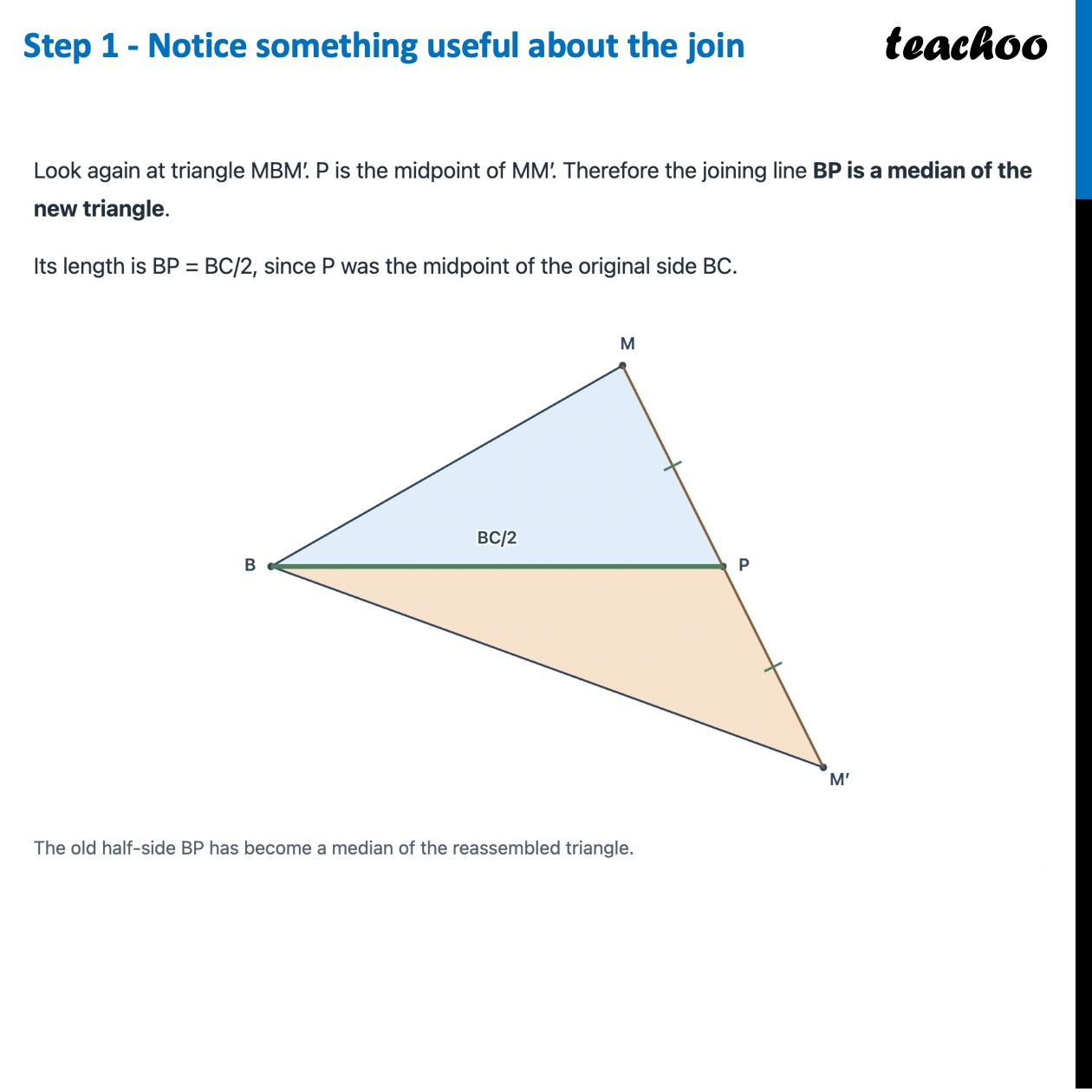
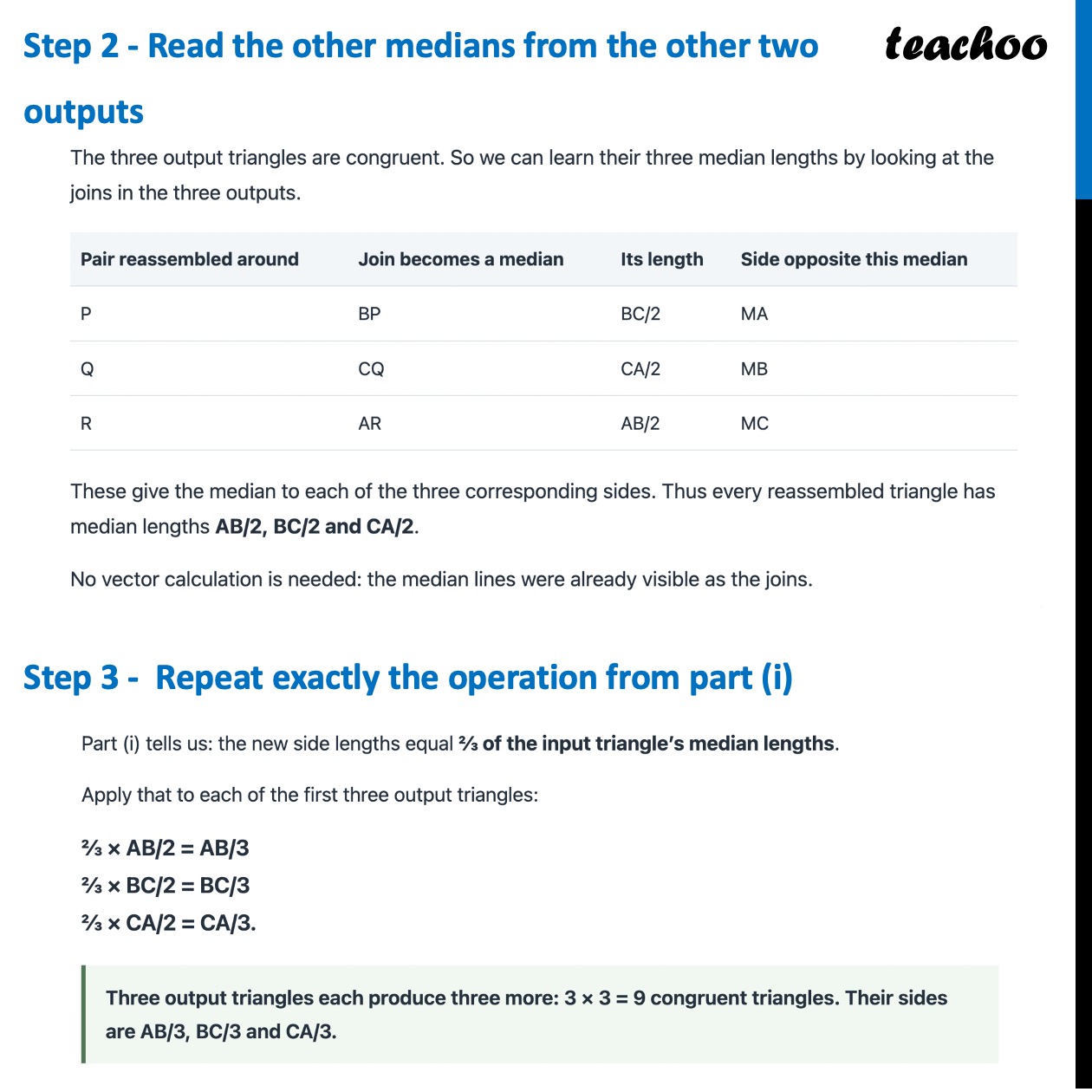
Question 6 (ii) You saw how to use the Midpoint Theorem to divide a given triangle into 4 congruent triangles. Can we divide a triangle into 3 congruent triangles? This exercise shows us how to do that and more, provided we are allowed to cut and reassemble. (ii) Repeat the procedure with each of the 3 assembled triangles you got in (i). Show that each of the resulting 9 triangles has sides (𝐴𝐵)/(3), (𝐵𝐶)/(3) 𝑎𝑛𝑑 (𝐴𝐶)/(3). The procedure and the result above were unnoticed till 2014, when they were discovered by Lee Sallows, an amateur mathematician! Okay, let’s do that Step 1 - Notice something useful about the join Look again at triangle MBM‘. P is the midpoint of MM’. Therefore the joining line BP is a median of the new triangle. Its length is BP = BC/2, since P was the midpoint of the original side BC. The old half-side BP has become a median of the reassembled triangle. Step 2 - Read the other medians from the other two outputs Step 3 - Repeat exactly the operation from part (i) The three output triangles are congruent. So we can learn their three median lengths by looking at the joins in the three outputs. Pair reassembled around Join becomes a median Its length Side opposite this median p BP BC/2 MA Q CQ CA/2 MB R AR AB/2 MC These give the median to each of the three corresponding sides. Thus every reassembled triangle has median lengths AB/2, BC/2 and CA/2. No vector calculation is needed: the median lines were already visible as the joins. Part (i) tells us: the new side lengths equal %% of the input triangle’s median lengths. Apply that to each of the first three output triangles: */, x AB/2 = AB/3 */, x BC/2 = BC/3 */, x CA/2 = CA/3. Three output triangles each produce three more: 3 x 3 = 9 congruent triangles. Their sides are AB/3, BC/3 and CA/3.