End-of-Chapter Exercises

 You are here
Last updated at November 5, 2026 by Teachoo
Transcript
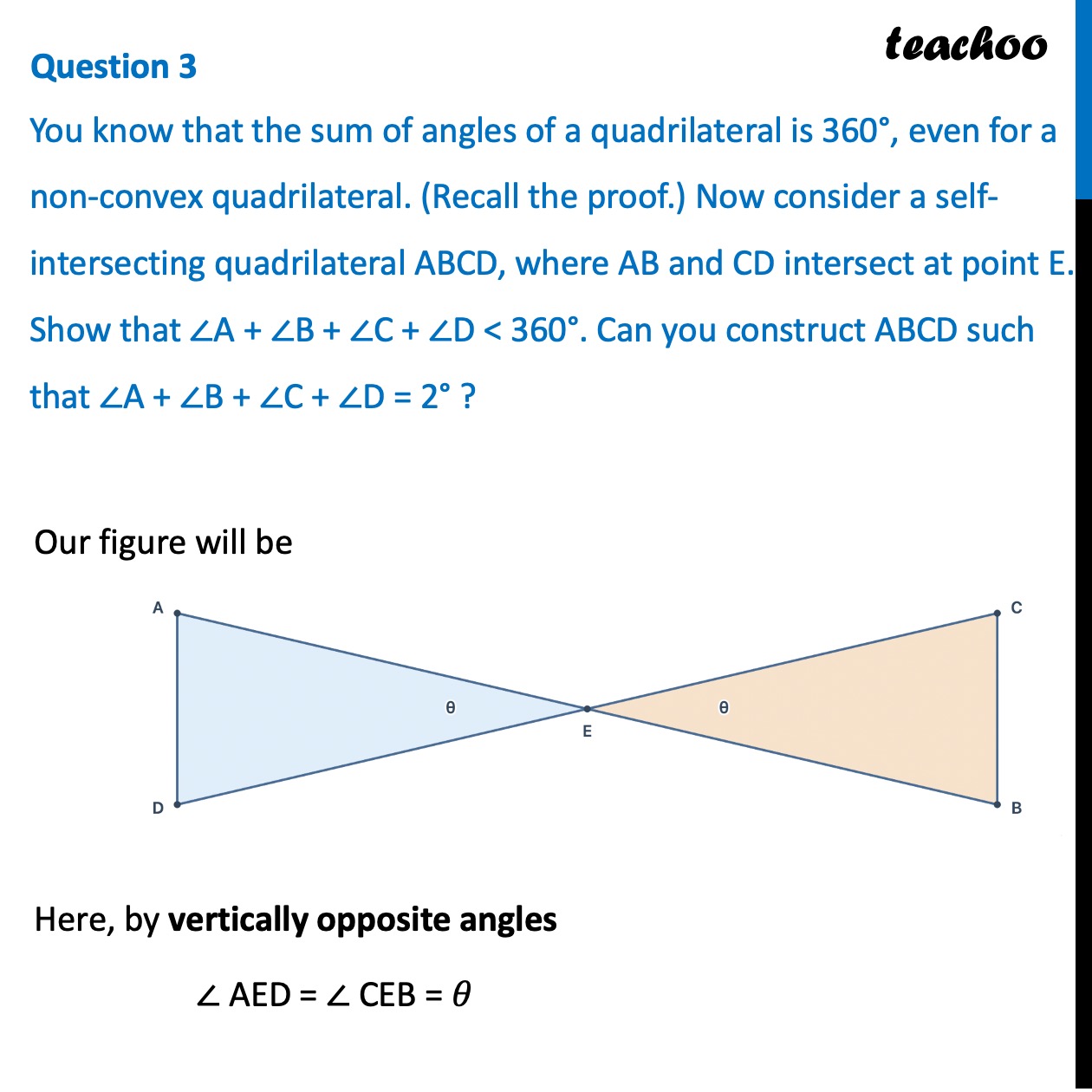
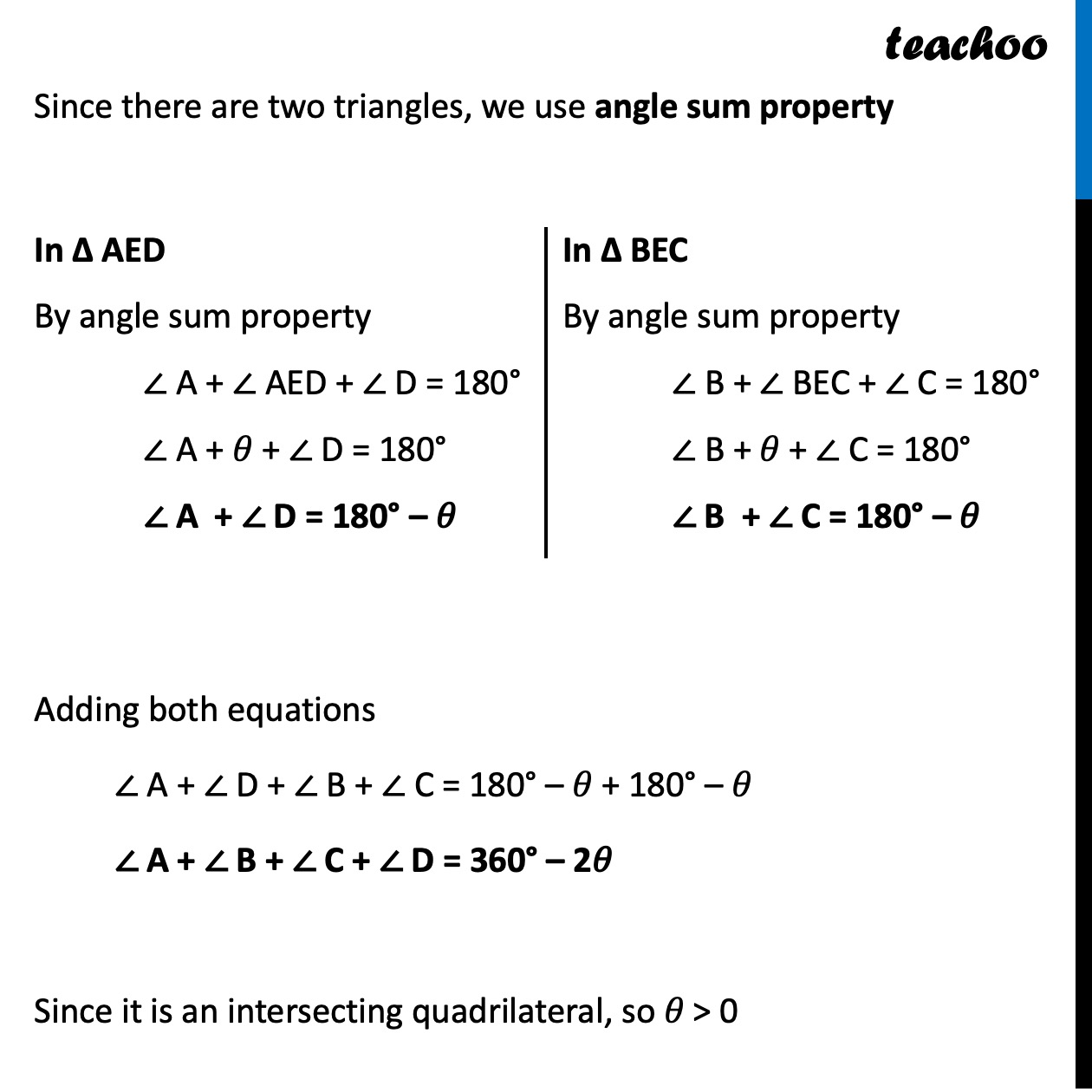
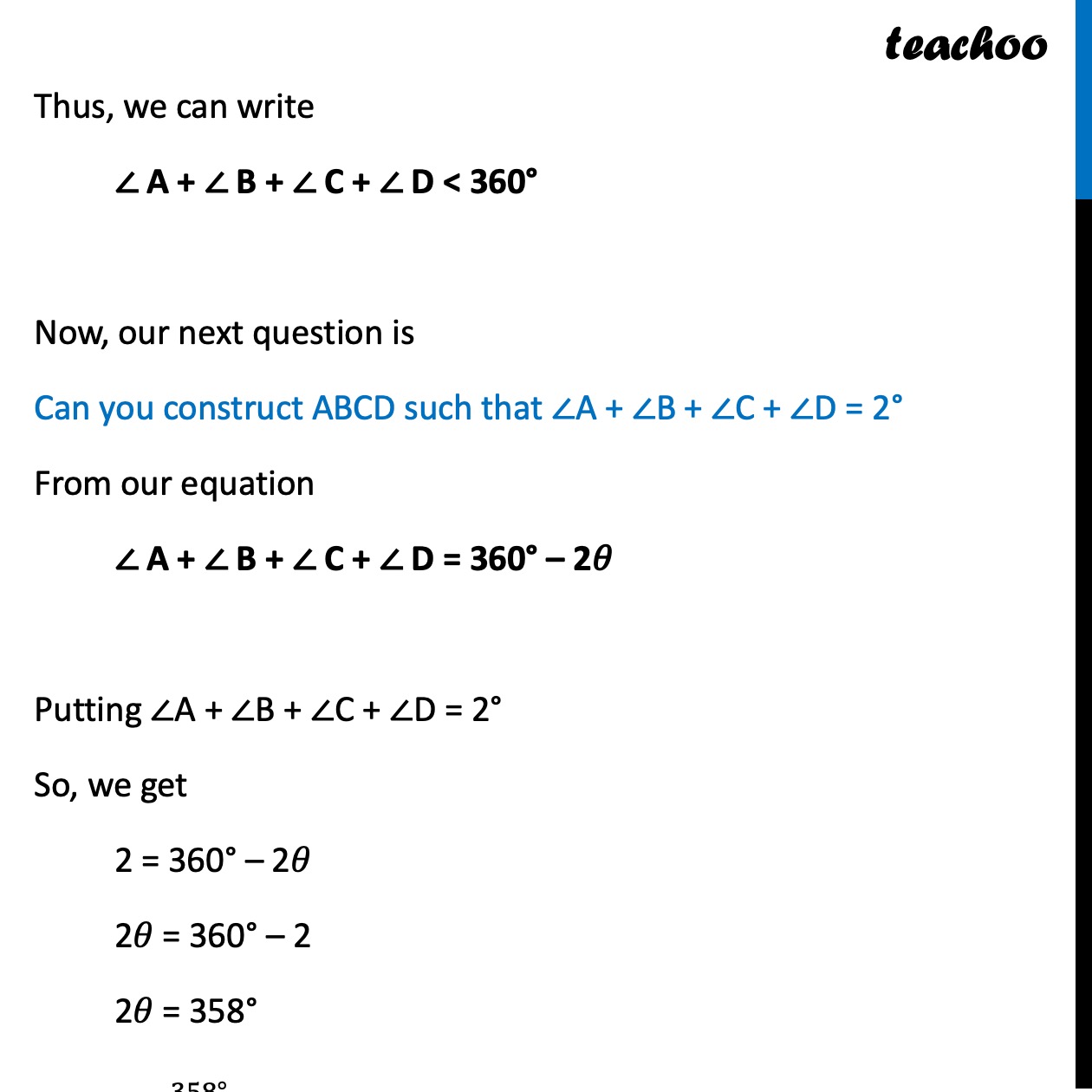
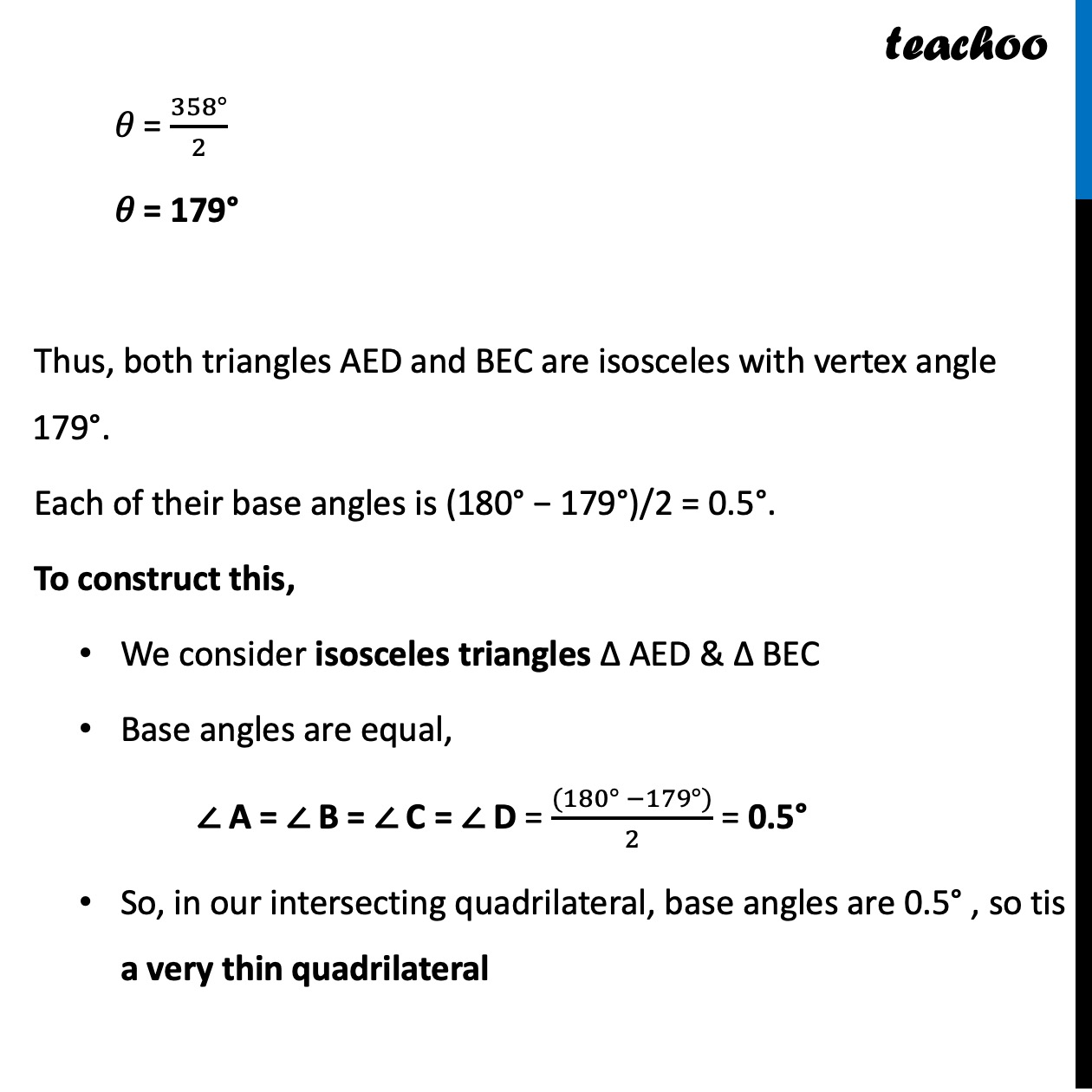
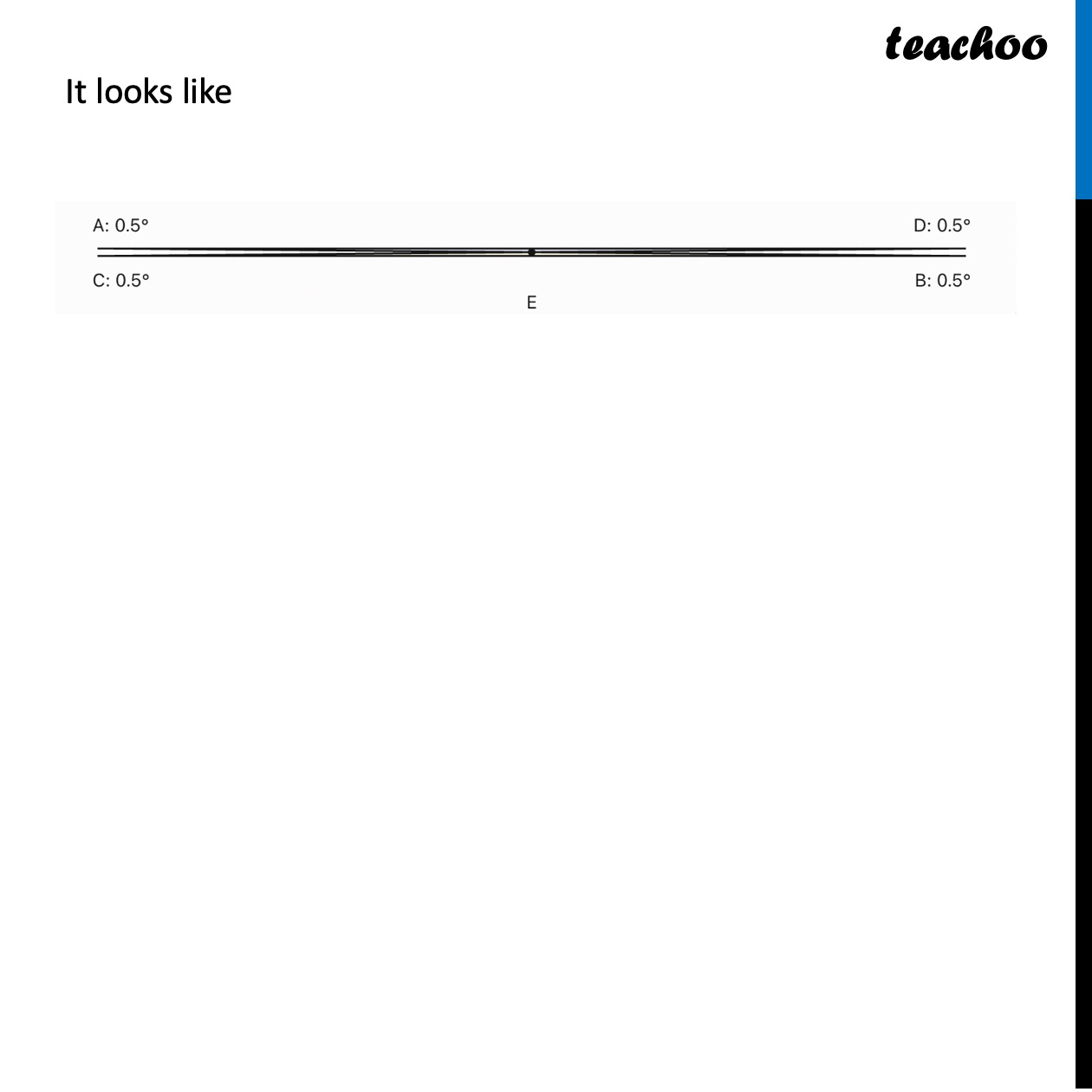
Question 3 You know that the sum of angles of a quadrilateral is 360°, even for a non-convex quadrilateral. (Recall the proof.) Now consider a self-intersecting quadrilateral ABCD, where AB and CD intersect at point E. Show that ∠A + ∠B + ∠C + ∠D < 360°. Can you construct ABCD such that ∠A + ∠B + ∠C + ∠D = 2° ? Our figure will be Here, by vertically opposite angles ∠ AED = ∠ CEB = 𝜃 Since there are two triangles, we use angle sum property Adding both equations ∠ A + ∠ D + ∠ B + ∠ C = 180° – 𝜃 + 180° – 𝜃 ∠ A + ∠ B + ∠ C + ∠ D = 360° – 2𝜃 Since it is an intersecting quadrilateral, so 𝜃 > 0 In ∆ BEC By angle sum property ∠ B + ∠ BEC + ∠ C = 180° ∠ B + 𝜃 + ∠ C = 180° ∠ B + ∠ C = 180° – 𝜃 In ∆ AED By angle sum property ∠ A + ∠ AED + ∠ D = 180° ∠ A + 𝜃 + ∠ D = 180° ∠ A + ∠ D = 180° – 𝜃 Thus, we can write ∠ A + ∠ B + ∠ C + ∠ D < 360° Now, our next question is Can you construct ABCD such that ∠A + ∠B + ∠C + ∠D = 2° From our equation ∠ A + ∠ B + ∠ C + ∠ D = 360° – 2𝜃 Putting ∠A + ∠B + ∠C + ∠D = 2° So, we get 2 = 360° – 2𝜃 2𝜃 = 360° – 2 2𝜃 = 358° 𝜃 = (358°)/(2) 𝜃 = 179° Thus, both triangles AED and BEC are isosceles with vertex angle 179°. Each of their base angles is (180° − 179°)/2 = 0.5°. To construct this, We consider isosceles triangles 𝜃 = (358°)/(2) 𝜃 = 179° Thus, both triangles AED and BEC are isosceles with vertex angle 179°. Each of their base angles is (180° − 179°)/2 = 0.5°. To construct this, We consider isosceles triangles ∆ AED & ∆ BEC Base angles are equal, ∠ A = ∠ B = ∠ C = ∠ D = ((180° −179°))/(2) = 0.5° So, in our intersecting quadrilateral, base angles are 0.5° , so tis a very thin quadrilateral It looks like A: 0.5° D: 0.5° C: 0.5° B: 0.5°