End-of-Chapter Exercises

 You are here
Last updated at November 5, 2026 by Teachoo
Transcript
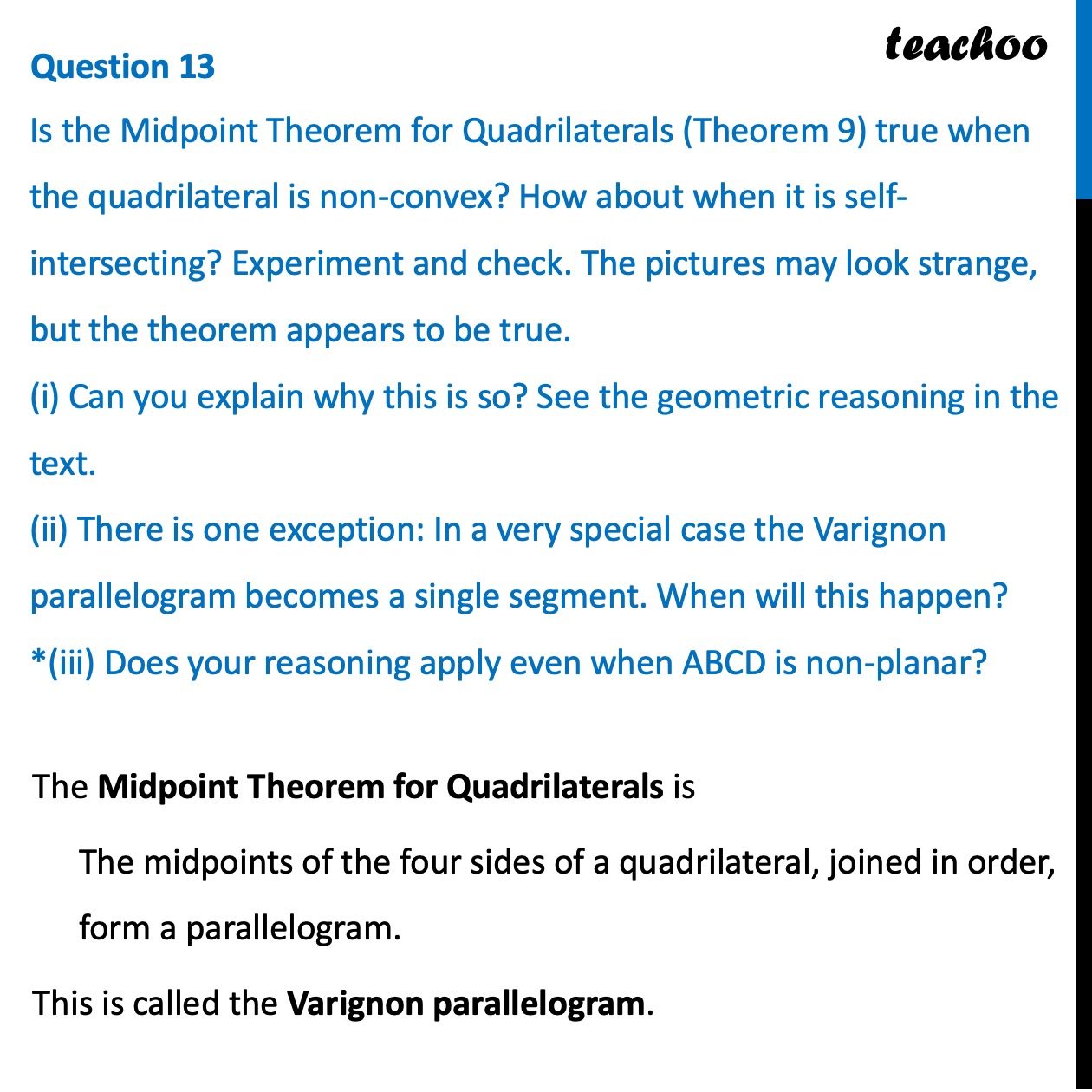
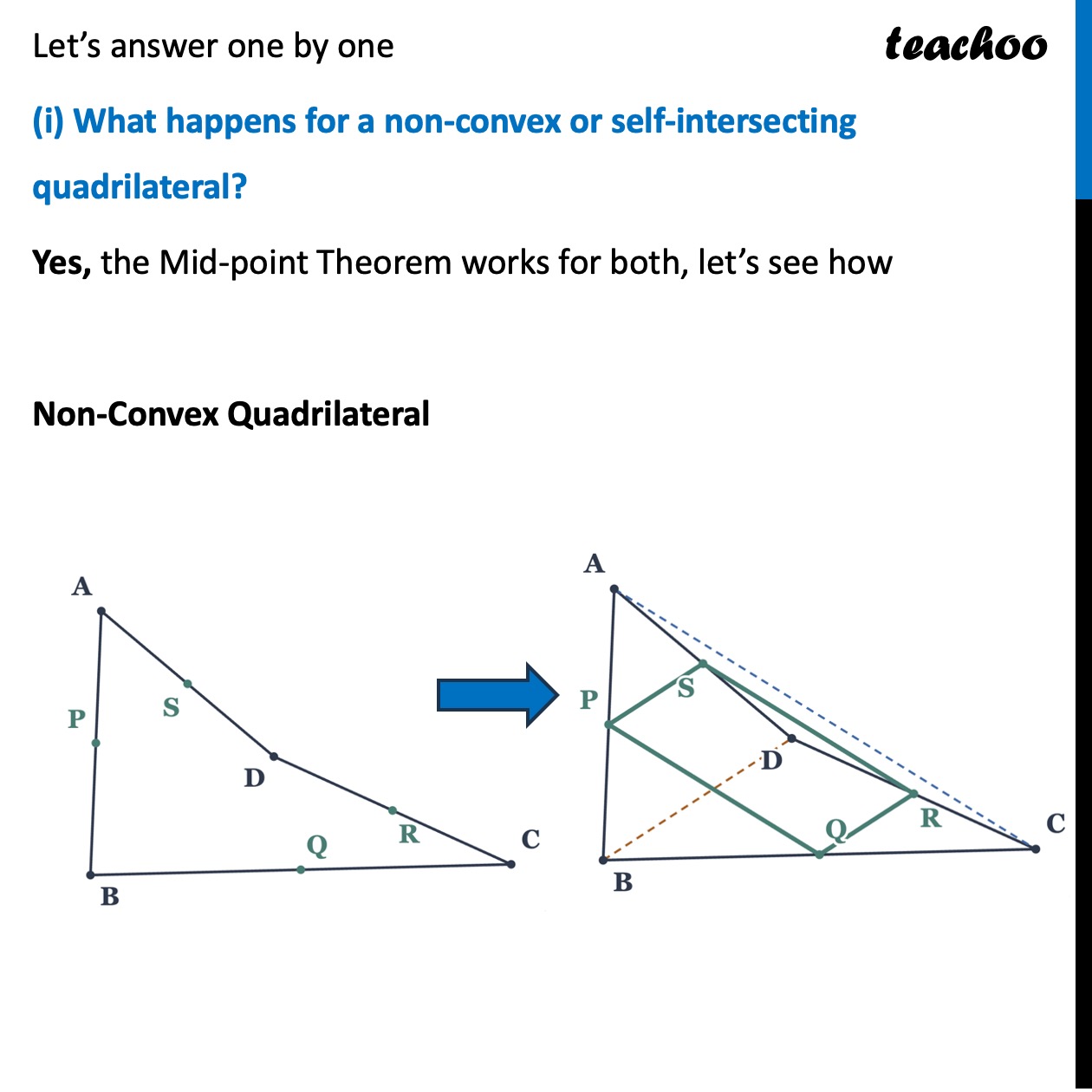
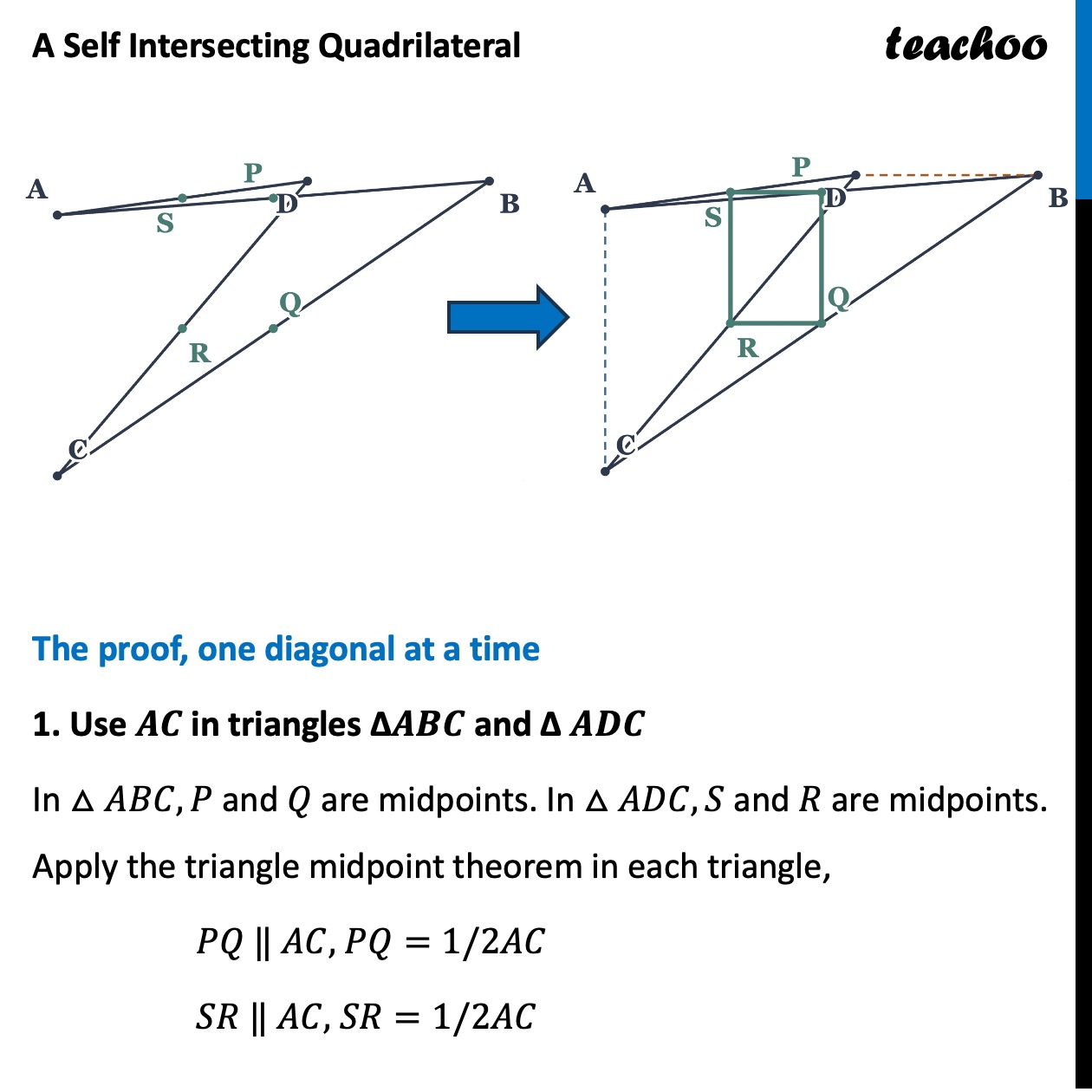
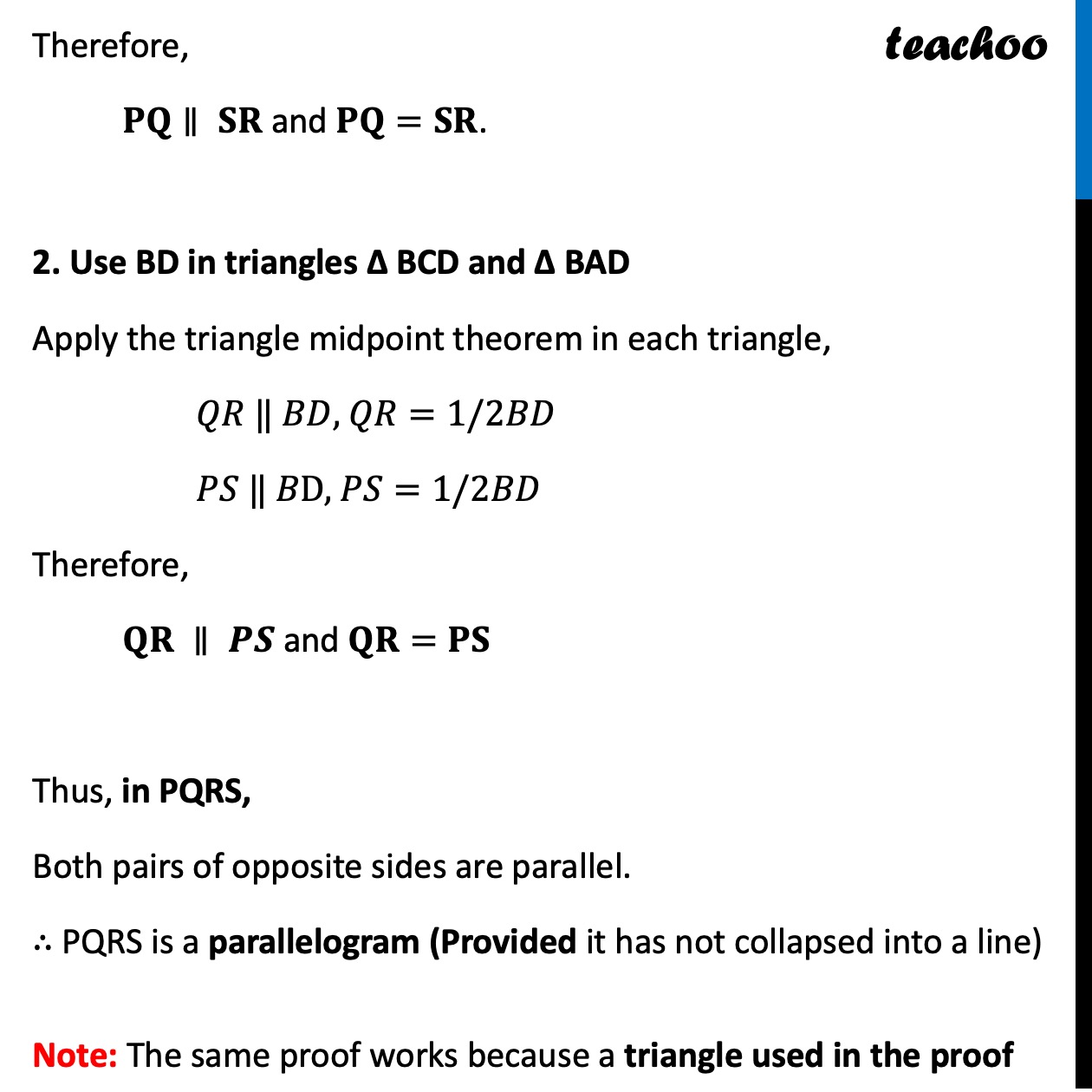
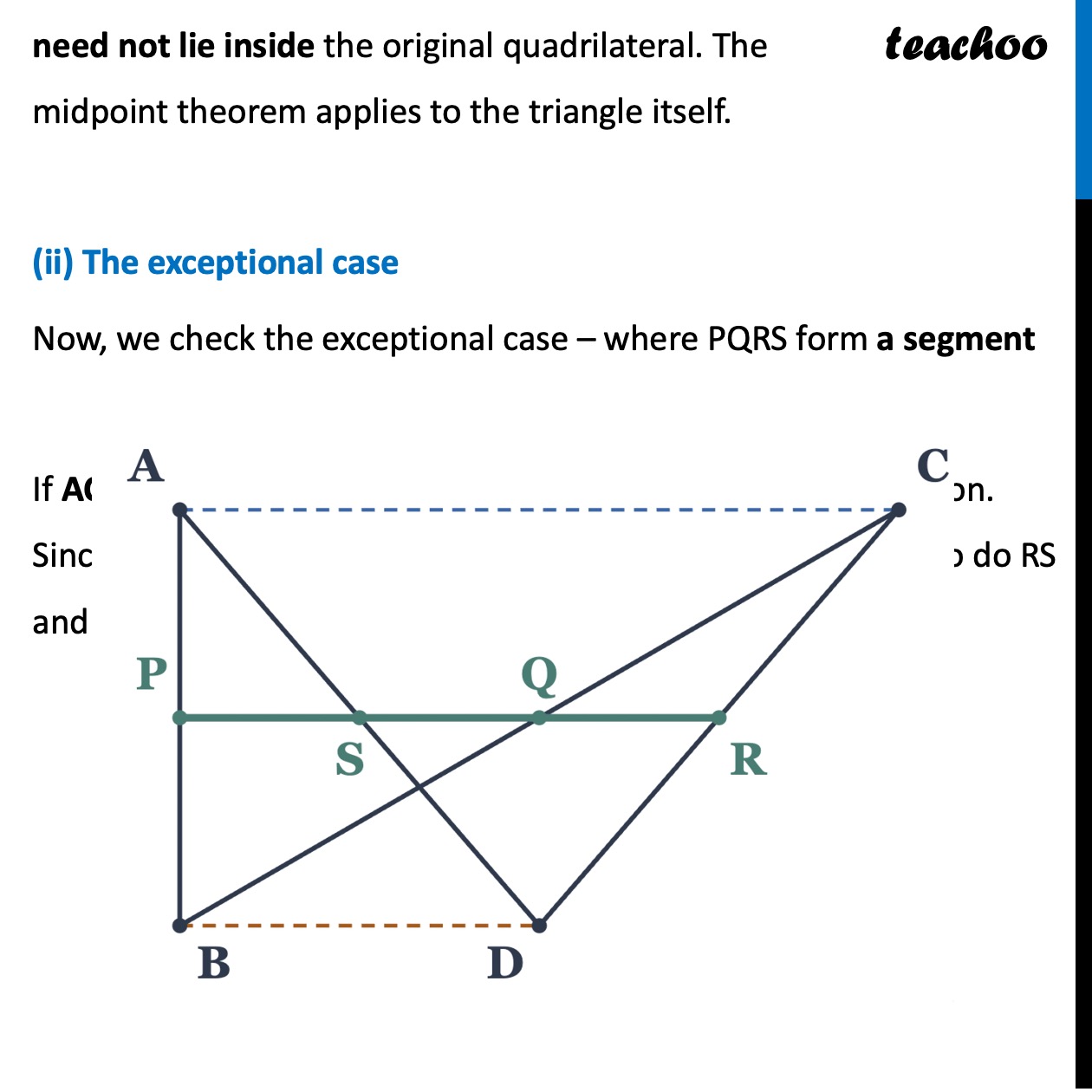
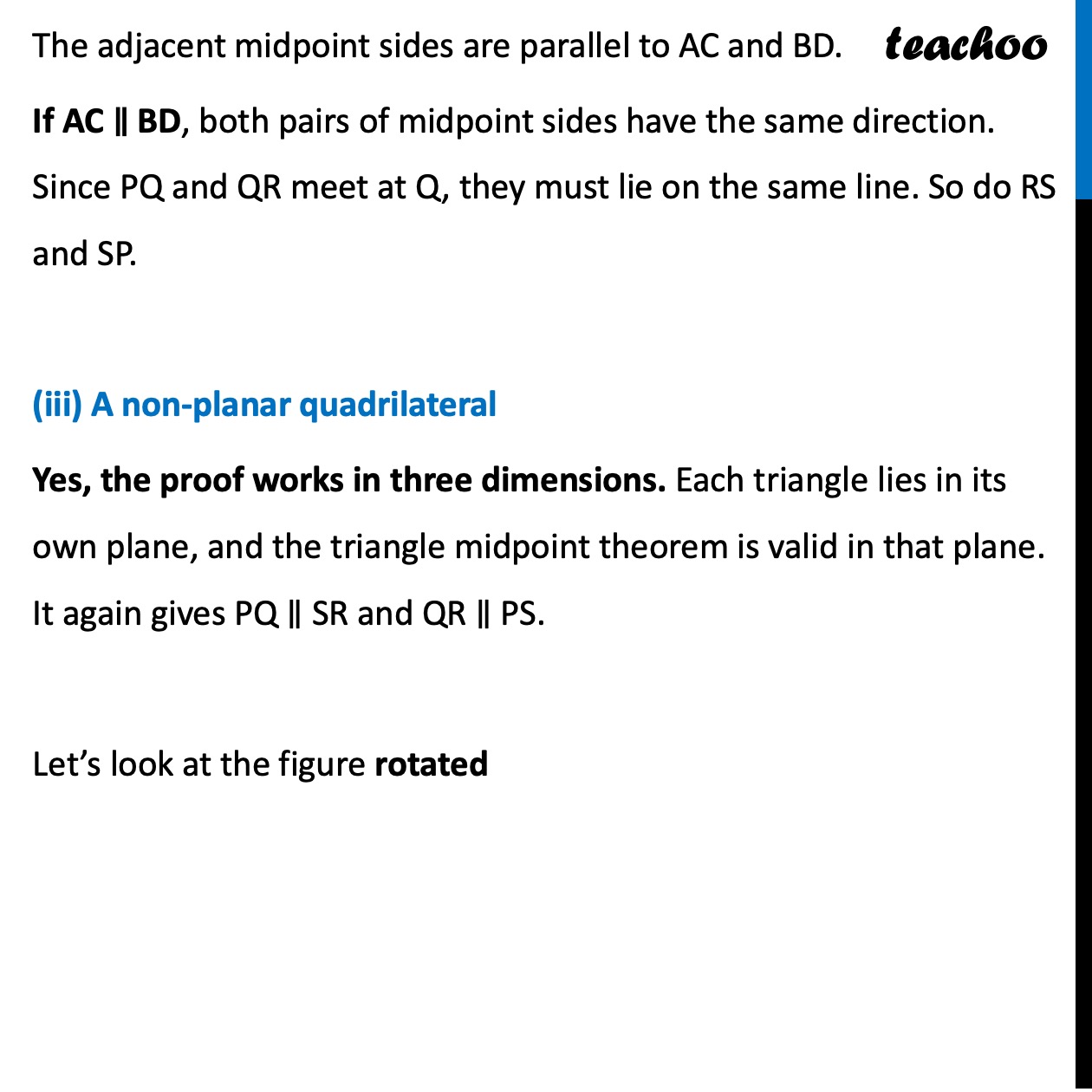
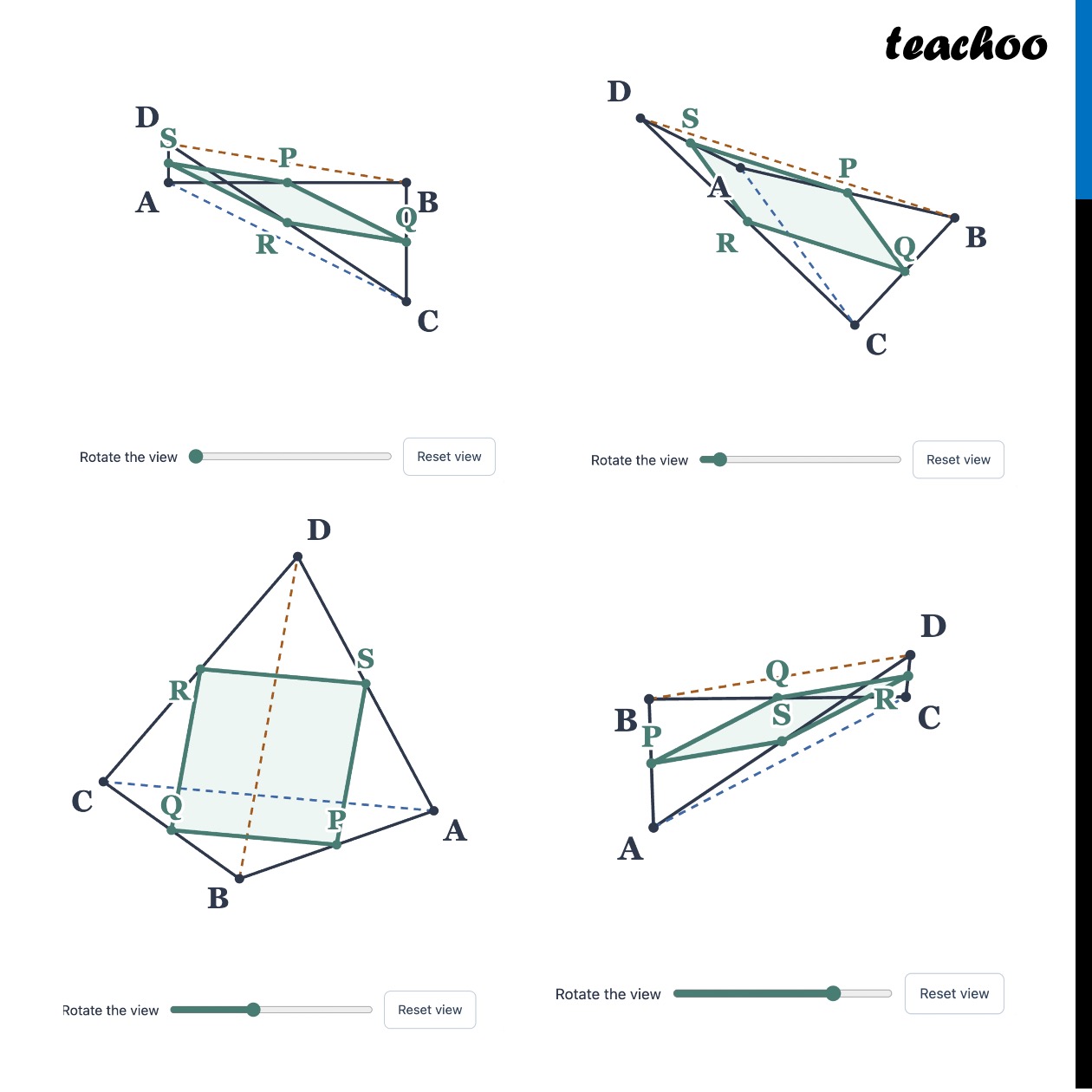
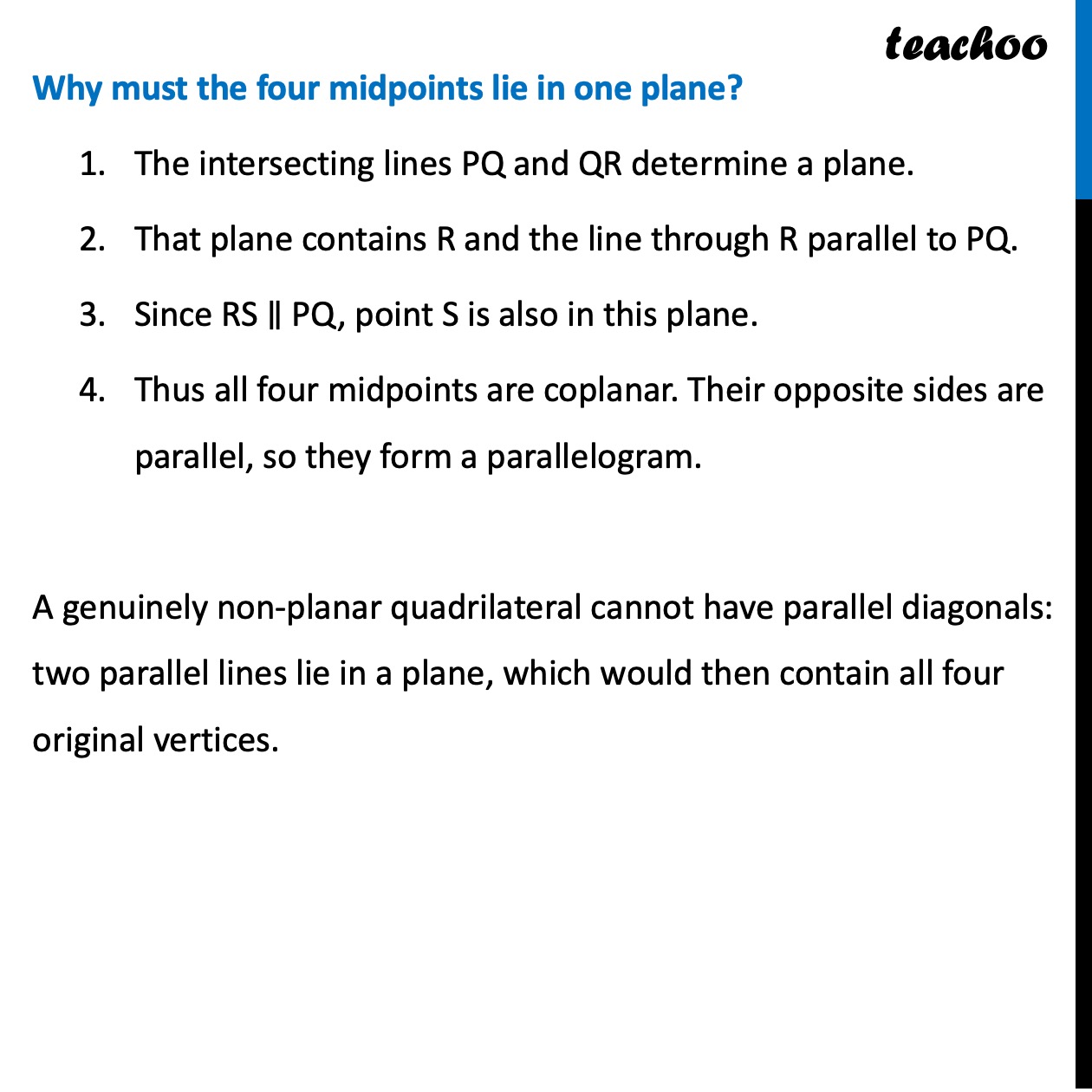
Question 13 Is the Midpoint Theorem for Quadrilaterals (Theorem 9) true when the quadrilateral is non-convex? How about when it is self-intersecting? Experiment and check. The pictures may look strange, but the theorem appears to be true. (i) Can you explain why this is so? See the geometric reasoning in the text. (ii) There is one exception: In a very special case the Varignon parallelogram becomes a single segment. When will this happen? *(iii) Does your reasoning apply even when ABCD is non-planar? The Midpoint Theorem for Quadrilaterals is The midpoints of the four sides of a quadrilateral, joined in order, form a parallelogram. This is called the Varignon parallelogram. Let’s answer one by one (i) What happens for a non-convex or self-intersecting quadrilateral? Yes, the Mid-point Theorem works for both, let’s see how Non-Convex Quadrilateral A Self Intersecting Quadrilateral The proof, one diagonal at a time 1. Use 𝑨𝑪 in triangles ∆𝑨𝑩𝑪 and ∆ 𝑨𝑫𝑪 In △𝐴𝐵𝐶,𝑃 and 𝑄 are midpoints. In △𝐴𝐷𝐶,𝑆 and 𝑅 are midpoints. Apply the triangle midpoint theorem in each triangle, 𝑃𝑄 ‖ 𝐴𝐶, 𝑃𝑄=1/2𝐴𝐶 𝑆𝑅 ‖ 𝐴𝐶, 𝑆𝑅=1/2𝐴𝐶 Therefore, 𝐏𝐐∥ 𝐒𝐑 and 𝐏𝐐=𝐒𝐑. 2. Use BD in triangles ∆ BCD and ∆ BAD Apply the triangle midpoint theorem in each triangle, 𝑄𝑅 ‖ 𝐵𝐷, 𝑄𝑅=1/2𝐵𝐷 𝑃𝑆 ‖ 𝐵D, 𝑃𝑆=1/2𝐵𝐷 Therefore, 𝐐𝐑 ∥ 𝑷𝑺 and 𝐐𝐑=𝐏𝐒 Thus, in PQRS, Both pairs of opposite sides are parallel. ∴ PQRS is a parallelogram (Provided it has not collapsed into a line) Note: The same proof works because a triangle used in the proof need not lie inside the original quadrilateral. The midpoint theorem applies to the triangle itself. Ne Therefore, 𝐏𝐐∥ 𝐒𝐑 and 𝐏𝐐=𝐒𝐑. 2. Use BD in triangles ∆ BCD and ∆ BAD Apply the triangle midpoint theorem in each triangle, 𝑄𝑅 ‖ 𝐵𝐷, 𝑄𝑅=1/2𝐵𝐷 𝑃𝑆 ‖ 𝐵D, 𝑃𝑆=1/2𝐵𝐷 Therefore, 𝐐𝐑 ∥ 𝑷𝑺 and 𝐐𝐑=𝐏𝐒 Thus, in PQRS, Both pairs of opposite sides are parallel. ∴ PQRS is a parallelogram (Provided it has not collapsed into a line) Note: The same proof works because a triangle used in the proof need not lie inside the original quadrilateral. The midpoint theorem applies to the triangle itself. (ii) The exceptional case Now, we check the exceptional case – where PQRS form a segment If AC ∥ BD, both pairs of midpoint sides have the same direction. Since PQ and QR meet at Q, they must lie on the same line. So do RS and SP. The adjacent midpoint sides are parallel to AC and BD. If AC ∥ BD, both pairs of midpoint sides have the same direction. Since PQ and QR meet at Q, they must lie on the same line. So do RS and SP. (iii) A non-planar quadrilateral Yes, the proof works in three dimensions. Each triangle lies in its own plane, and the triangle midpoint theorem is valid in that plane. It again gives PQ ∥ SR and QR ∥ PS. Let’s look at the figure rotated Rotate the view > Reset view Rotate the View CE @) => Reset view Rotate the view @ > Reset view Rotate the view @@ > | Reset view Why must the four midpoints lie in one plane? The intersecting lines PQ and QR determine a plane. That plane contains R and the line through R parallel to PQ. Since RS ∥ PQ, point S is also in this plane. Thus all four midpoints are coplanar. Their opposite sides are parallel, so they form a parallelogram. A genuinely non-planar quadrilateral cannot have parallel diagonals: two parallel lines lie in a plane, which would then contain all four original vertices.