End-of-Chapter Exercises

 You are here
Last updated at November 5, 2026 by Teachoo
Transcript
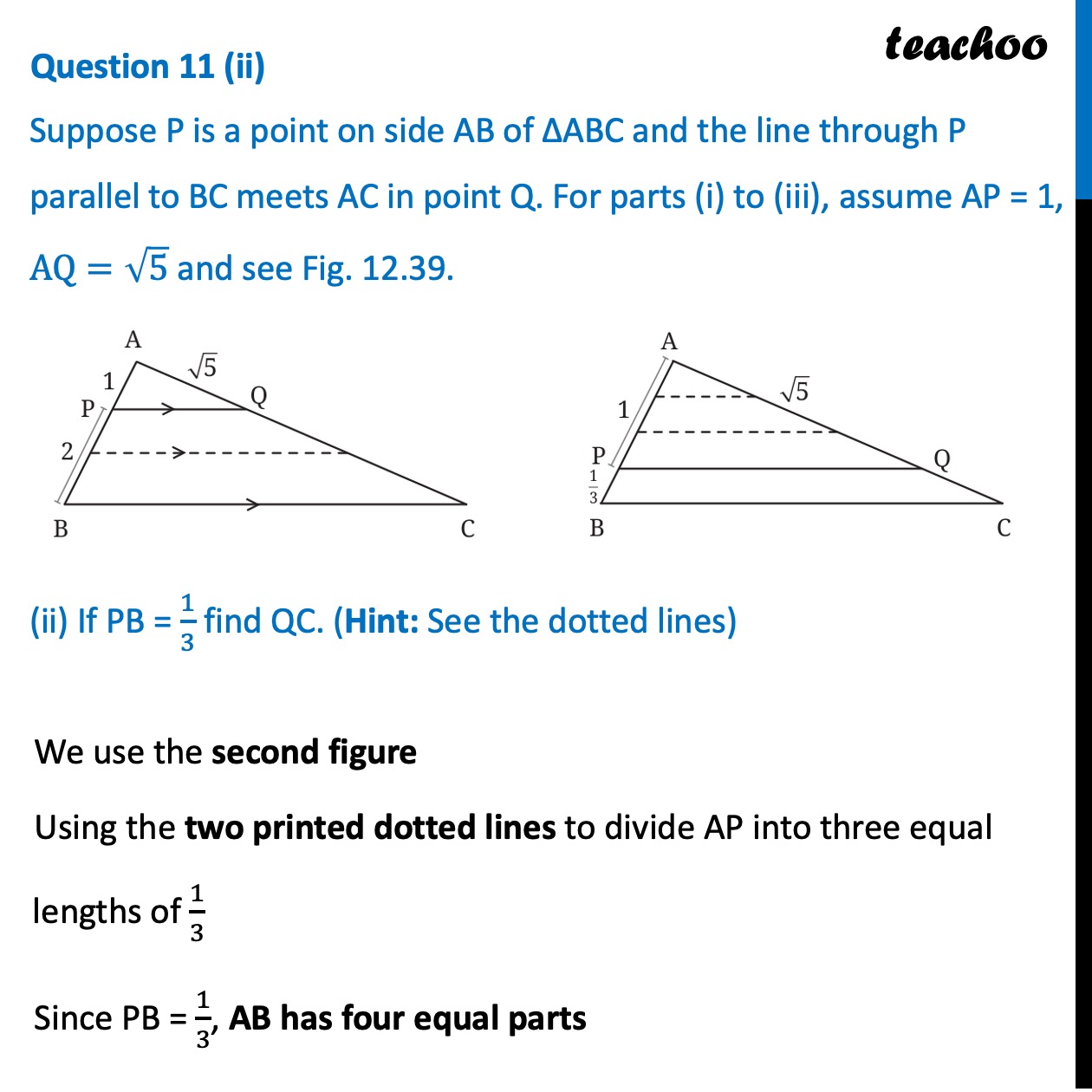
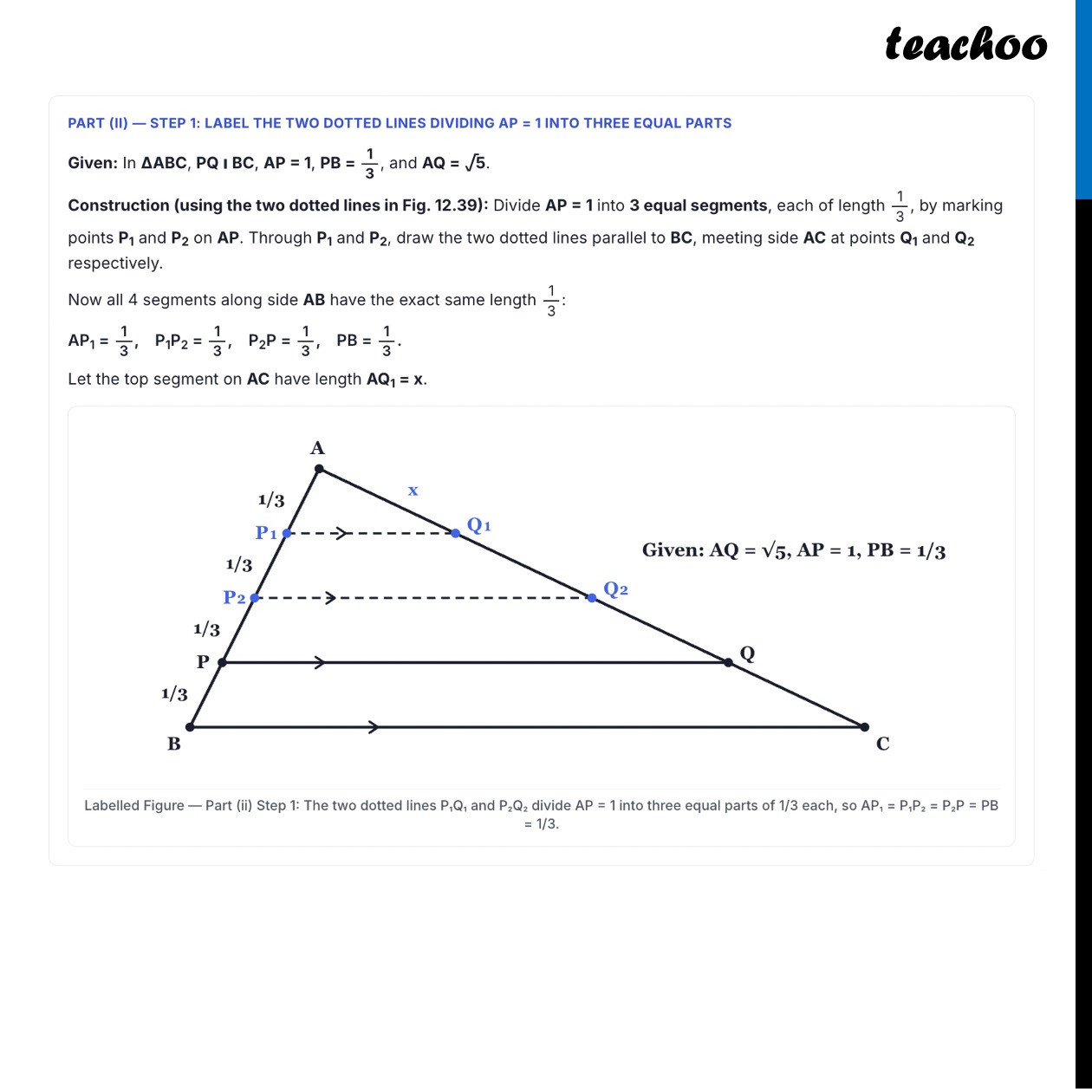
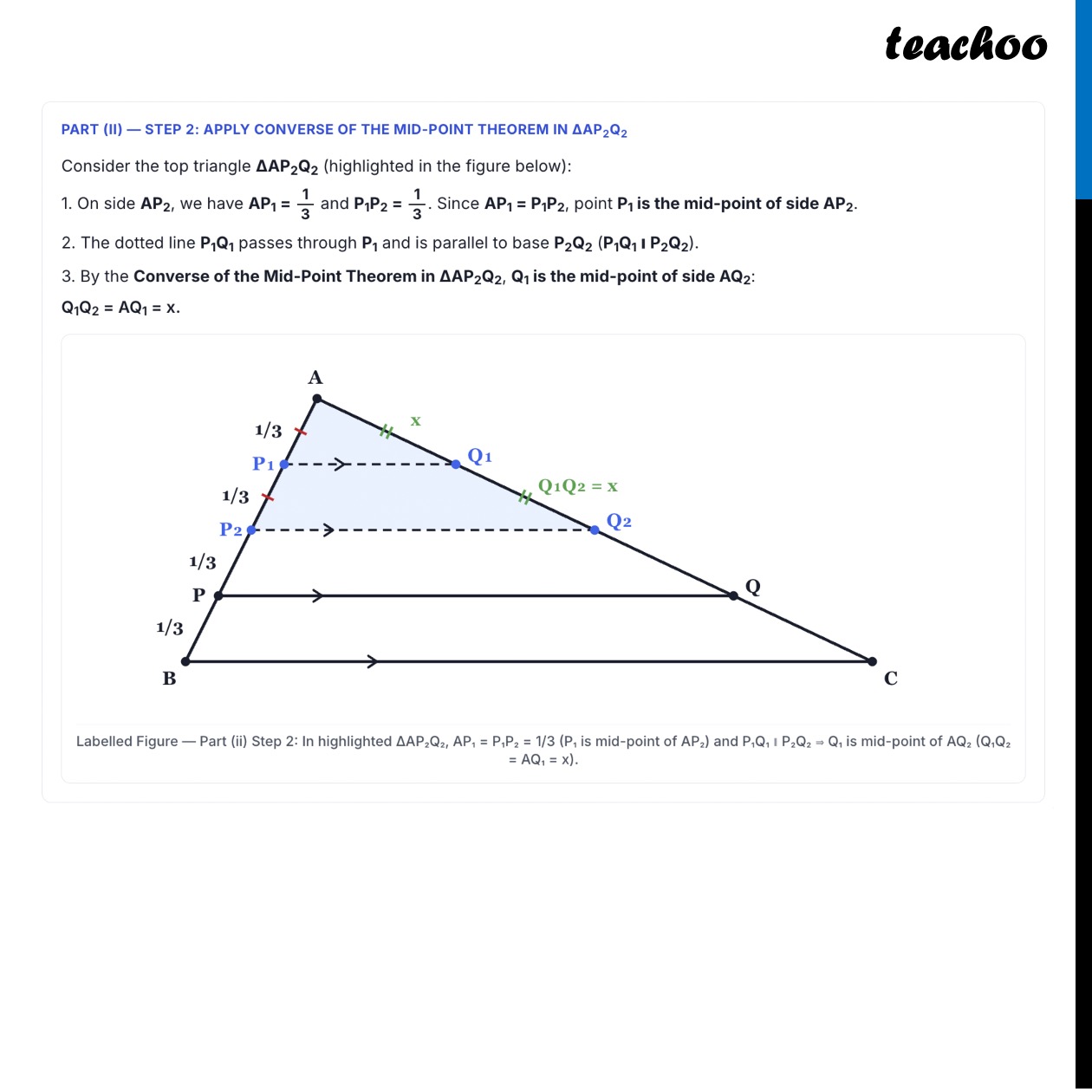
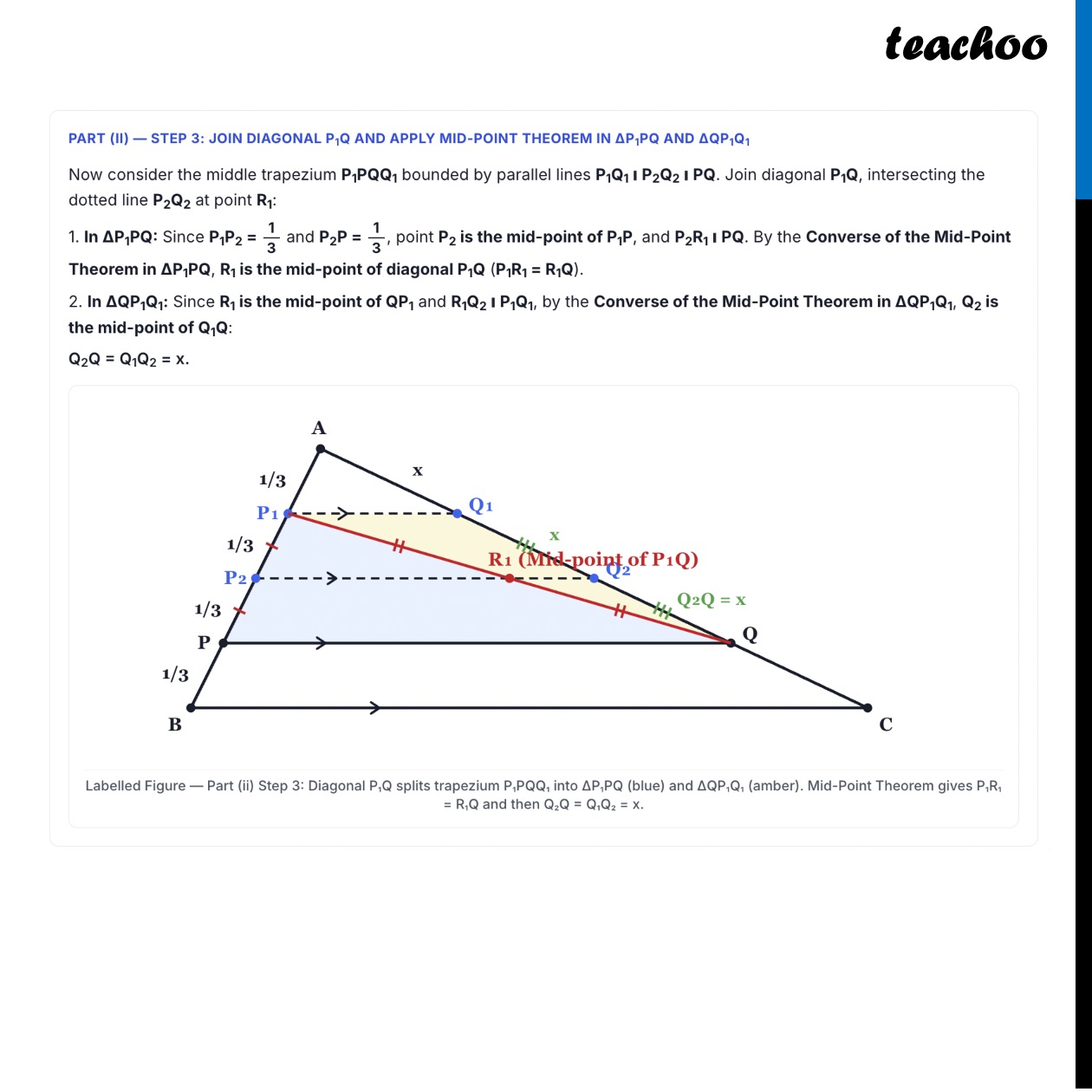
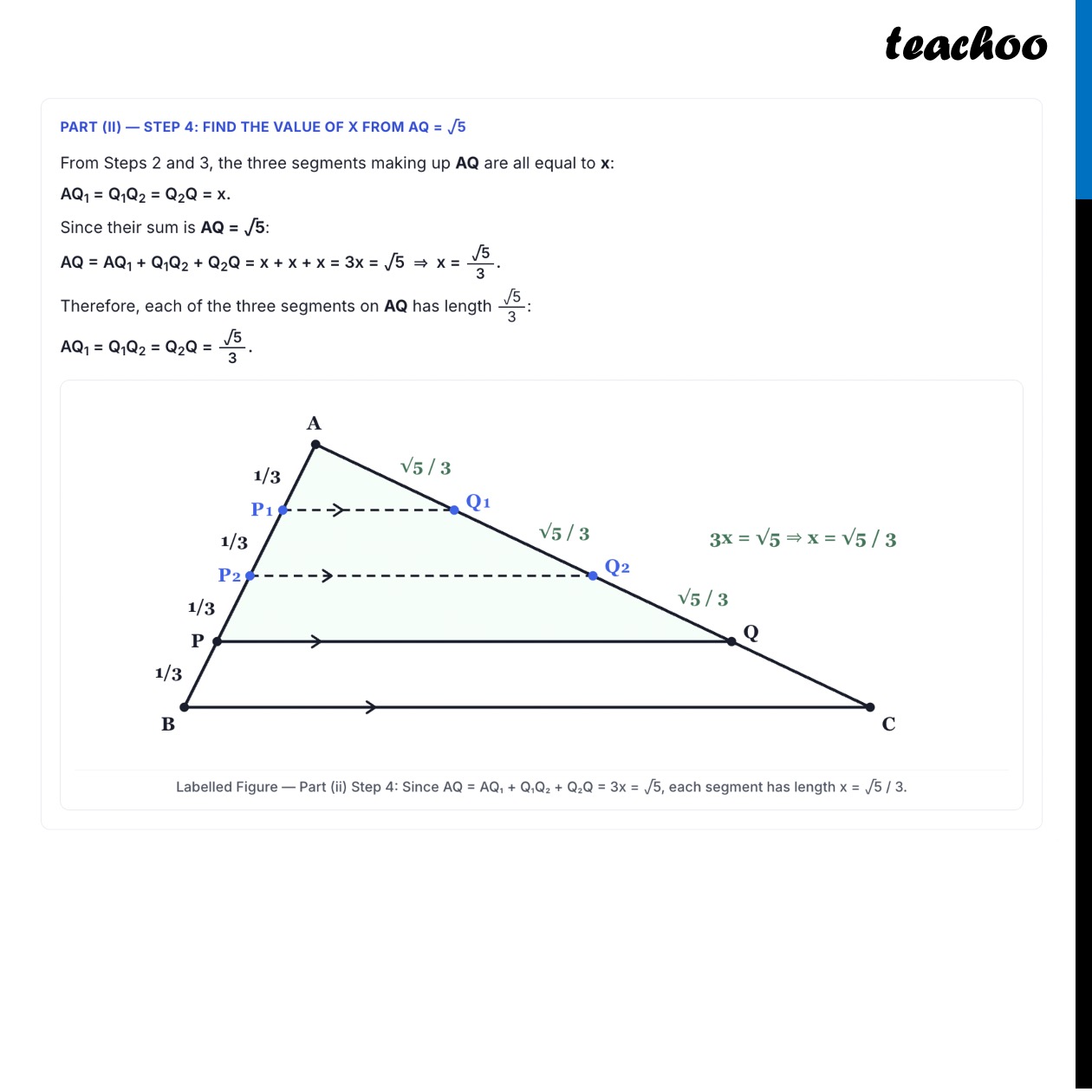
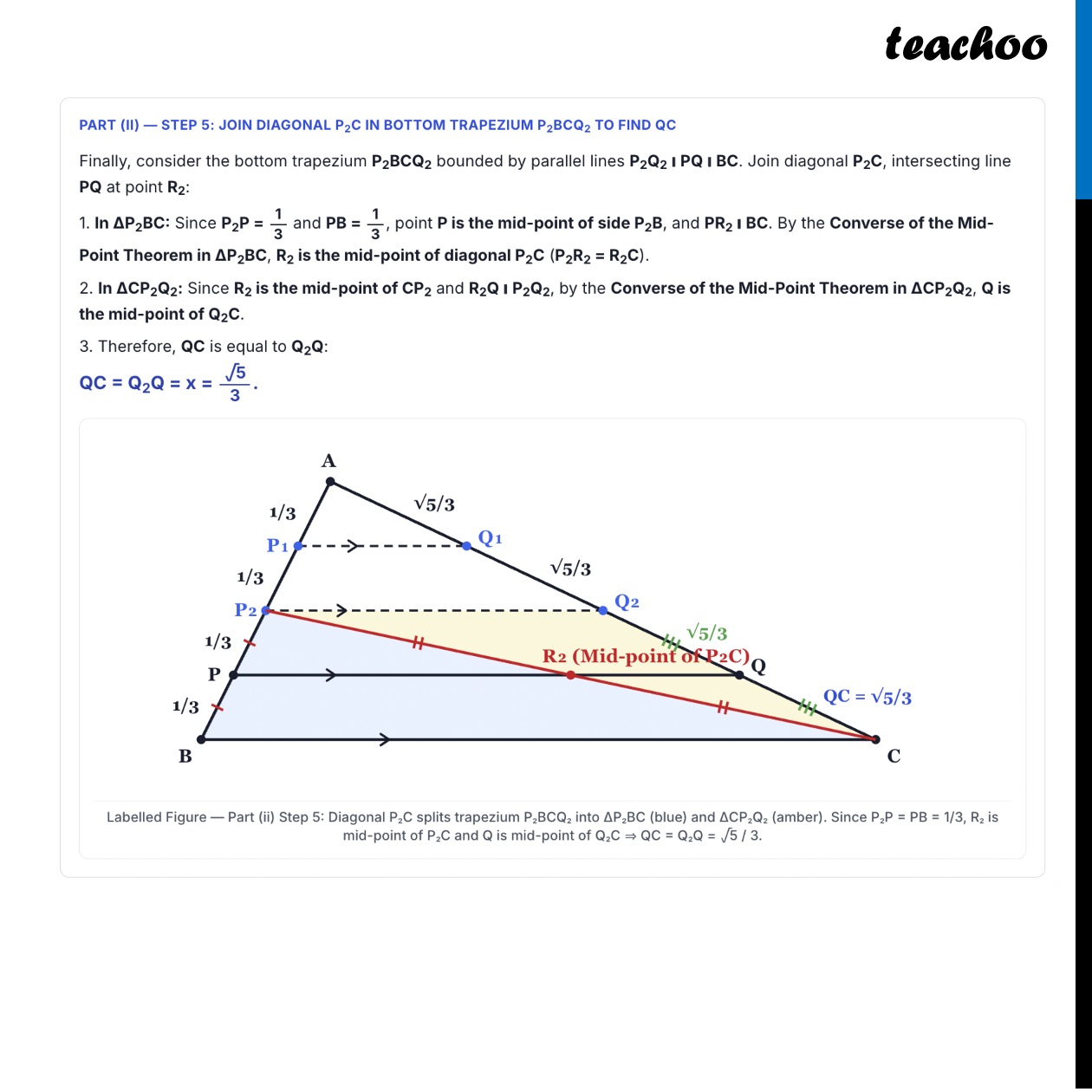
Question 11 (ii) Suppose P is a point on side AB of ∆ABC and the line through P parallel to BC meets AC in point Q. For parts (i) to (iii), assume AP = 1, AQ=sqrt(5) and see Fig. 12.39. (ii) If PB = (1)/(3) find QC. (Hint: See the dotted lines) We use the second figure Using the two printed dotted lines to divide AP into three equal lengths of (1)/(3) Since PB = (1)/(3), AB has four equal parts Fig. 12.39 PART (Il) — STEP 1: LABEL THE TWO DOTTED LINES DIVIDING AP = 1INTO THREE EQUAL PARTS Given: In AABC, PQ1BC, AP = 1, PB = + and AQ = 5. Construction (using the two dotted lines in Fig. 12.39): Divide AP = 1into 3 equal segments, each of length +, by marking points Py and P2 on AP. Through P, and P2, draw the two dotted lines parallel to BC, meeting side AC at points Q; and Q2 respectively. Now all 4 segments along side AB have the exact same length +: 1 1 3" P4P2 = Let the top segment on AC have length AQ, = x. Given: AQ = V5, AP = 1, PB = 1/3 Qo B C Labelled Figure — Part (ii) Step 1: The two dotted lines P,Q, and P,Q, divide AP = 1 into three equal parts of 1/3 each, so AP, = P,P, = P,P = PB = 1/3. PART (Il) — STEP 2: APPLY CONVERSE OF THE MID-POINT THEOREM IN AAP.Q, Consider the top triangle AAP2Qz2 (highlighted in the figure below): 1. On side AP2, we have AP, = 7 and P4P2 = x Since AP, = P;P2, point P; is the mid-point of side AP2. 2. The dotted line P,Q, passes through P, and is parallel to base P2Q2 (P,Q, 1 P2Q>). 3. By the Converse of the Mid-Point Theorem in AAP2Q2, Q; is the mid-point of side AQ>: Q1Q2 = AQ; =x. C Labelled Figure — Part (ii) Step 2: In highlighted AAP,Q,, AP, = P,P, = 1/3 (P, is mid-point of AP.) and P,Q, 1 P,Q, = Q, is mid-point of AQ, (Q,Q, = AQ, = xX). PART (Il) — STEP 3: JOIN DIAGONAL P,Q AND APPLY MID-POINT THEOREM IN AP,PQ AND AQP,Q, Now consider the middle trapezium P;PQQ, bounded by parallel lines P7Q; 1 P2Q21PQ. Join diagonal P,Q, intersecting the dotted line P2Q> at point Rj: 1. In AP,PQ: Since P,P2 = _ and P2P = + point P2 is the mid-point of P,P, and P2R,1 PQ. By the Converse of the Mid-Point Theorem in AP;PQ, R; is the mid-point of diagonal P;Q (P1R; = R1Q). 2. In AQP,Q;: Since R, is the mid-point of QP; and R;Qz 1 P;Q,, by the Converse of the Mid-Point Theorem in AQP,Q;, Q2 is the mid-point of Q,Q: Q2Q = Q1Q2 = x. C Labelled Figure — Part (ii) Step 3: Diagonal P,Q splits trapezium P,PQQ, into AP,PQ (blue) and AQP,Q, (amber). Mid-Point Theorem gives P,R, = R,Q and then Q,Q = Q,Q, = x. PART (Il) — STEP 4: FIND THE VALUE OF X FROM AQ = /5 From Steps 2 and 3, the three segments making up AQ are all equal to x: AQ; = Q1Q2 = Q2Q = x. Since their sum is AQ = /5: AQ = AQ, + QQ, + Q.Q=x+x+x=3x=/5 = x2 8, Therefore, each of the three segments on AQ has length 8. AQ, = Q,Q2 = Q2Q = 6. A 1/3 3x = V5 >x=V5/3 Vv5/3 B C Labelled Figure — Part (ii) Step 4: Since AQ = AQ, + Q,Q, + Q.Q = 3x = /5, each segment has length x = /5/ 3. PART (Il) — STEP 5: JOIN DIAGONAL P2C IN BOTTOM TRAPEZIUM P2BCQ> TO FIND QC Finally, consider the bottom trapezium P2BCQ2 bounded by parallel lines P2Q2 1PQ1 BC. Join diagonal P2C, intersecting line PQ at point Ro: 1. In AP2BC: Since P2P = + and PB = a point P is the mid-point of side P2B, and PR21 BC. By the Converse of the Mid- Point Theorem in AP2BC, R2 is the mid-point of diagonal P2C (P2R2 = R2C). 2. In ACP2Qz2: Since R2 is the mid-point of CP2 and R2Q 1 P2Qz2, by the Converse of the Mid-Point Theorem in ACP2Q2, Q is the mid-point of Q2C. 3. Therefore, QC is equal to Q2Q: Qc =Q,Q=x= 8. v5/3 B C Labelled Figure — Part (ii) Step 5: Diagonal P,C splits trapezium P,BCQ, into AP,BC (blue) and ACP,Q, (amber). Since P,P = PB = 1/3, R2 is mid-point of P2C and Q is mid-point of Q.C = QC = Q,Q = /5/3.