End-of-Chapter Exercises

 You are here
Last updated at November 5, 2026 by Teachoo
Transcript
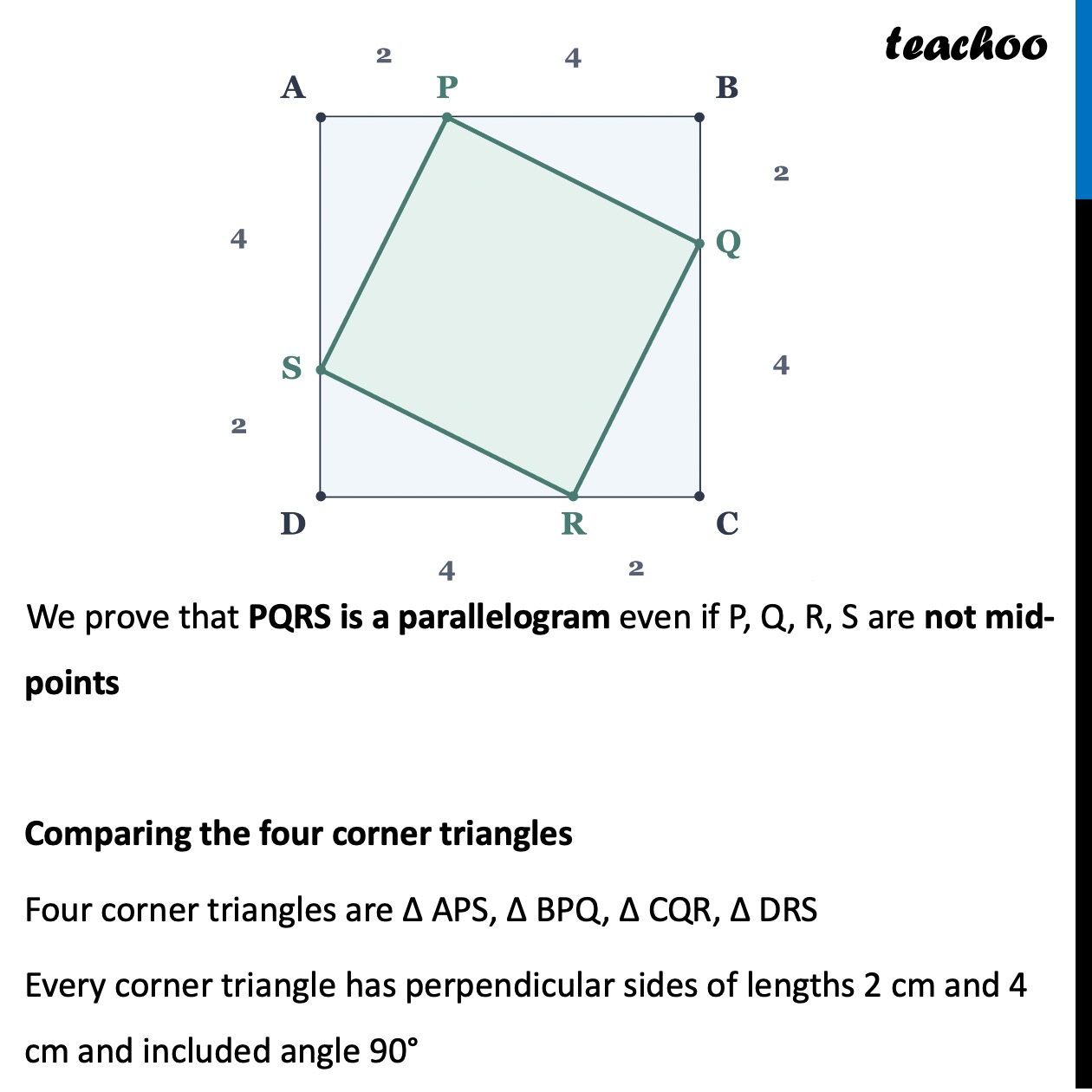
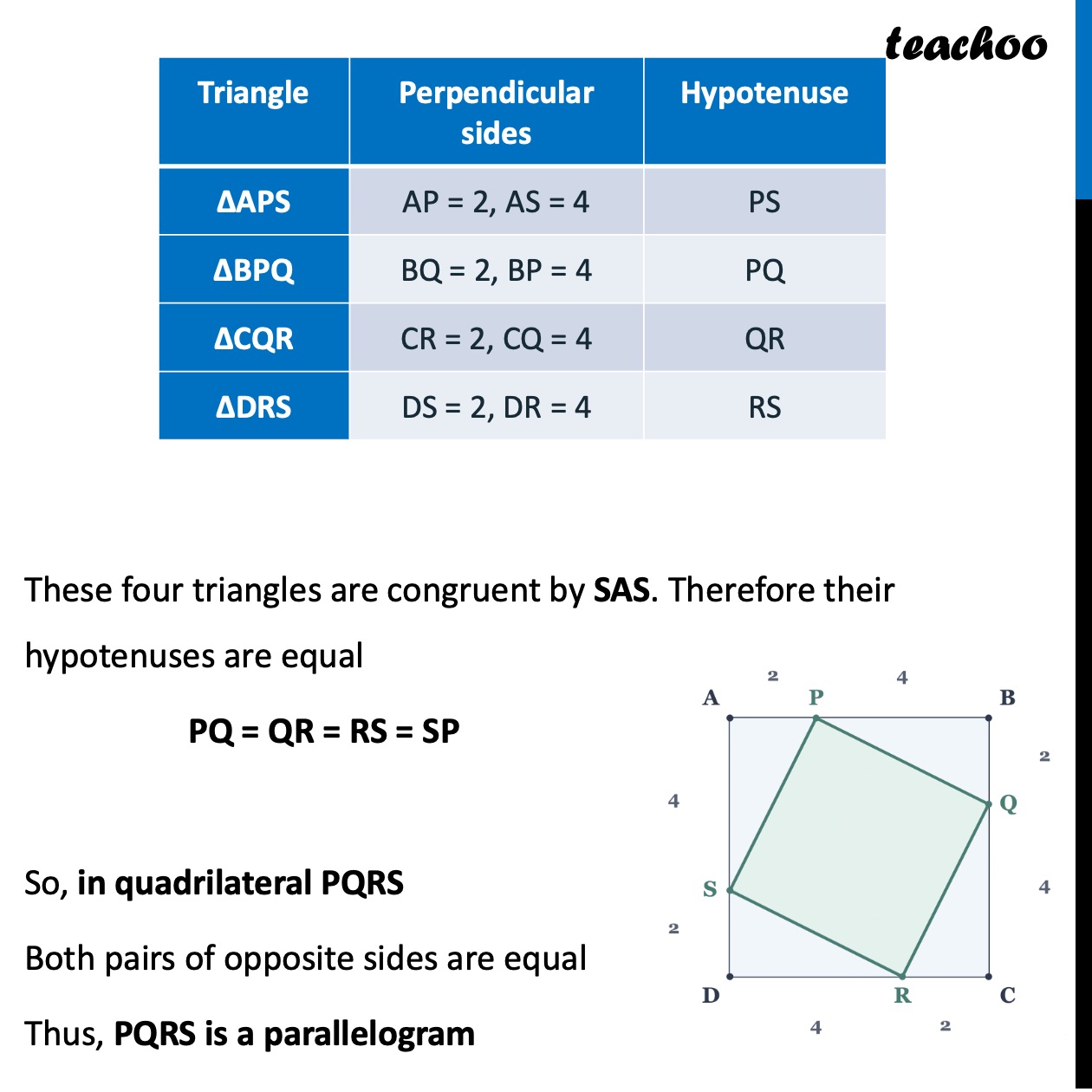
Question 14 Let P, Q, R, S be four points on sides AB, BC, CD and DA respectively of a quadrilateral ABCD. Suppose PQRS is a parallelogram. Must P, Q, R and S be midpoints of the respective sides? This can be considered a possible converse question to Theorem 9. We don’t know if this is true or not So, to check it, we take an example Start with a square of side 6 cm Choose P, Q, R, S so that AP = BQ = CR = DS = 2 cm. The remaining portions are all 4 cm. So, our figure looks like We prove that PQRS is a parallelogram even if P, Q, R, S are not mid-points Comparing the four corner triangles Four corner triangles are ∆ APS, ∆ BPQ, ∆ CQR, ∆ DRS Every corner triangle has perpendicular sides of lengths 2 cm and 4 cm and included angle 90° These four triangles are congruent by SAS. Therefore their hypotenuses are equal PQ = QR = RS = SP So, in quadrilateral PQRS Both pairs of opposite sides are equal Thus, PQRS is a parallelogram Triangle | Perpendicular sides | Hypotenuse ∆APS | AP = 2, AS = 4 | PS ∆BPQ | BQ = 2, BP = 4 | PQ ∆CQR | CR = 2, CQ = 4 | QR ∆DRS | DS = 2, DR = 4 | RS So, PQRS is a parallelogram, but P, Q, R, S are not midpoints. Therefore, the proposed converse is false