End-of-Chapter Exercises

 You are here
Last updated at November 5, 2026 by Teachoo
Transcript
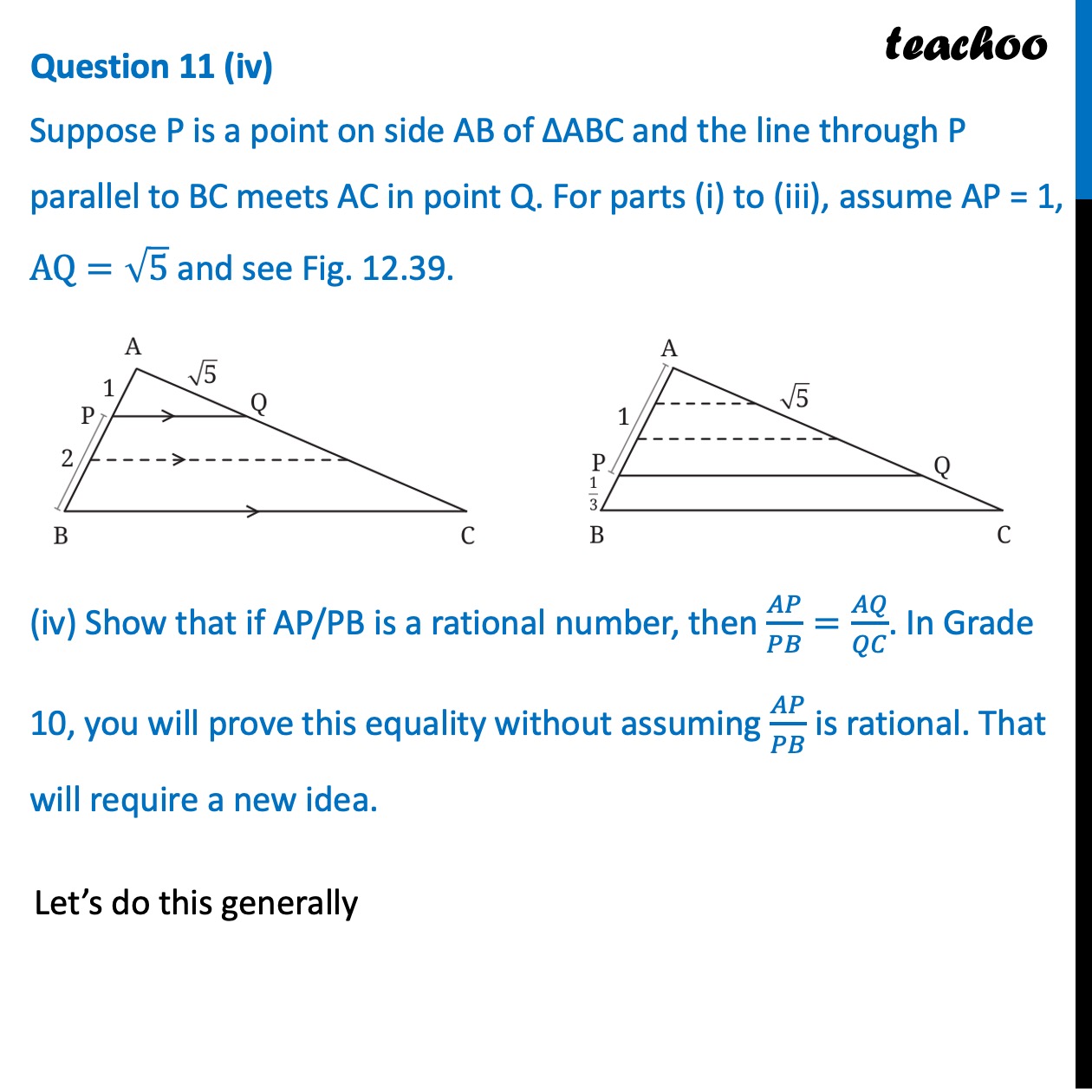
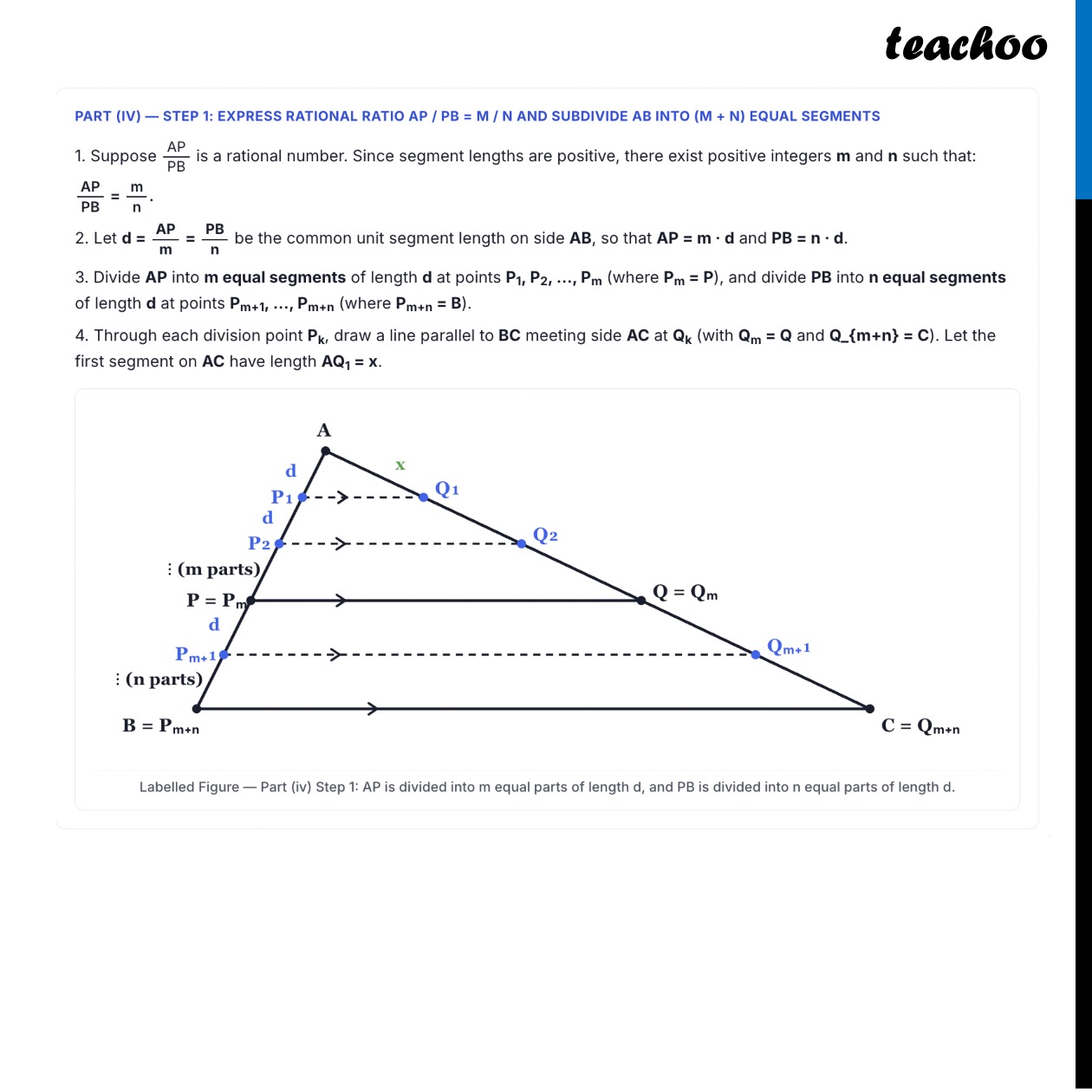
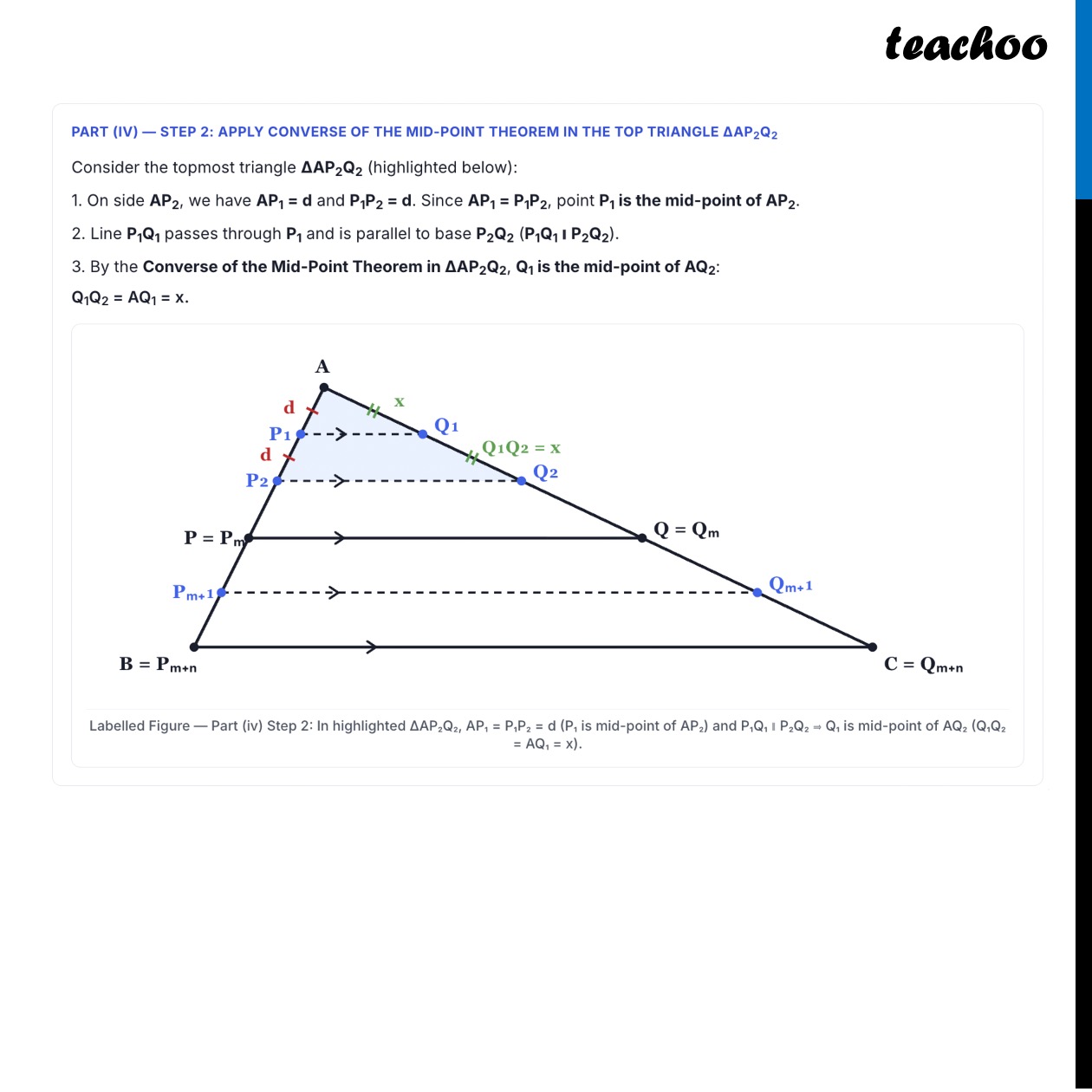
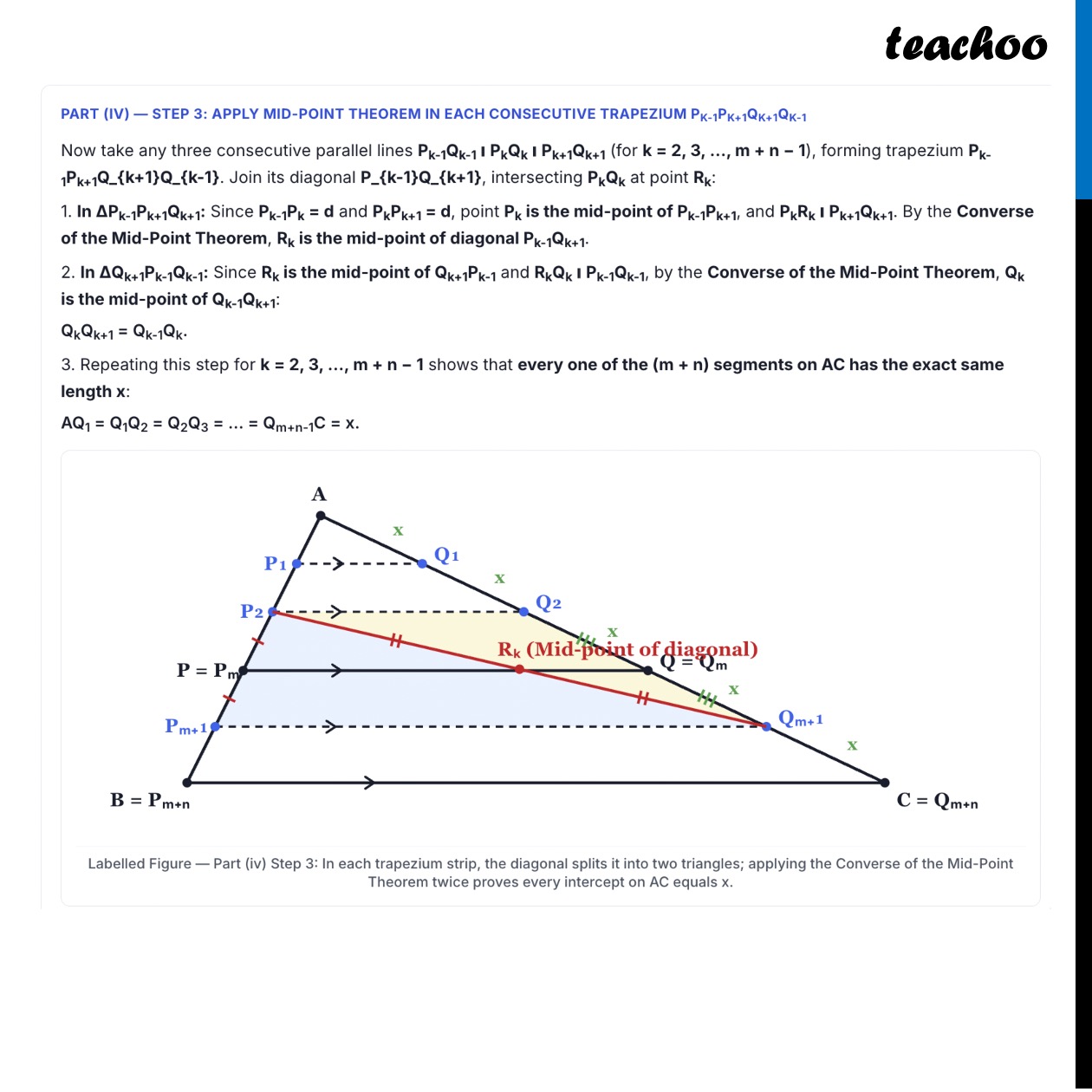
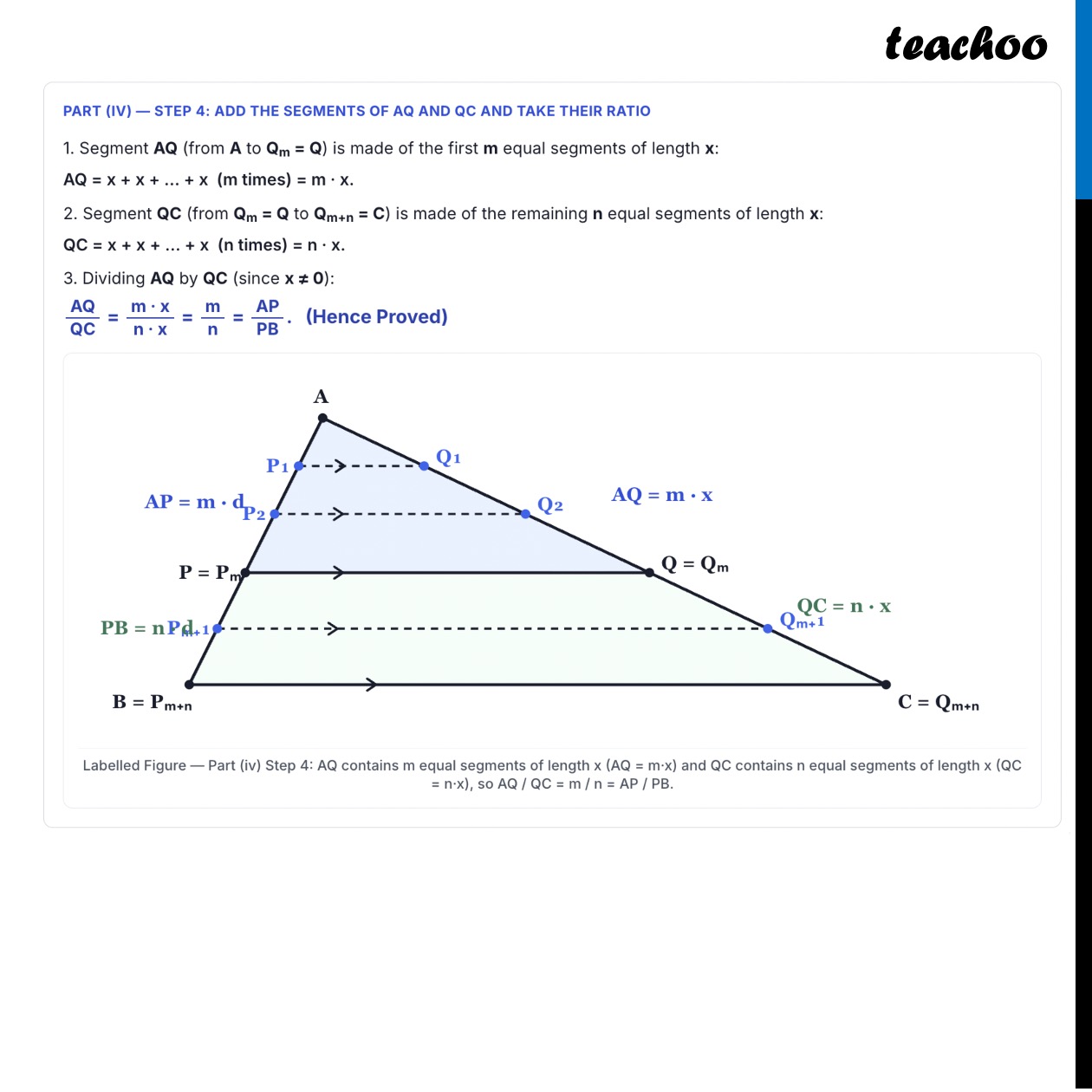
Question 11 (iv) Suppose P is a point on side AB of ∆ABC and the line through P parallel to BC meets AC in point Q. For parts (i) to (iii), assume AP = 1, AQ=sqrt(5) and see Fig. 12.39. (iv) Show that if AP/PB is a rational number, then (𝐴𝑃)/(𝑃𝐵)=(𝐴𝑄)/(𝑄𝐶). In Grade 10, you will prove this equality without assuming (𝐴𝑃)/(𝑃𝐵) is rational. That will require a new idea. Let’s do this generally Fig. 12.39 PART (IV) — STEP 1: EXPRESS RATIONAL RATIO AP / PB = M/ N AND SUBDIVIDE AB INTO (M + N) EQUAL SEGMENTS 1. Suppose — is a rational number. Since segment lengths are positive, there exist positive integers m and n such that: AP m PB On’ 2.Letd= ~ = sis be the common unit segment length on side AB, so that AP = m-d and PB=n-d. 3. Divide AP into m equal segments of length d at points Py, P2, ..., Pm (where Pm = P), and divide PB into n equal segments of length d at points Pm4+1, ..-, Pm+n (where Pm+n = B). 4. Through each division point P,, draw a line parallel to BC meeting side AC at Q, (with Q,, = Q and Q_{m+n} = C). Let the first segment on AC have length AQ, = x. C = Qmen Labelled Figure — Part (iv) Step 1: AP is divided into m equal parts of length d, and PB is divided into n equal parts of length d. PART (IV) — STEP 2: APPLY CONVERSE OF THE MID-POINT THEOREM IN THE TOP TRIANGLE AAP2Q>, Consider the topmost triangle AAP2Q> (highlighted below): 1. On side AP2, we have AP, = d and P,P2 = d. Since AP, = P,P2, point P, is the mid-point of AP». 2. Line P,Q, passes through P, and is parallel to base P2Q> (P;Q,1 P2Q>). 3. By the Converse of the Mid-Point Theorem in AAP2Q2, Q; is the mid-point of AQ2: Q1Q2 = AQ; =x. B = Pimsn C= Qmen Labelled Figure — Part (iv) Step 2: In highlighted AAP,Q., AP, = P,P, = d (P, is mid-point of AP.) and P,Q, | PQ. = Q, is mid-point of AQ, (Q,Q, = AQ, = xX). PART (IV) — STEP 3: APPLY MID-POINT THEOREM IN EACH CONSECUTIVE TRAPEZIUM Px-1P,41QK41Qk-1 Now take any three consecutive parallel lines Py-7Qx-7 1 PK Qx I Px41Qx41 (for k = 2, 3,..., m+n —-1), forming trapezium Px. wP41Q_{k+1}Q_{k-1}. Join its diagonal P_{k-1}Q_{k+1}, intersecting P,Q, at point Rx: 1. In AP,-4PK41QK41: Since Py-4P, = d and P;,,Py4, = d, point P;, is the mid-point of Py_7Py44, and P,.Ry | Px41Q.41. By the Converse of the Mid-Point Theorem, R, is the mid-point of diagonal P,.;Q,44. 2. In AQK47PK-1Qx-1: Since R, is the mid-point of Q,..4P,-7 and Ry, Q, I Px-7Qx-1, by the Converse of the Mid-Point Theorem, Q, is the mid-point of Q,-1Q441: QQ = Qk-1Qk. 3. Repeating this step for k = 2, 3, ..., m +n — 1 shows that every one of the (m + n) segments on AC has the exact same length x: AQ) = Q1Q2 = Q2Q3 =... = Qman-1€ = X. A at of gia nal) B = Pimsn C= Qmen Labelled Figure — Part (iv) Step 3: In each trapezium strip, the diagonal splits it into two triangles; applying the Converse of the Mid-Point Theorem twice proves every intercept on AC equals x. PART (IV) — STEP 4: ADD THE SEGMENTS OF AQ AND QC AND TAKE THEIR RATIO 1. Segment AQ (from A to Qm = Q) is made of the first m equal segments of length x: AQ=xX+xX+...+xX (mtimes) =m- x. 2. Segment QC (from Qm = Q to Qm+n = C) is made of the remaining n equal segments of length x: QC=x+x+...+x (ntimes) =n-x. 3. Dividing AQ by QC (since x # 0): AQ _ m-x _ m _ AP QC n-x n- PB’ (Hence Proved) B= Pmen C = Qmsn Labelled Figure — Part (iv) Step 4: AQ contains m equal segments of length x (AQ = m-x) and QC contains n equal segments of length x (QC = n-x), so AQ /QC = m/n=AP/ PB.