End-of-Chapter Exercises

 You are here
Last updated at November 5, 2026 by Teachoo
Transcript
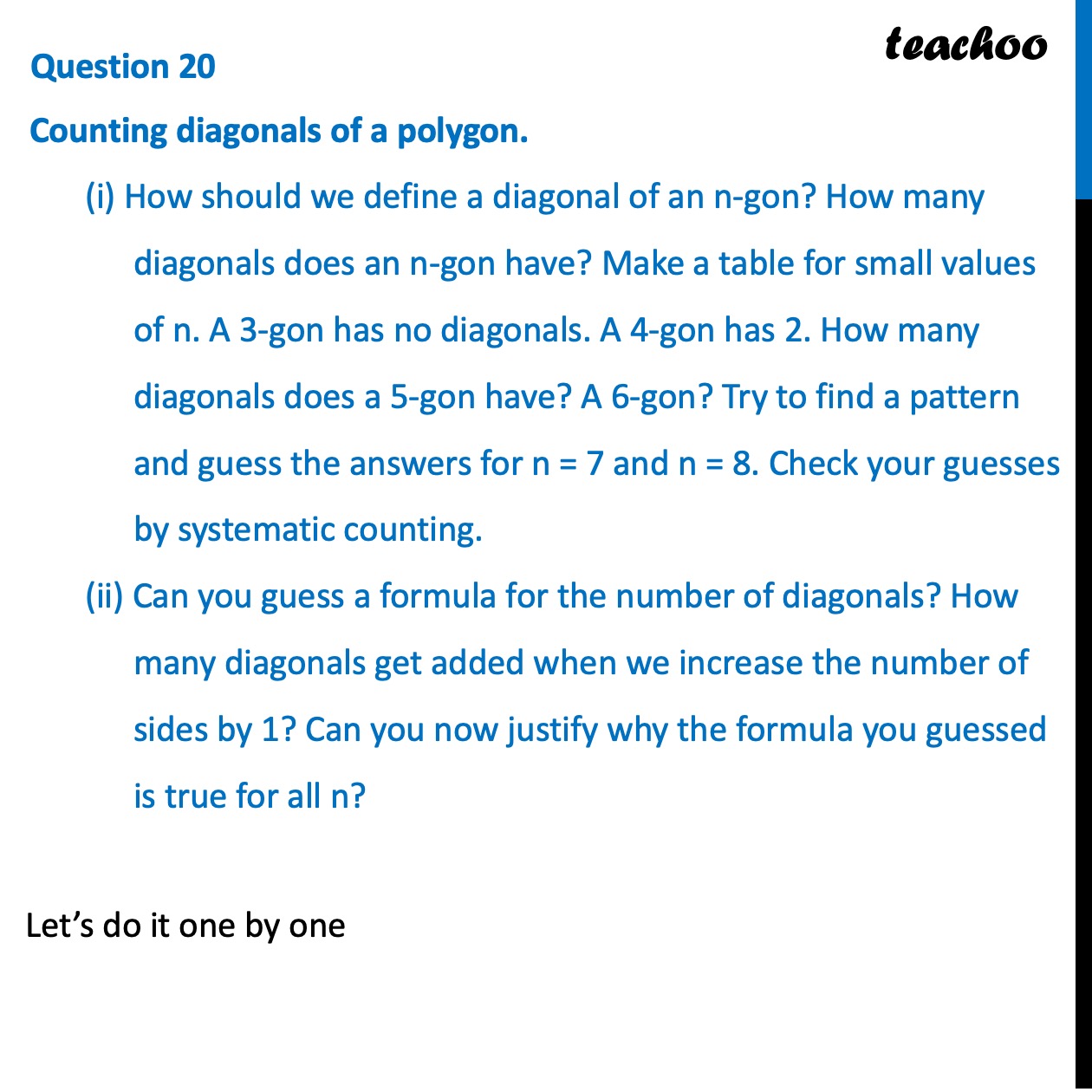
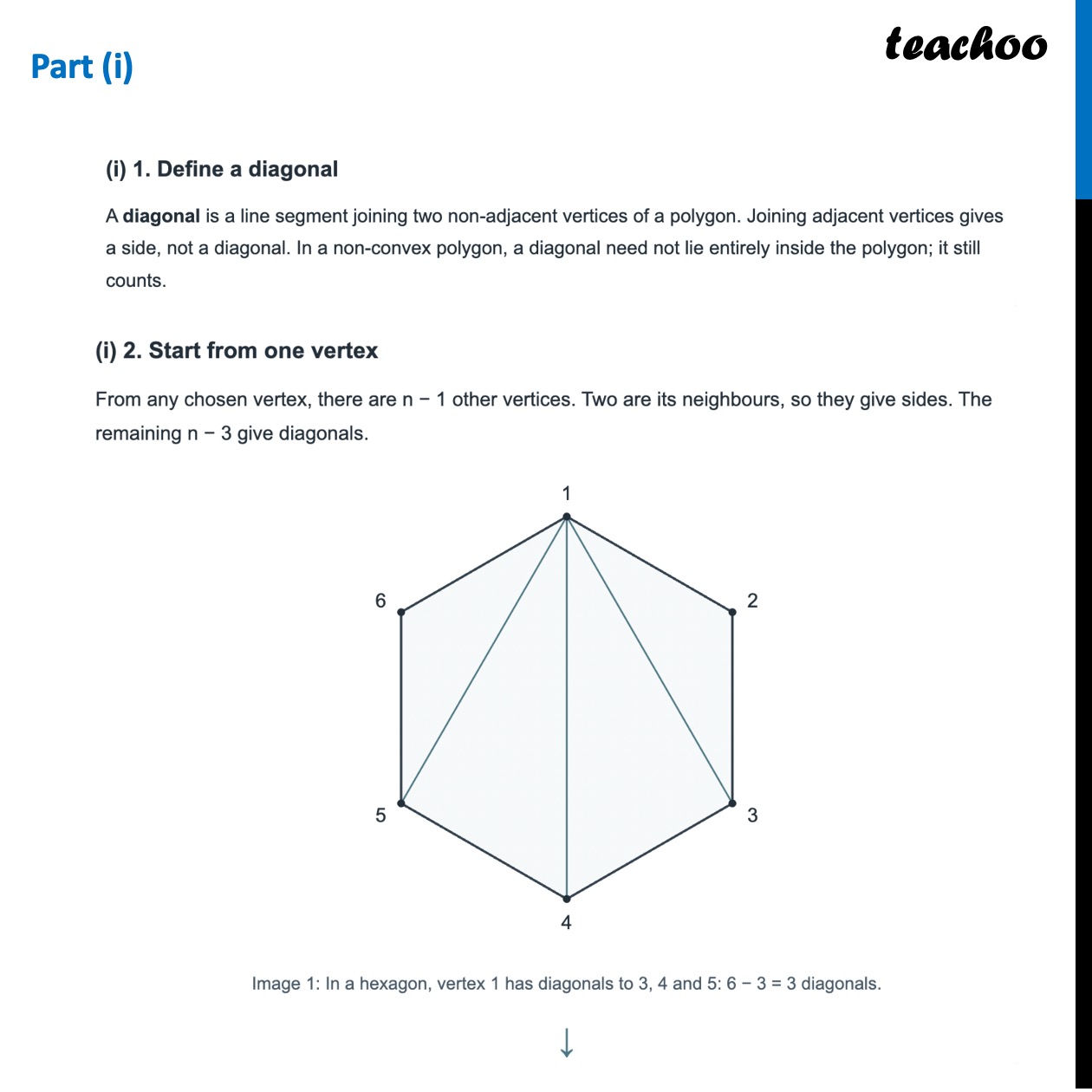
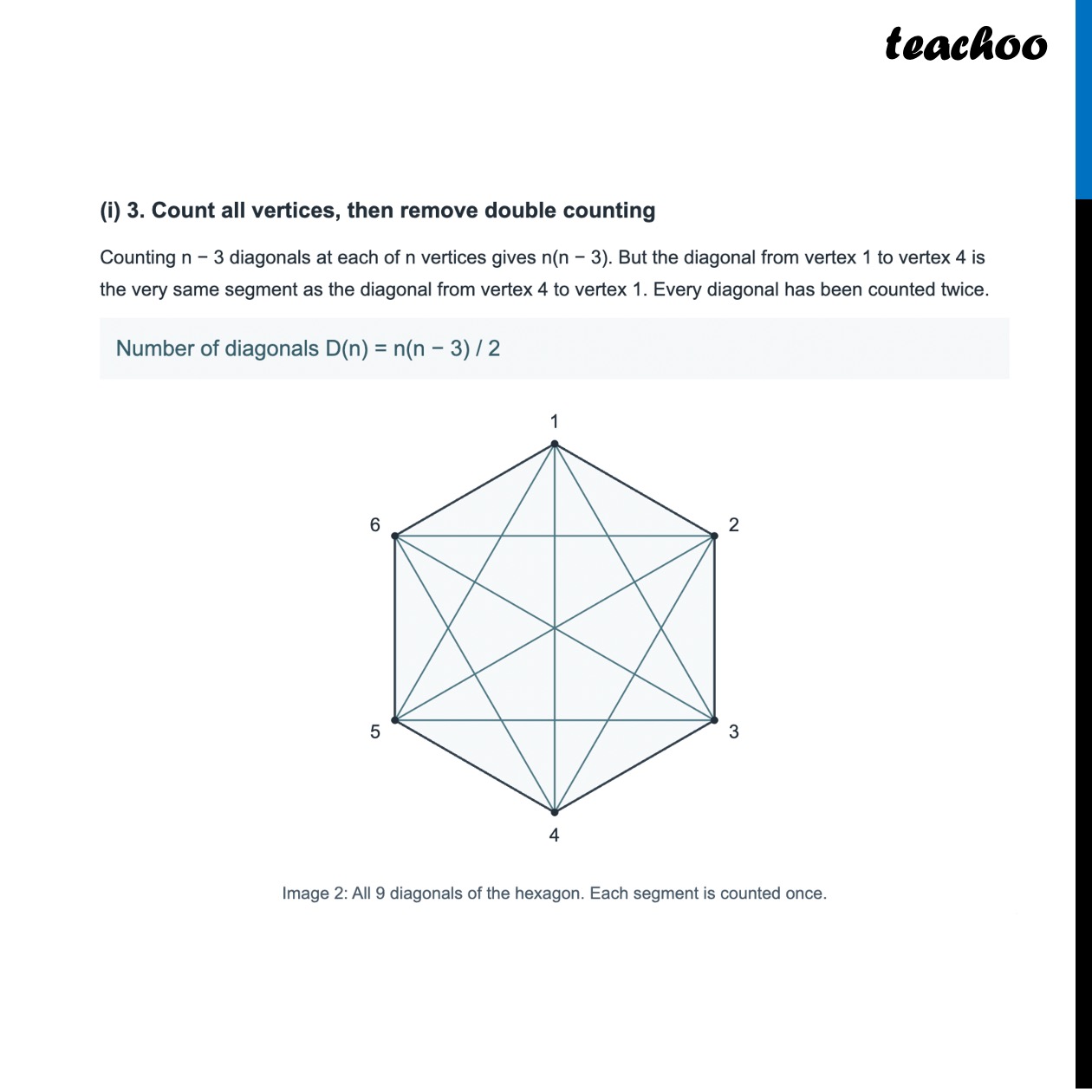
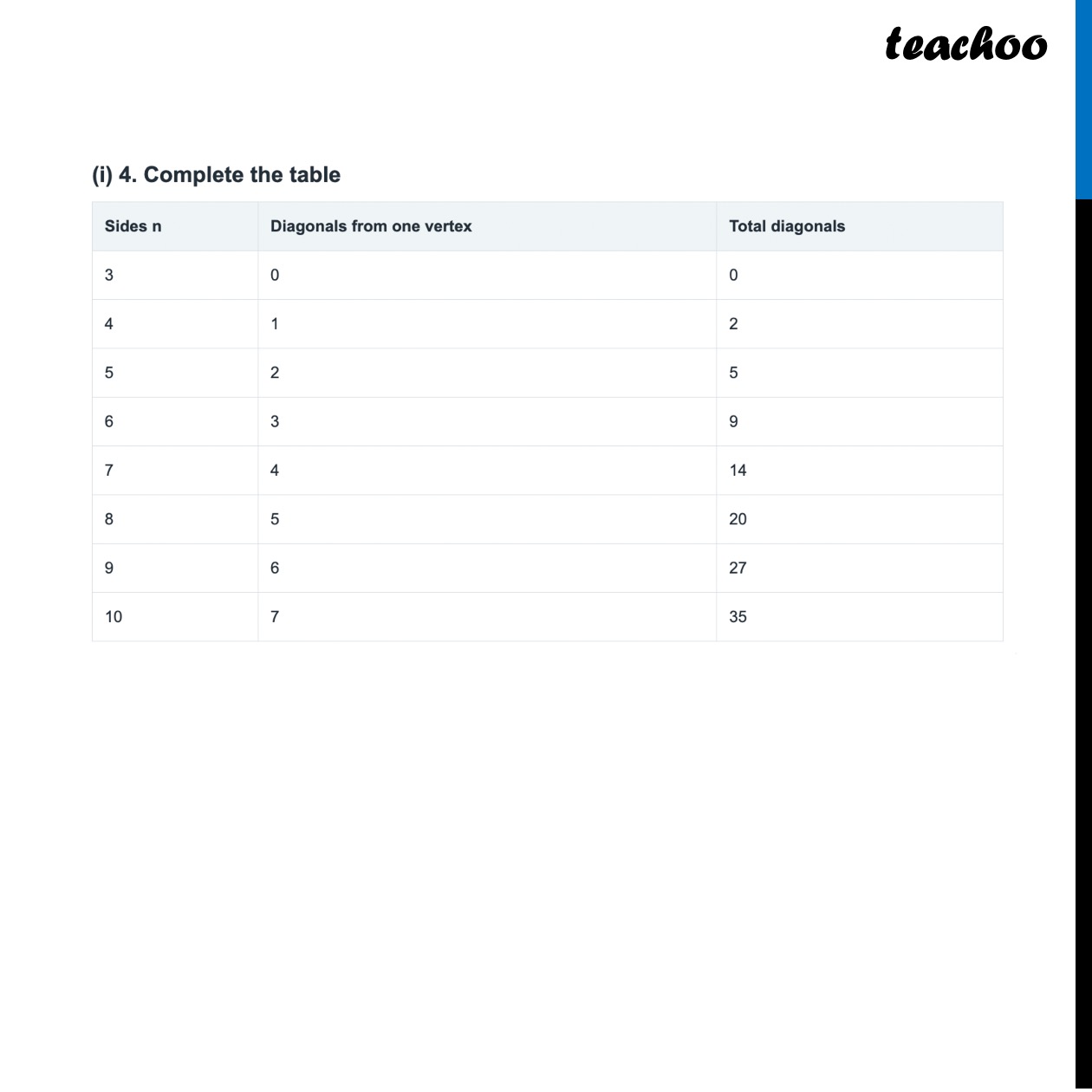
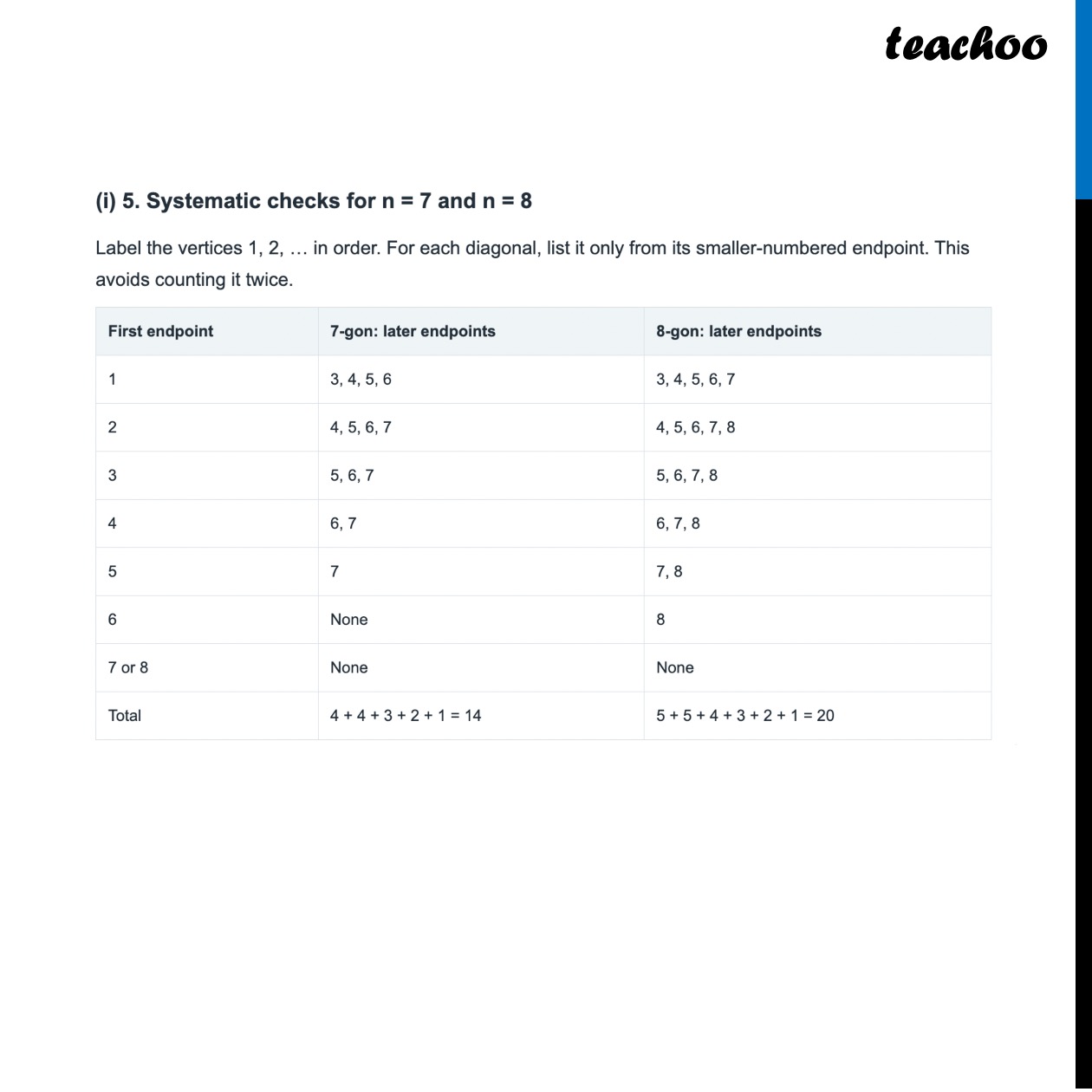
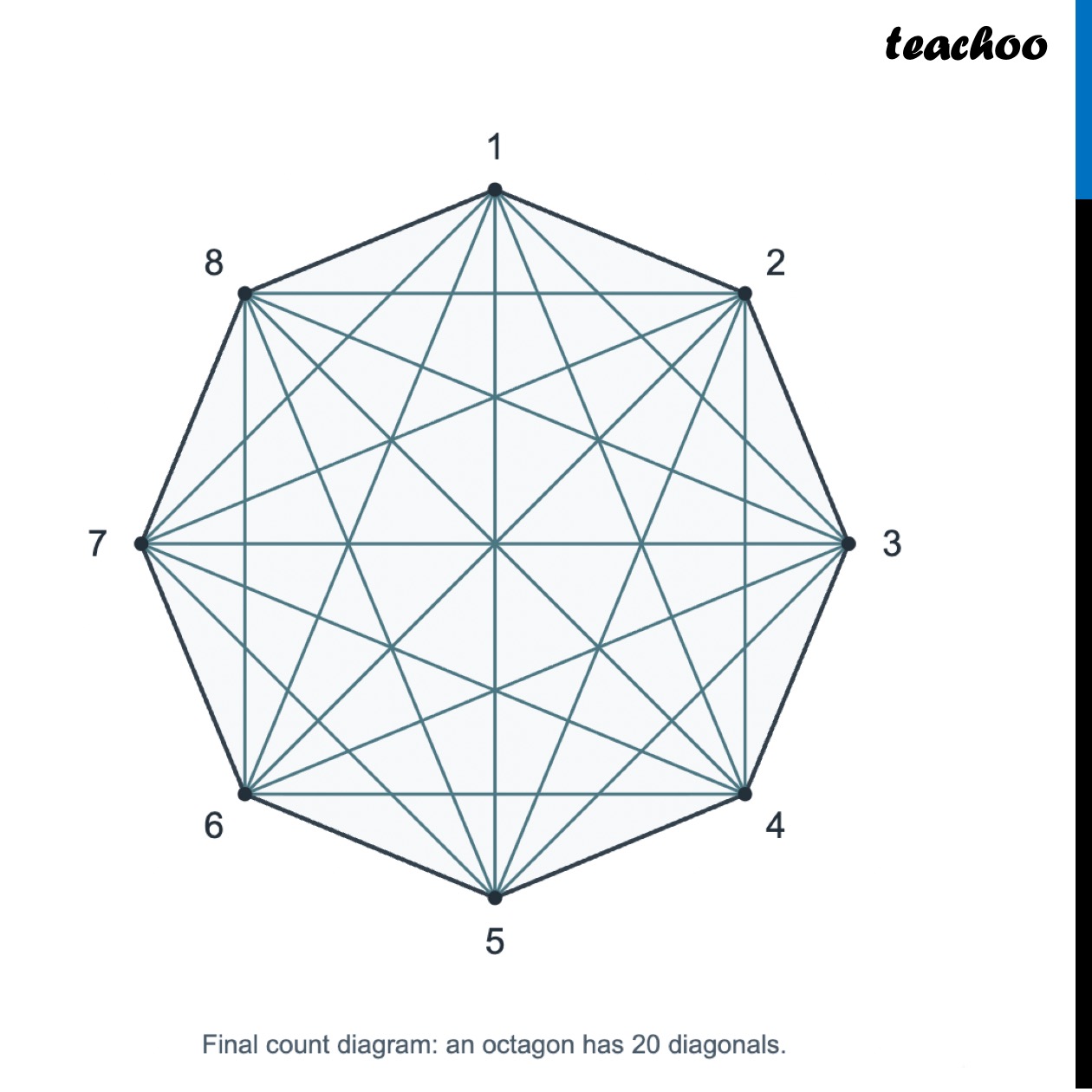
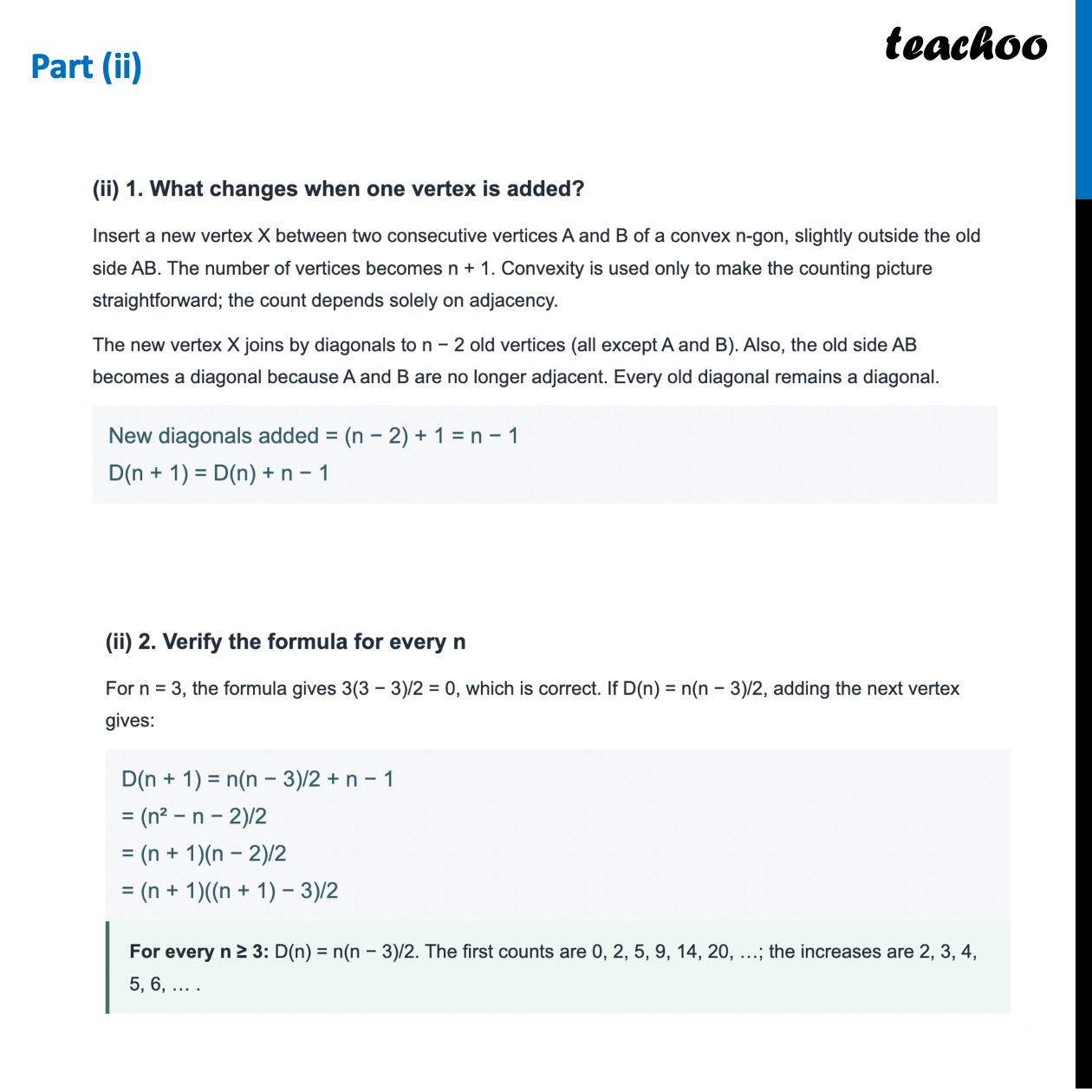
Question 20 Counting diagonals of a polygon. (i) How should we define a diagonal of an n-gon? How many diagonals does an n-gon have? Make a table for small values of n. A 3-gon has no diagonals. A 4-gon has 2. How many diagonals does a 5-gon have? A 6-gon? Try to find a pattern and guess the answers for n = 7 and n = 8. Check your guesses by systematic counting. (ii) Can you guess a formula for the number of diagonals? How many diagonals get added when we increase the number of sides by 1? Can you now justify why the formula you guessed is true for all n? Let’s do it one by one Part (i) (i) 1. Define a diagonal A diagonal is a line segment joining two non-adjacent vertices of a polygon. Joining adjacent vertices gives a side, not a diagonal. In a non-convex polygon, a diagonal need not lie entirely inside the polygon; it still counts. (i) 2. Start from one vertex From any chosen vertex, there are n — 1 other vertices. Two are its neighbours, so they give sides. The remaining n — 3 give diagonals. Image 1: In a hexagon, vertex 1 has diagonals to 3, 4 and 5: 6 - 3 = 3 diagonals. i (i) 3. Count all vertices, then remove double counting Counting n - 3 diagonals at each of n vertices gives n(n — 3). But the diagonal from vertex 1 to vertex 4 is the very same segment as the diagonal from vertex 4 to vertex 1. Every diagonal has been counted twice. Number of diagonals D(n) = n(n - 3) / 2 Image 2: All 9 diagonals of the hexagon. Each segment is counted once. (i) 4. Complete the table Sides n 10 Diagonals from one vertex Total diagonals 20 27 35 (i) 5. Systematic checks for n= 7 and n=8 Label the vertices 1, 2, ... in order. For each diagonal, list it only from its smaller-numbered endpoint. This avoids counting it twice. First endpoint 7-gon: later endpoints 8-gon: later endpoints 1 3,4, 5,6 3, 4, 5, 6, 7 2 4,5,6,7 4, 5,6, 7,8 3 5, 6, 7 5,6, 7,8 4 6,7 6, 7,8 5 7 7,8 6 None 8 7or8 None None Total 4+4+3+2+1=14 5+5+4+3+2+1=20 Final count diagram: an octagon has 20 diagonals. Part (ii) (ii) 1. What changes when one vertex is added? Insert a new vertex X between two consecutive vertices A and B of a convex n-gon, slightly outside the old side AB. The number of vertices becomes n + 1. Convexity is used only to make the counting picture straightforward; the count depends solely on adjacency. The new vertex X joins by diagonals to n - 2 old vertices (all except A and B). Also, the old side AB becomes a diagonal because A and B are no longer adjacent. Every old diagonal remains a diagonal. New diagonals added = (n- 2)+1=n-1 D(n + 1) = D(n)+n- 1 (ii) 2. Verify the formula for every n For n = 3, the formula gives 3(3 — 3)/2 = 0, which is correct. If D(n) = n(n — 3)/2, adding the next vertex gives: D(n + 1)=n(n- 3)/2+n- 1 =(n?-n-2)/2 =(n+1)(n - 2)/2 =(n+1)((n+1)- 3)/2 For every n 2 3: D(n) = n(n — 3)/2. The first counts are 0, 2, 5, 9, 14, 20, ...; the increases are 2, 3, 4,