End-of-Chapter Exercises

 You are here
Last updated at November 5, 2026 by Teachoo
Transcript
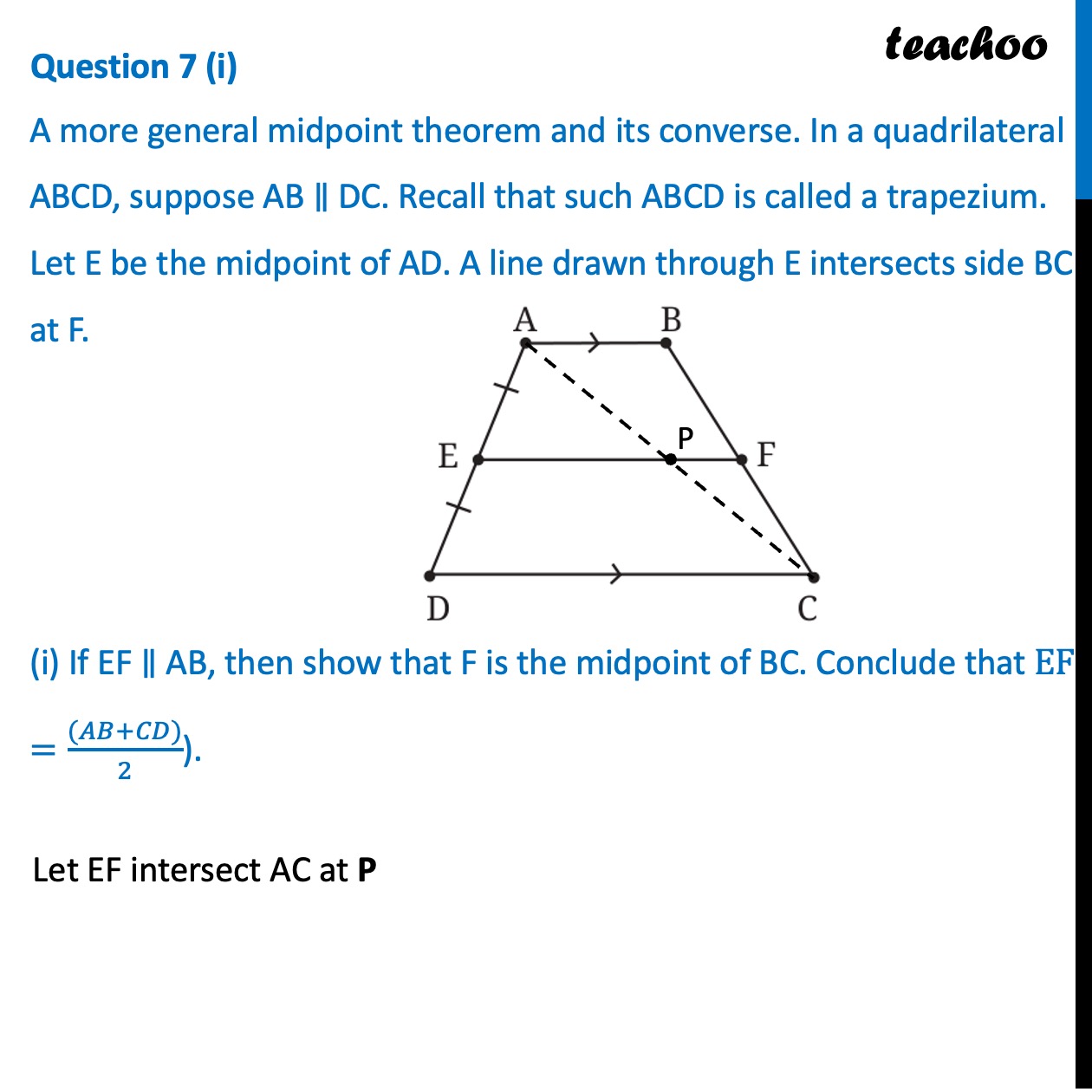
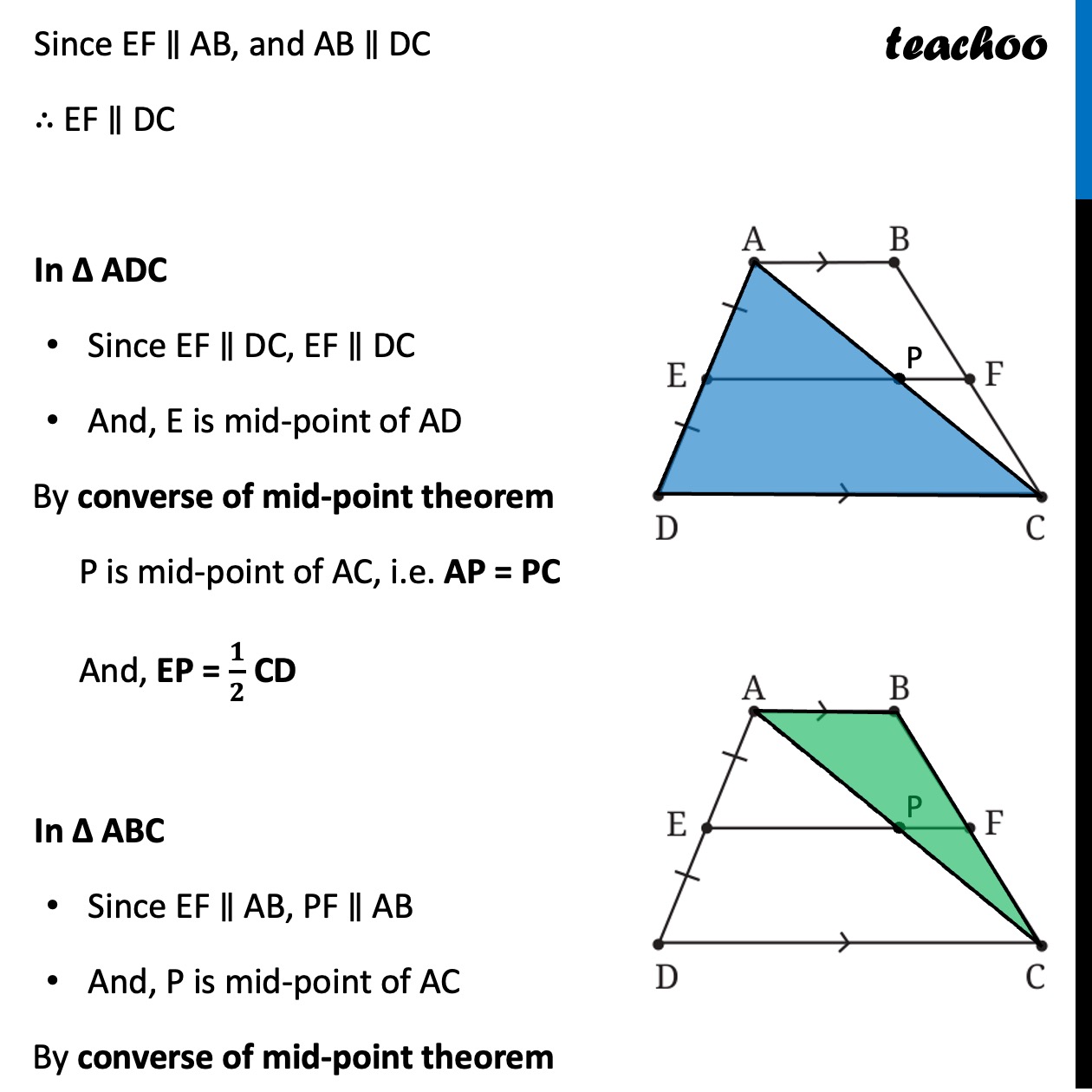
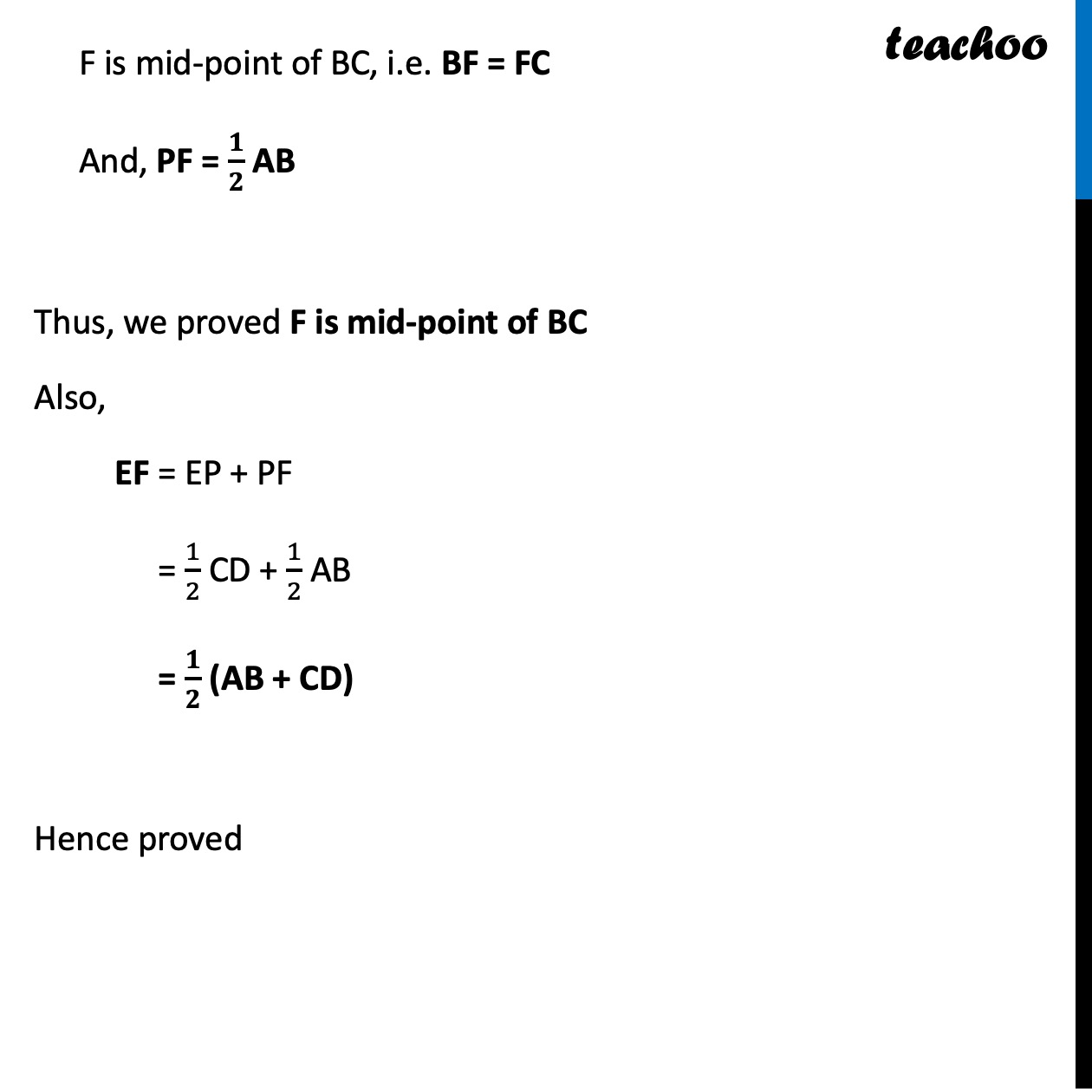
Question 7 (i) A more general midpoint theorem and its converse. In a quadrilateral ABCD, suppose AB ∥ DC. Recall that such ABCD is called a trapezium. Let E be the midpoint of AD. A line drawn through E intersects side BC at F. (i) If EF ∥ AB, then show that F is the midpoint of BC. Conclude that EF=((𝐴𝐵+𝐶𝐷))/(2)(. Let EF intersect AC at P P Fig, 12.36 Since EF ∥ AB, and AB ∥ DC ∴ EF ∥ DC In ∆ ADC Since EF ∥ DC, EF ∥ DC And, E is mid-point of AD By converse of mid-point theorem P is mid-point of AC, i.e. AP = PC And, EP = (𝟏)/(𝟐) CD In ∆ ABC Since EF ∥ AB, PF ∥ AB And, P is mid-point of AC By converse of mid-point theorem F is mid-point of BC, i.e. BF = FC And, PF = (𝟏)/(𝟐) AB Thus, we proved F is mid-point of BC Also, EF = EP + PF = (1)/(2) CD + (1)/(2) AB = (𝟏)/(𝟐) (AB + CD) Hence proved P P Fig, 12.36 F is mid-point of BC, i.e. BF = FC And, PF = (𝟏)/(𝟐) AB Thus, we proved F is mid-point of BC Also, EF = EP + PF = (1)/(2) CD + (1)/(2) AB = (𝟏)/(𝟐) (AB + CD) Hence proved
