End-of-Chapter Exercises

 You are here
Last updated at November 5, 2026 by Teachoo
Transcript
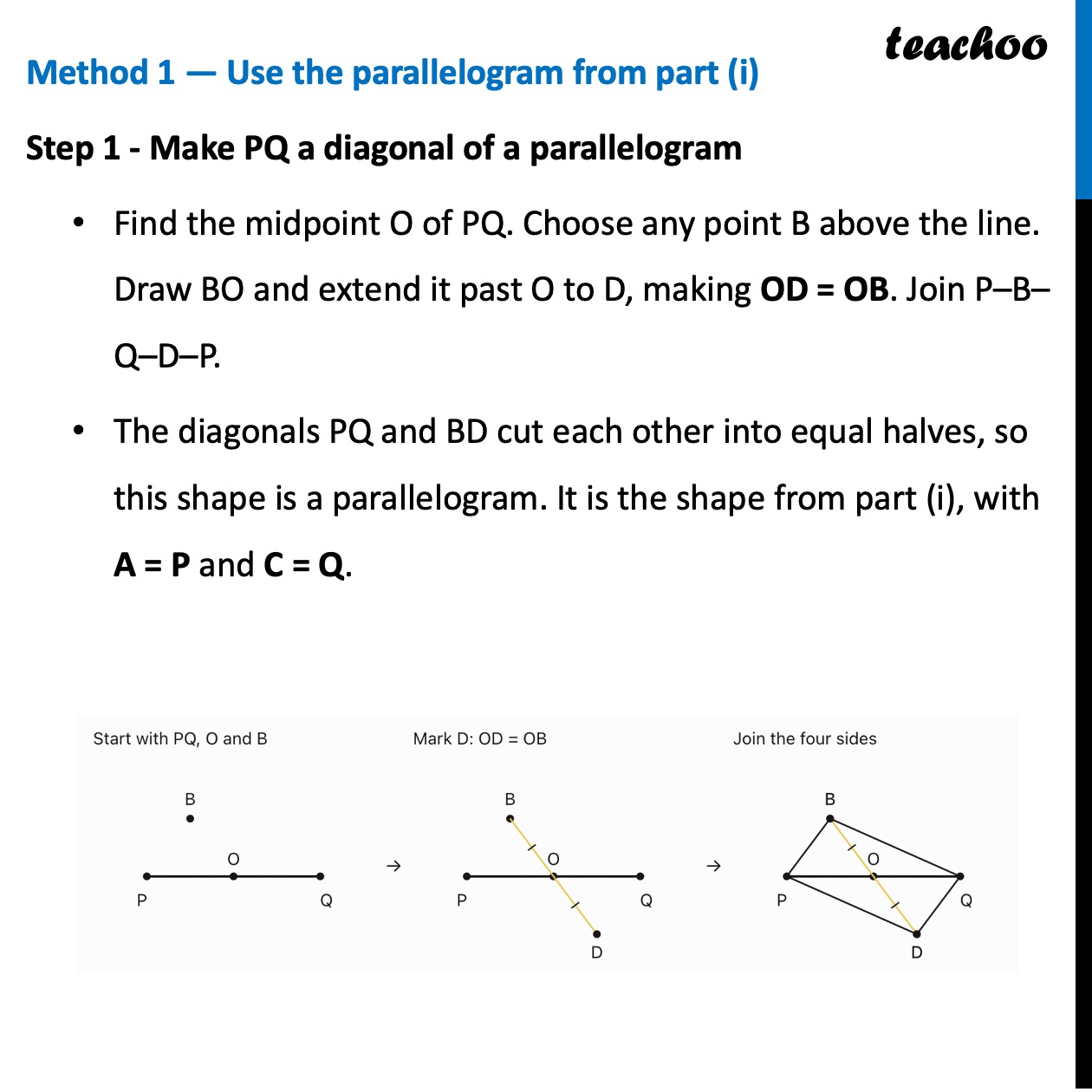
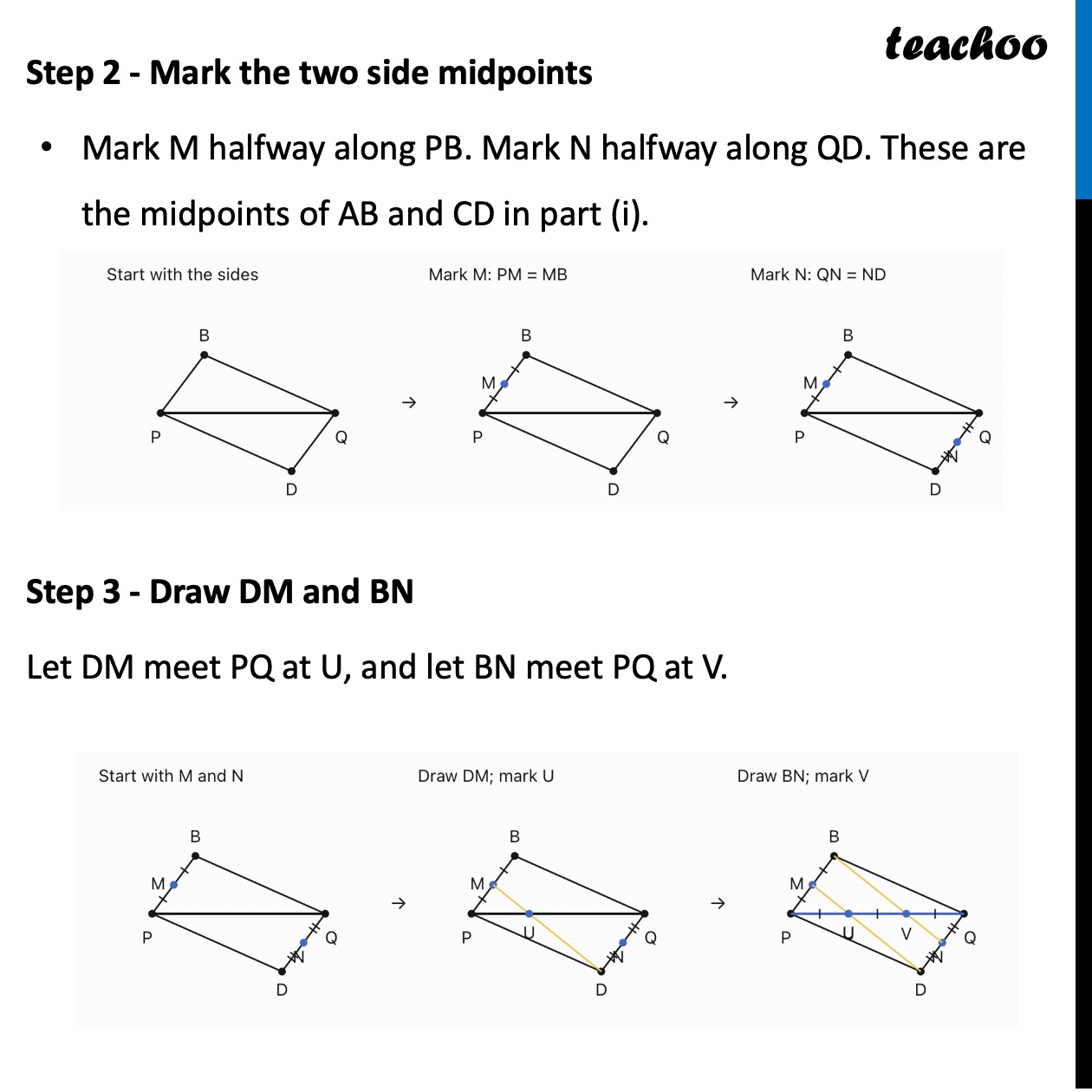
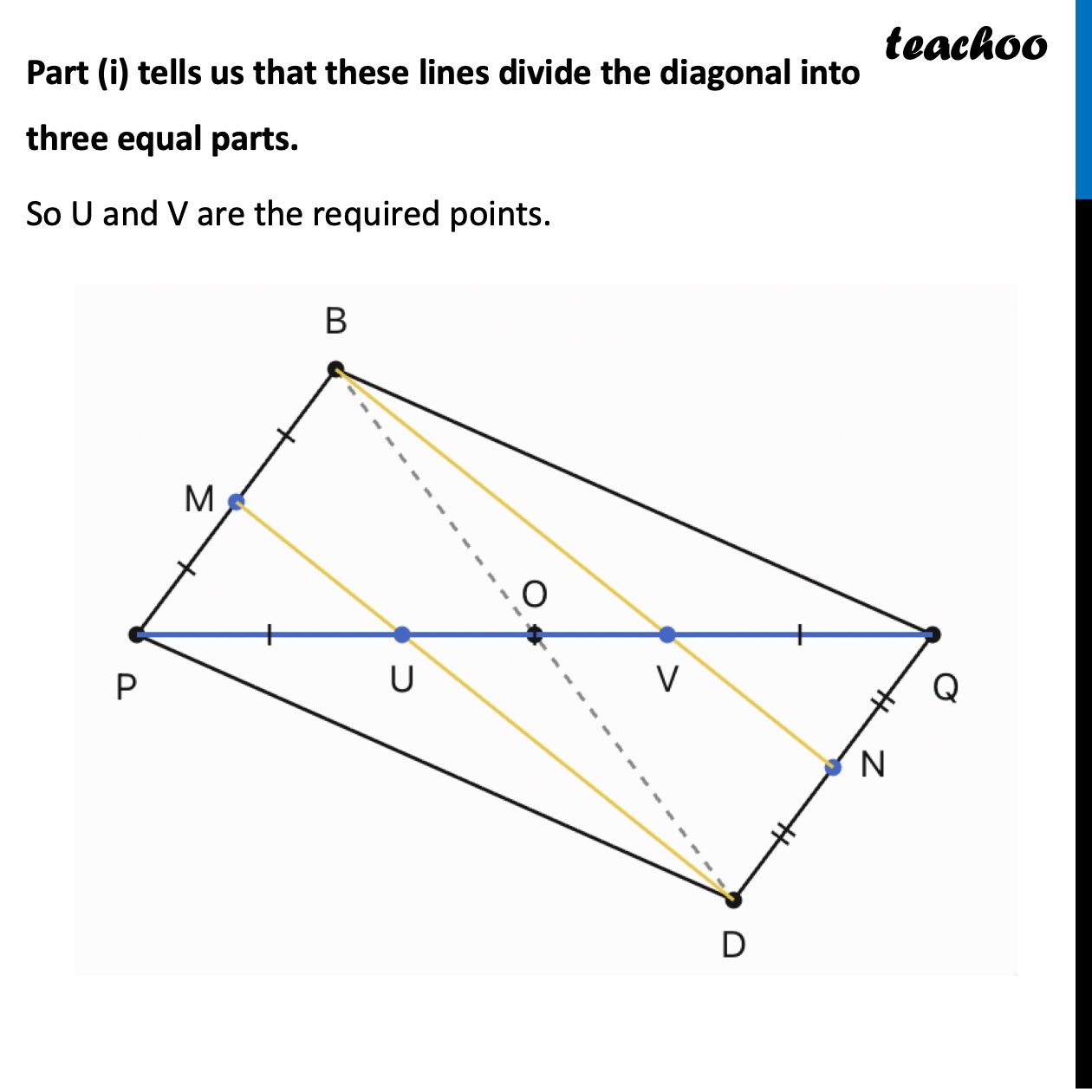
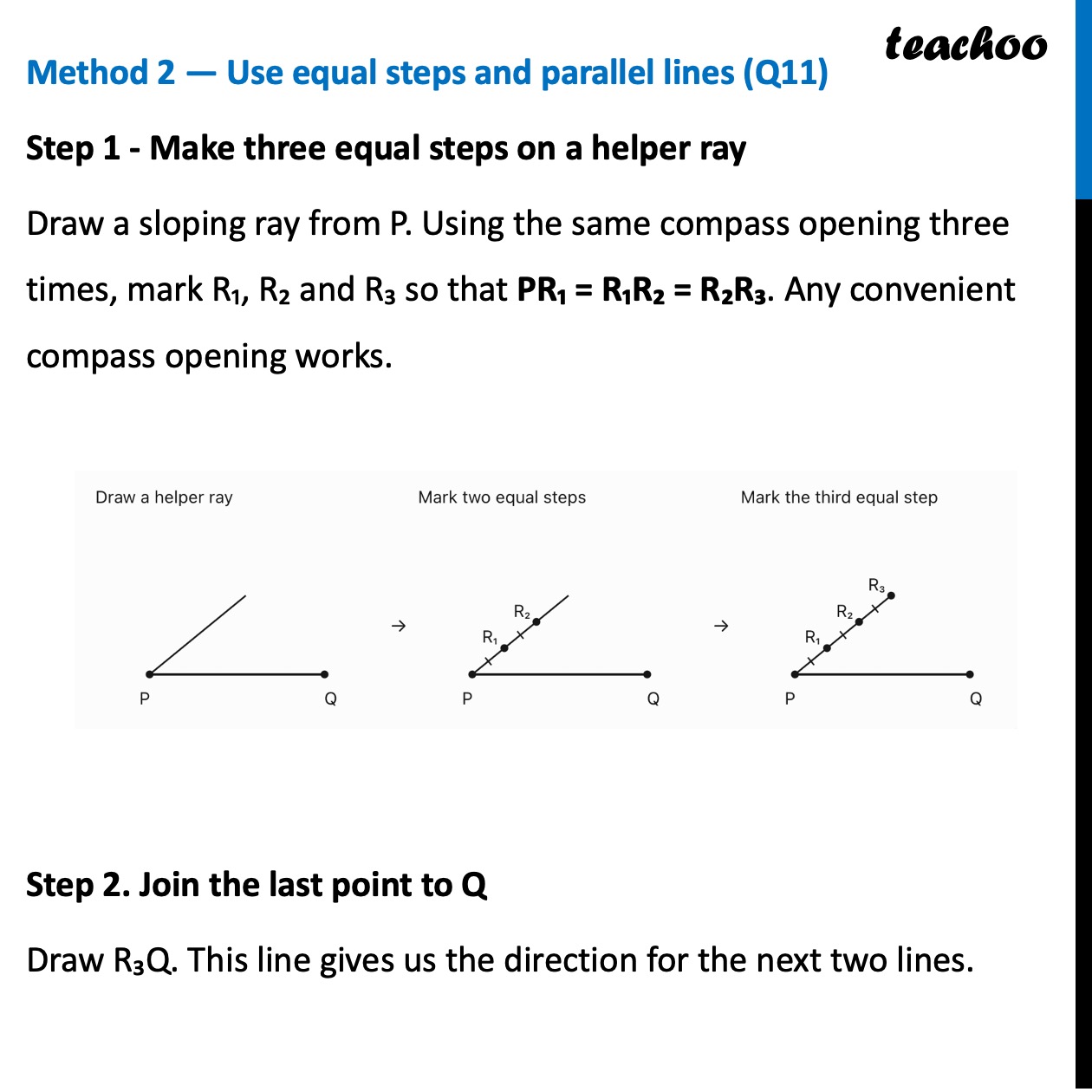
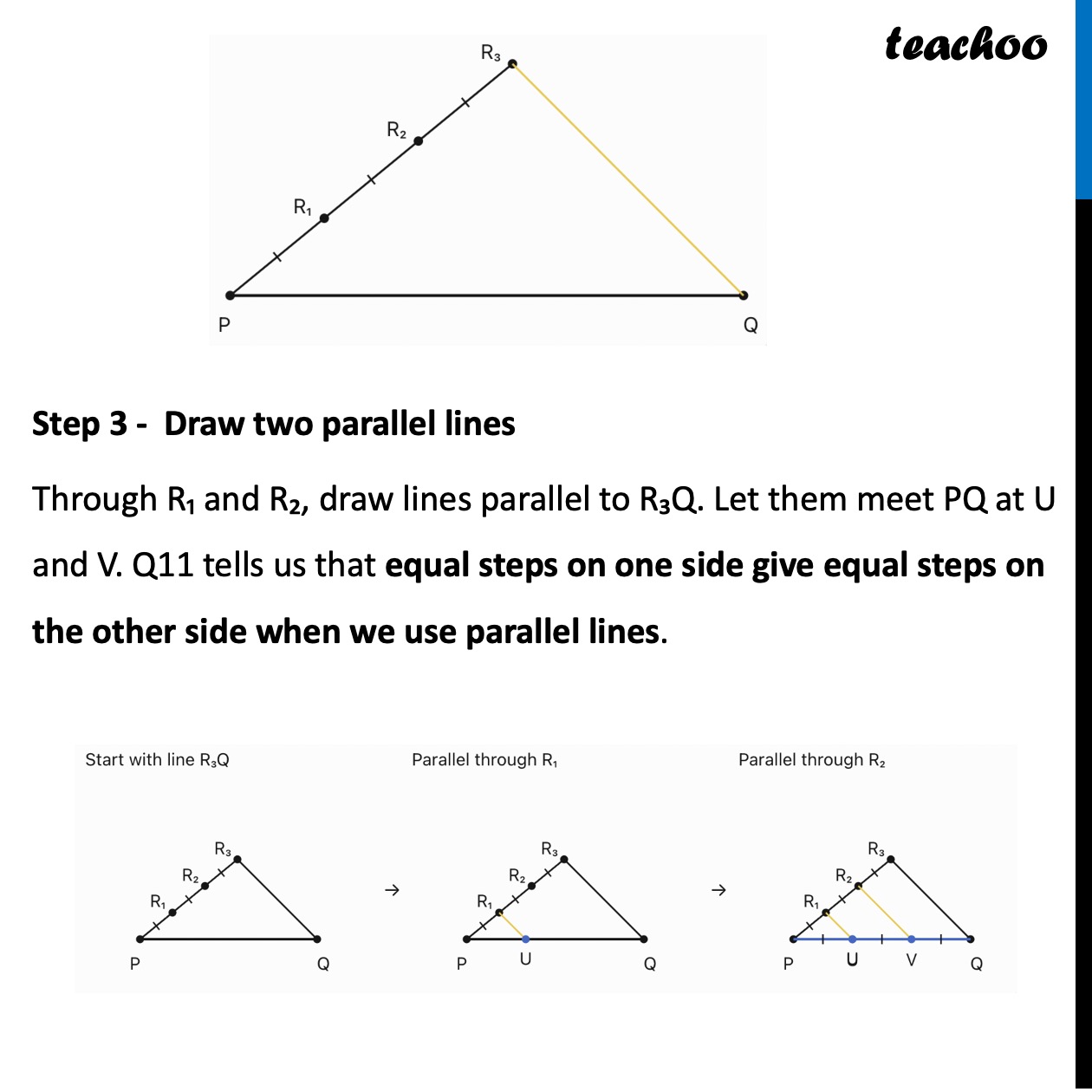
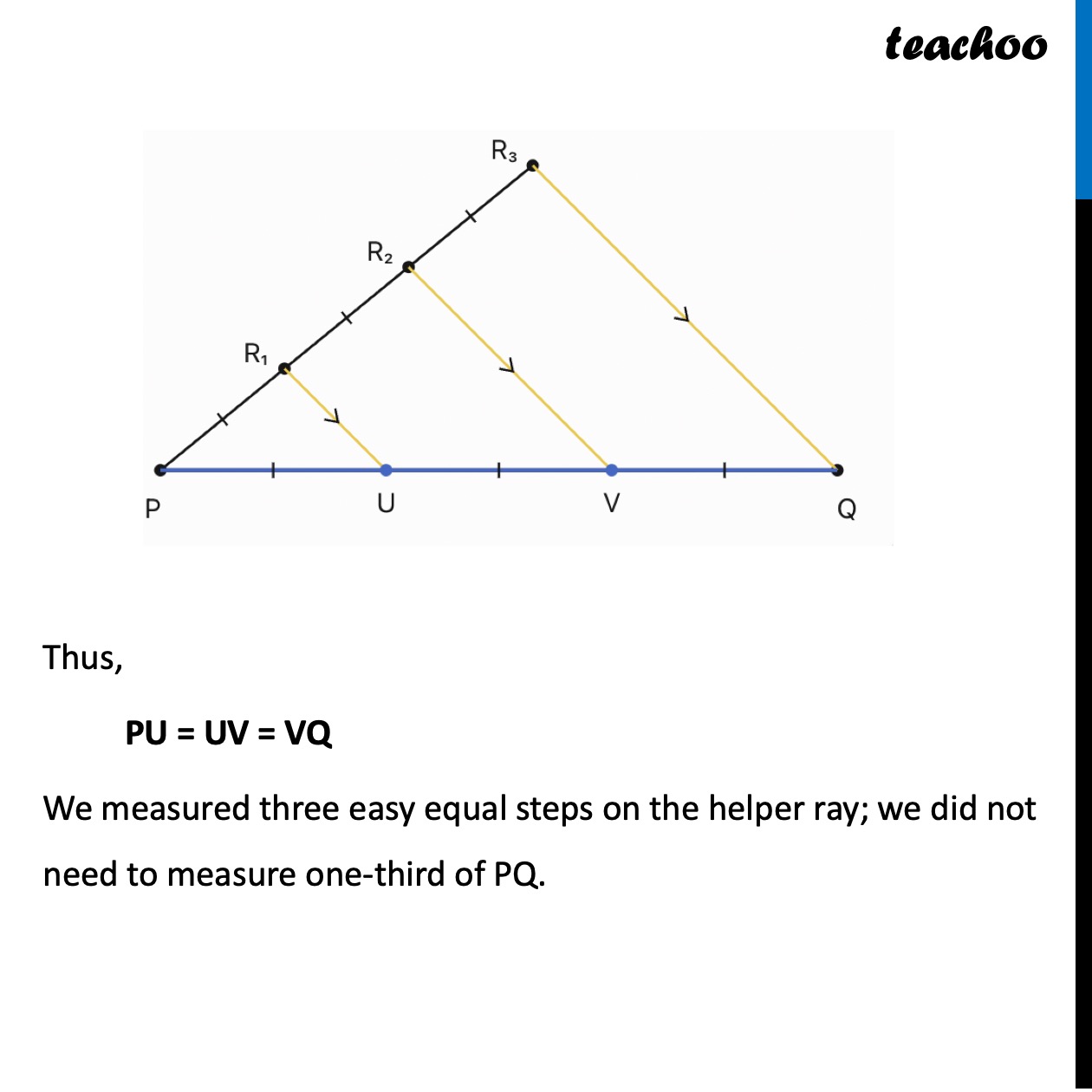
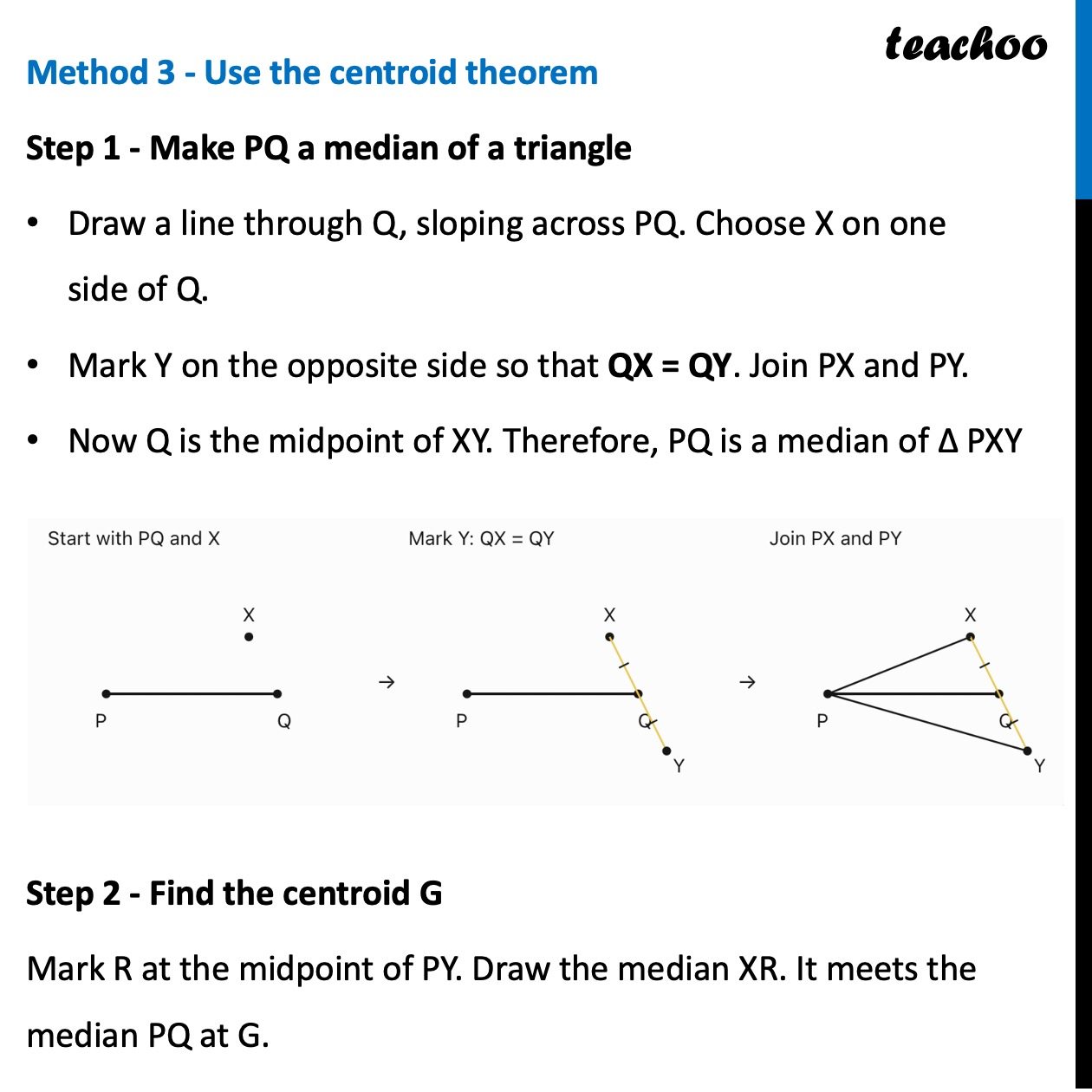
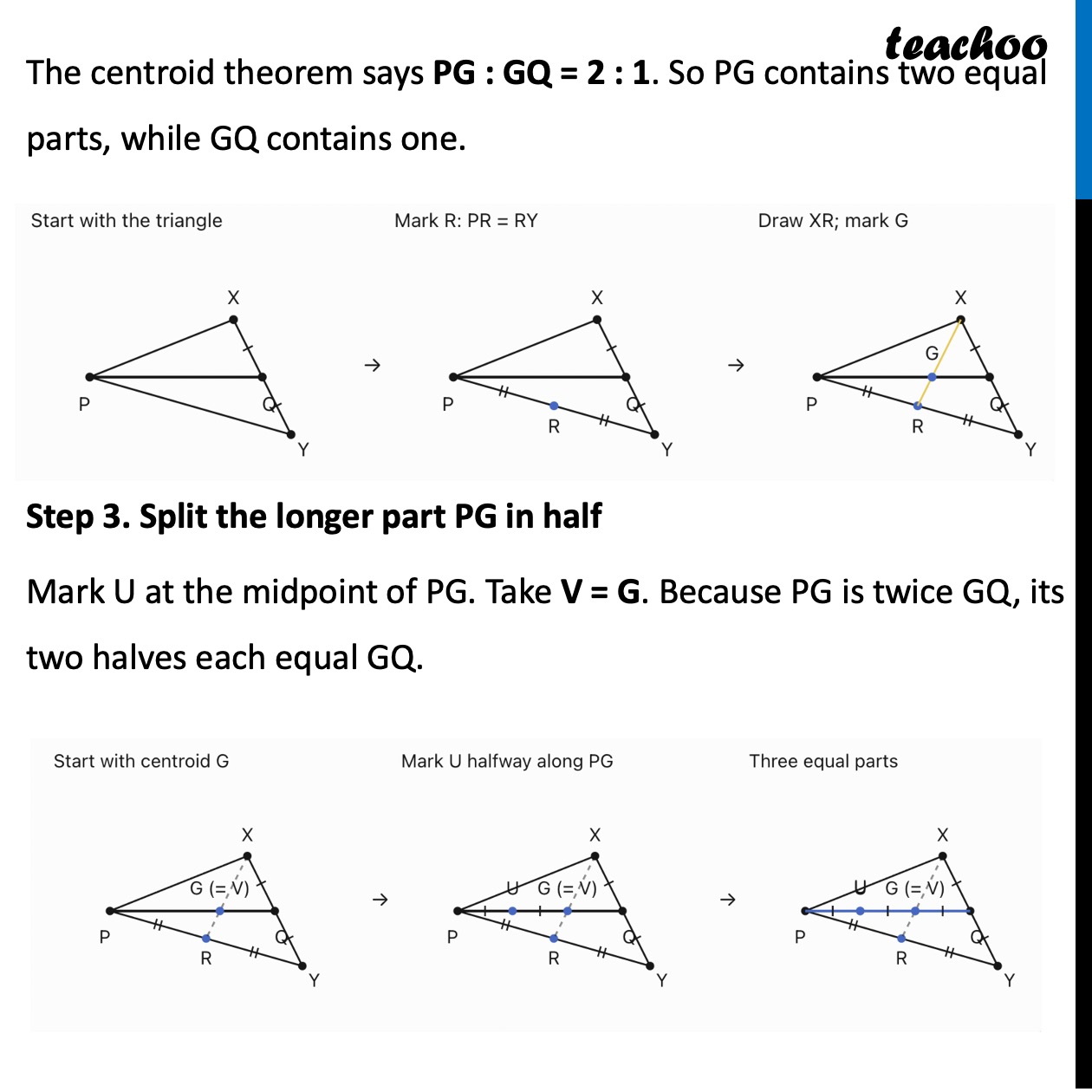
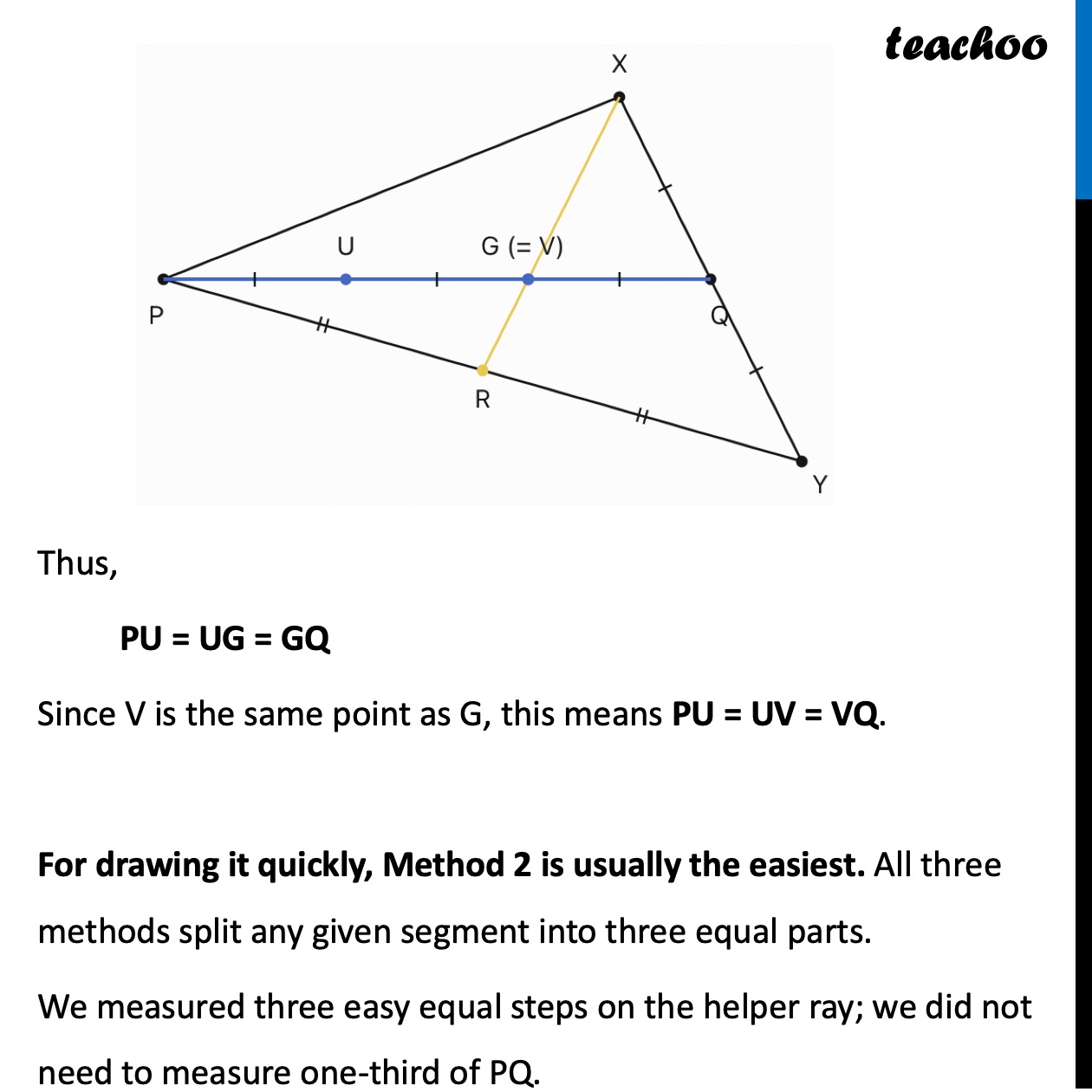
Question 12 (ii) Use part (i) to find a procedure to trisect any given segment PQ. Find two other ways to trisect PQ, one using Exercise 11 above and a third using the Centroid Theorem. We do using 3 methods Method 1 - Parallelogram Diagonal Make PQ the diagonal of a parallelogram PBQD and connect opposite midpoints DM and BN Method 2 - 3 Equal Parts on a Ray (Question 11) Mark 3 equal segments PA₁ = A₁A₂ = A₂A₃ on a ray from P and draw parallels to A₃Q Method 3 – Centroid Theorem (2 : 1 Median Intersection) Make PQ a median of ΔPBC, intersect it with median CM at centroid Y, then bisect PY. Method 1 — Use the parallelogram from part (i) Step 1. Make PQ a diagonal of a parallelogram Find the midpoint O of PQ. Choose any point B above the line. Draw BO and extend it past O to D, making OD = OB. Join P–B–Q–D–P. The diagonals PQ and BD cut each other into equal halves, so this shape is a parallelogram. It is the shape from part (i), with A = P and C = Q. Method 1 — Use the parallelogram from part (i) Step 1 - Make PQ a diagonal of a parallelogram Find the midpoint O of PQ. Choose any point B above the line. Draw BO and extend it past O to D, making OD = OB. Join P–B–Q–D–P. The diagonals PQ and BD cut each other into equal halves, so this shape is a parallelogram. It is the shape from part (i), with A = P and C = Q. Start with PQ, O and B Mark D: OD = OB Join the four sides Step 2 - Mark the two side midpoints Mark M halfway along PB. Mark N halfway along QD. These are the midpoints of AB and CD in part (i). Step 3 - Draw DM and BN Let DM meet PQ at U, and let BN meet PQ at V. Start with the sides Mark M: PM = MB Mark N: QN = ND Start with M and N Draw DM; mark U Draw BN; mark V Part (i) tells us that these lines divide the diagonal into three equal parts. So U and V are the required points. Method 2 — Use equal steps and parallel lines (Q11) Step 1 - Make three equal steps on a helper ray Draw a sloping ray from P. Using the same compass opening three times, mark R₁, R₂ and R₃ so that PR₁ = R₁R₂ = R₂R₃. Any convenient compass opening works. Step 2. Join the last point to Q Draw R₃Q. This line gives us the direction for the next two lines. Draw a helper ray Mark two equal steps Mark the third equal step R, R2 Step 3 - Draw two parallel lines Through R₁ and R₂, draw lines parallel to R₃Q. Let them meet PQ at U and V. Q11 tells us that equal steps on one side give equal steps on the other side when we use parallel lines. Ri Ra Start with line R;Q Parallel through R, Parallel through R, R, R2 Ro R, R, R, Thus, PU = UV = VQ We measured three easy equal steps on the helper ray; we did not need to measure one-third of PQ. Rs Ra Ri Method 3 - Use the centroid theorem Step 1 - Make PQ a median of a triangle Draw a line through Q, sloping across PQ. Choose X on one side of Q. Mark Y on the opposite side so that QX = QY. Join PX and PY. Now Q is the midpoint of XY. Therefore, PQ is a median of ∆ PXY Step 2 - Find the centroid G Mark R at the midpoint of PY. Draw the median XR. It meets the median PQ at G. The centroid theorem says PG : GQ = 2 : 1. So PG contains two equal parts, while GQ contains one. Start with PQ and X Mark Y: QX = QY Join PX and PY The centroid theorem says PG : GQ = 2 : 1. So PG contains two equal parts, while GQ contains one. Step 3. Split the longer part PG in half Mark U at the midpoint of PG. Take V = G. Because PG is twice GQ, its two halves each equal GQ. Start with the triangle Mark R: PR = RY Draw XR; mark G Start with centroid G Mark U halfway along PG Three equal parts Thus, PU = UG = GQ Since V is the same point as G, this means PU = UV = VQ. For drawing it quickly, Method 2 is usually the easiest. All three methods split any given segment into three equal parts. We measured three easy equal steps on the helper ray; we did not need to measure one-third of PQ. Pak
