End-of-Chapter Exercises

 You are here
Last updated at November 5, 2026 by Teachoo
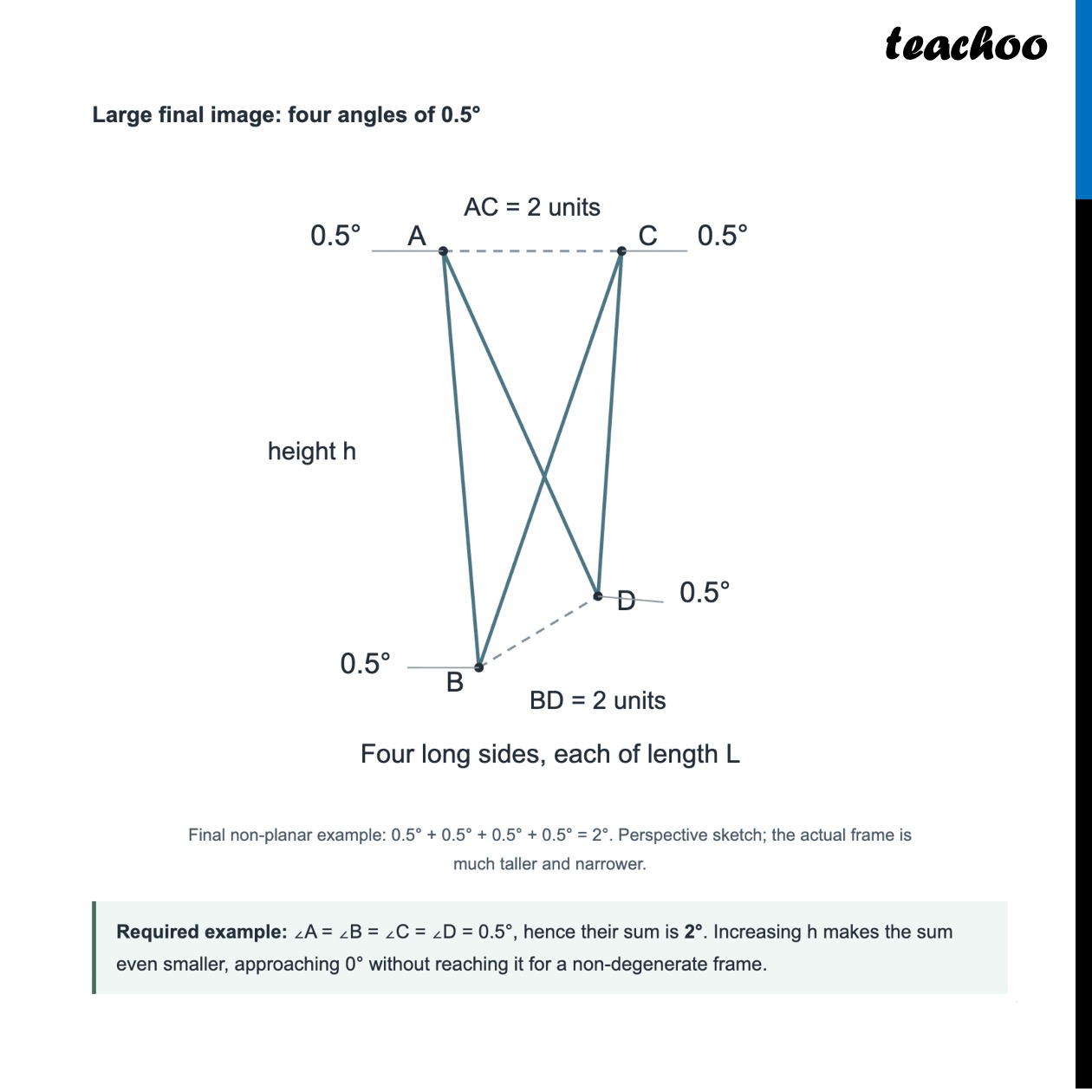
Transcript
Question 17 Show that the sum of angles of a non-planar quadrilateral is always less than 360°. Can you find a non-planar quadrilateral ABCD for which ∠A + ∠B + ∠C + ∠D = 2°? (Hint: Think of a diagonal, say AC, as a hinge around which triangles ABC and ADC can rotate.) What happens to each angle of ABCD as you do this rotation? Let’s draw a diagram 1. What does “non-planar”’ mean? The four vertices do not lie in one plane. Think of a four-sided wire frame bent in space. Its angle at a vertex is the smaller angle between the two sides meeting there. We are not using a reflex angle from a flat drawing. 2. Split the frame along AC The diagonal AC gives two ordinary triangles: ABC and ADC. Each has angle sum 180°, even when the triangles lie in different planes. AC is the hinge Image 1: Two triangles share AC. D is lifted out of the plane ABC; this is a perspective sketch. 1. What does “non-planar” mean? The four vertices do not lie in one plane. Think of a four-sided wire frame bent in space. Its angle at a vertex is the smaller angle between the two sides meeting there. We are not using a reflex angle from a flat drawing. 2. Split the frame along AC The diagonal AC gives two ordinary triangles: ABC and ADC. Each has angle sum 180°, even when the triangles lie in different planes. 3. Follow the four angles as the triangles fold At B, both sides BA and BC stay in the same rigid triangle. So .B stays unchanged. Likewise, zD stays unchanged. At A and C, one side belongs to each triangle, so those two angles change as we fold. When the triangles are flattened on opposite sides of AC, the two triangle angles at A add together. Once we fold away from this flat position, the angle between AB and AD becomes strictly smaller than that sum. The same is true at C. zBAD < zBAC + zCAD zBCD < zBCA + zACD This is the angle inequality for three non-coplanar rays: the angle between the first and third is less than the sum of the two angles through the middle ray. If that sum exceeds 180°, the inequality is immediate; otherwise, flattening the two sectors on opposite sides gives their largest possible combined angle. 4. Add the inequalities zA+2B+2C+ 2D < (zBAC + ABC + BCA) + (ZCAD + zADC + ZACD) = 180° + 180° = 360° Therefore, every non-planar quadrilateral has angle sum strictly less than 360°. The strict inequality matters: a genuinely folded frame is not the flat case. 5. Can the total be as small as 2°? Yes. Make each of its four angles 0.5°. Put A and C a short distance apart at the top, and B and D a short distance apart far below. Turn the bottom short segment through 90° compared with the top one. Join the vertices in the order A-B—C—D-A. AC = 2 units A C height h BD = 2 units Four long sides, each of length L Image 2: An enlarged perspective sketch of the 2° example. The short diagonals are in parallel horizontal planes and point in perpendicular directions. Not to scale. 6. Specify it exactly (So 2° is not just an estimate) Take AC = BD = 2 units. Centre both segments on the same vertical line, with AC pointing left-right and BD pointing front—back. Let the vertical separation be h. Each of the four boundary sides then has the same length L, where L? = h? + 17 + 17 = h? + 2. A geometric way to choose L is to first draw an isosceles triangle with base 2 units and vertex angle 0.5°, then use its equal side length as L. This describes the choice without needing trigonometry. The calculation below gives the same length exactly. At every vertex, the two adjacent sides form an isosceles triangle with equal sides L and opposite base 2. Bisecting that triangle gives sin(half the vertex angle) = 1/L. Choose L so that its vertex angle is exactly 0.5°: L=1/sin(0.25°) h = v(L? - 2) = 229.179 units Then each vertex angle is 2 x 0.25° = 0.5°. The sine calculation is only used to specify an exact example; the picture and the equal isosceles triangles explain why all four angles match. Equivalently, the four points are A(-1, 0, h), B(O, -1, 0), C(1, 0, h), D(O, 1, 0). They are not coplanar: the horizontal lines AC and BD lie at different heights and are not parallel, so no single plane can contain both. Large final image: four angles of 0.5° Large final image: four angles of 0.5° AC = 2 units 05S. A C US. height h BD = 2 units Four long sides, each of length L Final non-planar example: 0.5° + 0.5° + 0.5° + 0.5° = 2°. Perspective sketch; the actual frame is much taller and narrower. Required example: zA= 2B = zC = 2D = 0.5°, hence their sum is 2°. Increasing h makes the sum even smaller, approaching 0° without reaching it for a non-degenerate frame.