End-of-Chapter Exercises

 You are here
Last updated at November 5, 2026 by Teachoo
Transcript
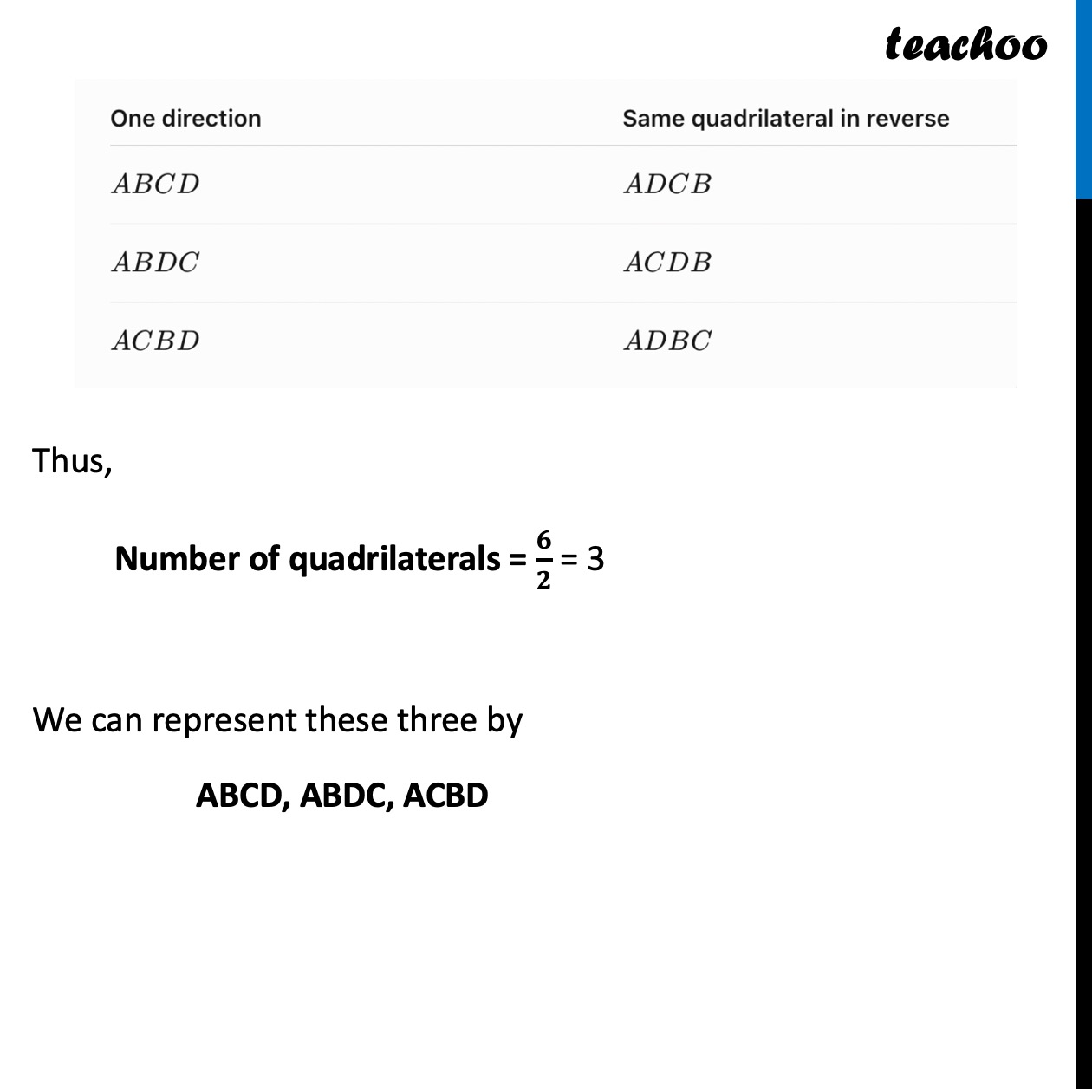
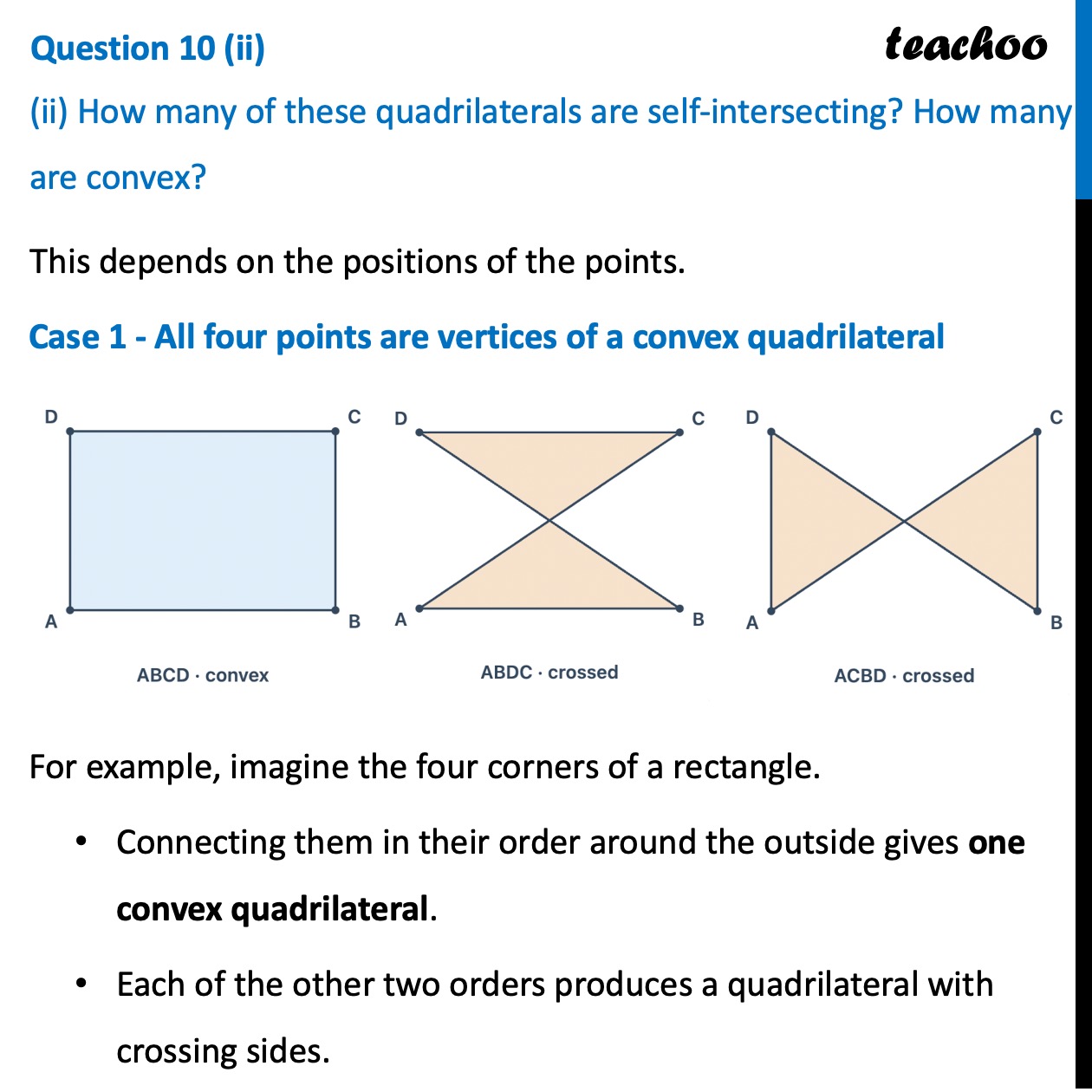
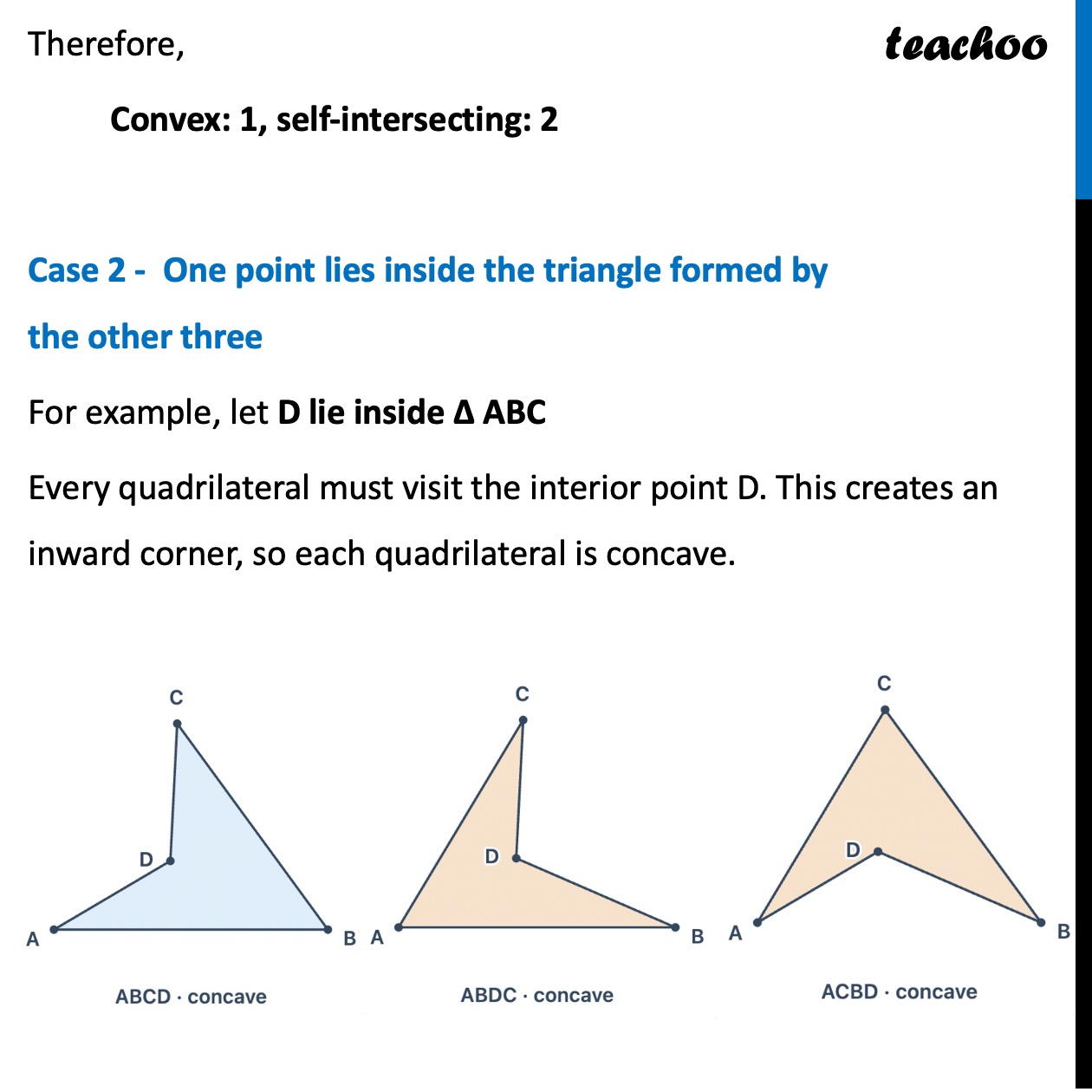
Question 10 (i) Consider 4 points A, B, C, D in the plane with no three collinear. Answer the following questions. Some answers may require you to consider different cases, depending on how the points are positioned in the plane. (i) How many different quadrilaterals do they form if the quadrilateral is allowed to be self-intersecting or non-convex? The shape depends on the order in which we connect the points. Starting at A, the six possible orders of the remaining three vertices are: ABCD, ABDC, ACBD, ACDB, ADBC, ADCB However, travelling around the same quadrilateral in the opposite direction does not produce a new quadrilateral Thus, Number of quadrilaterals = (𝟔)/(𝟐) = 3 We can represent these three by ABCD, ABDC, ACBD One direction Same quadrilateral in reverse ABCD ADCB ABDC AC'DB AC BD ADBC Question 10 (ii) (ii) How many of these quadrilaterals are self-intersecting? How many are convex? This depends on the positions of the points. Case 1 - All four points are vertices of a convex quadrilateral For example, imagine the four corners of a rectangle. Connecting them in their order around the outside gives one convex quadrilateral. Each of the other two orders produces a quadrilateral with crossing sides. ABCD - convex ABDC - crossed ACBD - crossed Therefore, Convex: 1, self-intersecting: 2 Case 2 - One point lies inside the triangle formed by the other three For example, let D lie inside ∆ ABC Every quadrilateral must visit the interior point D. This creates an inward corner, so each quadrilateral is concave. ABCD - concave ABDC - concave ACBD - concave Therefore, Convex: 0, self-intersecting: 0 All three are simple concave quadrilaterals These are the only two possibilities because no three points are collinear.