End-of-Chapter Exercises

 You are here
Last updated at November 5, 2026 by Teachoo
Transcript
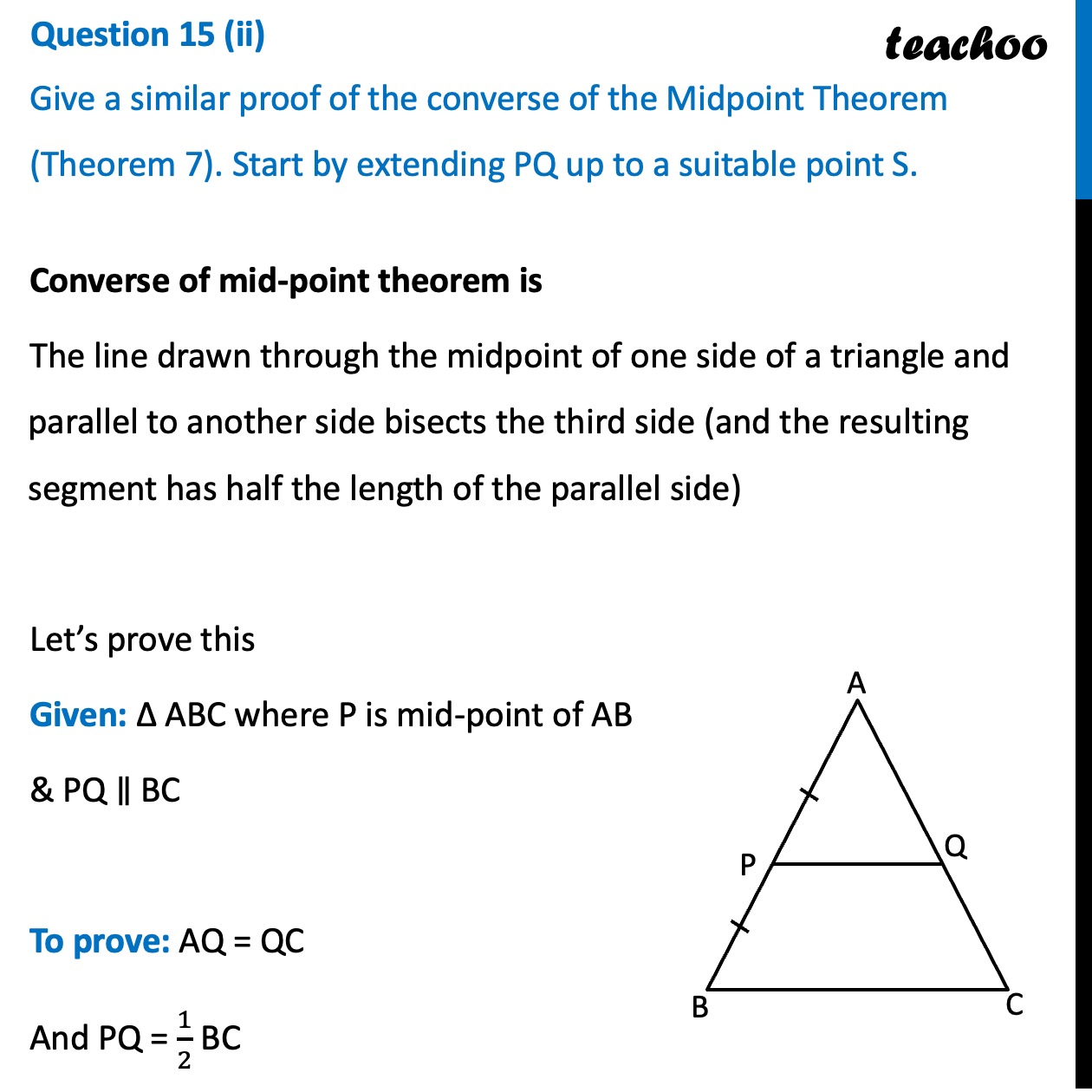
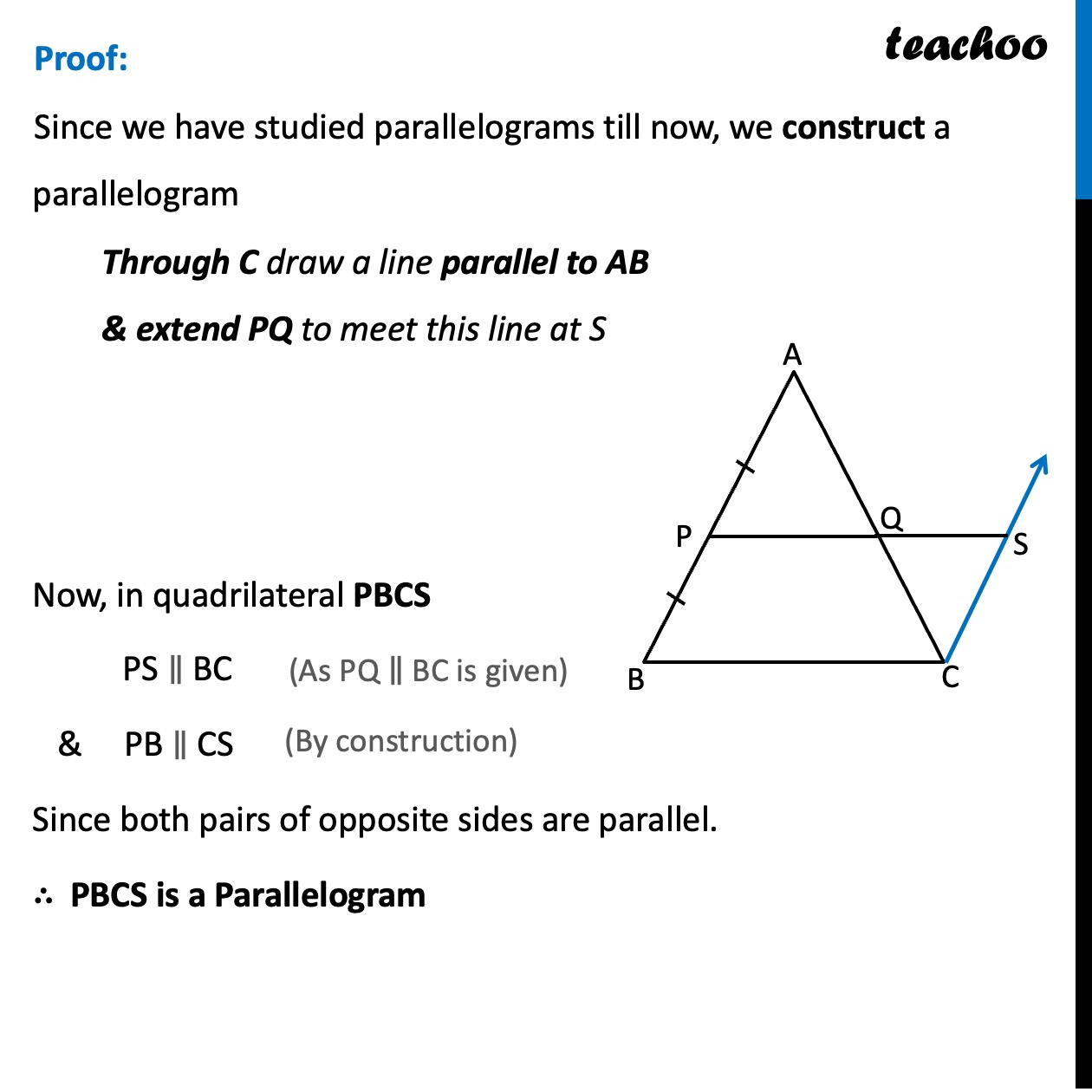
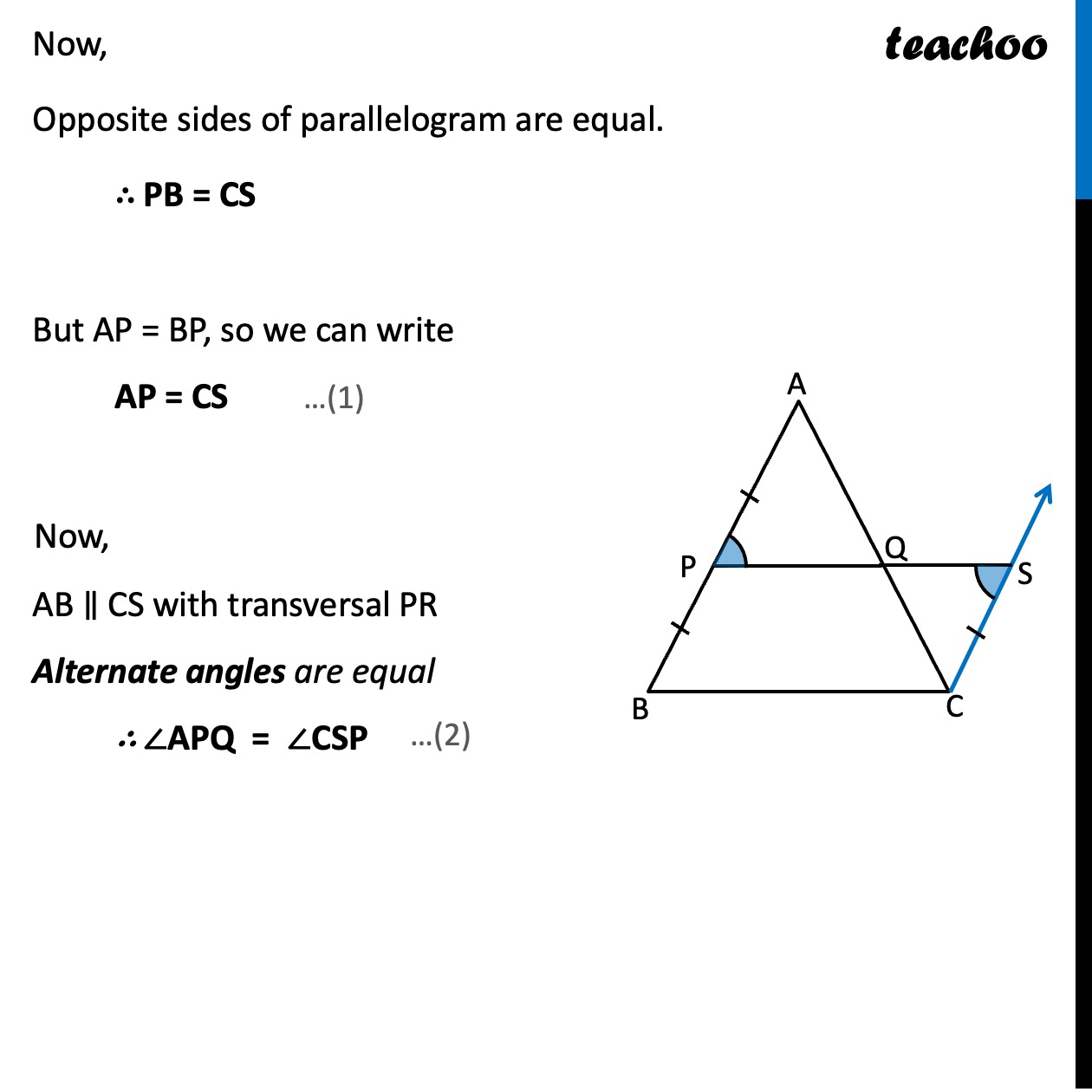
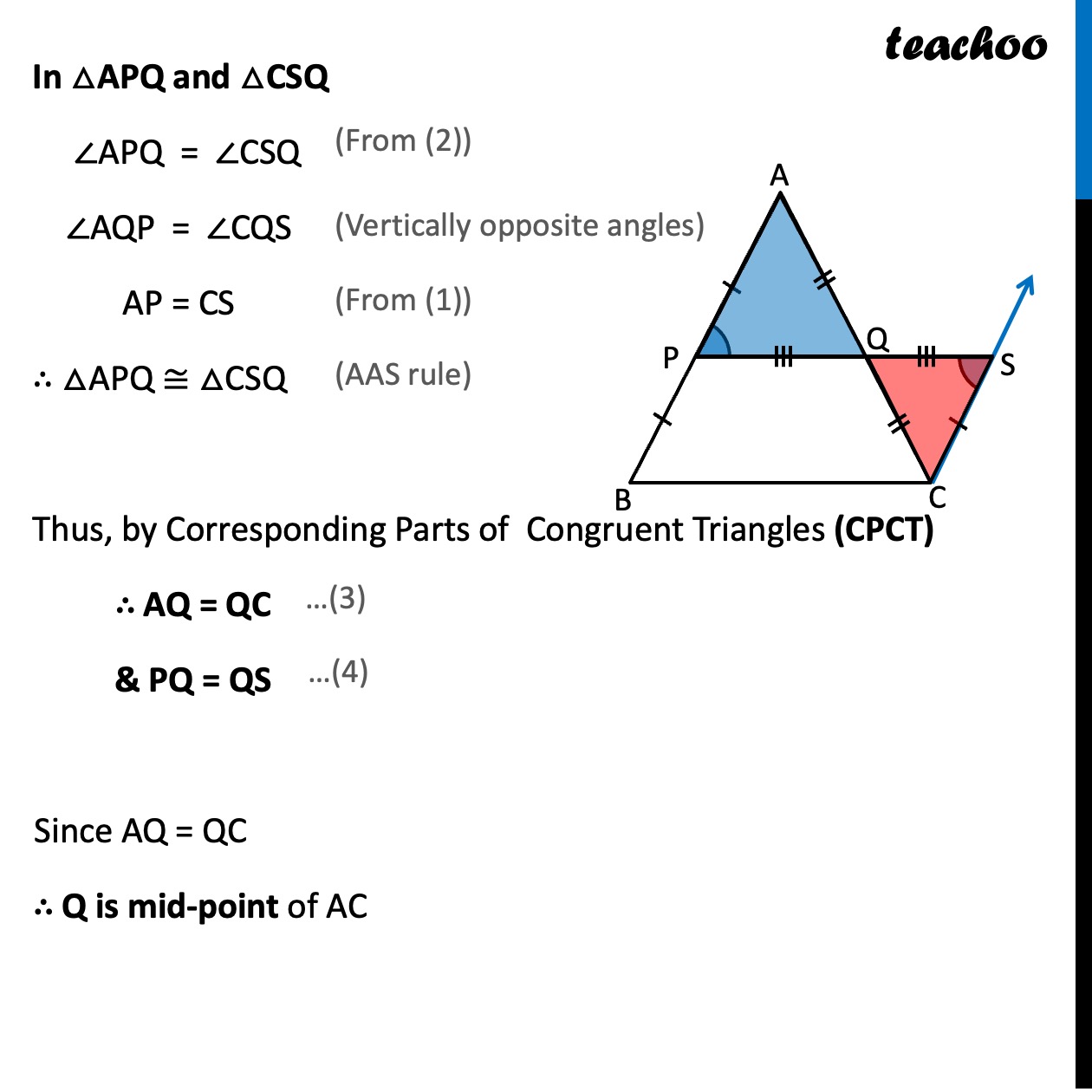
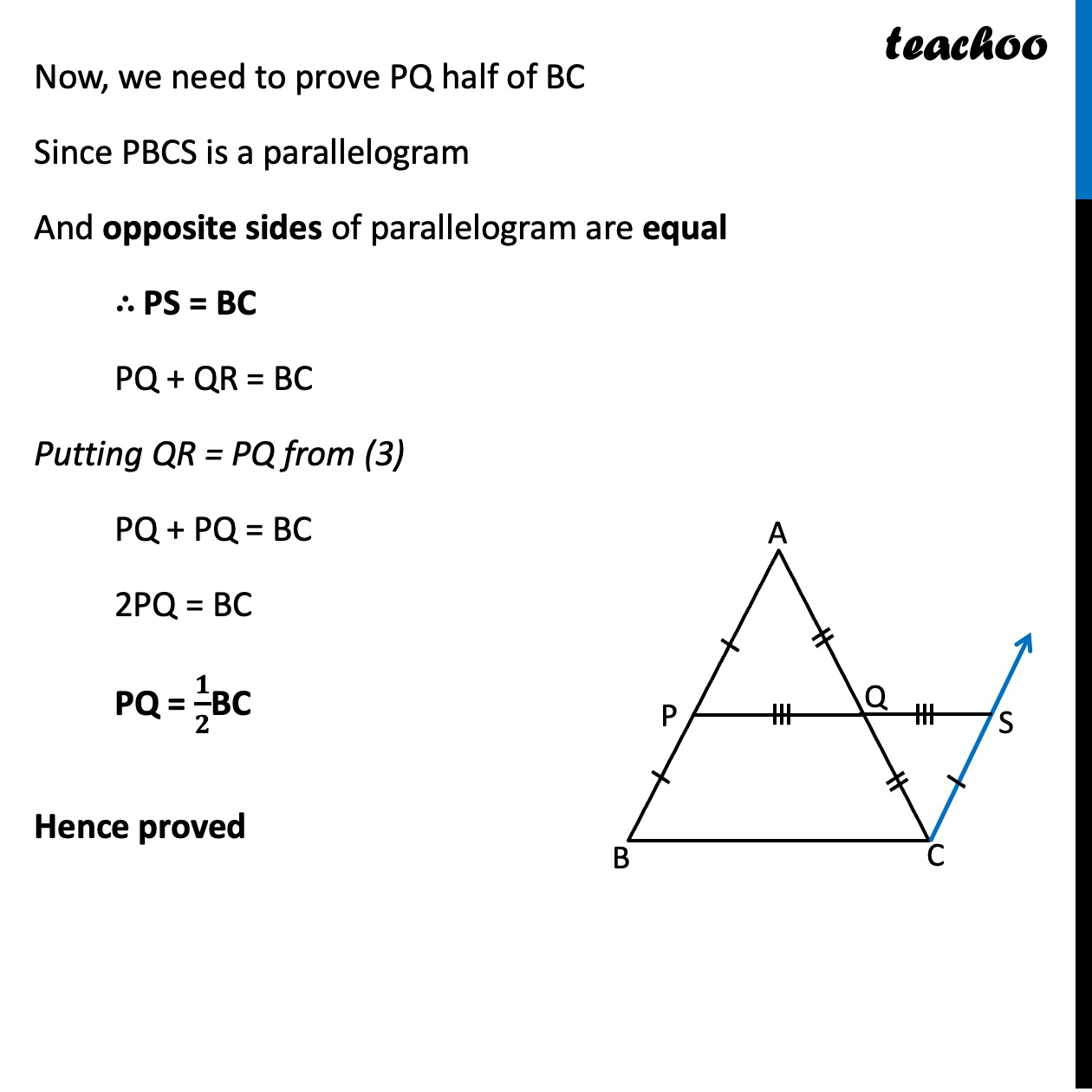
Question 15 (ii) Give a similar proof of the converse of the Midpoint Theorem (Theorem 7). Start by extending PQ up to a suitable point S. Converse of mid-point theorem is The line drawn through the midpoint of one side of a triangle and parallel to another side bisects the third side (and the resulting segment has half the length of the parallel side) Let’s prove this Given: ∆ ABC where P is mid-point of AB & PQ ∥ BC To prove: AQ = QC And PQ = (1)/(2) BC A B C P Q Proof: Since we have studied parallelograms till now, we construct a parallelogram Through C draw a line parallel to AB & extend PQ to meet this line at S Now, in quadrilateral PBCS PS ∥ BC & PB ∥ CS Since both pairs of opposite sides are parallel. ∴ PBCS is a Parallelogram A B C P Q S (By construction) (As PQ ∥ BC is given) Now, Opposite sides of parallelogram are equal. ∴ PB = CS But AP = BP, so we can write AP = CS Now, AB ∥ CS with transversal PR Alternate angles are equal ∴ ∠APQ = ∠CSP A B C P Q S …(1) …(2) In △APQ and △CSQ ∠APQ = ∠CSQ ∠AQP = ∠CQS AP = CS ∴ △APQ ≅ △CSQ Thus, by Corresponding Parts of Congruent Triangles (CPCT) ∴ AQ = QC & PQ = QS Since AQ = QC ∴ Q is mid-point of AC A B C P Q S (From (2)) (From (1)) (AAS rule) (Vertically opposite angles) …(3) …(4) Now, we need to prove PQ half of BC Since PBCS is a parallelogram And opposite sides of parallelogram are equal ∴ PS = BC PQ + QR = BC Putting QR = PQ from (3) PQ + PQ = BC 2PQ = BC PQ = (𝟏)/(𝟐)BC Hence proved A B C P Q S