End-of-Chapter Exercises

 You are here
Last updated at November 5, 2026 by Teachoo
Transcript
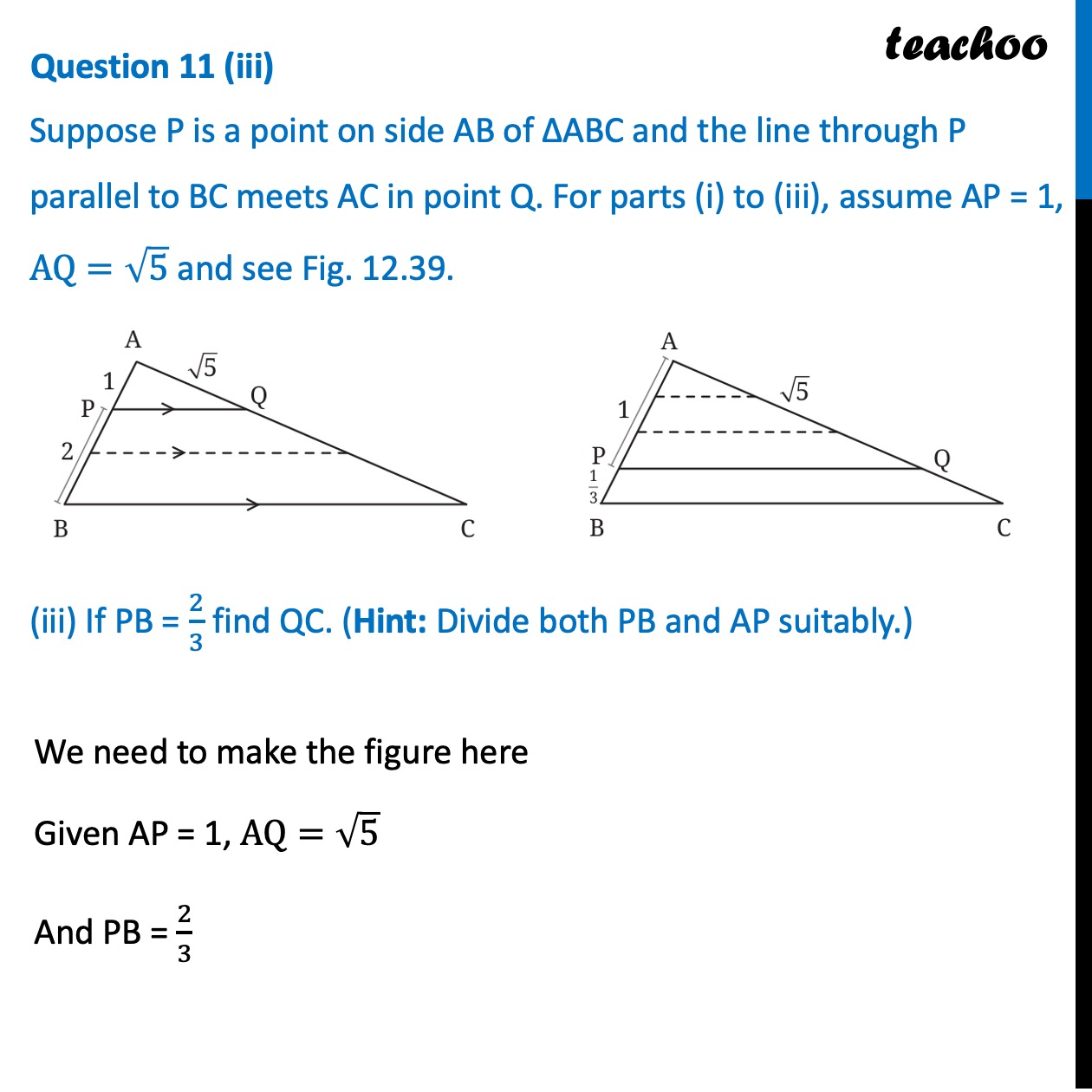
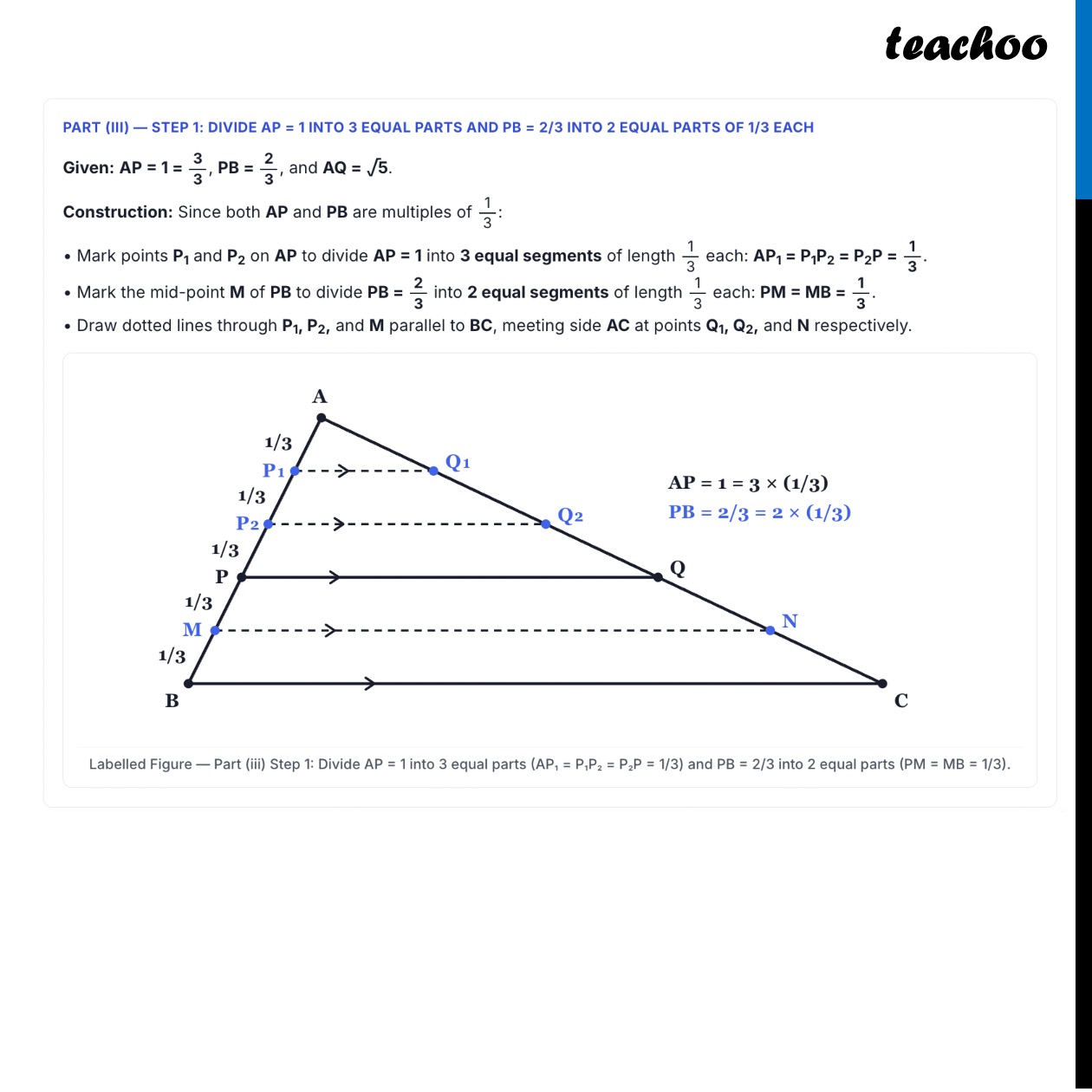
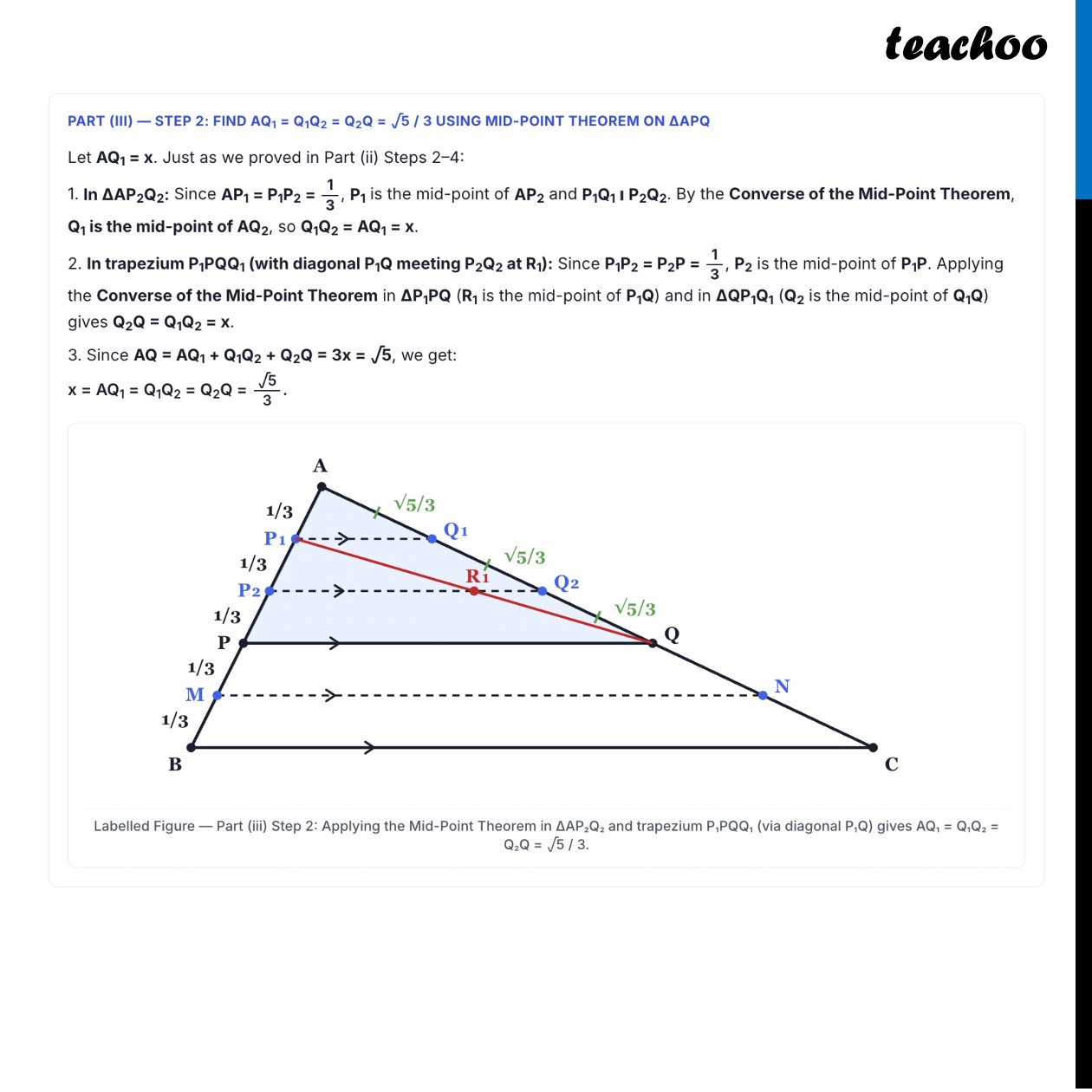
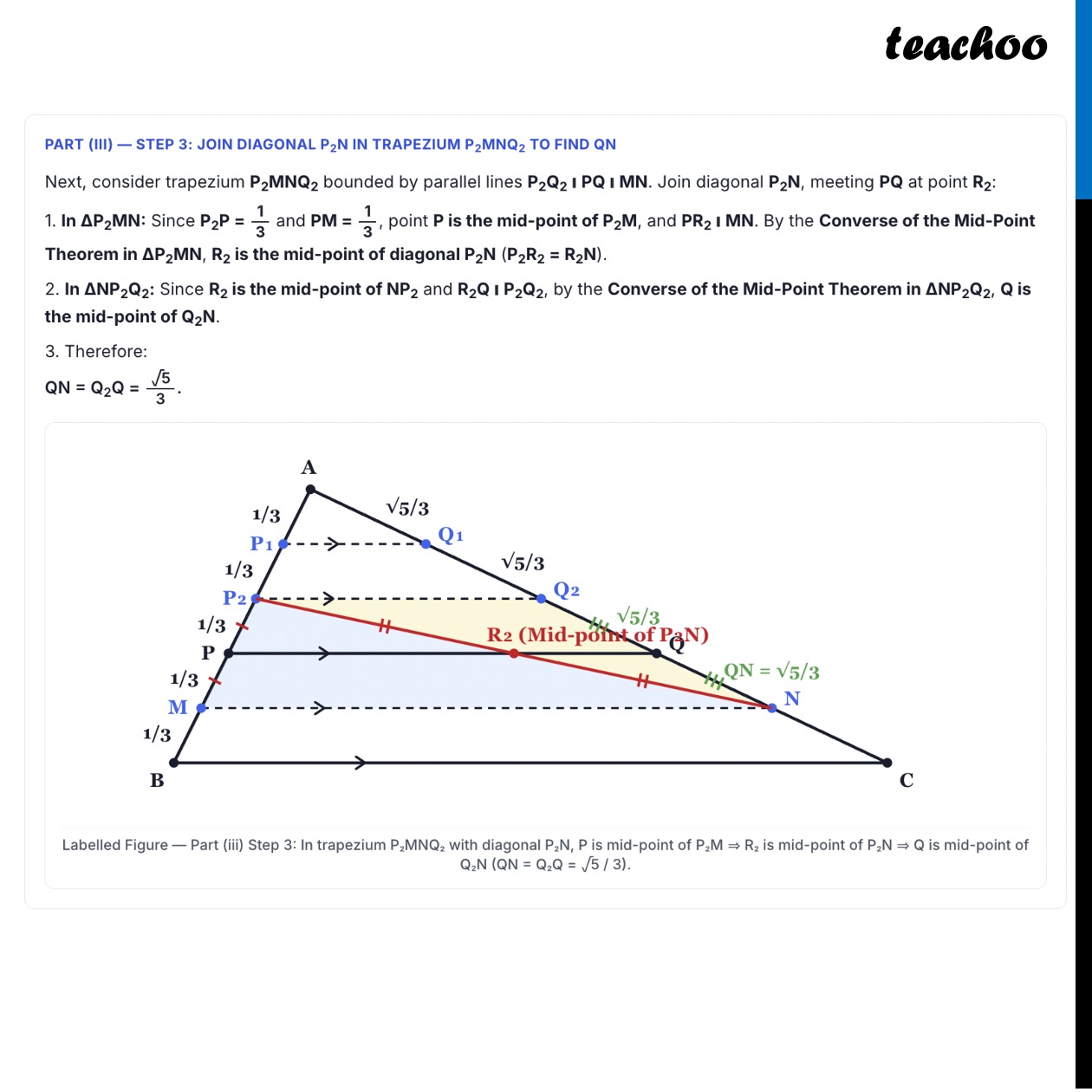
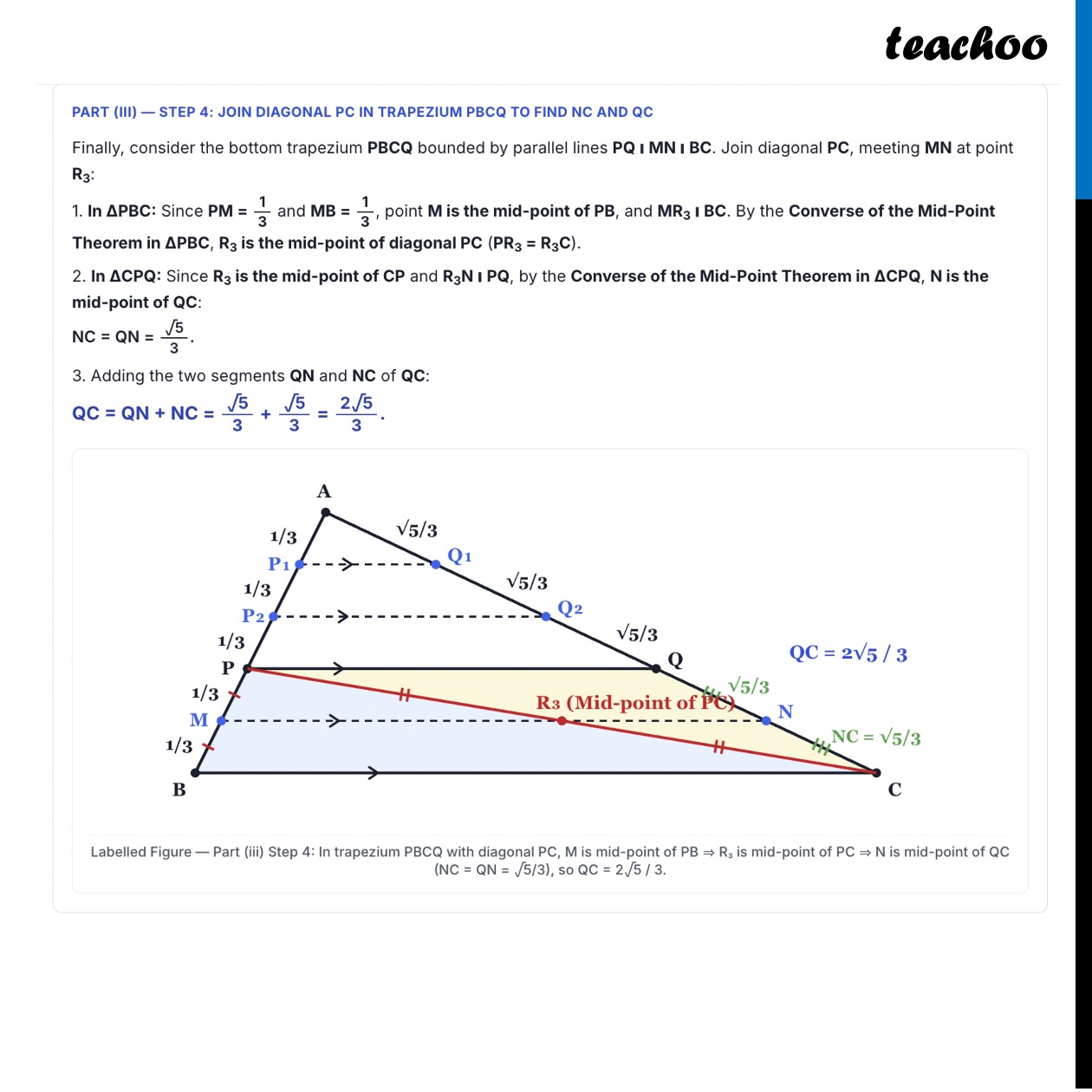
Question 11 (iii) Suppose P is a point on side AB of ∆ABC and the line through P parallel to BC meets AC in point Q. For parts (i) to (iii), assume AP = 1, AQ=sqrt(5) and see Fig. 12.39. (iii) If PB = (2)/(3) find QC. (Hint: Divide both PB and AP suitably.) We need to make the figure here Given AP = 1, AQ=sqrt(5) And PB = (2)/(3) Fig. 12.39 PART (Ill) — STEP 1: DIVIDE AP = 1INTO 3 EQUAL PARTS AND PB = 2/3 INTO 2 EQUAL PARTS OF 1/3 EACH . 3 2 Given: AP = 1= 3: PB=-—. and AQ = J/5. Construction: Since both AP and PB are multiples of + e Mark points P, and P2 on AP to divide AP = 1 into 3 equal segments of length — each: AP, = P,P2 = P2P = + e Mark the mid-point M of PB to divide PB = — into 2 equal segments of length — each: PM = MB = +. e Draw dotted lines through P;, Pz, and M parallel to BC, meeting side AC at points Q;, Q2, and N respectively. A AP =1=3 x (1/3) PB = 2/3 = 2 x (4/3) Q B C Labelled Figure — Part (iii) Step 1: Divide AP = 1 into 3 equal parts (AP, = P,P, = P,P = 1/3) and PB = 2/3 into 2 equal parts (PM = MB = 1/3). PART (Ill) — STEP 2: FIND AQ, = Q,Q> = Q2Q = /5/ 3 USING MID-POINT THEOREM ON AAPQ Let AQ, = x. Just as we proved in Part (ii) Steps 2-4: 1. In AAP2Qz2: Since AP, = P1P2 = + P, is the mid-point of AP2z and P1Q,1 P2Q2. By the Converse of the Mid-Point Theorem, Q, is the mid-point of AQ>, so Q,Q2 = AQ, = x. 2. In trapezium P;PQQ; (with diagonal P;Q meeting P2Q>2 at Rj): Since PyP2 = P2P = > P2 is the mid-point of PyP. Applying the Converse of the Mid-Point Theorem in AP,PQ (R, is the mid-point of P,Q) and in AQP,Q, (Qz> is the mid-point of Q,Q) gives Q2Q = Q,Q2 = x. 3. Since AQ = AQ; + Q:Q2 + Q2Q = 3x = J5, we get: x = AQ, = QQ) = Q,Q = ate C Labelled Figure — Part (iii) Step 2: Applying the Mid-Point Theorem in AAP,Q, and trapezium P,PQQ, (via diagonal P,Q) gives AQ, = Q,Q, = Q.Q = /5/3. PART (Ill) — STEP 3: JOIN DIAGONAL P2N IN TRAPEZIUM P2MNQ> TO FIND QN Next, consider trapezium PgMNQ> bounded by parallel lines P2Q2 1PQ1 MN. Join diagonal P2N, meeting PQ at point Ro: 1. In AP2MN: Since P2P = — and PM = 7 point P is the mid-point of P2M, and PR2! MN. By the Converse of the Mid-Point Theorem in AP2MN, R2 is the mid-point of diagonal P2N (P2R2 = R2N). 2. In ANP2Q>: Since R2 is the mid-point of NPz and R2Q 1 P2Qz, by the Converse of the Mid-Point Theorem in ANP2Q>), Q is the mid-point of Q2N. 3. Therefore: QN=Q,Q = = Labelled Figure — Part (iii) Step 3: In trapezium P,MNQ, with diagonal P.N, P is mid-point of P.M = R, is mid-point of P,N > Q is mid-point of Q.N (QN = Q.Q = /5/ 3). PART (Ill) — STEP 4: JOIN DIAGONAL PC IN TRAPEZIUM PBCQ TO FIND NC AND QC Finally, consider the bottom trapezium PBCQ bounded by parallel lines PQ! MN1BC. Join diagonal PC, meeting MN at point R3: 1. In APBC: Since PM = 7 and MB = + point M is the mid-point of PB, and MR31 BC. By the Converse of the Mid-Point Theorem in APBC, R3 is the mid-point of diagonal PC (PR3 = R3C). 2. In ACPQ: Since R3 is the mid-point of CP and R3N1 PQ, by the Converse of the Mid-Point Theorem in ACPQ, N is the mid-point of QC: NC = QN= 3 3 3. Adding the two segments QN and NC of QC: _/5 , JS _ 2/5 QC = QN+NC= ee es ae Labelled Figure — Part (iii) Step 4: In trapezium PBCQ with diagonal PC, M is mid-point of PB = R; is mid-point of PC = N is mid-point of QC (NC = QN = J/5/3), so QC = 2,/5/ 3.