End-of-Chapter Exercises

 You are here
Last updated at November 5, 2026 by Teachoo
Transcript
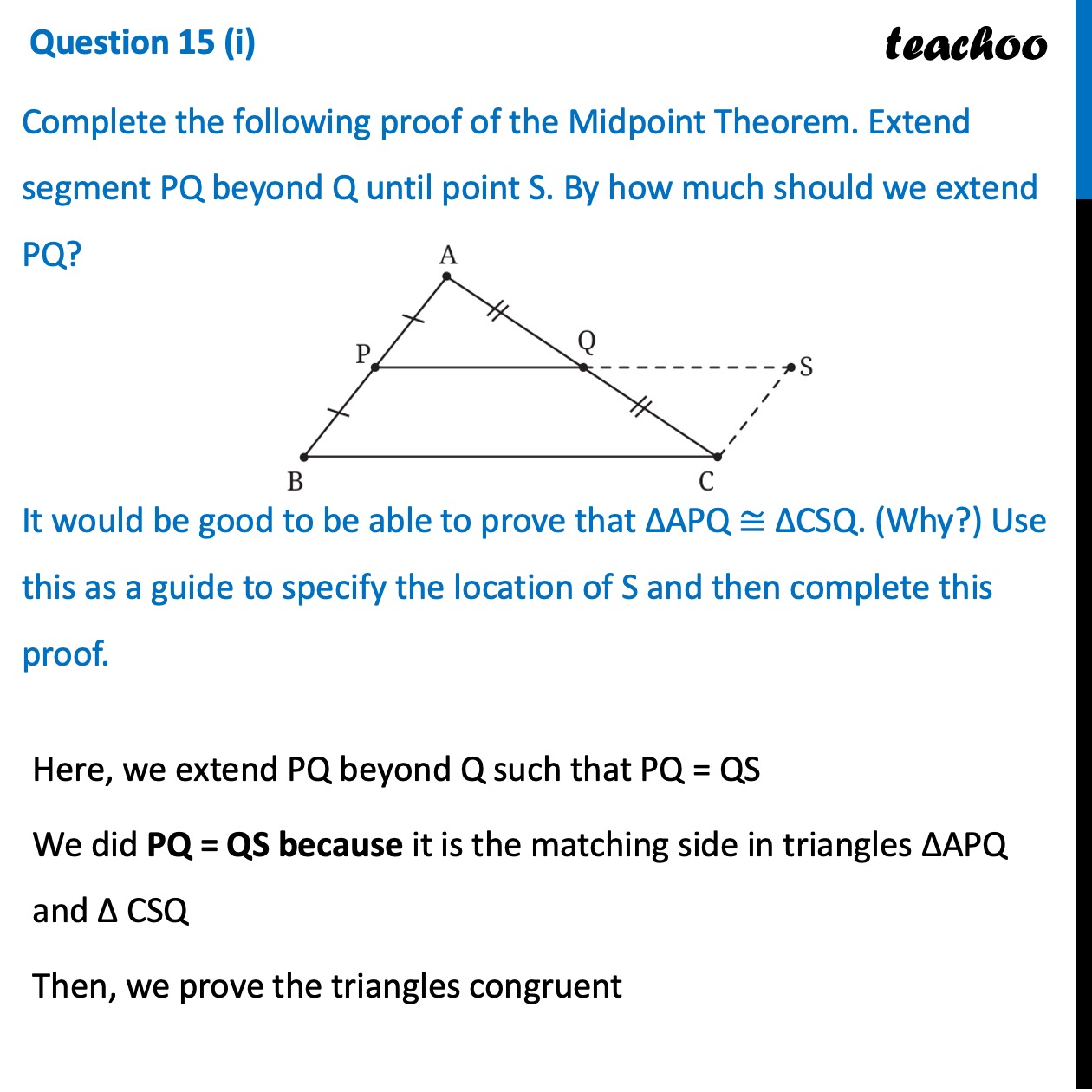
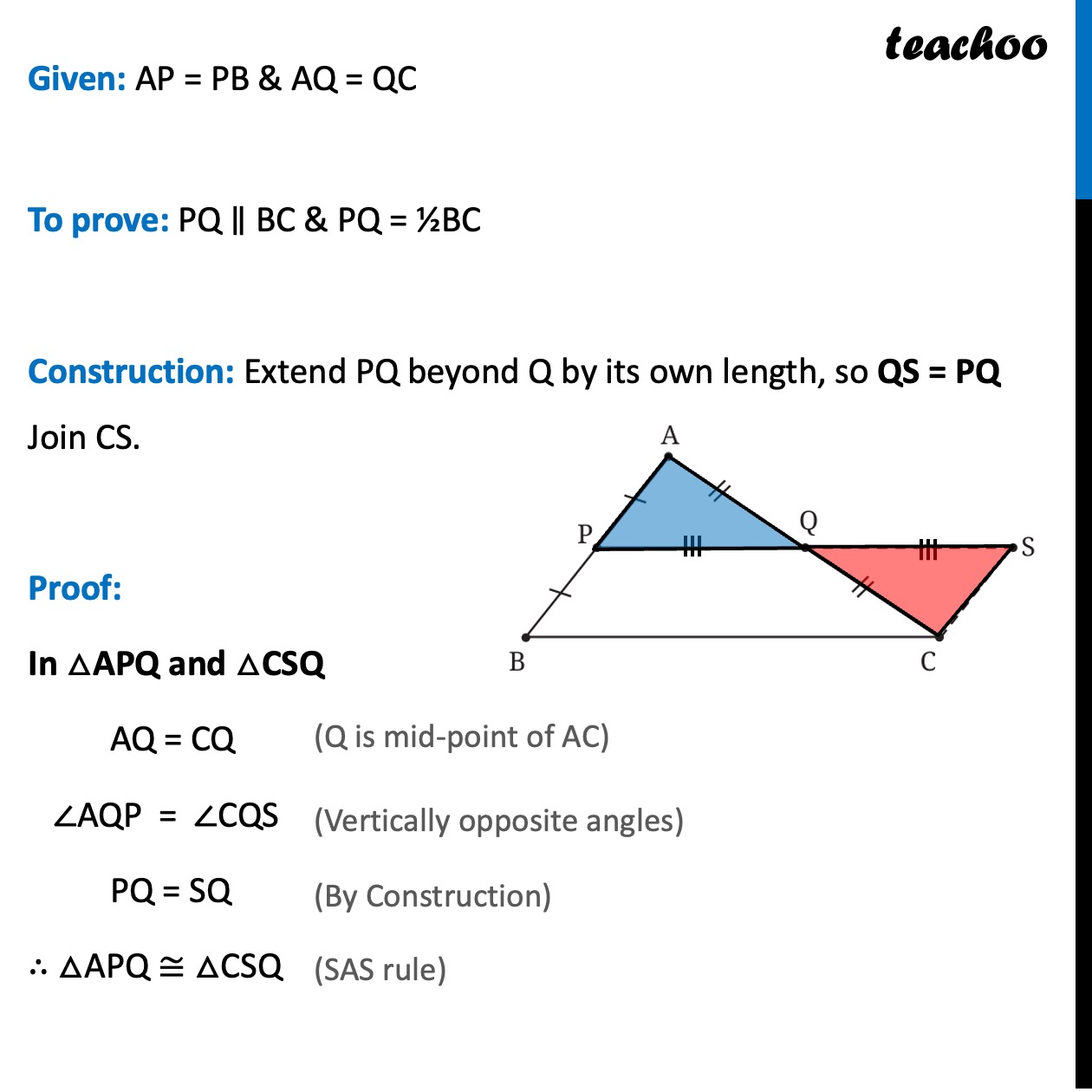
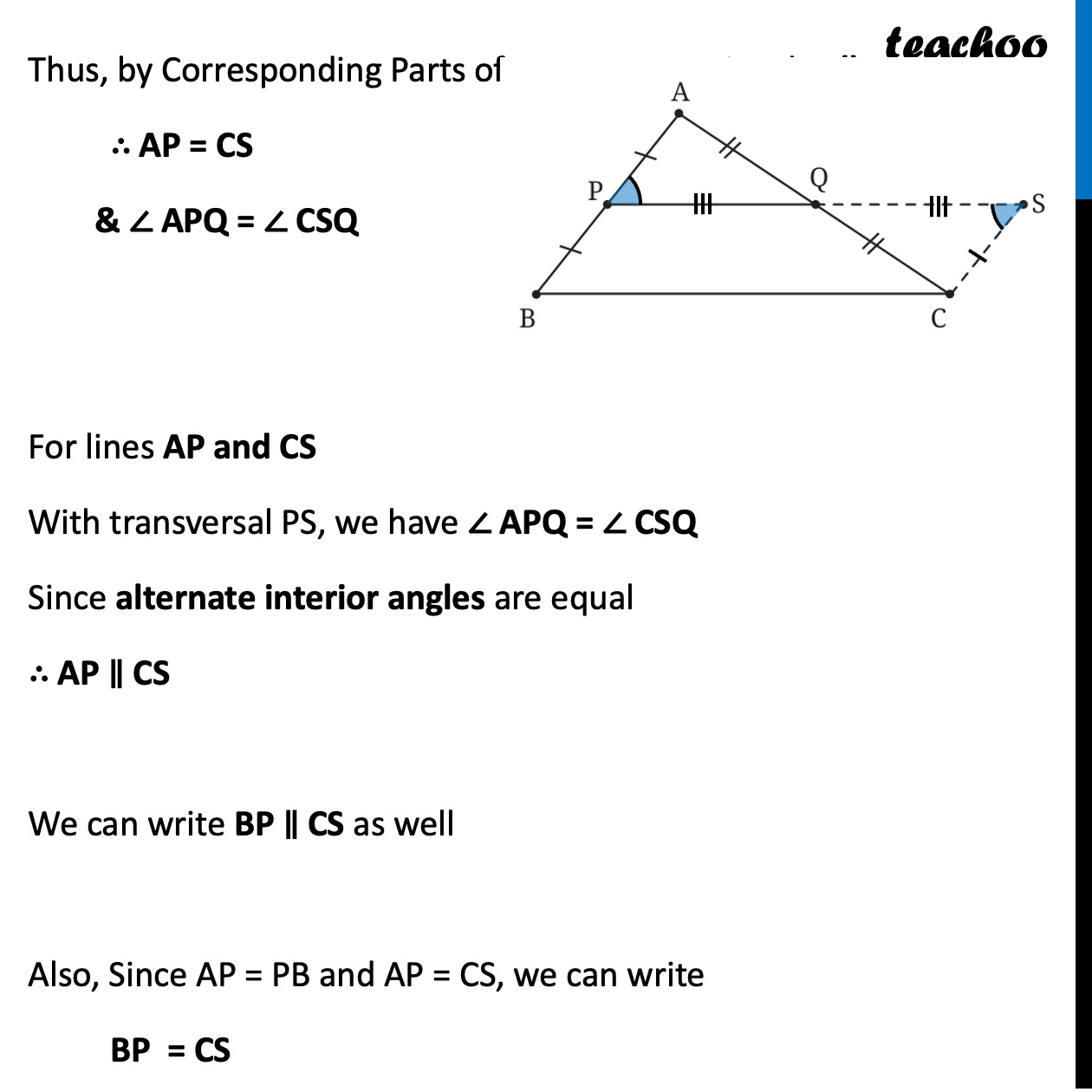
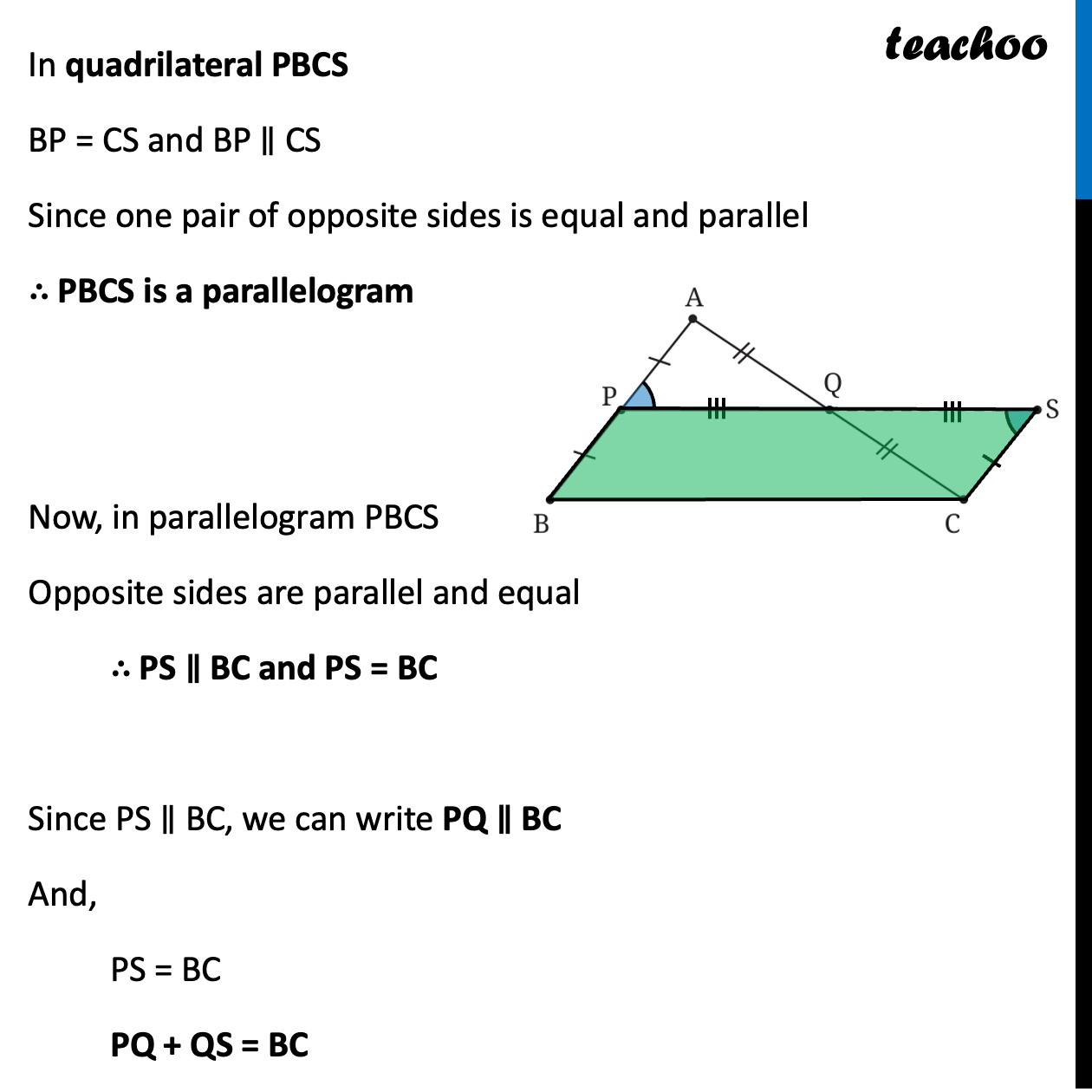
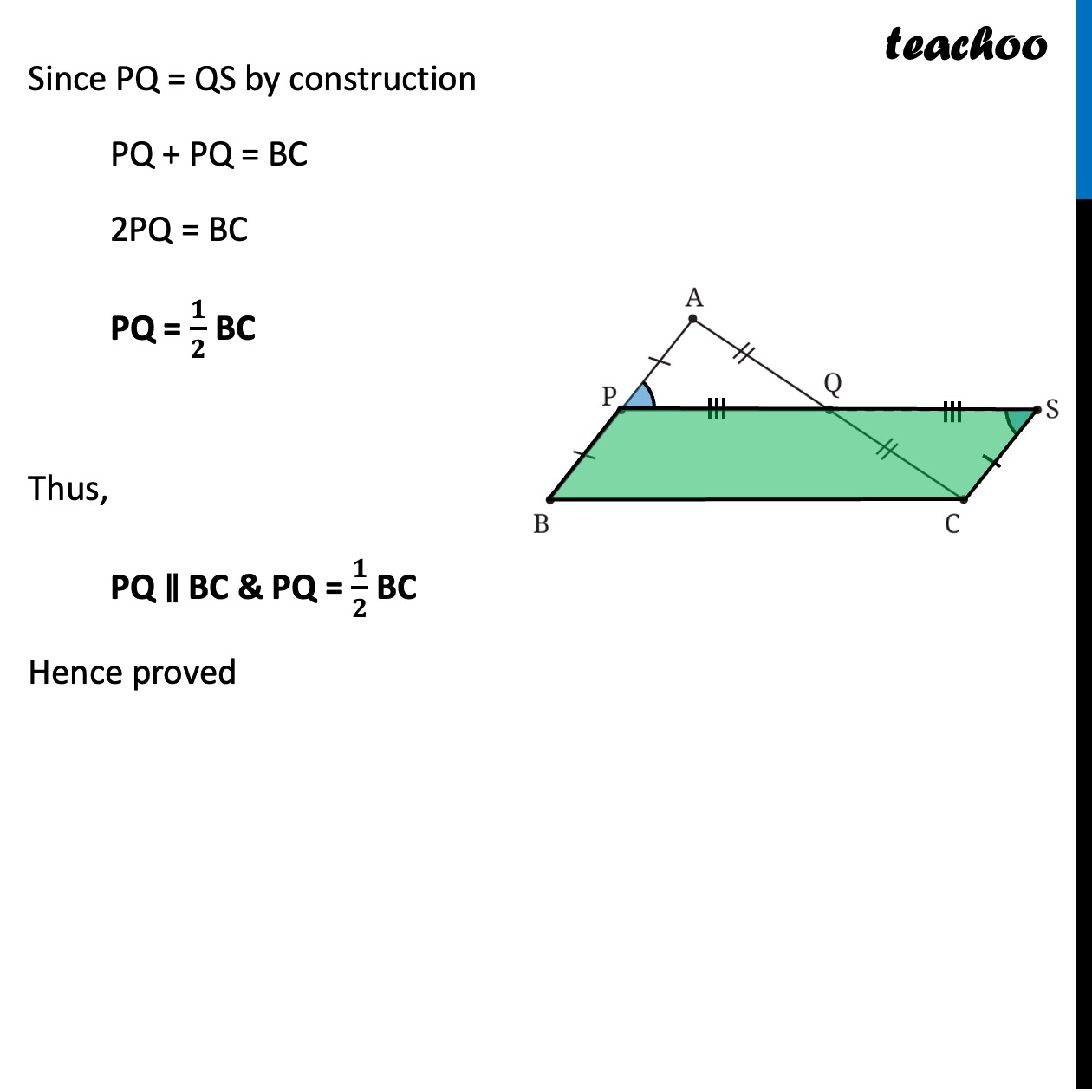
Question 15 (i) Complete the following proof of the Midpoint Theorem. Extend segment PQ beyond Q until point S. By how much should we extend PQ? It would be good to be able to prove that ∆APQ ≅ ∆CSQ. (Why?) Use this as a guide to specify the location of S and then complete this proof. Here, we extend PQ beyond Q such that PQ = QS We did PQ = QS because it is the matching side in triangles ∆APQ and ∆ CSQ Then, we prove the triangles congruent Fig, 12.41 Given: AP = PB & AQ = QC To prove: PQ ∥ BC & PQ = ½BC Construction: Extend PQ beyond Q by its own length, so QS = PQ Join CS. Proof: In △APQ and △CSQ AQ = CQ ∠AQP = ∠CQS PQ = SQ ∴ △APQ ≅ △CSQ (Q is mid-point of AC) (By Construction) (SAS rule) (Vertically opposite angles) Fig, 12.41 Thus, by Corresponding Parts of Congruent Triangles () ∴ AP = CS & ∠ APQ = ∠ CSQ For lines AP and CS With transversal PS, we have ∠ APQ = ∠ CSQ Since alternate interior angles are equal ∴ AP ∥ CS We can write BP ∥ CS as well Also, Since AP = PB and AP = CS, we can write BP = CS Fig, 12.41 In quadrilateral PBCS BP = CS and BP ∥ CS Since one pair of opposite sides is equal and parallel ∴ PBCS is a parallelogram Now, in parallelogram PBCS Opposite sides are parallel and equal ∴ PS ∥ BC and PS = BC Since PS ∥ BC, we can write PQ ∥ BC And, PS = BC PQ + QS = BC Fig, 12.41 Since PQ = QS by construction PQ + PQ = BC 2PQ = BC PQ = (𝟏)/(𝟐) BC Thus, PQ ∥ BC & PQ = (𝟏)/(𝟐) BC Hence proved Fig, 12.41