End-of-Chapter Exercises

 You are here
Last updated at November 5, 2026 by Teachoo
Transcript
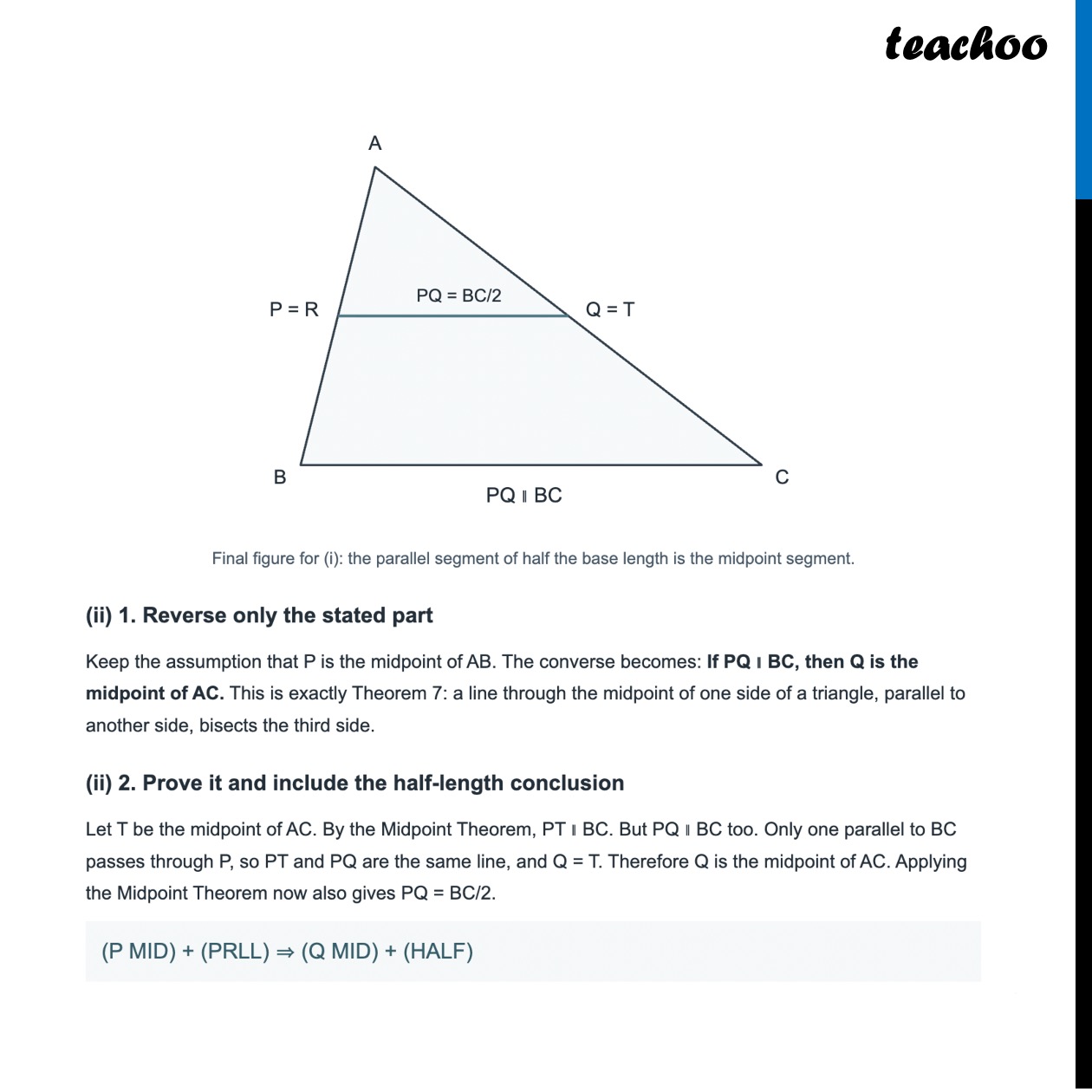
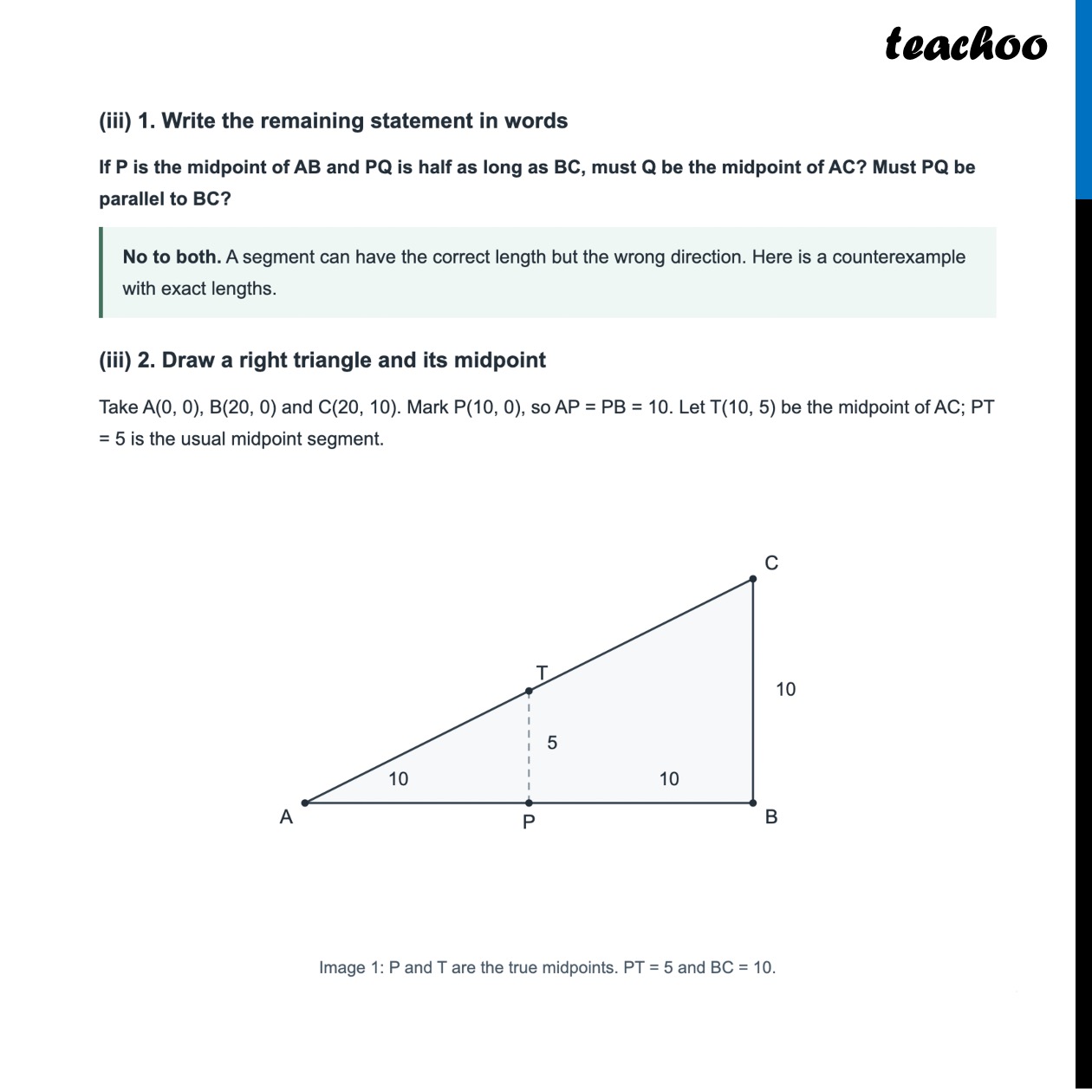
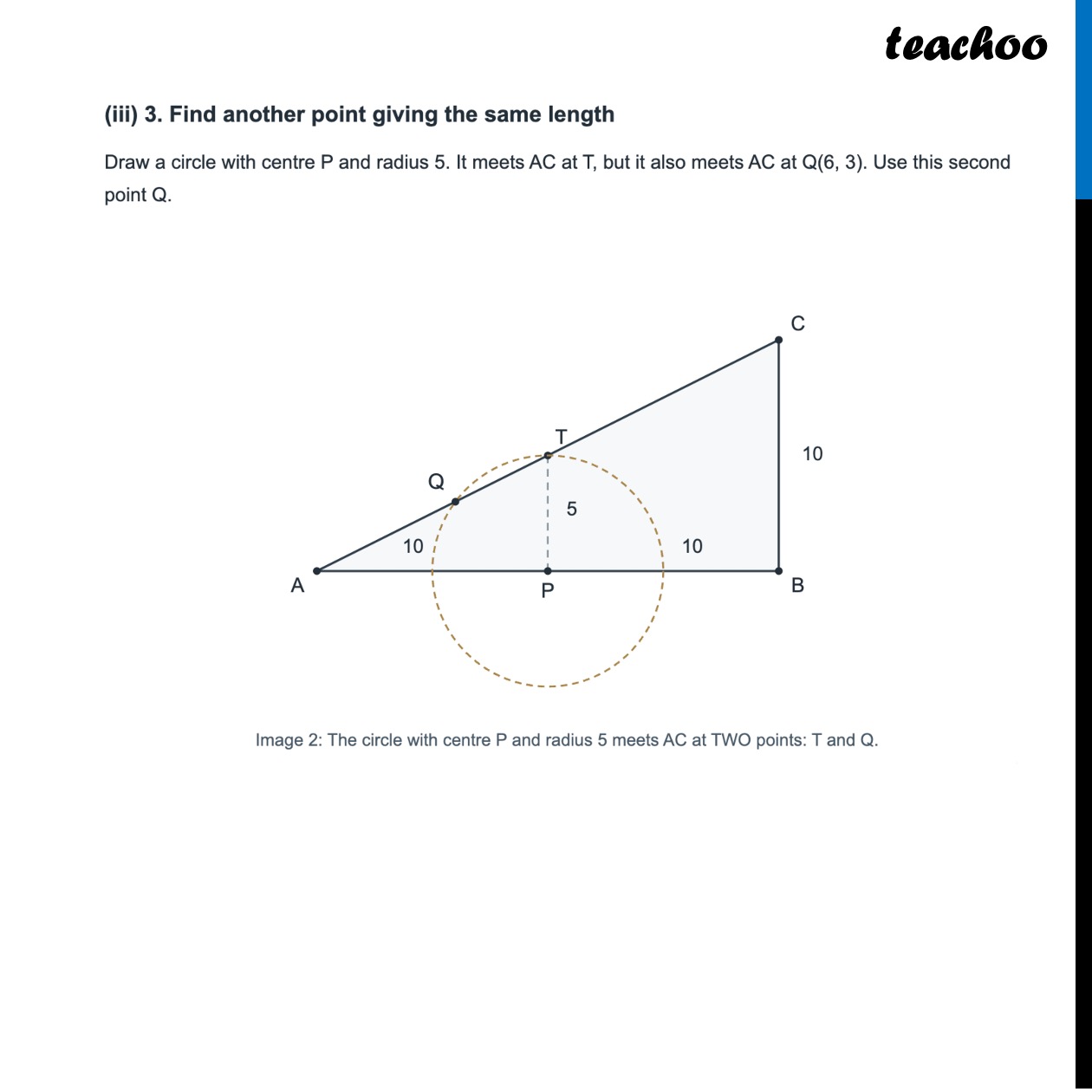
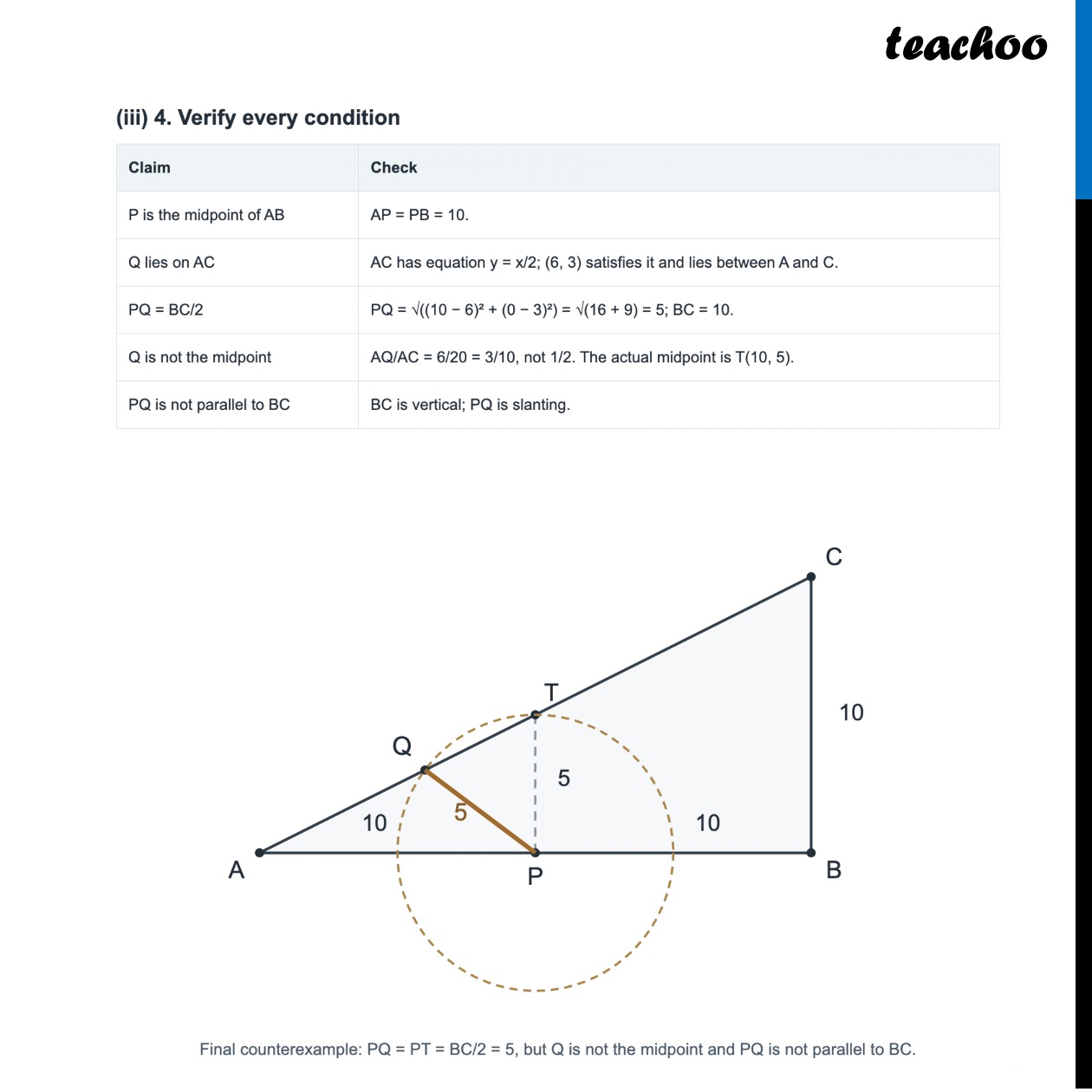
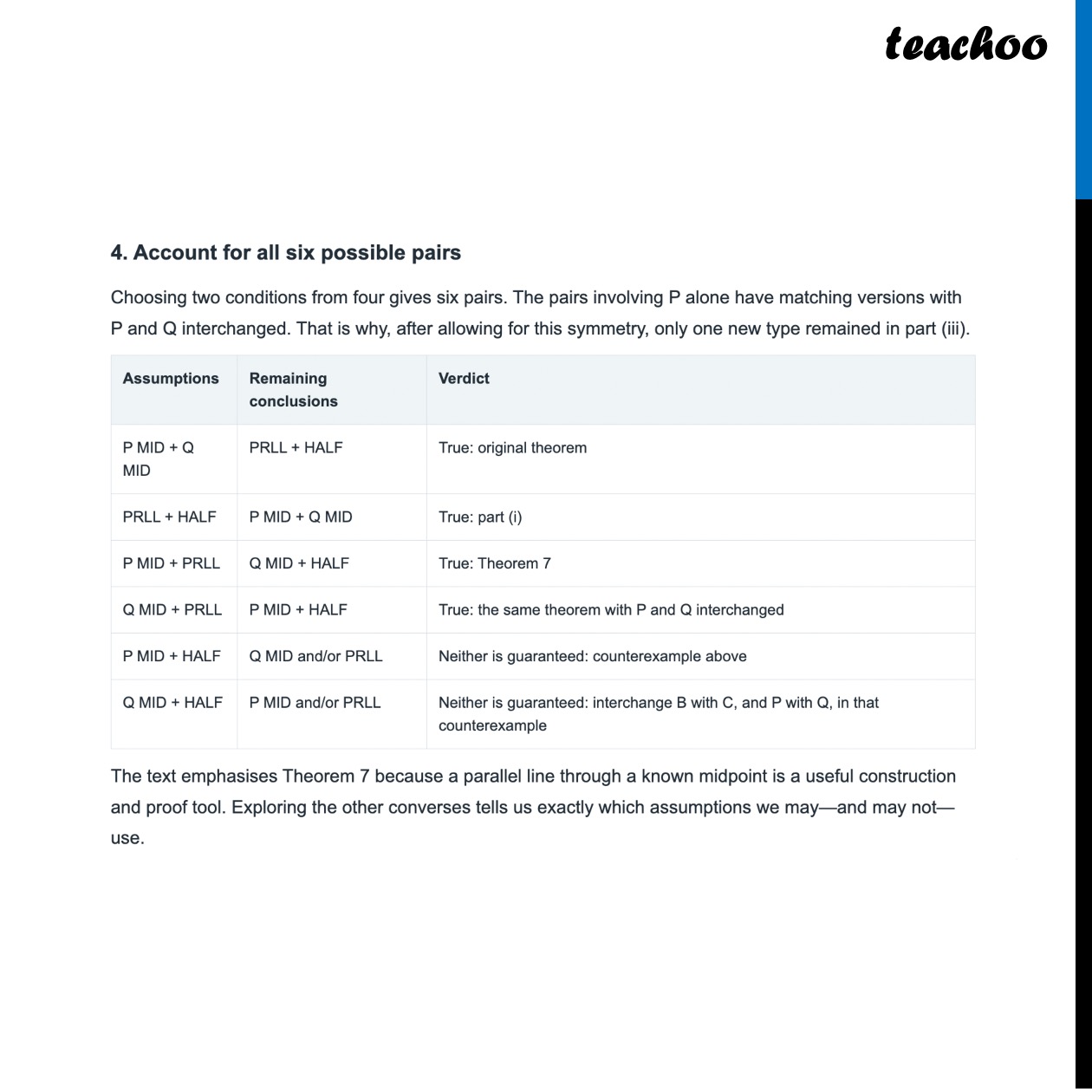
Question 22 Multiple converses to a theorem. Let us see how multiple statements can be considered converses to the Midpoint Theorem and how Theorem 7 is one of them. To formulate a converse we should express the original statement in “If … then …” form. For a complex statement, there may be multiple ways to do that. The Midpoint Theorem starts with ∆ABC and points P and Q on sides AB and AC respectively. The theorem has two assumptions and two conclusions, which we have named for further discussion. Assumptions: (P MID) P is the midpoint of AB, and (Q MID) Q is the midpoint of AC. Conclusions: (PRLL) PQ ∥ BC, and (HALF) PQ = (𝐵𝐶)/(2). Let us use these four named conditions to discuss various possible statements. (i) A natural converse of the Midpoint Theorem would be: “If (PRLL) and (HALF) are true, then (P MID) and (Q MID) are true.” Write out this statement fully. Experiment and see that it seems to be true! Prove the statement. (Hint: Try to run a proof of the Midpoint Theorem backwards.) (ii) To see Theorem 7 as a converse of the Midpoint Theorem, we first write the Midpoint Theorem as follows: “Suppose P is the midpoint of side AB of ∆ABC and Q is a point on side AC. If Q is the midpoint of AC then PQ ∥ BC.” (Also PQ = (𝐵𝐶)/(2), but let us set that aside for now.) Write the converse of the second sentence in quotes by keeping the first sentence the same. Verify that Theorem 7 is what you get! (And PQ = (𝐵𝐶)/(2) also follows.) Now write Theorem 7 in terms of the four named conditions. (iii) The discussion so far suggests that it is reasonable to take two of the four listed statements as assumptions and ask if the other two are true. Verify that only one such combination remains to be examined. “If (P MID) and (HALF) are true, then can we conclude (Q MID) and/or (PRLL)?” Write this out in words. This is a precise version of question (1) stated before Theorem 7. Can you answer it? In the text, why did we focus only on Theorem 7 among the multiple possibilities? Because Theorem 7 turns out to be particularly useful. It is still important to pursue various avenues while exploring a subject: often it is only after examining multiple possibilities that we can judge what is most valuable. 1. Begin with the original theorem (P MID) + (Q MID) = (PRLL) + (HALF) In words: the segment joining the midpoints of two sides of a triangle is parallel to the third side and half as long. The question asks which other pairs of facts can force the remaining facts. (i) 1. Write the full converse If P lies on AB and Q lies on AC, PQ is parallel to BC, and PQ is half as long as BC, then P is the midpoint of AB and Q is the midpoint of AC. (i) 2. Construct the actual midpoint segment Let R be the midpoint of AB and T be the midpoint of AC. By the Midpoint Theorem, RT | BC and RT = BC/2. Hence PQ I RT and PQ = RT. (i) 3. Prove P must coincide with R Suppose P # R. The parallel segments PQ and RT lie on distinct parallel lines. Join P to T and Q to R. In the quadrilateral P-Q—T-R, the pair PQ and RT is equal and parallel, so it is a parallelogram. Consequently PR 1 QT. But PR lies on AB, and QT lies on AC. This would make AB 1! AC, impossible because they are two sides of a non-degenerate triangle meeting at A. Thus P = R. Through P there is only one line parallel to BC, so Q = T as well. (i) True: (PRLL) + (HALF) => (P MID) + (Q MID). PQ =BC/2 PQ1BC Final figure for (i): the parallel segment of half the base length is the midpoint segment. (ii) 1. Reverse only the stated part Keep the assumption that P is the midpoint of AB. The converse becomes: If PQ | BC, then Q is the midpoint of AC. This is exactly Theorem 7: a line through the midpoint of one side of a triangle, parallel to another side, bisects the third side. (ii) 2. Prove it and include the half-length conclusion Let T be the midpoint of AC. By the Midpoint Theorem, PT 1 BC. But PQ 1 BC too. Only one parallel to BC passes through P, so PT and PQ are the same line, and Q = T. Therefore Q is the midpoint of AC. Applying the Midpoint Theorem now also gives PQ = BC/2. (P MID) + (PRLL) => (Q MID) + (HALF) (iii) 1. Write the remaining statement in words If P is the midpoint of AB and PQ is half as long as BC, must Q be the midpoint of AC? Must PQ be parallel to BC? No to both. A segment can have the correct length but the wrong direction. Here is a counterexample with exact lengths. (iii) 2. Draw a right triangle and its midpoint Take A(0, 0), B(20, 0) and C(20, 10). Mark P(10, 0), so AP = PB = 10. Let T(10, 5) be the midpoint of AC; PT = 5 is the usual midpoint segment. 10 Image 1: P and T are the true midpoints. PT = 5 and BC = 10. (iii) 3. Find another point giving the same length Draw a circle with centre P and radius 5. It meets AC at T, but it also meets AC at Q(6, 3). Use this second point Q. Image 2: The circle with centre P and radius 5 meets AC at TWO points: T and Q. (iii) 4. Verify every condition Claim P is the midpoint of AB Q lies on AC PQ = BC/2 Q is not the midpoint PQ is not parallel to BC Check AP = PB = 10. AC has equation y = x/2; (6, 3) satisfies it and lies between A and C. PQ = v((10 - 6)? + (0 - 3)?) = V(16 + 9) = 5; BC = 10. AQ/AC = 6/20 = 3/10, not 1/2. The actual midpoint is T(10, 5). BC is vertical; PQ is slanting. Final counterexample: PQ = PT = BC/2 = 5, but Q is not the midpoint and PQ is not parallel to BC. 4. Account for all six possible pairs Choosing two conditions from four gives six pairs. The pairs involving P alone have matching versions with P and Q interchanged. That is why, after allowing for this symmetry, only one new type remained in part (iii). Assumptions PMID+Q MID PRLL + HALF P MID + PRLL Q MID + PRLL P MID + HALF Q MID + HALF Remaining conclusions P MID + Q MID Q MID and/or PRLL P MID and/or PRLL Verdict True: original theorem True: part (i) True: Theorem 7 True: the same theorem with P and Q interchanged Neither is guaranteed: counterexample above Neither is guaranteed: interchange B with C, and P with Q, in that counterexample The text emphasises Theorem 7 because a parallel line through a known midpoint is a useful construction and proof tool. Exploring the other converses tells us exactly which assumptions we may—and may not— use.