End-of-Chapter Exercises

 You are here
Last updated at November 5, 2026 by Teachoo
Transcript
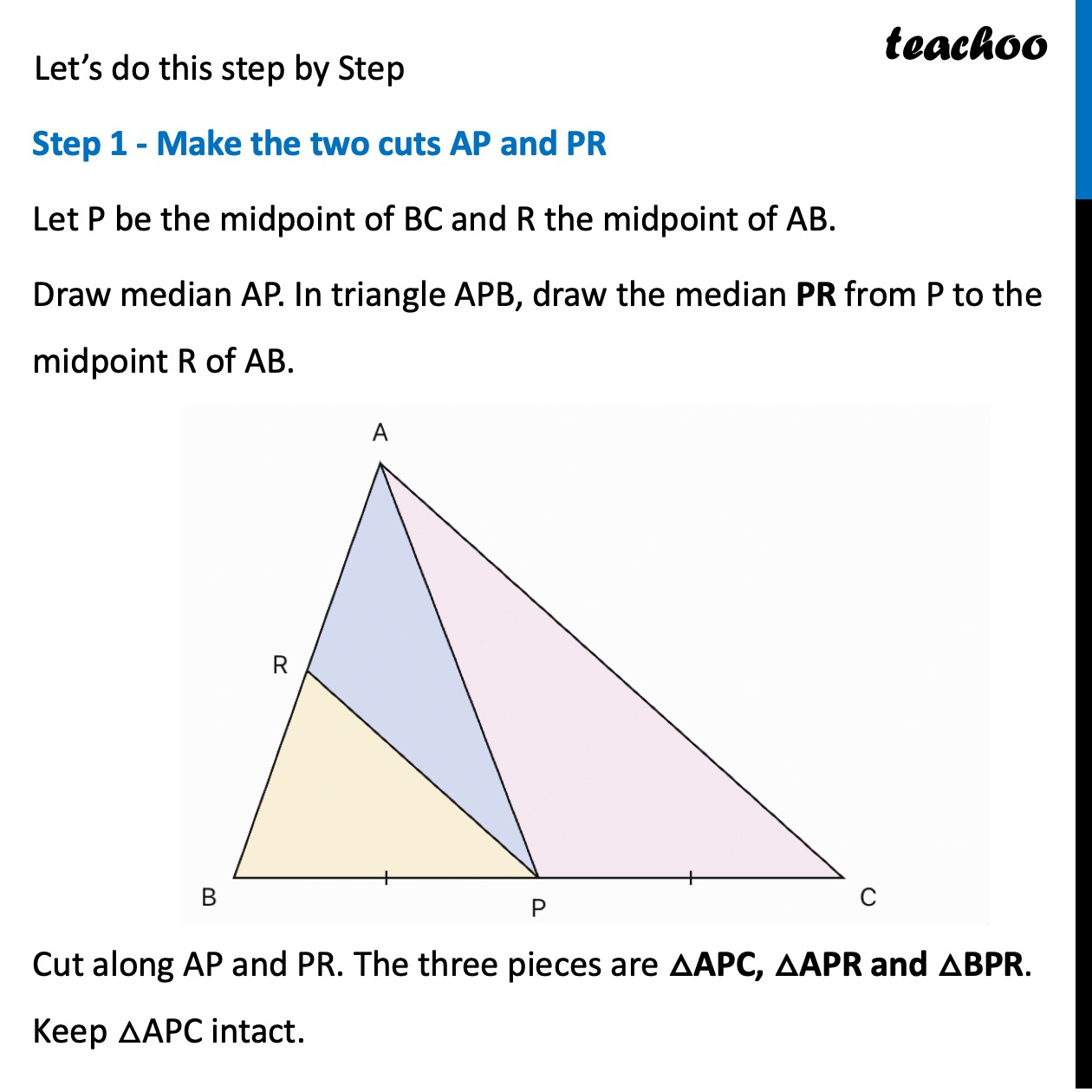
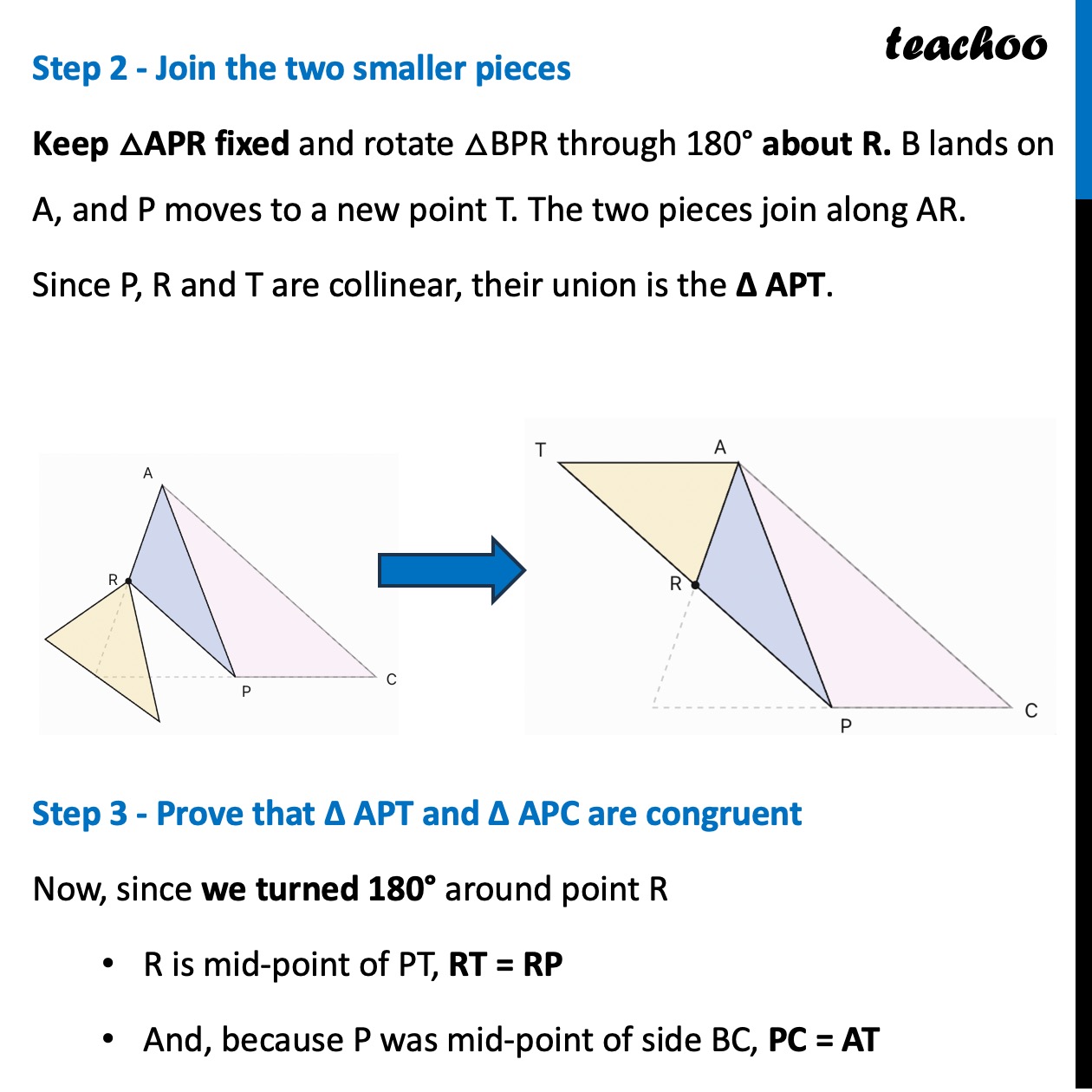
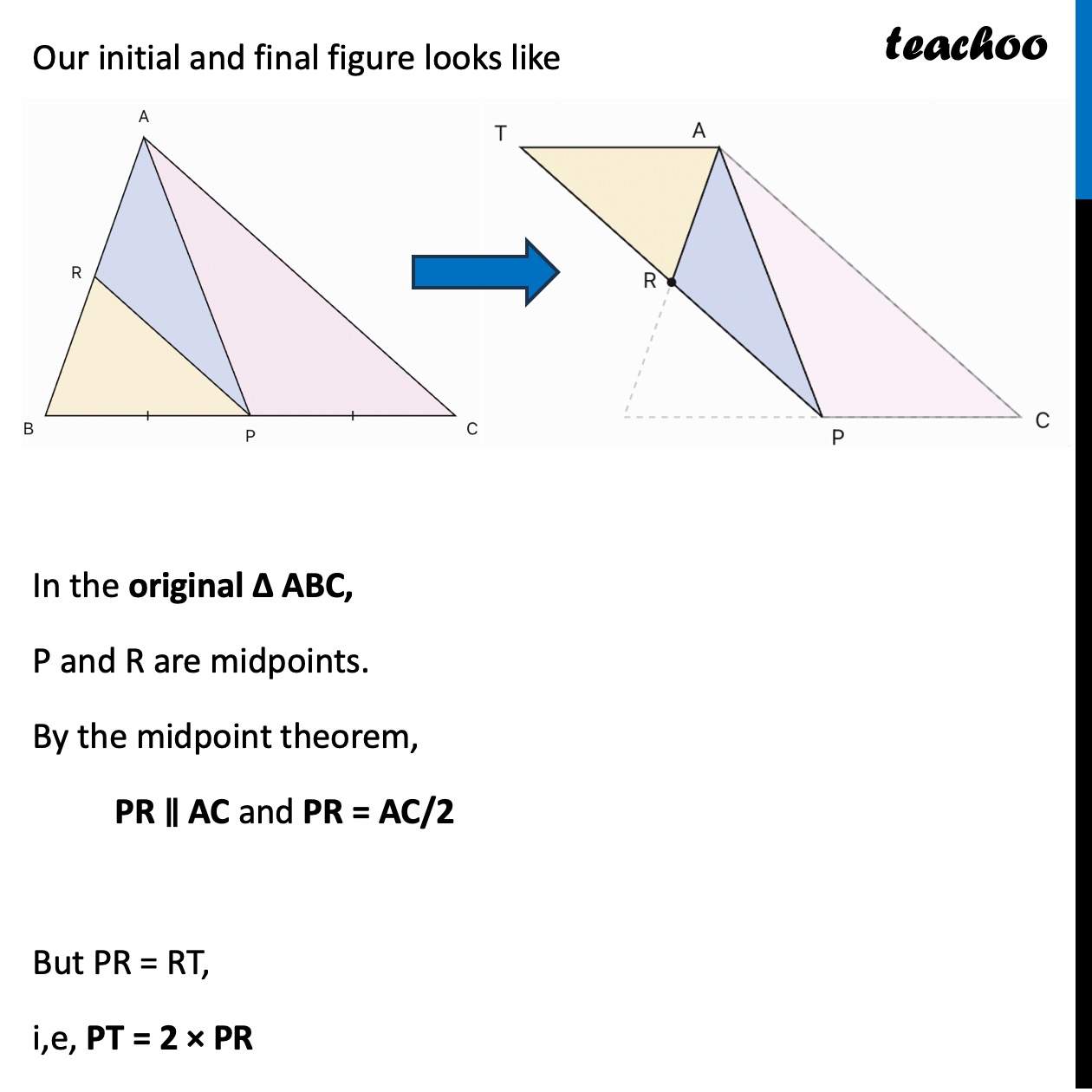
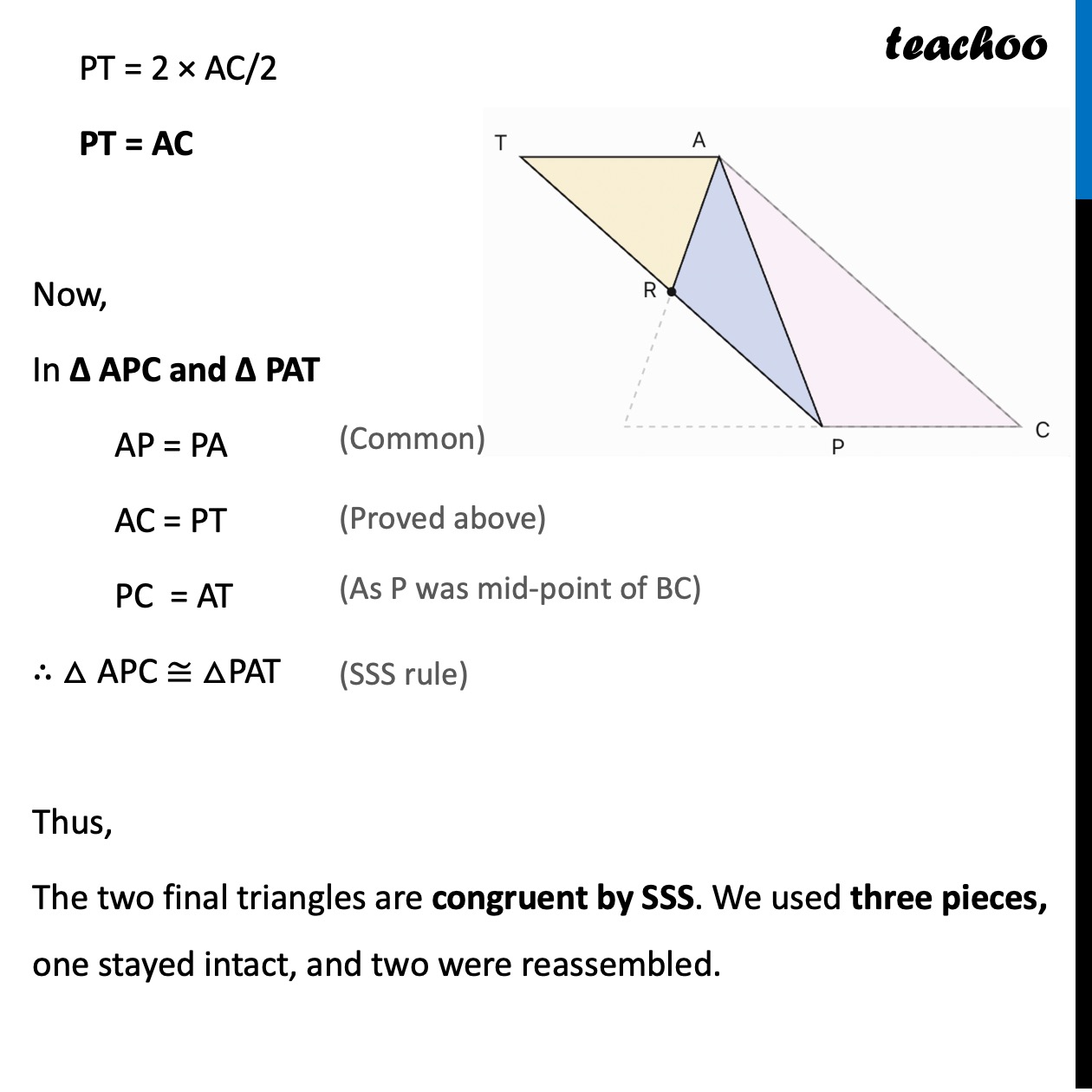
Question 6 (iii) You saw how to use the Midpoint Theorem to divide a given triangle into 4 congruent triangles. Can we divide a triangle into 3 congruent triangles? This exercise shows us how to do that and more, provided we are allowed to cut and reassemble. (iii) Naturally, we can next ask about the possibility of cutting a triangle and reassembling it into 2 congruent triangles. You were asked this question in the chapter Measuring Space: Perimeter and Area. Can you solve this now? (Hint: Use median AP in ∆ABC and then a median of ∆APB.) For any two given figures with straight sides, we can ask whether one figure can be cut (using only straight cuts) into pieces and reassembled to make the other. This notion is called scissors congruence. The figures need not be in the plane. Research on such questions at a higher level is ongoing. Let’s do this step by Step Step 1 - Make the two cuts AP and PR Let P be the midpoint of BC and R the midpoint of AB. Draw median AP. In triangle APB, draw the median PR from P to the midpoint R of AB. Cut along AP and PR. The three pieces are △APC, △APR and △BPR. Keep △APC intact. Step 2 - Join the two smaller pieces Keep △APR fixed and rotate △BPR through 180° about R. B lands on A, and P moves to a new point T. The two pieces join along AR. Since P, R and T are collinear, their union is the ∆ APT. Step 3 - Prove that ∆ APT and ∆ APC are congruent Now, since we turned 180° around point R R is mid-point of PT, RT = RP And, because P was mid-point of side BC, PC = AT Our initial and final figure looks like In the original ∆ ABC, P and R are midpoints. By the midpoint theorem, PR ∥ AC and PR = AC/2 But PR = RT, i,e, PT = 2 × PR PT = 2 × AC/2 PT = AC Now, In ∆ APC and ∆ PAT AP = PA AC = PT PC = AT ∴ △ APC ≅ △PAT Thus, The two final triangles are congruent by SSS. We used three pieces, one stayed intact, and two were reassembled. (Common) (As P was mid-point of BC) (SSS rule) (Proved above)
