End-of-Chapter Exercises

 You are here
Last updated at November 5, 2026 by Teachoo
Transcript
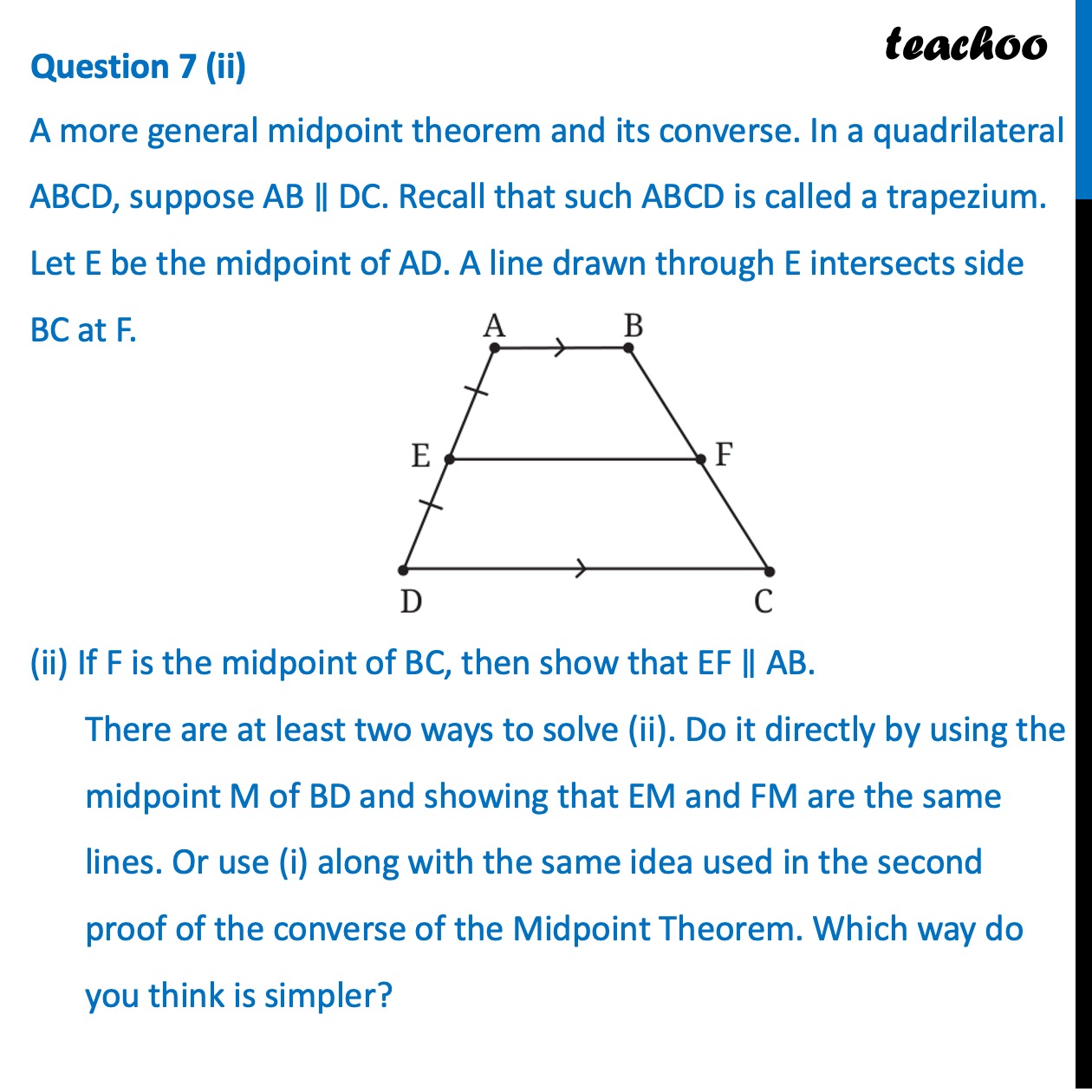
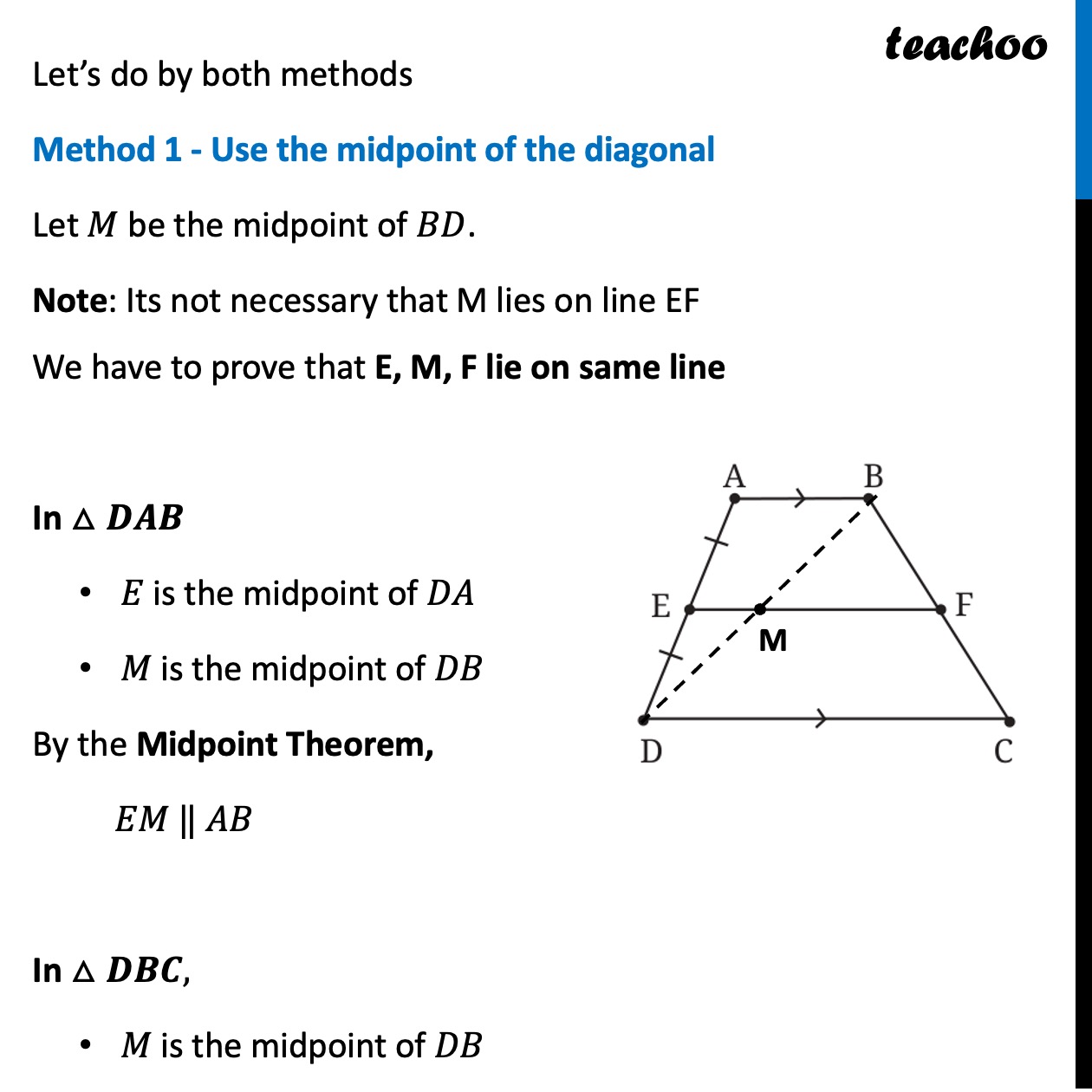
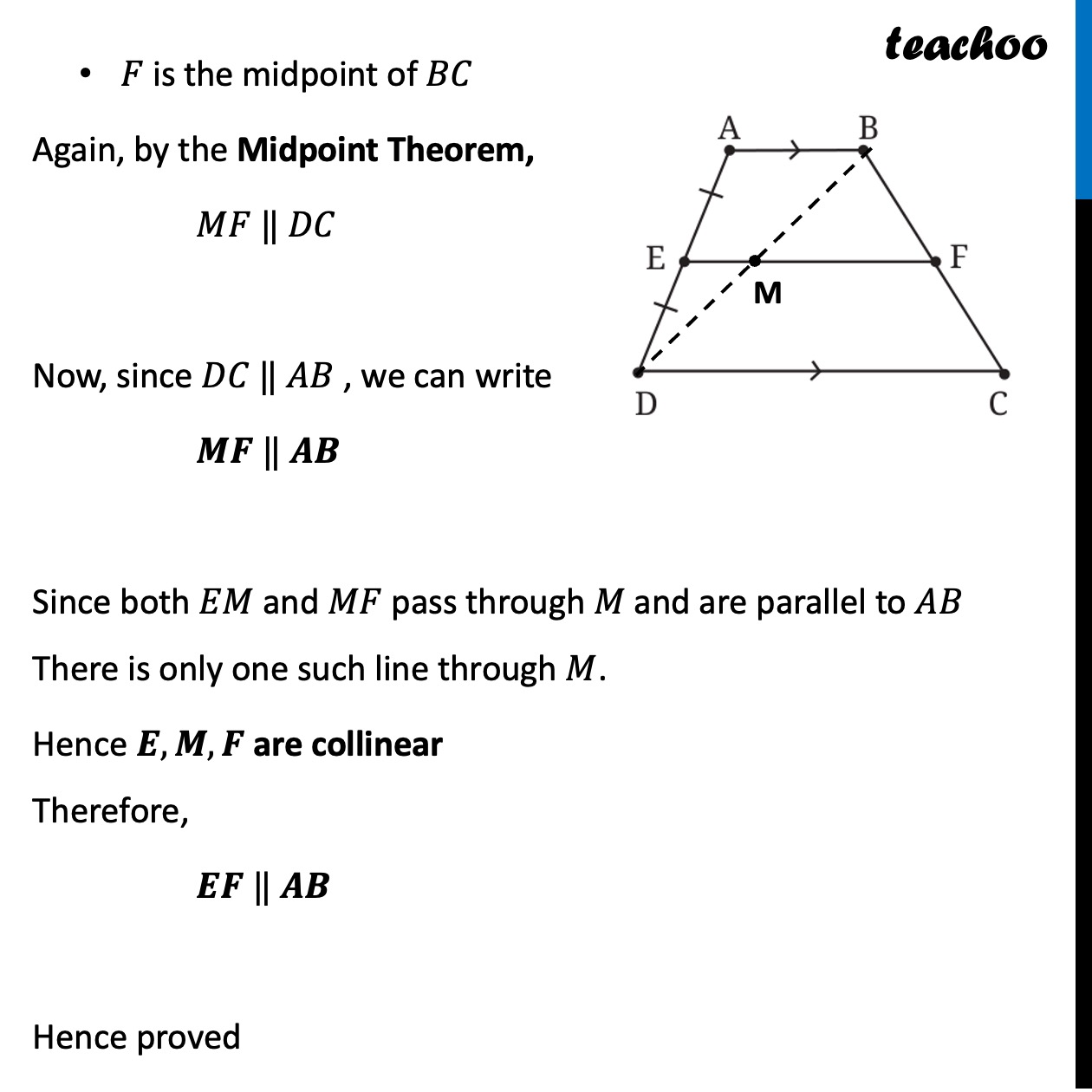
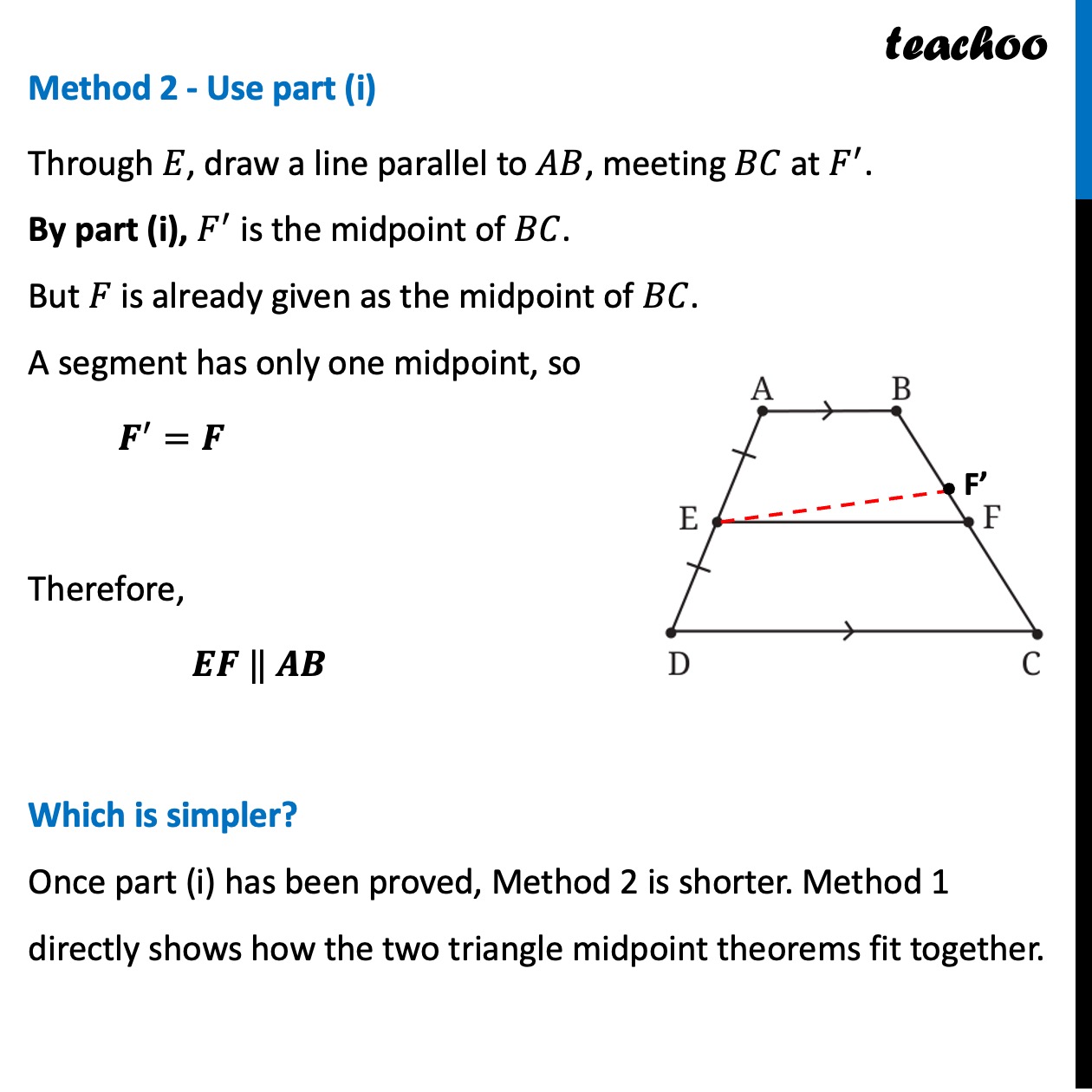
Question 7 (ii) A more general midpoint theorem and its converse. In a quadrilateral ABCD, suppose AB ∥ DC. Recall that such ABCD is called a trapezium. Let E be the midpoint of AD. A line drawn through E intersects side BC at F. (ii) If F is the midpoint of BC, then show that EF ∥ AB. There are at least two ways to solve (ii). Do it directly by using the midpoint M of BD and showing that EM and FM are the same lines. Or use (i) along with the same idea used in the second proof of the converse of the Midpoint Theorem. Which way do you think is simpler? Fig, 12.36 Let’s do by both methods Method 1 - Use the midpoint of the diagonal Let 𝑀 be the midpoint of 𝐵𝐷. Note: Its not necessary that M lies on line EF We have to prove that E, M, F lie on same line In △𝑫𝑨𝑩 𝐸 is the midpoint of 𝐷𝐴 𝑀 is the midpoint of 𝐷𝐵 By the Midpoint Theorem, 𝐸𝑀 ‖ 𝐴𝐵 In △𝑫𝑩𝑪, 𝑀 is the midpoint of 𝐷𝐵 𝐹 is the midpoint of 𝐵𝐶 Again, by the Midpoint Theorem, 𝑀𝐹 ‖ 𝐷𝐶 Now, since 𝐷𝐶 ‖ 𝐴𝐵 , we can write 𝑴𝑭 ‖ 𝑨𝑩 Since both 𝐸𝑀 and 𝑀𝐹 pass through 𝑀 and are parallel to 𝐴𝐵 There is only one such line through 𝑀. Hence 𝑬,𝑴,𝑭 are collinear Therefore: 𝐸𝐹‖𝐴𝐵. M Fig, 12.36 𝐹 is the midpoint of 𝐵𝐶 Again, by the Midpoint Theorem, 𝑀𝐹 ‖ 𝐷𝐶 Now, since 𝐷𝐶 ‖ 𝐴𝐵 , we can write 𝑴𝑭 ‖ 𝑨𝑩 Since both 𝐸𝑀 and 𝑀𝐹 pass through 𝑀 and are parallel to 𝐴𝐵 There is only one such line through 𝑀. Hence 𝑬,𝑴,𝑭 are collinear Therefore, 𝑬𝑭 ‖ 𝑨𝑩 Hence proved M Fig, 12.36 Method 2 - Use part (i) Through 𝐸, draw a line parallel to 𝐴𝐵, meeting 𝐵𝐶 at 𝐹^(′). By part (i), 𝐹^(′) is the midpoint of 𝐵𝐶. But 𝐹 is already given as the midpoint of 𝐵𝐶. A segment has only one midpoint, so 𝑭^(′)=𝑭 Therefore, 𝑬𝑭 ‖ 𝑨𝑩 Which is simpler? Once part (i) has been proved, Method 2 is shorter. Method 1 directly shows how the two triangle midpoint theorems fit together. F’ Fig, 12.36