End-of-Chapter Exercises

 You are here
Last updated at November 5, 2026 by Teachoo
Transcript
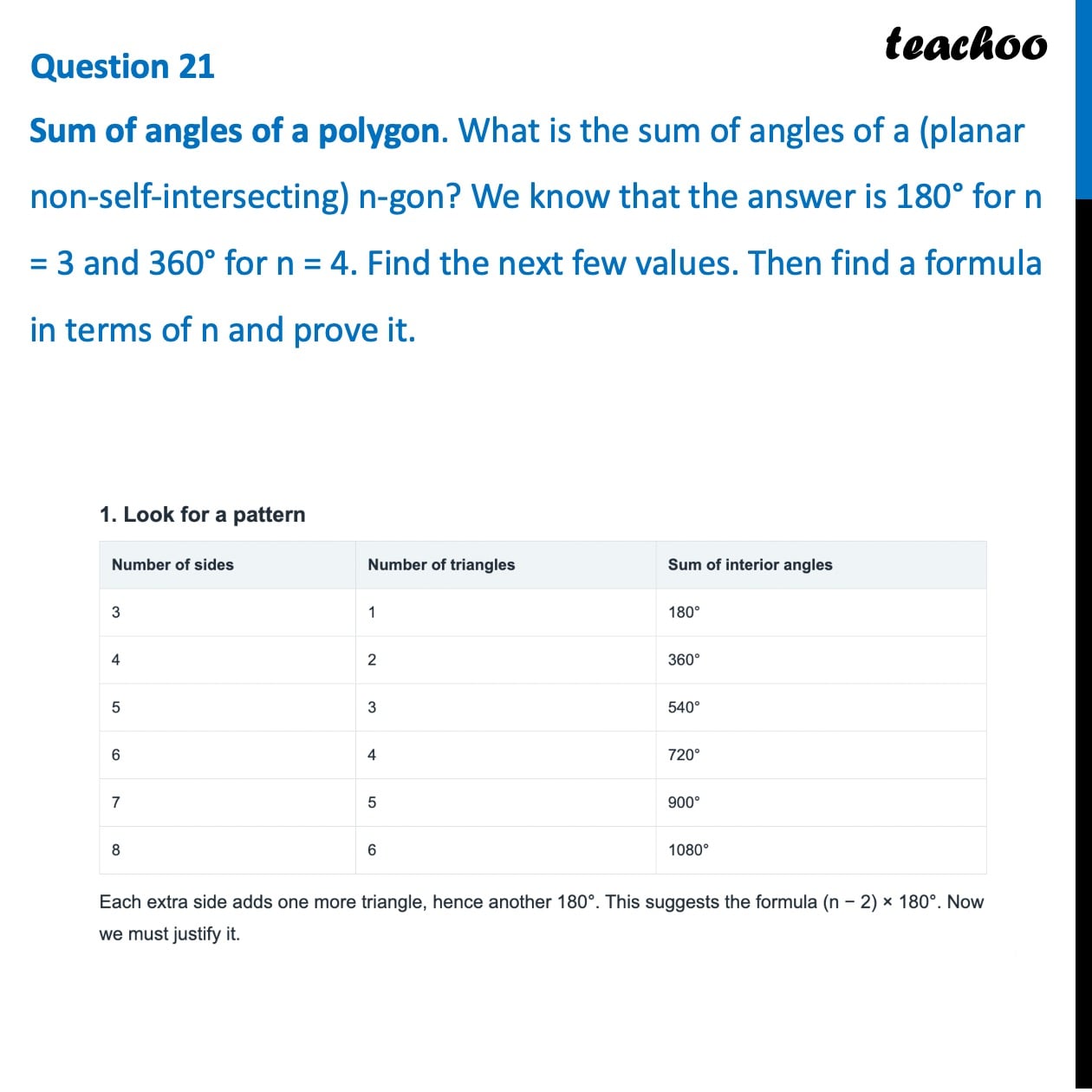
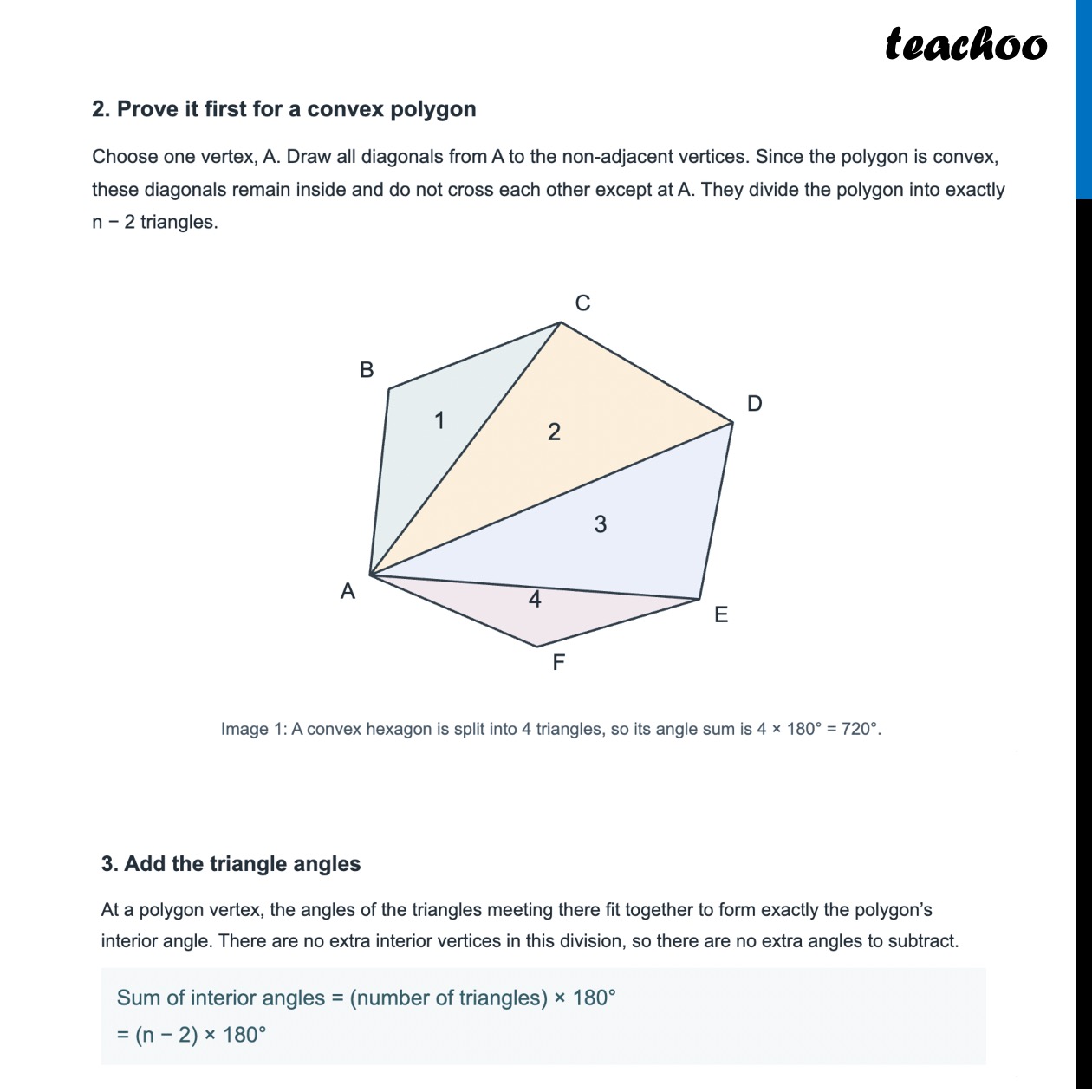
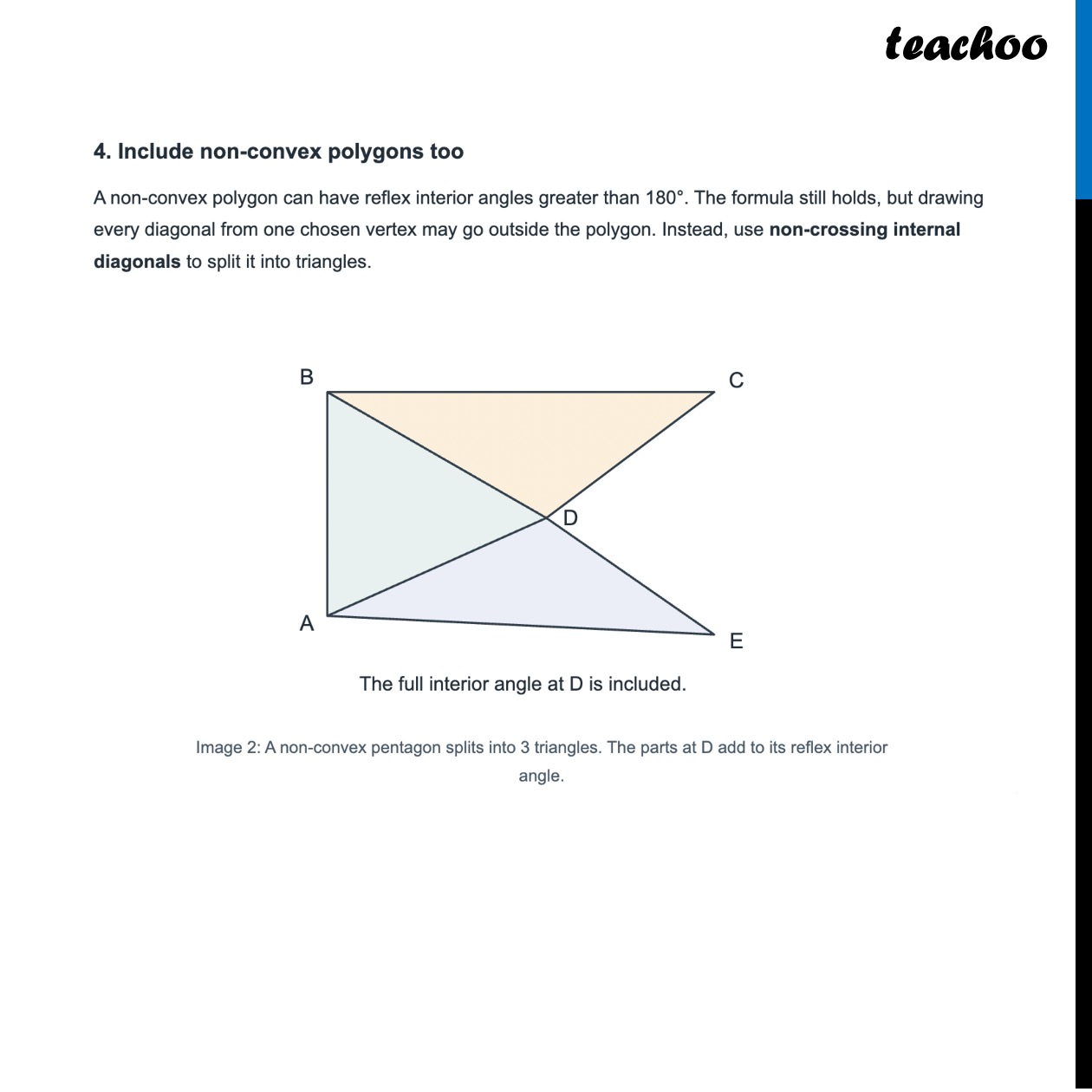
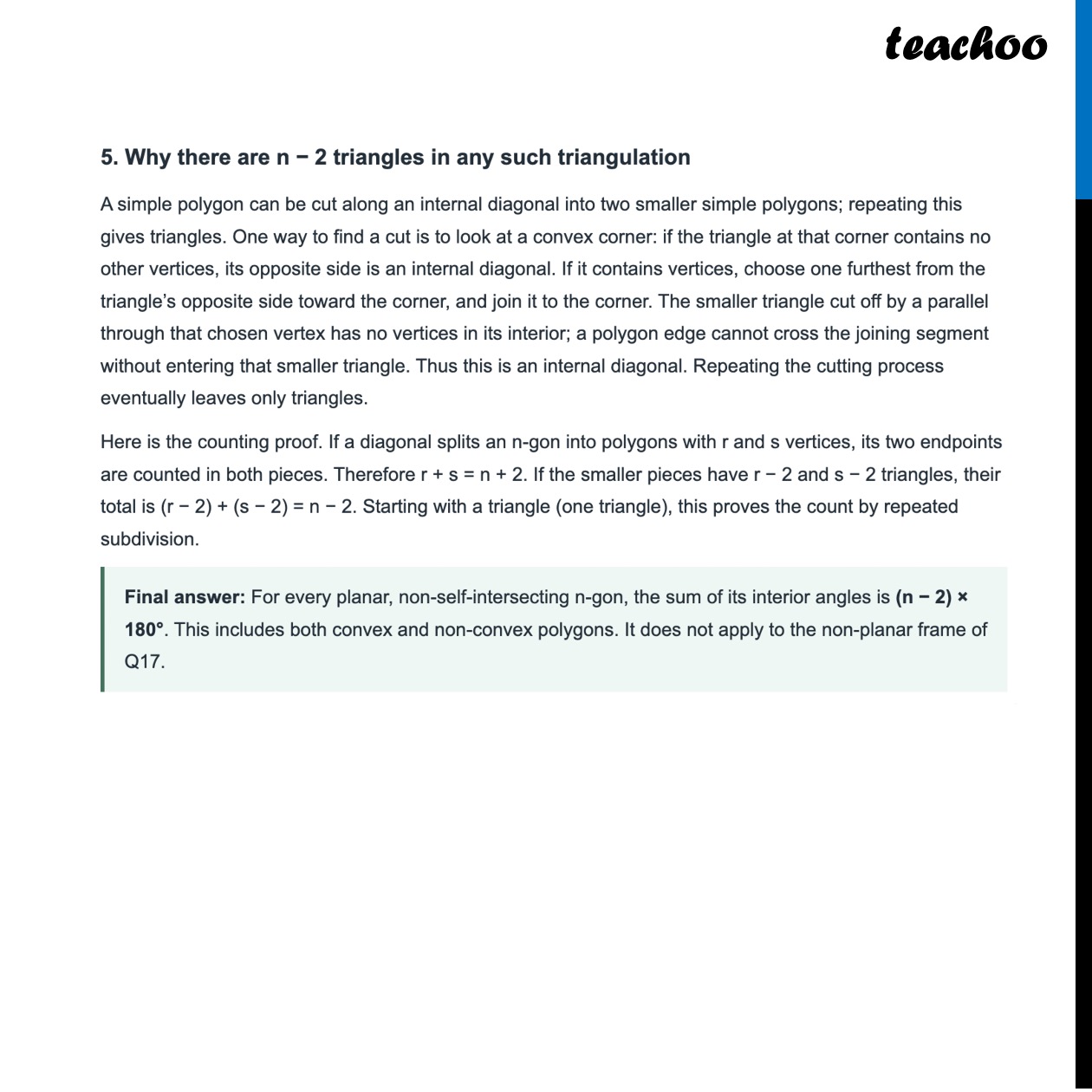
Question 21 Sum of angles of a polygon. What is the sum of angles of a (planar non-self-intersecting) n-gon? We know that the answer is 180° for n = 3 and 360° for n = 4. Find the next few values. Then find a formula in terms of n and prove it. 1. Look for a pattern Number of sides Number of triangles Sum of interior angles 3 1 180° 4 2 360° 5 3 540° 6 4 720° 7 5 900° 8 6 1080° Each extra side adds one more triangle, hence another 180°. This suggests the formula (n — 2) x 180°. Now we must justify it. 2. Prove it first for a convex polygon Choose one vertex, A. Draw all diagonals from A to the non-adjacent vertices. Since the polygon is convex, these diagonals remain inside and do not cross each other except at A. They divide the polygon into exactly n - 2 triangles. Image 1: Aconvex hexagon is split into 4 triangles, so its angle sum is 4 x 180° = 720°. 3. Add the triangle angles At a polygon vertex, the angles of the triangles meeting there fit together to form exactly the polygon’s interior angle. There are no extra interior vertices in this division, so there are no extra angles to subtract. Sum of interior angles = (number of triangles) x 180° = (n - 2) x 180° 4. Include non-convex polygons too A non-convex polygon can have reflex interior angles greater than 180°. The formula still holds, but drawing every diagonal from one chosen vertex may go outside the polygon. Instead, use non-crossing internal diagonals to split it into triangles. The full interior angle at D is included. Image 2: A non-convex pentagon splits into 3 triangles. The parts at D add to its reflex interior angle. 5. Why there are n — 2 triangles in any such triangulation A simple polygon can be cut along an internal diagonal into two smaller simple polygons; repeating this gives triangles. One way to find a cut is to look at a convex corner: if the triangle at that corner contains no other vertices, its opposite side is an internal diagonal. If it contains vertices, choose one furthest from the triangle’s opposite side toward the corner, and join it to the corner. The smaller triangle cut off by a parallel through that chosen vertex has no vertices in its interior; a polygon edge cannot cross the joining segment without entering that smaller triangle. Thus this is an internal diagonal. Repeating the cutting process eventually leaves only triangles. Here is the counting proof. If a diagonal splits an n-gon into polygons with r and s vertices, its two endpoints are counted in both pieces. Therefore r + s = n + 2. If the smaller pieces have r - 2 and s — 2 triangles, their total is (r - 2) + (s - 2) =n - 2. Starting with a triangle (one triangle), this proves the count by repeated subdivision. Final answer: For every planar, non-self-intersecting n-gon, the sum of its interior angles is (n — 2) x 180°. This includes both convex and non-convex polygons. It does not apply to the non-planar frame of Gir.