End-of-Chapter Exercises

 You are here
Last updated at November 5, 2026 by Teachoo
Transcript
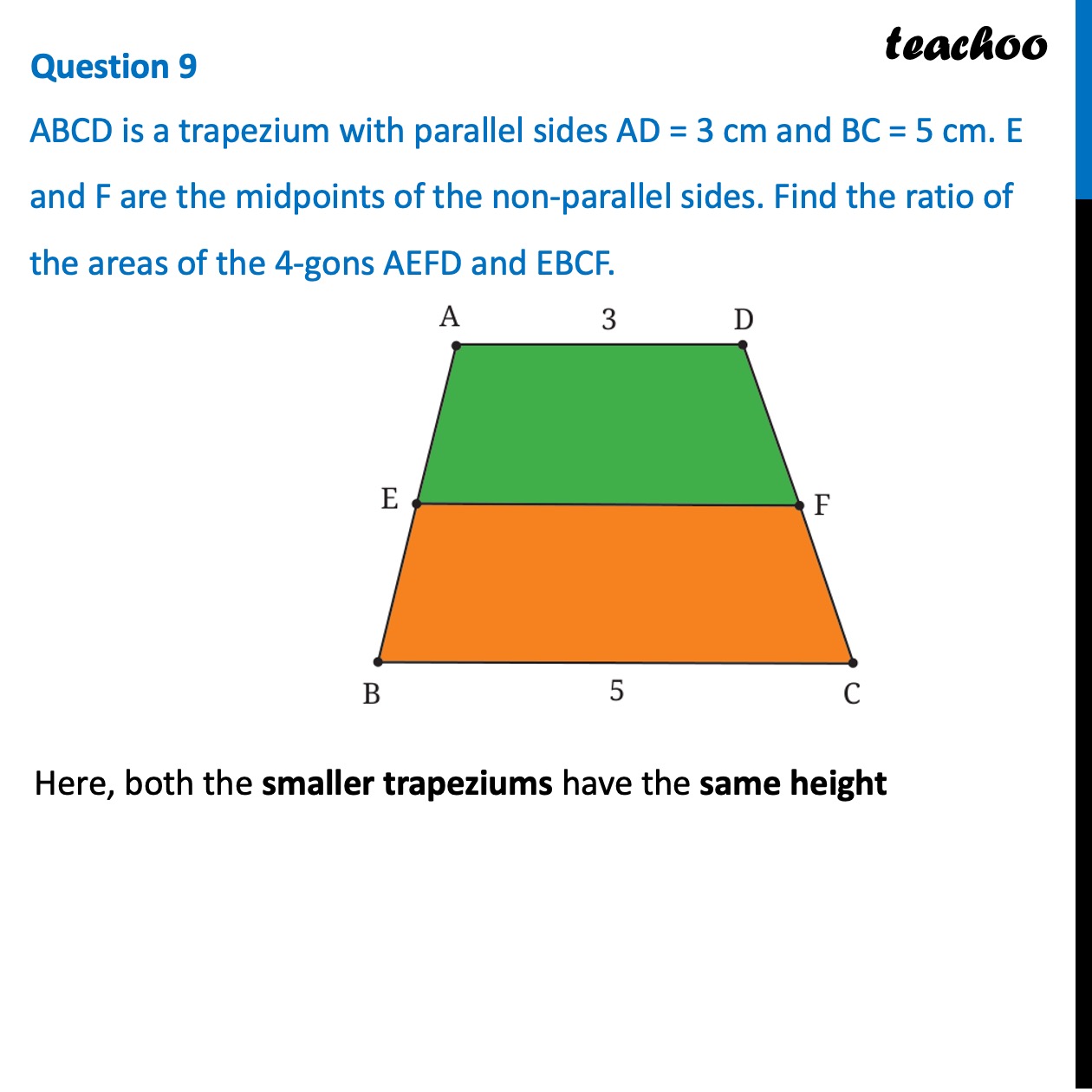
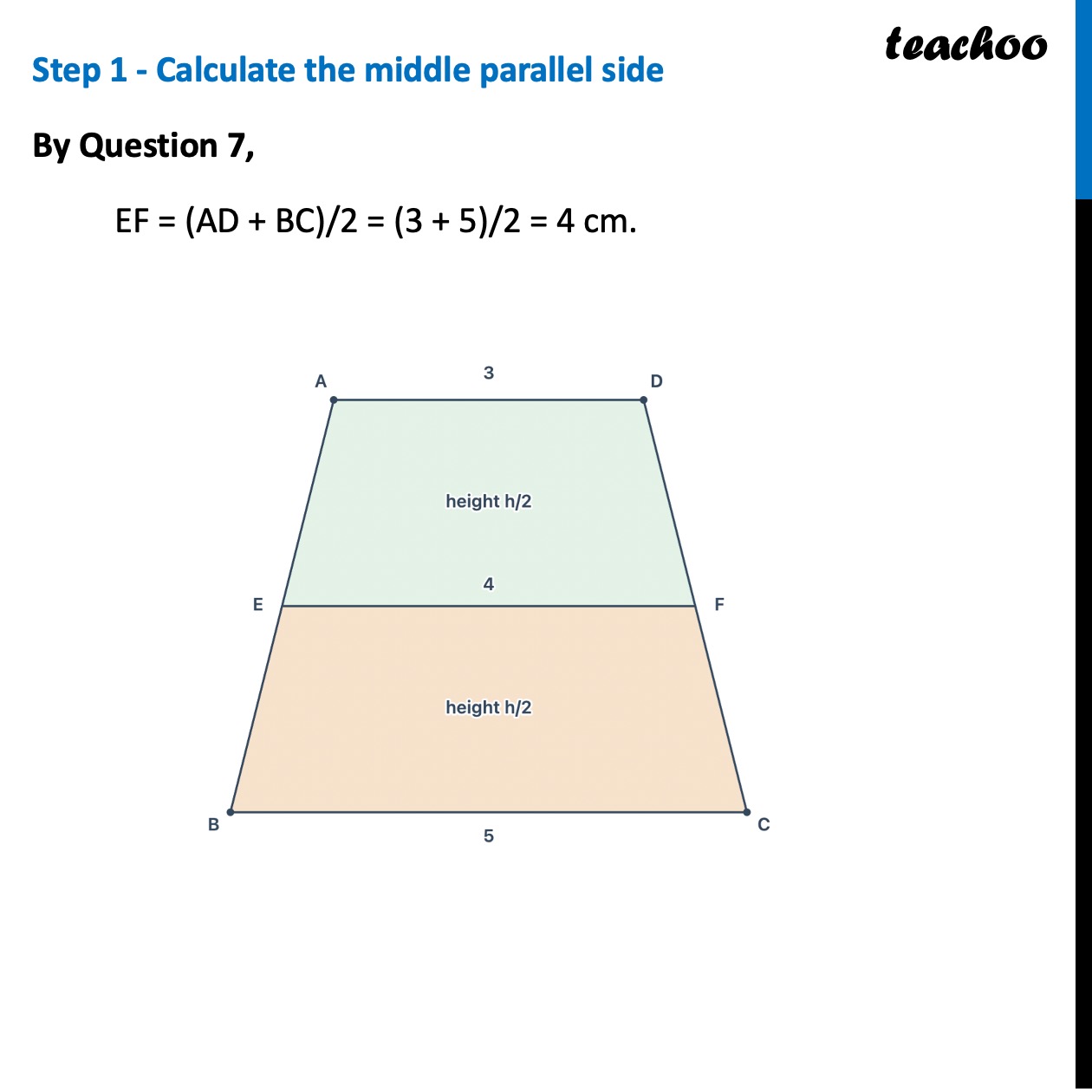
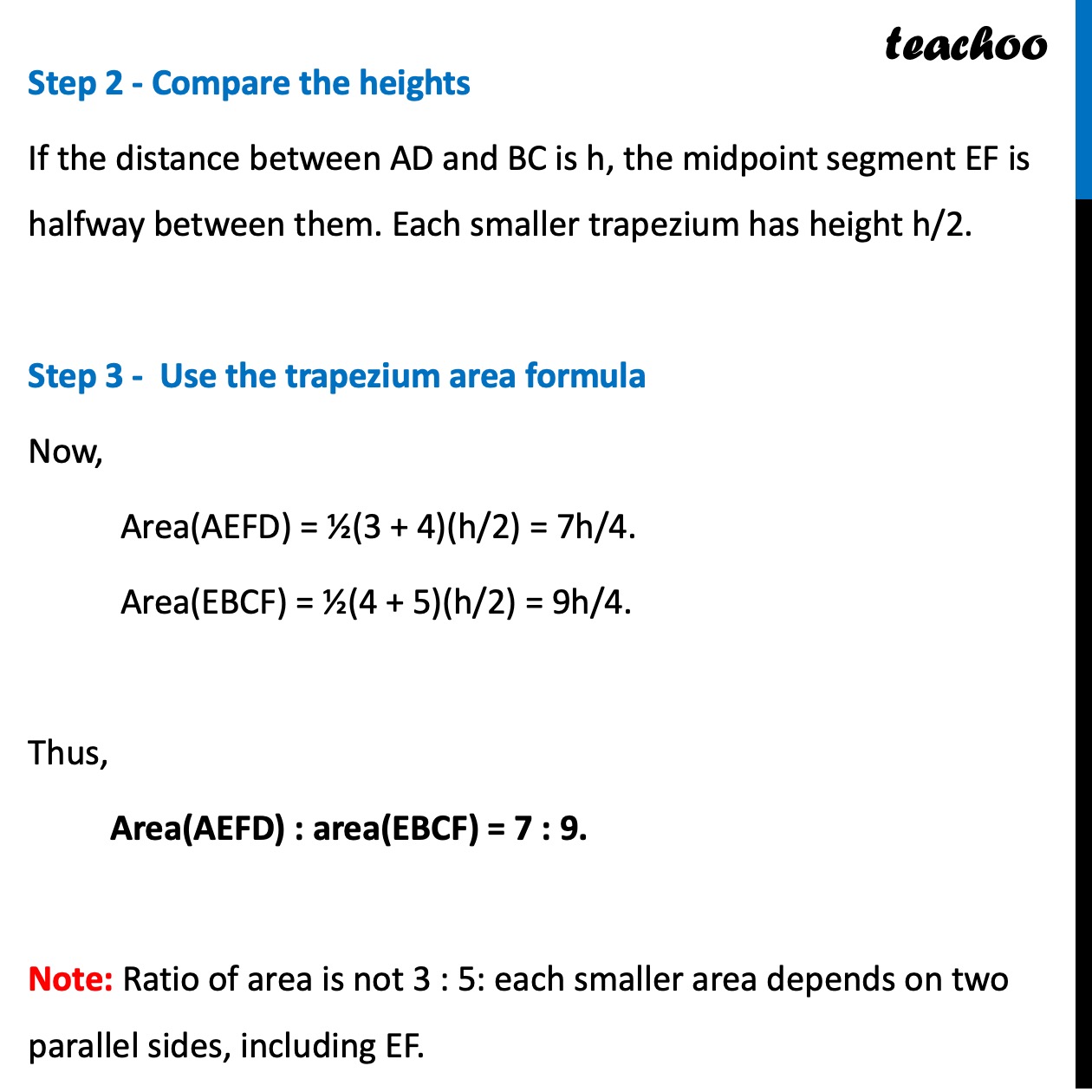
Question 9 ABCD is a trapezium with parallel sides AD = 3 cm and BC = 5 cm. E and F are the midpoints of the non-parallel sides. Find the ratio of the areas of the 4-gons AEFD and EBCF. Here, both the smaller trapeziums have the same height 5 Fig. 12.38 Step 1 - Calculate the middle parallel side By Question 7, EF = (AD + BC)/2 = (3 + 5)/2 = 4 cm. By Question 7, EF = (AD + BC)/2 = (3 + 5)/2=4 cm. height h/2 Both smaller trapeziums have the same height h/2. Step 2 - Compare the heights If the distance between AD and BC is h, the midpoint segment EF is halfway between them. Each smaller trapezium has height h/2. Step 3 - Use the trapezium area formula Now, Area(AEFD) = ½(3 + 4)(h/2) = 7h/4. Area(EBCF) = ½(4 + 5)(h/2) = 9h/4. Thus, Area(AEFD) : area(EBCF) = 7 : 9. Note: Ratio of area is not 3 : 5: each smaller area depends on two parallel sides, including EF.