End-of-Chapter Exercises

 You are here
Last updated at November 5, 2026 by Teachoo
Transcript
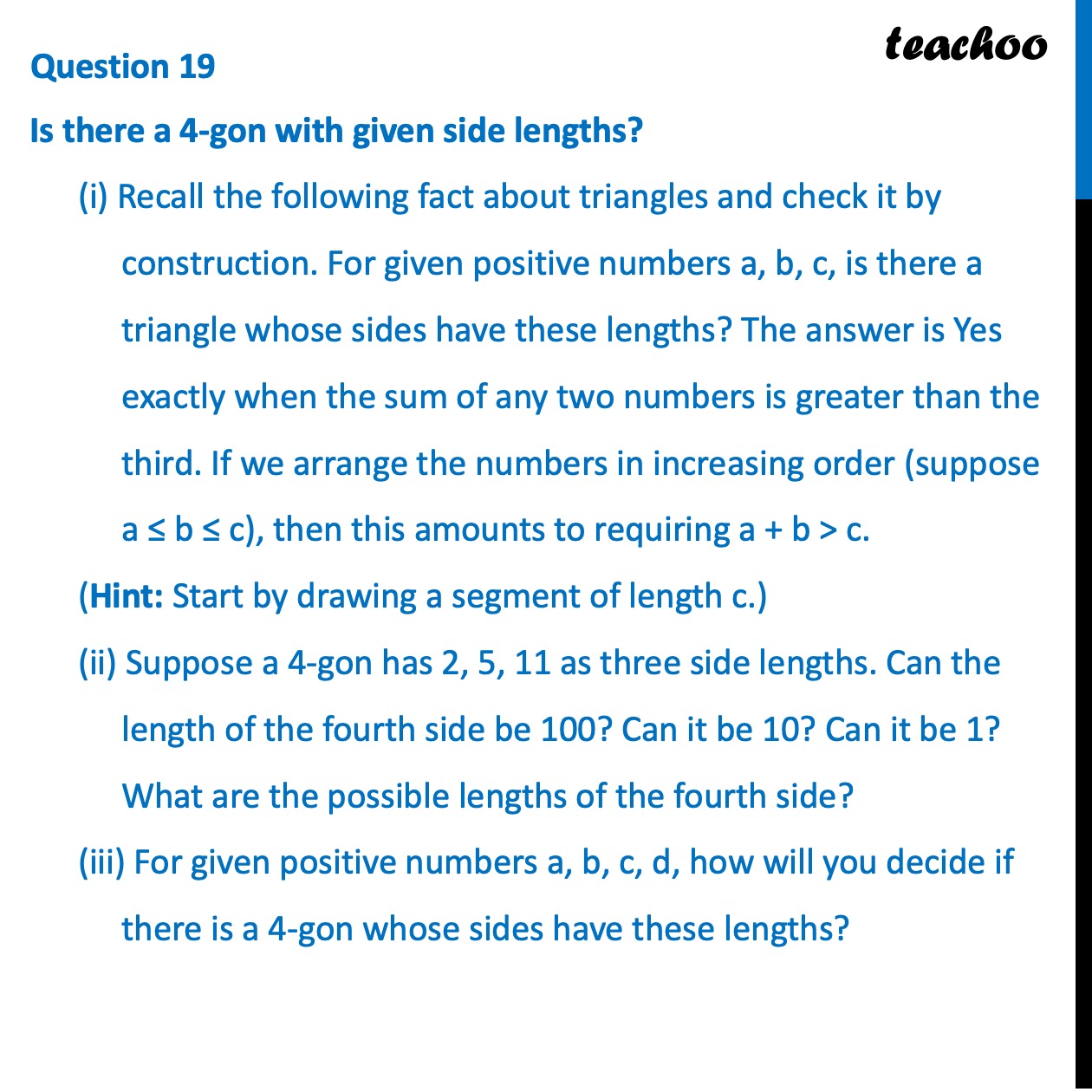
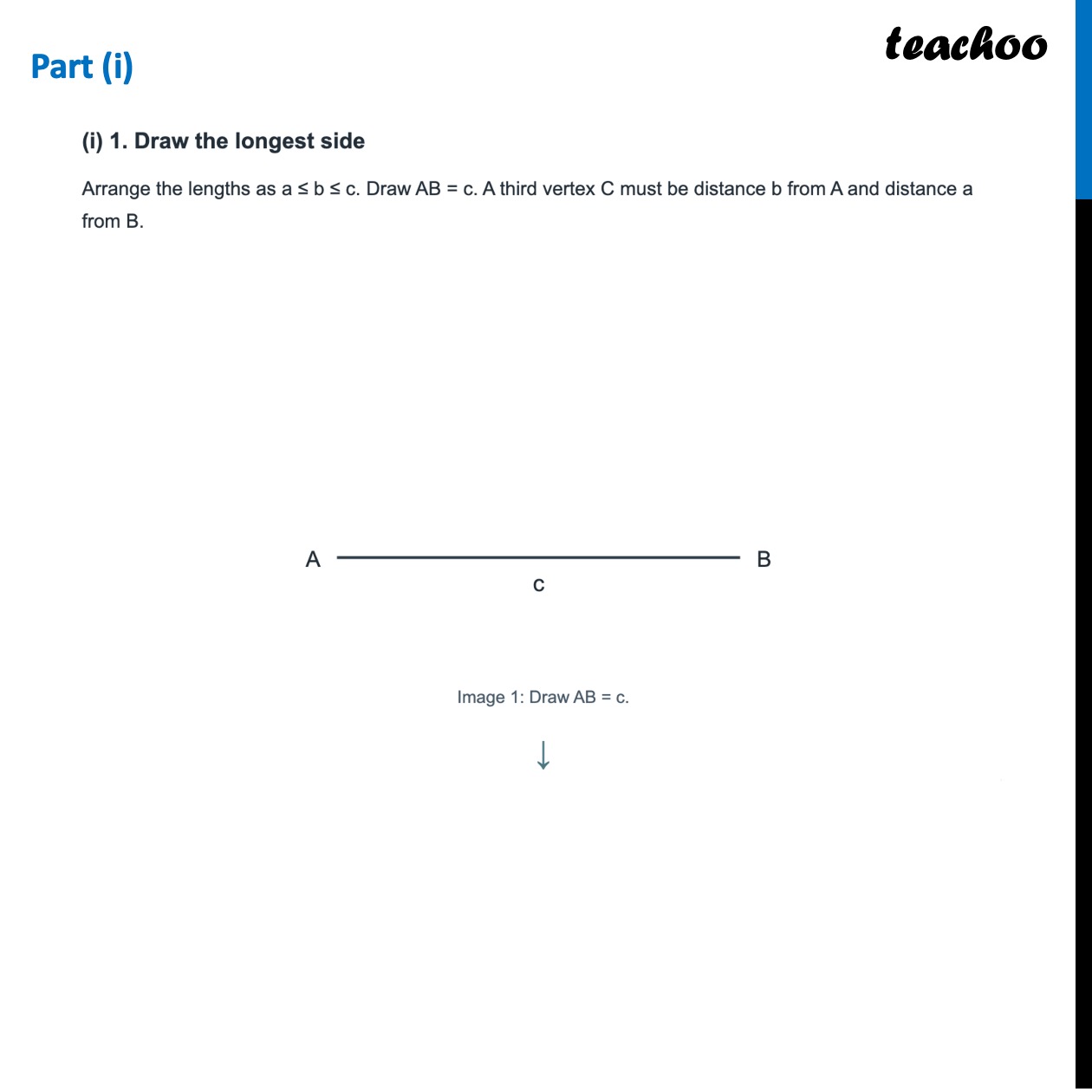
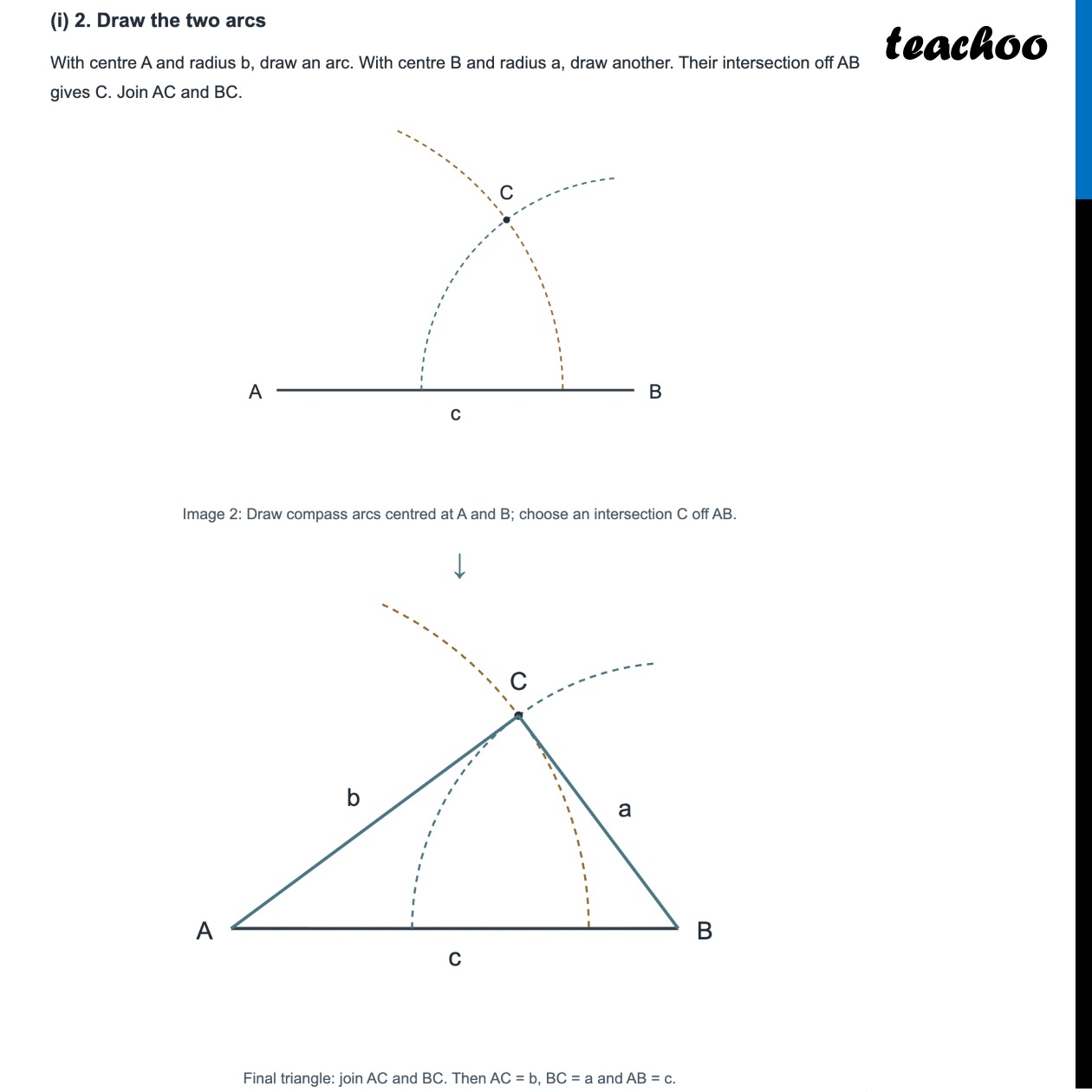
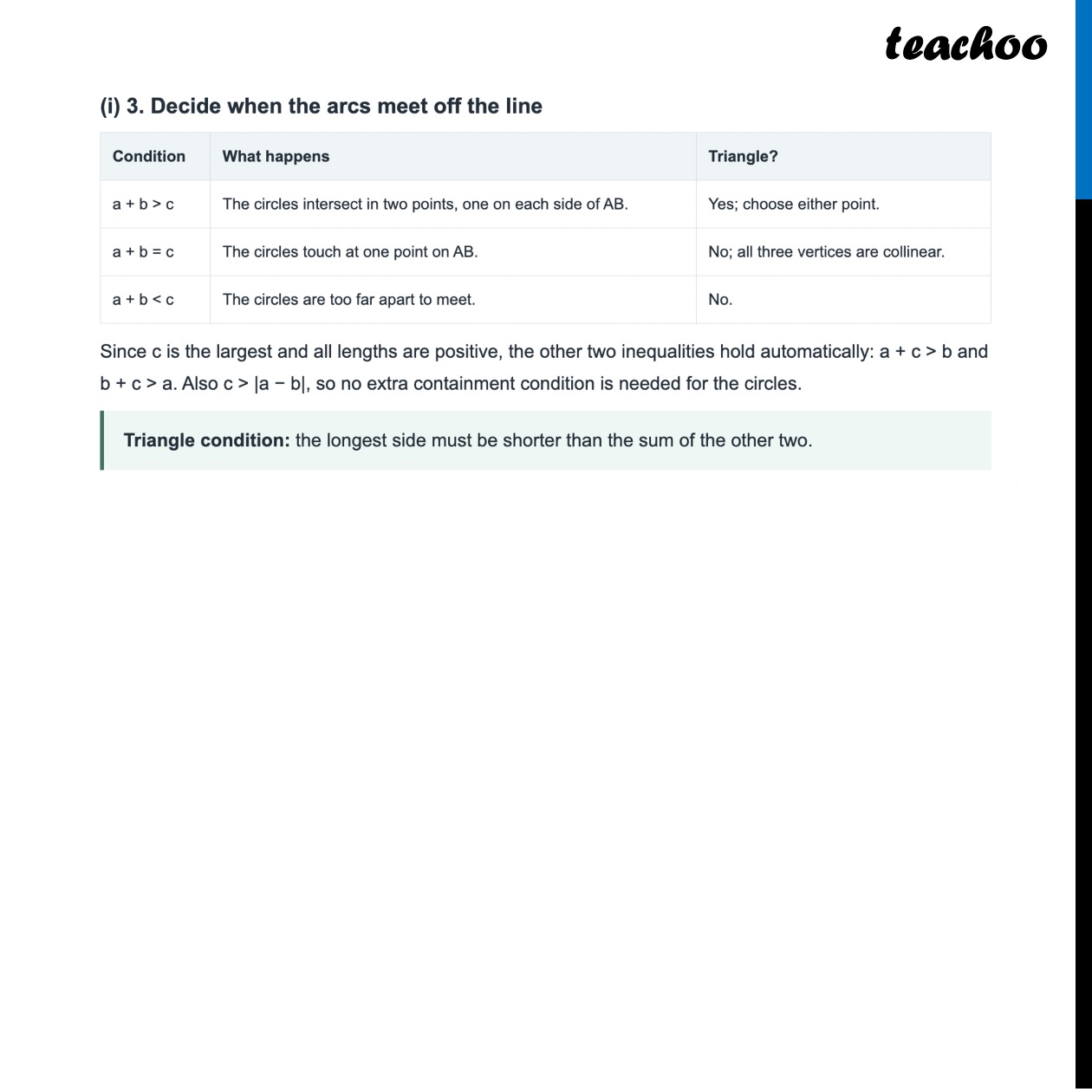
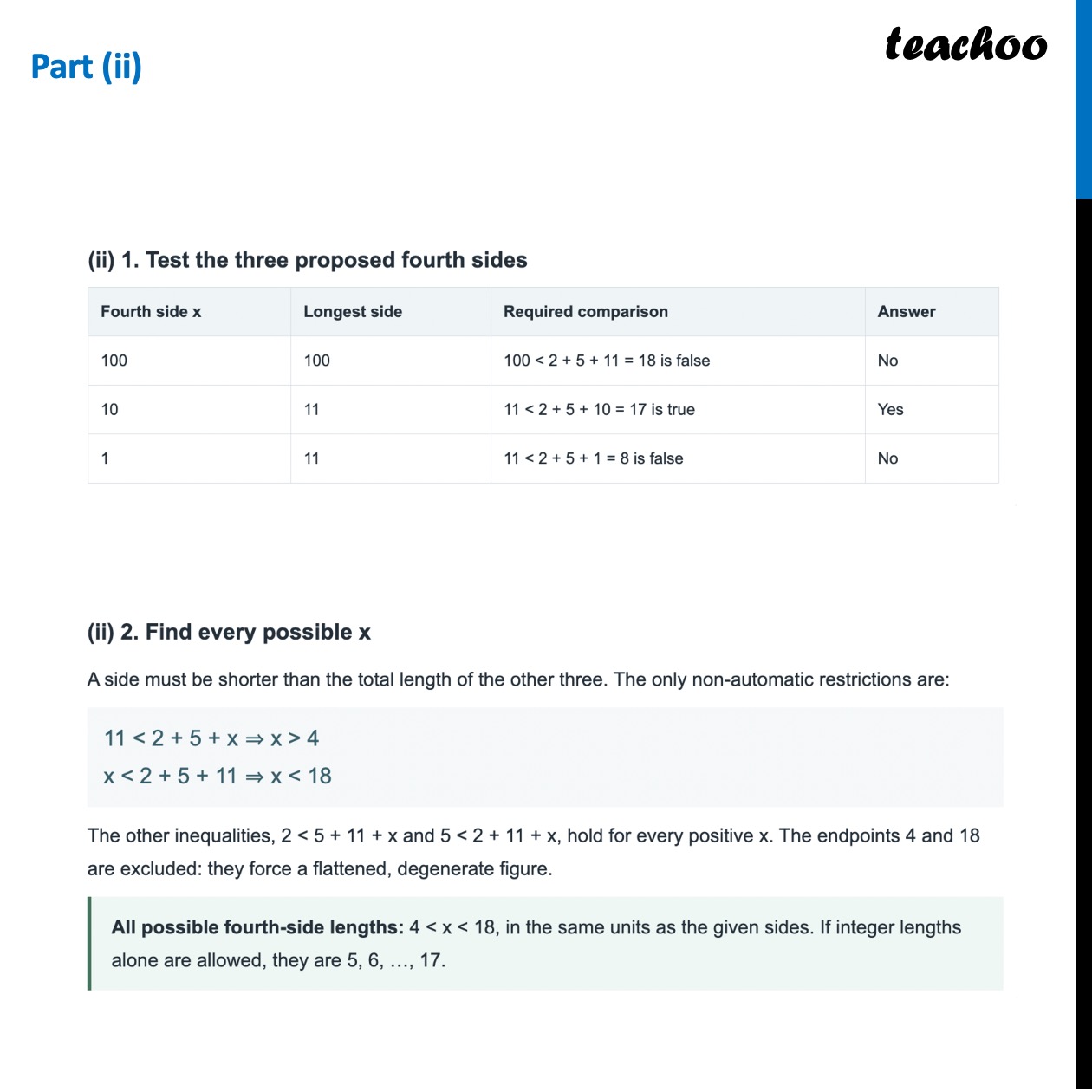
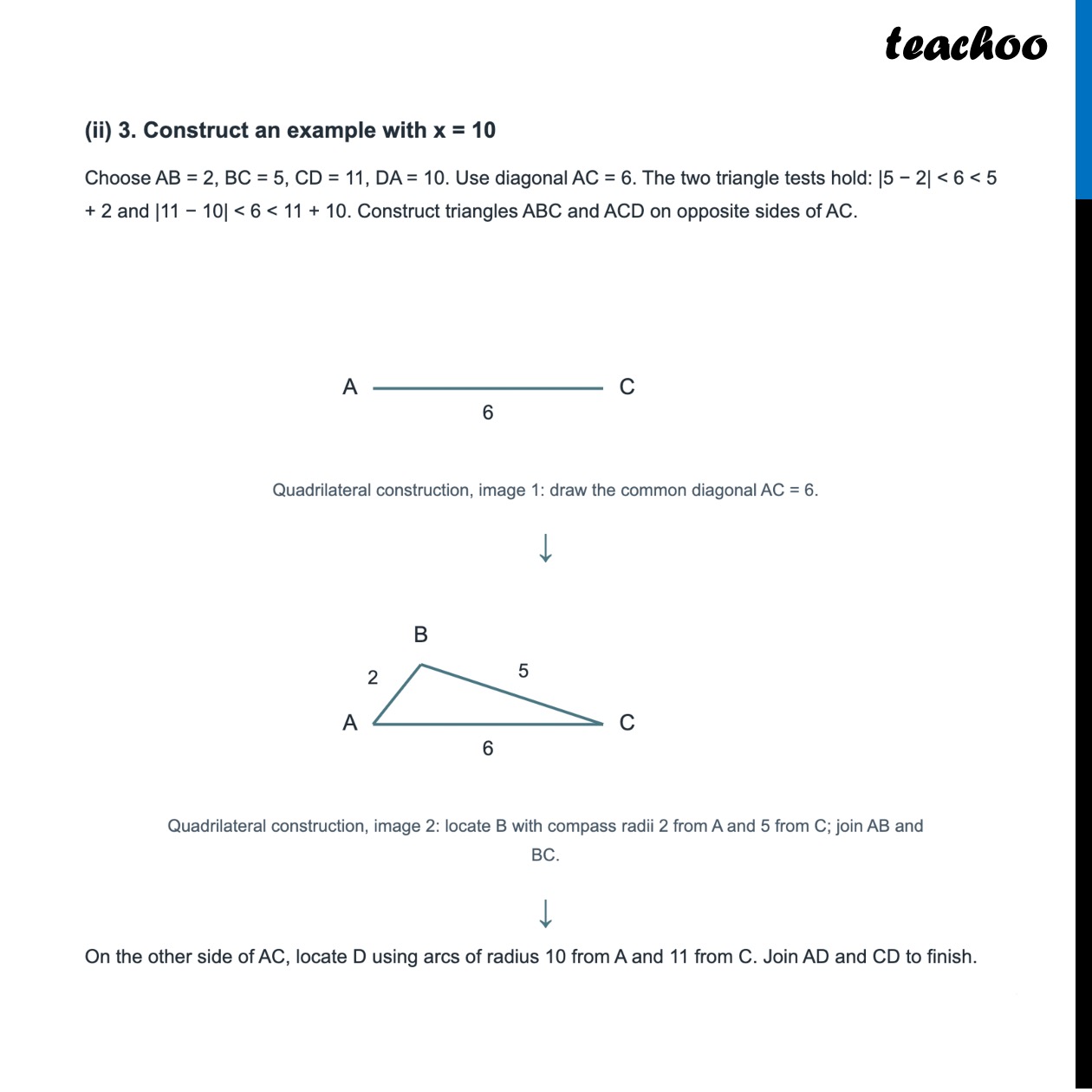
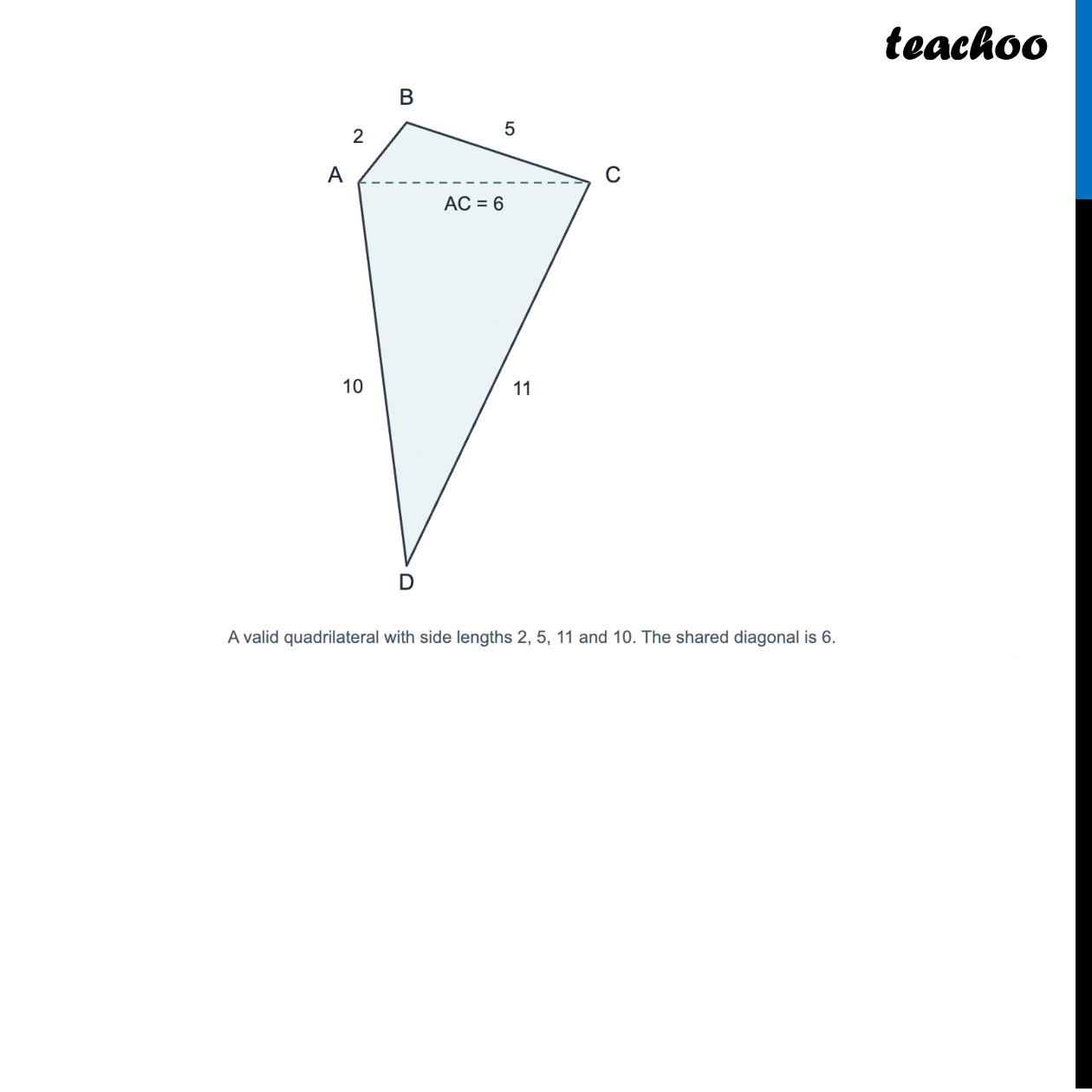
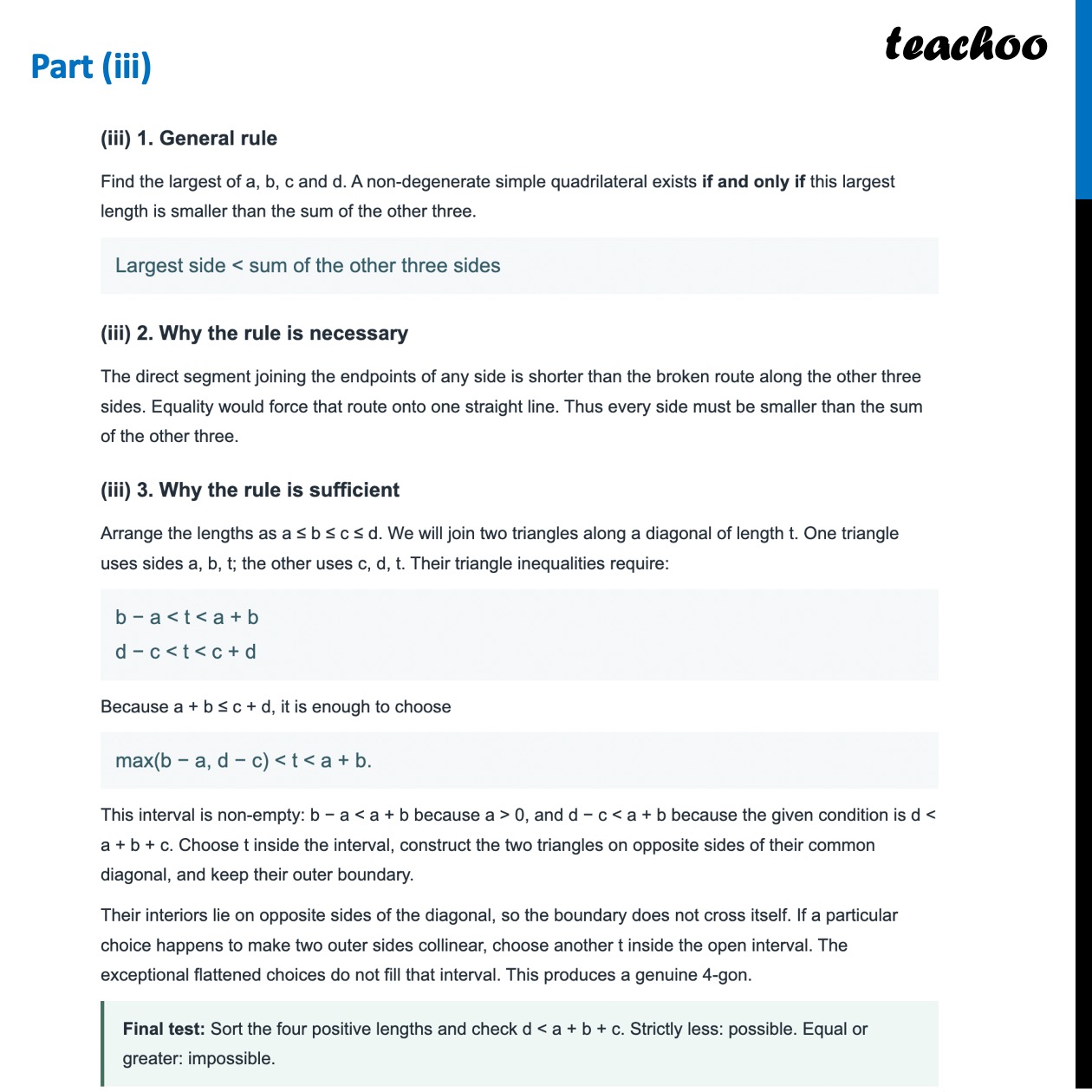
Question 19 Is there a 4-gon with given side lengths? (i) Recall the following fact about triangles and check it by construction. For given positive numbers a, b, c, is there a triangle whose sides have these lengths? The answer is Yes exactly when the sum of any two numbers is greater than the third. If we arrange the numbers in increasing order (suppose a ≤ b ≤ c), then this amounts to requiring a + b > c. (Hint: Start by drawing a segment of length c.) (ii) Suppose a 4-gon has 2, 5, 11 as three side lengths. Can the length of the fourth side be 100? Can it be 10? Can it be 1? What are the possible lengths of the fourth side? (iii) For given positive numbers a, b, c, d, how will you decide if there is a 4-gon whose sides have these lengths? Part (i) (i) 1. Draw the longest side Arrange the lengths as as b sc. Draw AB =. A third vertex C must be distance b from A and distance a from B. Image 1: Draw AB = c. { (i) 2. Draw the two arcs With centre A and radius b, draw an arc. With centre B and radius a, draw another. Their intersection off AB gives C. Join AC and BC. Image 2: Draw compass arcs centred at A and B; choose an intersection C off AB Final triangle: join AC and BC. Then AC = b, BC = a and AB =c. (i) 3. Decide when the arcs meet off the line Condition What happens Triangle? atb>c The circles intersect in two points, one on each side of AB. Yes; choose either point. atb=c The circles touch at one point on AB. No; all three vertices are collinear. atb<c The circles are too far apart to meet. No. Since c is the largest and all lengths are positive, the other two inequalities hold automatically: a + c > b and b +c>a.Alsoc > |a-— bj, so no extra containment condition is needed for the circles. Triangle condition: the longest side must be shorter than the sum of the other two. Part (ii) (ii) 2. Find every possible x Aside must be shorter than the total length of the other three. The only non-automatic restrictions are: 11<2+5+x>x>4 x<2+5+115>x< 18 The other inequalities, 2 <5 +11+x and 5<2+ 11 +x, hold for every positive x. The endpoints 4 and 18 are excluded: they force a flattened, degenerate figure. All possible fourth-side lengths: 4 < x < 18, in the same units as the given sides. If integer lengths alone are allowed, they are 5, 6, ..., 17. (ii) 1. Test the three proposed fourth sides Fourth side x Longest side Required comparison Answer 100 100 100 <2+5+ 11 = 18 is false No 10 11 11<2+5+ 10=17 is true Yes 4 11 11<2+5+1=8is false No (ii) 3. Construct an example with x = 10 Choose AB = 2, BC = 5, CD = 11, DA= 10. Use diagonal AC = 6. The two triangle tests hold: |5 - 2| <6 <5 + 2 and |11 -— 10] < 6 < 11 + 10. Construct triangles ABC and ACD on opposite sides of AC. Quadrilateral construction, image 1: draw the common diagonal AC = 6. { Lr A C 6 Quadrilateral construction, image 2: locate B with compass radii 2 from A and 5 from C; join AB and BC. On the other side of AC, locate D using arcs of radius 10 from A and 11 from C. Join AD and CD to finish. 5 NO 10 11 D A valid quadrilateral with side lengths 2, 5, 11 and 10. The shared diagonal is 6. Part (iii) (iii) 1. General rule Find the largest of a, b, c and d. Anon-degenerate simple quadrilateral exists if and only if this largest length is smaller than the sum of the other three. Largest side < sum of the other three sides (iii) 2. Why the rule is necessary The direct segment joining the endpoints of any side is shorter than the broken route along the other three sides. Equality would force that route onto one straight line. Thus every side must be smaller than the sum of the other three. (iii) 3. Why the rule is sufficient Arrange the lengths as as b $c <d. We will join two triangles along a diagonal of length t. One triangle uses sides a, b, t; the other uses c, d, t. Their triangle inequalities require: b-a<t<atb d-c<t<ctd Because a + b $c +d, it is enough to choose max(b -a,d-c)<t<atb. This interval is non-empty: b - a < a + b because a > 0, and d - c <a + b because the given condition is d < a +b +c. Choose t inside the interval, construct the two triangles on opposite sides of their common diagonal, and keep their outer boundary. Their interiors lie on opposite sides of the diagonal, so the boundary does not cross itself. If a particular choice happens to make two outer sides collinear, choose another t inside the open interval. The exceptional flattened choices do not fill that interval. This produces a genuine 4-gon. Final test: Sort the four positive lengths and check d < a+b +c. Strictly less: possible. Equal or greater: impossible.