End-of-Chapter Exercises

 You are here
End-of-Chapter Exercises
Last updated at August 14, 2026 by Teachoo
Transcript
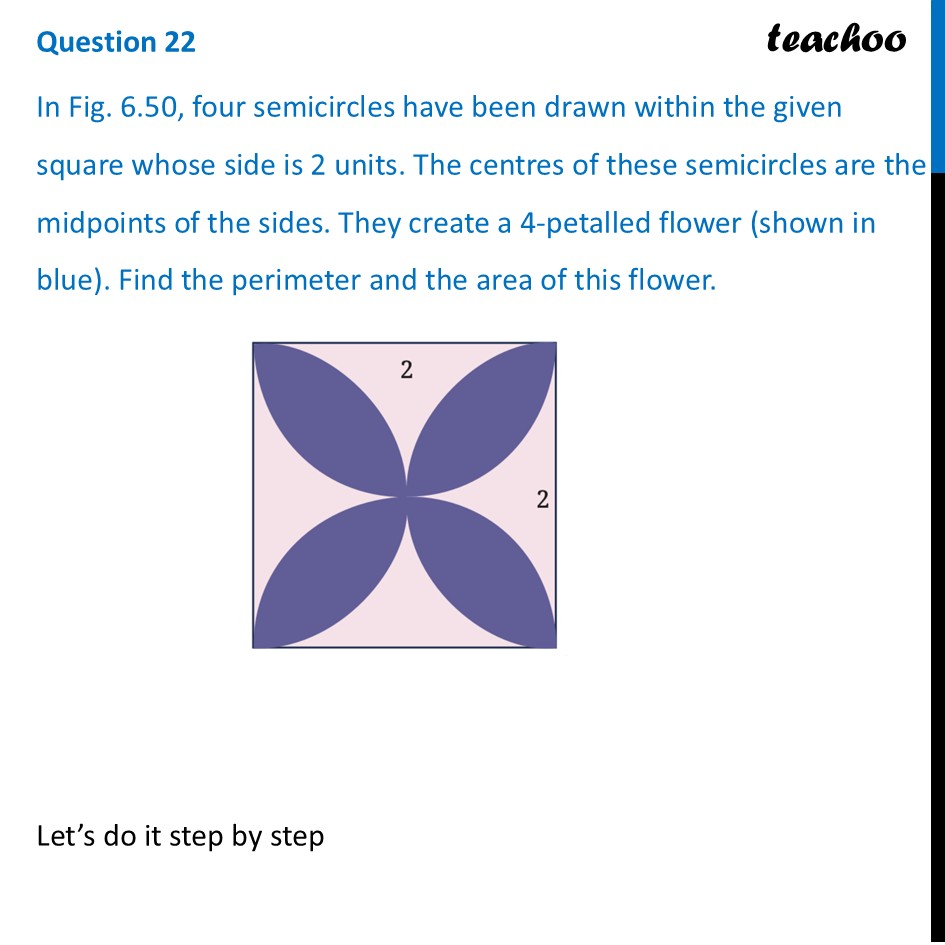
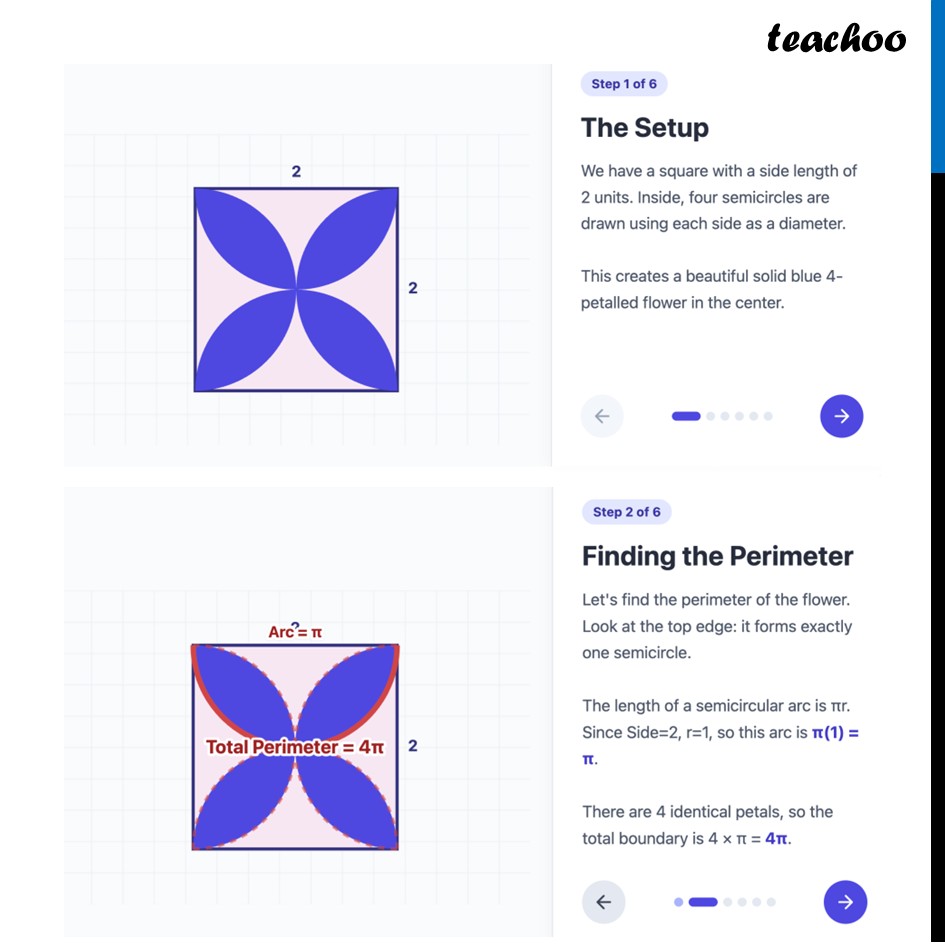
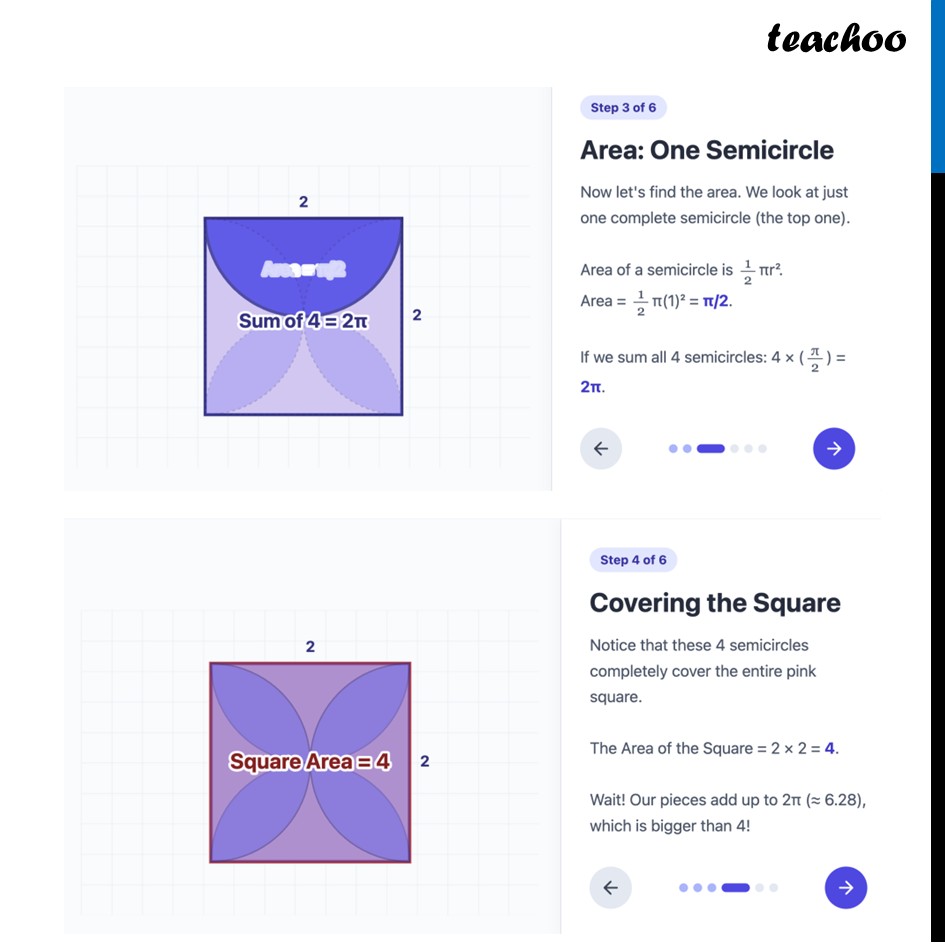
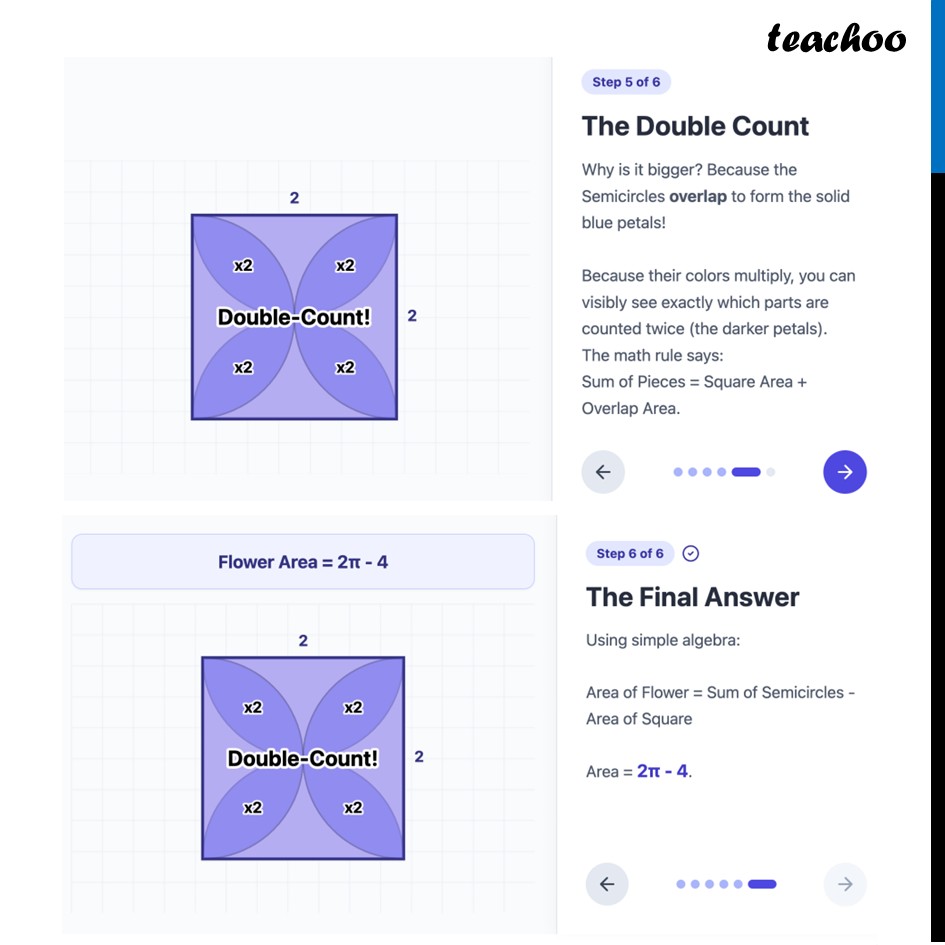
Question 22 In Fig. 6.50, four semicircles have been drawn within the given square whose side is 2 units. The centres of these semicircles are the midpoints of the sides. They create a 4-petalled flower (shown in blue). Find the perimeter and the area of this flower. Let’s do it step by step Step 1 of 6 The Setup We have a square with a side length of 2 units. Inside, four semicircles are drawn using each side as a diameter. This creates a beautiful solid blue 4petalled flower in the center. Step 2 of 6 Finding the Perimeter Let's find the perimeter of the flower. Look at the top edge: it forms exactly one semicircle. The length of a semicircular arc is πr. Since Side =2,r=1, so this arc is π(1)= π. There are 4 identical petals, so the total boundary is 4×π=4π Step 3 of 6 Area: One Semicircle Now let's find the area. We look at just one complete semicircle (the top one). Area of a semicircle is 1/2 πr^2. Area =1/2 π(1)^2=π/2. If we sum all 4 semicircles: 4×(π/2)=2π. Step 4 of 6 Covering the Square Notice that these 4 semicircles completely cover the entire pink square. The Area of the Square =2×2=4. Wait! Our pieces add up to 2π(≈6.28), which is bigger than 4 ! Step 5 of 6 The Double Count Why is it bigger? Because the Semicircles overlap to form the solid blue petals! Because their colors multiply, you can visibly see exactly which parts are counted twice (the darker petals). The math rule says: Sum of Pieces = Square Area + Overlap Area. Step 6 of 6 The Final Answer Using simple algebra: Area of Flower = Sum of Semicircles Area of Square Area .