![[Class 9] What fraction of the triangle is shaded? - Ganita Manjari - End-of-Chapter Exercises](https://cdn.teachoo.com/9c342add-6c2a-4f79-8d6d-d70740aa9f8a/slide126.jpg)
End-of-Chapter Exercises

 You are here
End-of-Chapter Exercises
Last updated at August 14, 2026 by Teachoo
Transcript
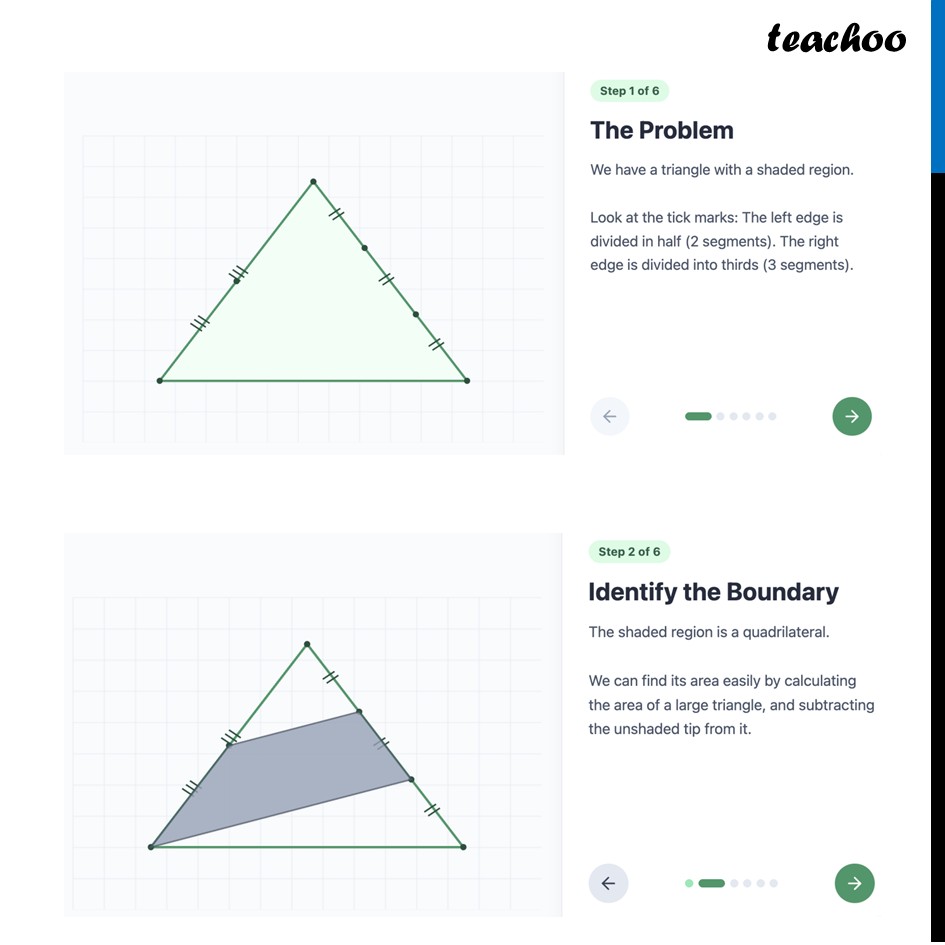
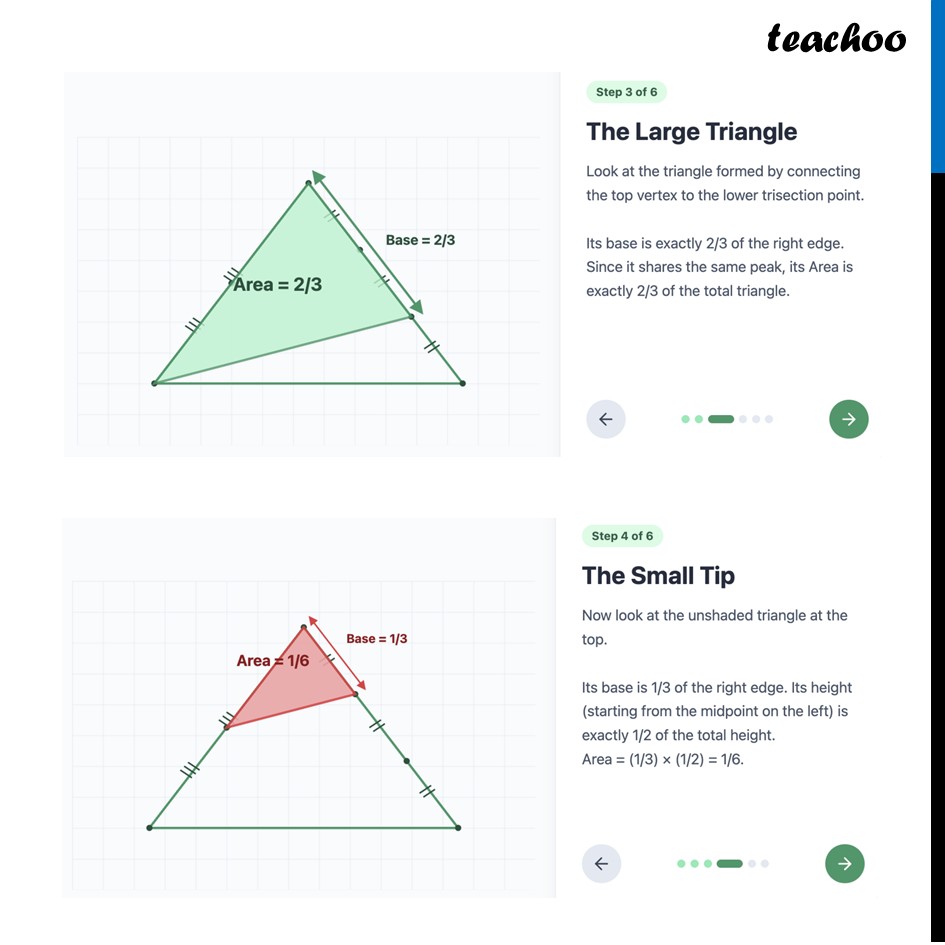
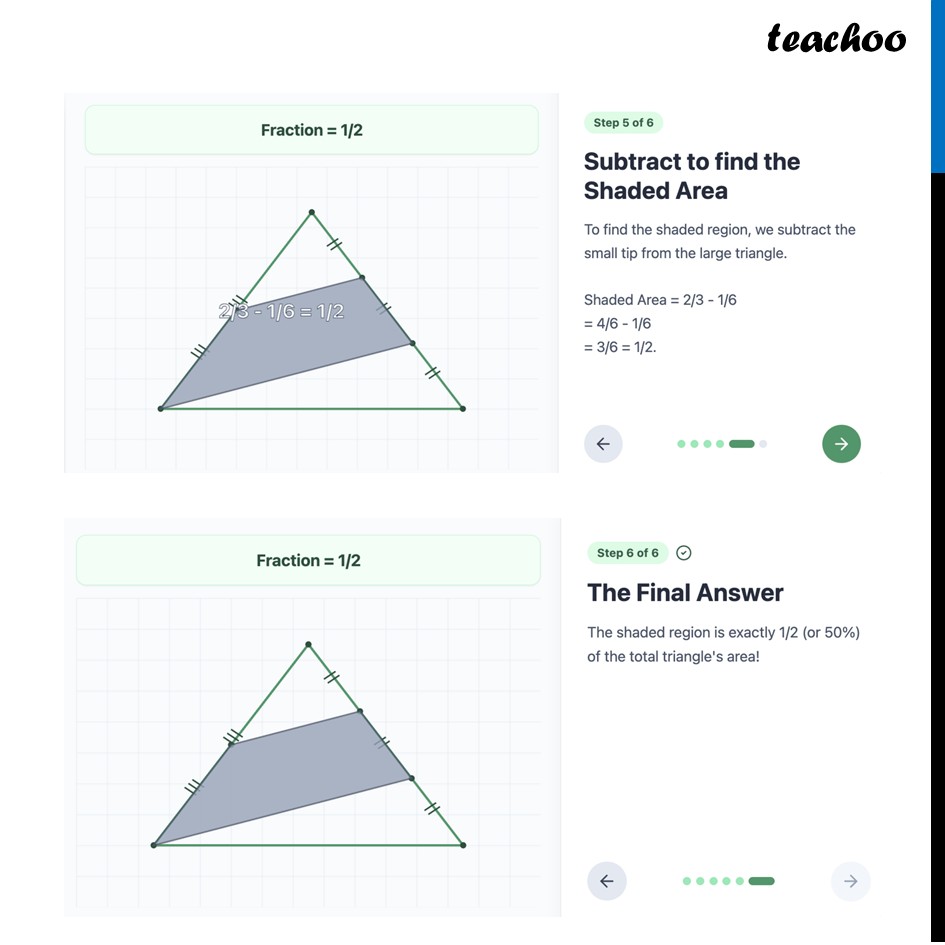
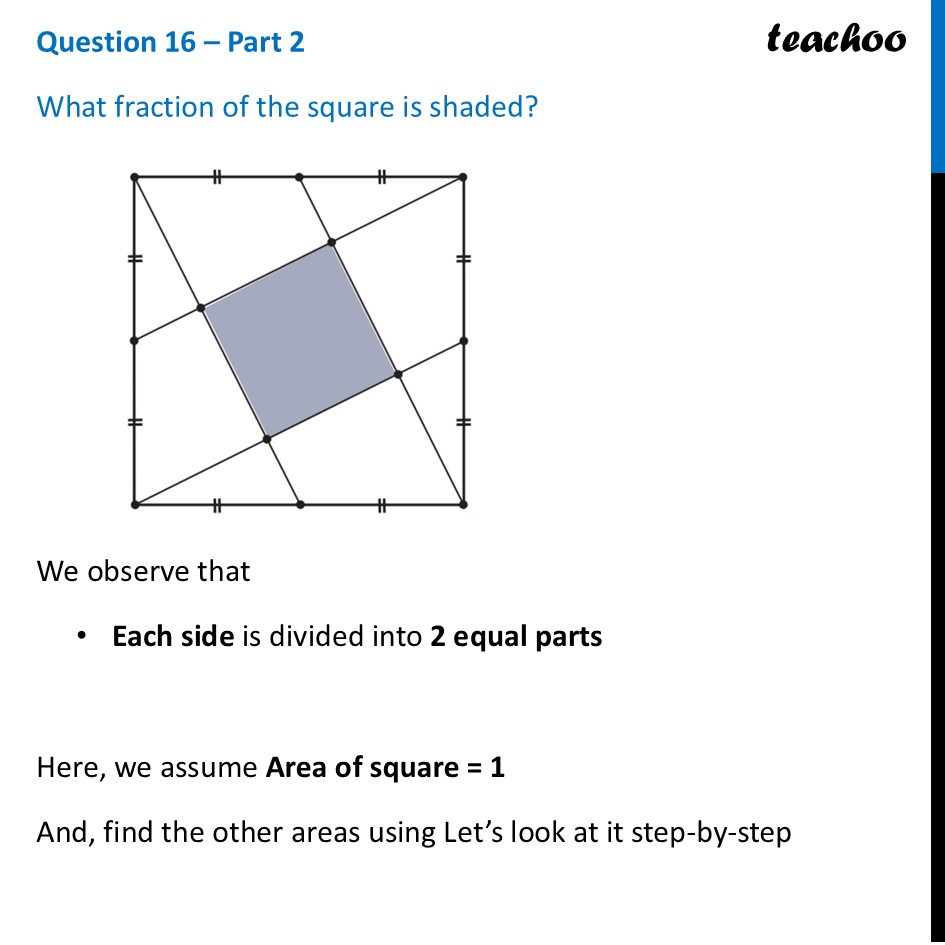
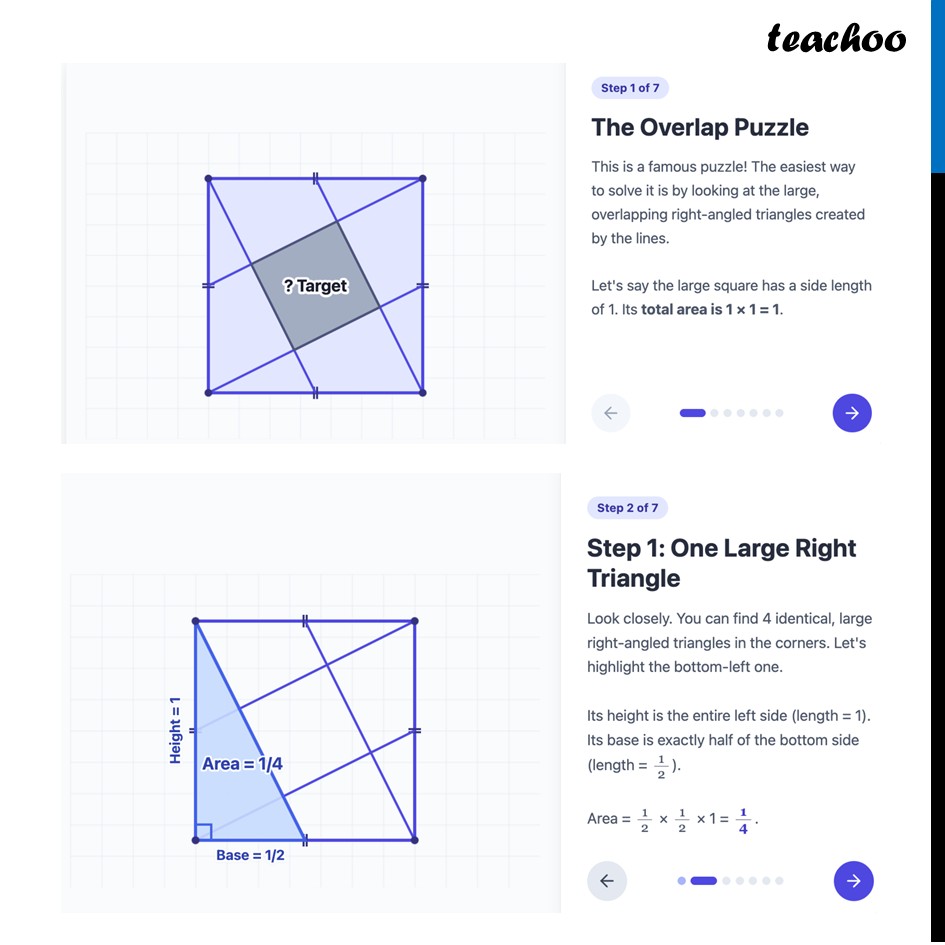
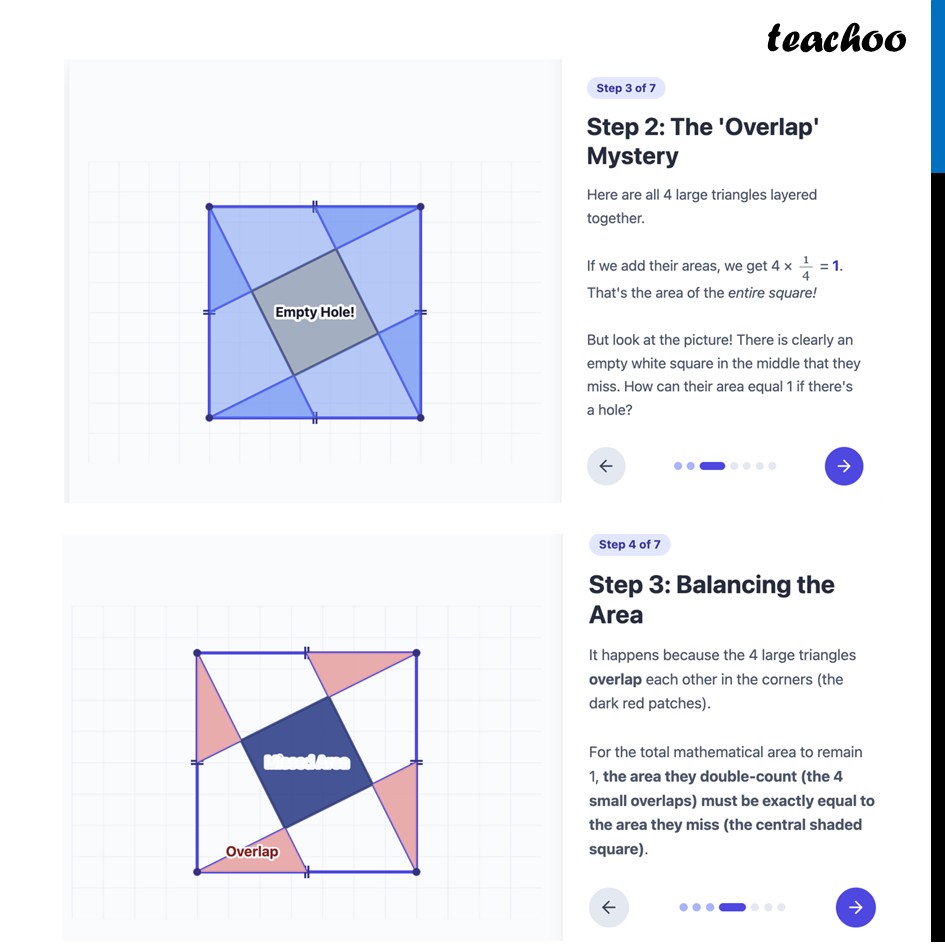
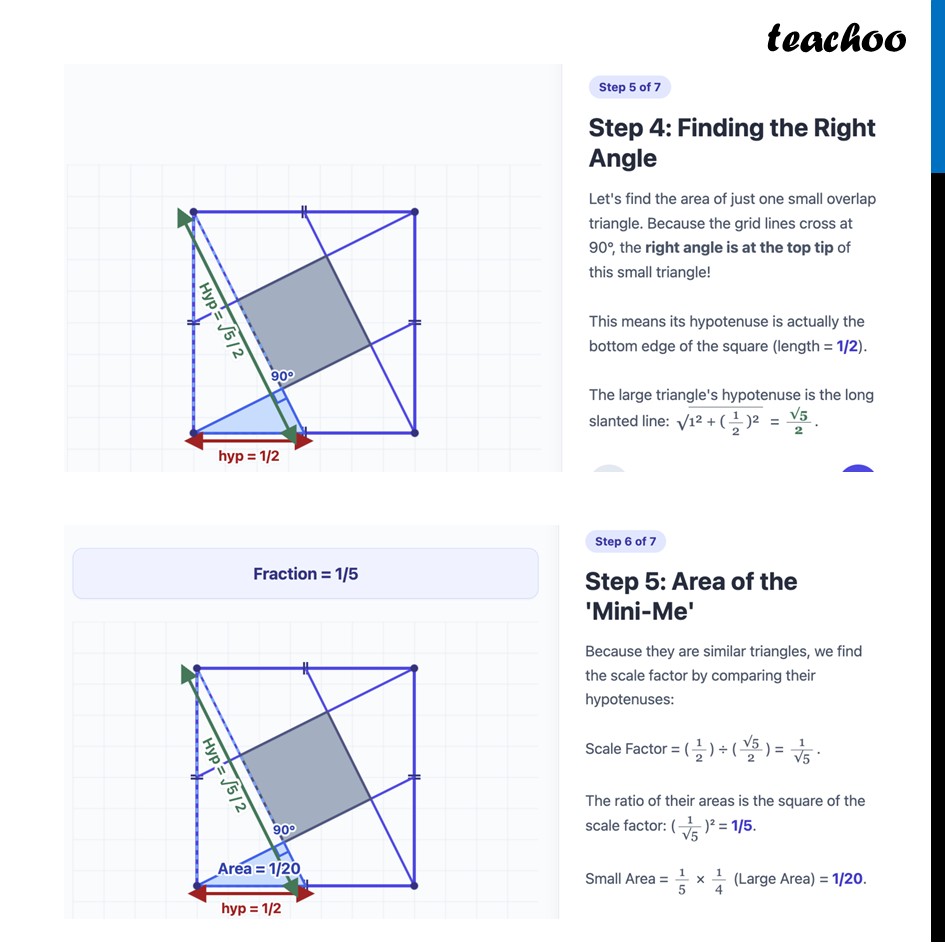
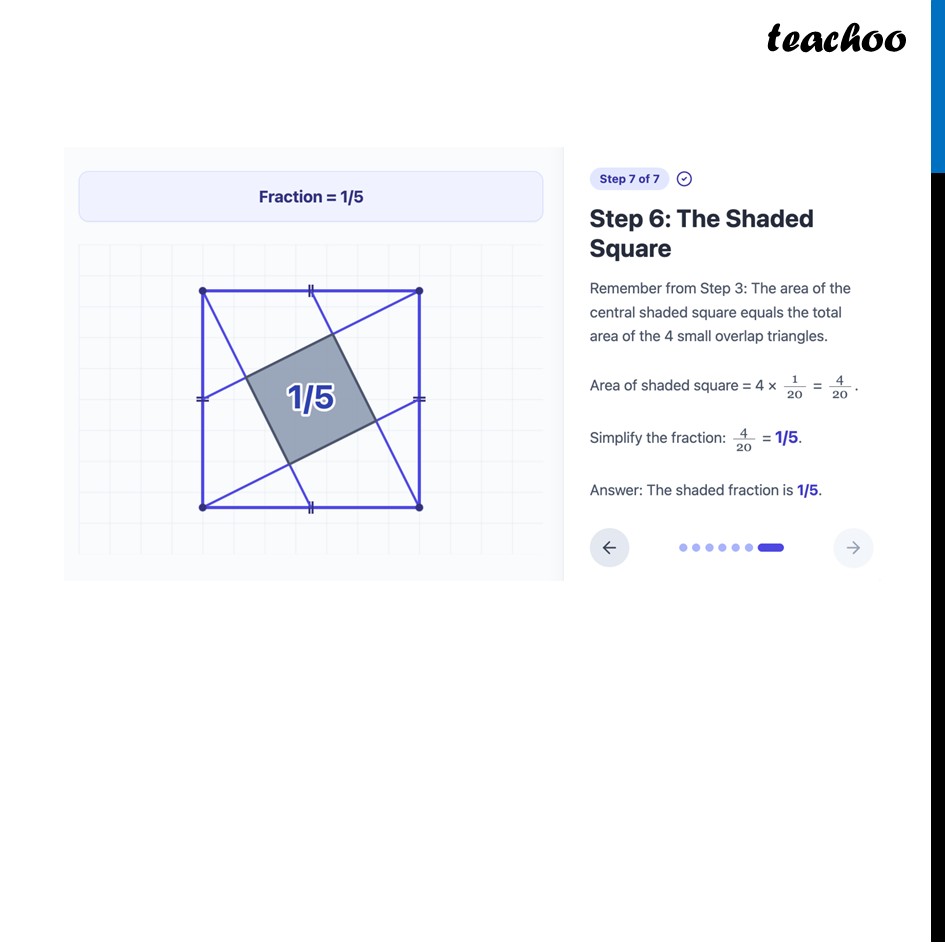
Question 16 – Part 1 What fraction of the triangle is shaded? We observe that Left side is divided into 2 equal parts Right side is divided into 3 equal parts Let’s look at it step-by-step Step 1 of 6 The Problem We have a triangle with a shaded region. Look at the tick marks: The left edge is divided in half ( 2 segments). The right edge is divided into thirds ( 3 segments). Step 2 of 6 Identify the Boundary The shaded region is a quadrilateral. We can find its area easily by calculating the area of a large triangle, and subtracting the unshaded tip from it.Step 3 of 6 The Large Triangle Look at the triangle formed by connecting the top vertex to the lower trisection point. Its base is exactly 2/3 of the right edge. Since it shares the same peak, its Area is exactly 2/3 of the total triangle. Step 4 of 6 The Small Tip Now look at the unshaded triangle at the top. Its base is 1/3 of the right edge. Its height (starting from the midpoint on the left) is exactly 1/2 of the total height. Area =(1/3)×(1/2)=1/6 Step 5 of 6 Subtract to find the Shaded Area To find the shaded region, we subtract the small tip from the large triangle. ■(&" Shaded Area " =2/3-1/6@& =4/6-1/6@& =3/6=1/2) Step 6 of 6 The Final Answer The shaded region is exactly 1/2 (or 50%) of the total triangle's area! Question 16 – Part 2 What fraction of the square is shaded? We observe that Each side is divided into 2 equal parts Here, we assume Area of square = 1 And, find the other areas using Let’s look at it step-by-step Step 1 of 7 The Overlap Puzzle This is a famous puzzle! The easiest way to solve it is by looking at the large, overlapping right-angled triangles created by the lines. Let's say the large square has a side length of 1 . Its total area is 1×1=1. Step 2 of 7 Step 1: One Large Right Triangle Look closely. You can find 4 identical, large right-angled triangles in the corners. Let's highlight the bottom-left one. Its height is the entire left side (length = 1). Its base is exactly half of the bottom side (┤ length ├ =1/2). Area =1/2×1/2×1=1/4 Step 3 of 7 Step 2: The 'Overlap' Mystery Here are all 4 large triangles layered together. If we add their areas, we get 4×1/4=1. That's the area of the entire square! But look at the picture! There is clearly an empty white square in the middle that they miss. How can their area equal 1 if there's a hole? Step 4 of 7 Step 3: Balancing the Area It happens because the 4 large triangles overlap each other in the corners (the dark red patches). For the total mathematical area to remain 1, the area they double-count (the 4 small overlaps) must be exactly equal to the area they miss (the central shaded square). Step 5 of 7 Step 4: Finding the Right Angle Let's find the area of just one small overlap triangle. Because the grid lines cross at 90^∘, the right angle is at the top tip of this small triangle! This means its hypotenuse is actually the bottom edge of the square (length = 1/2). The large triangle's hypotenuse is the long slanted line: √(1^2+(1/2)^2 )=√5/2. Step 6 of 7 Step 5: Area of the 'Mini-Me' Because they are similar triangles, we find the scale factor by comparing their hypotenuses: Scale Factor =(1/2)÷(√5/2)=1/√5. The ratio of their areas is the square of the scale factor: (1/√5)^2=1/5. Small Area =1/5×1/4( Large Area )=1/20 Step 7 of 7 Step 6: The Shaded Square Remember from Step 3: The area of the central shaded square equals the total area of the 4 small overlap triangles. Area of shaded square =4×1/20=4/20. Simplify the fraction: 4/20=1/5. Answer: The shaded fraction is 1/5