End-of-Chapter Exercises

 You are here
End-of-Chapter Exercises
Last updated at August 14, 2026 by Teachoo
Transcript
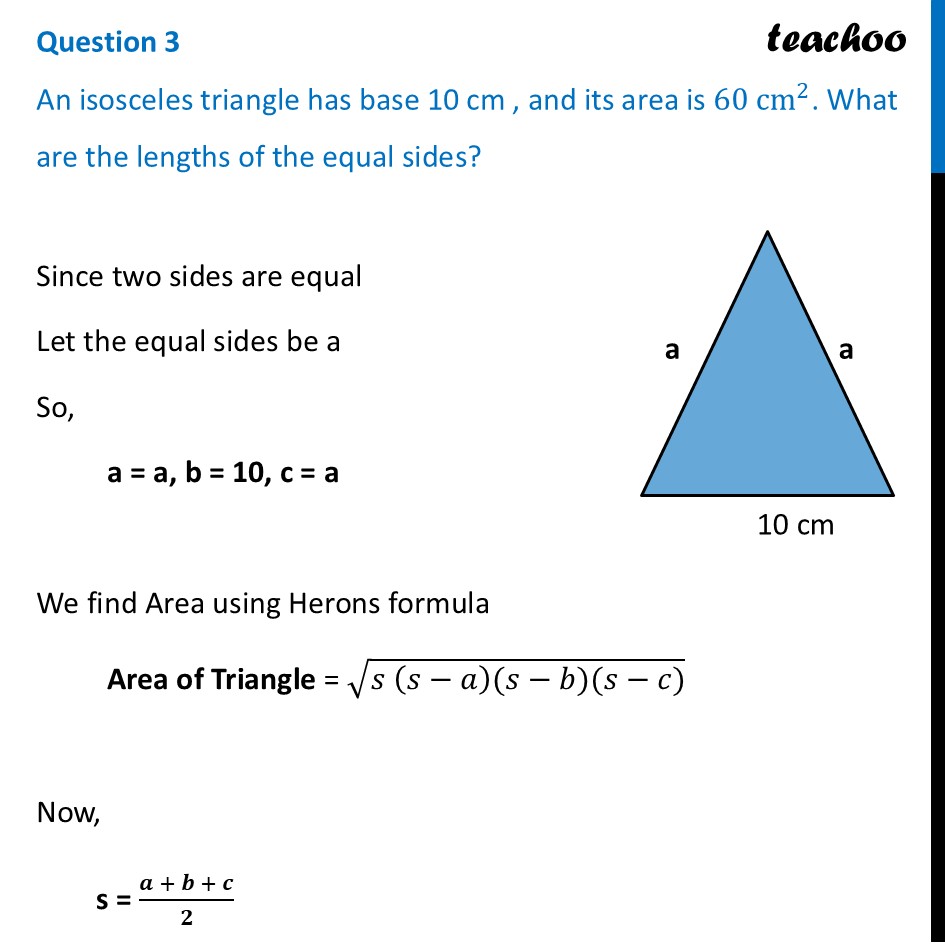
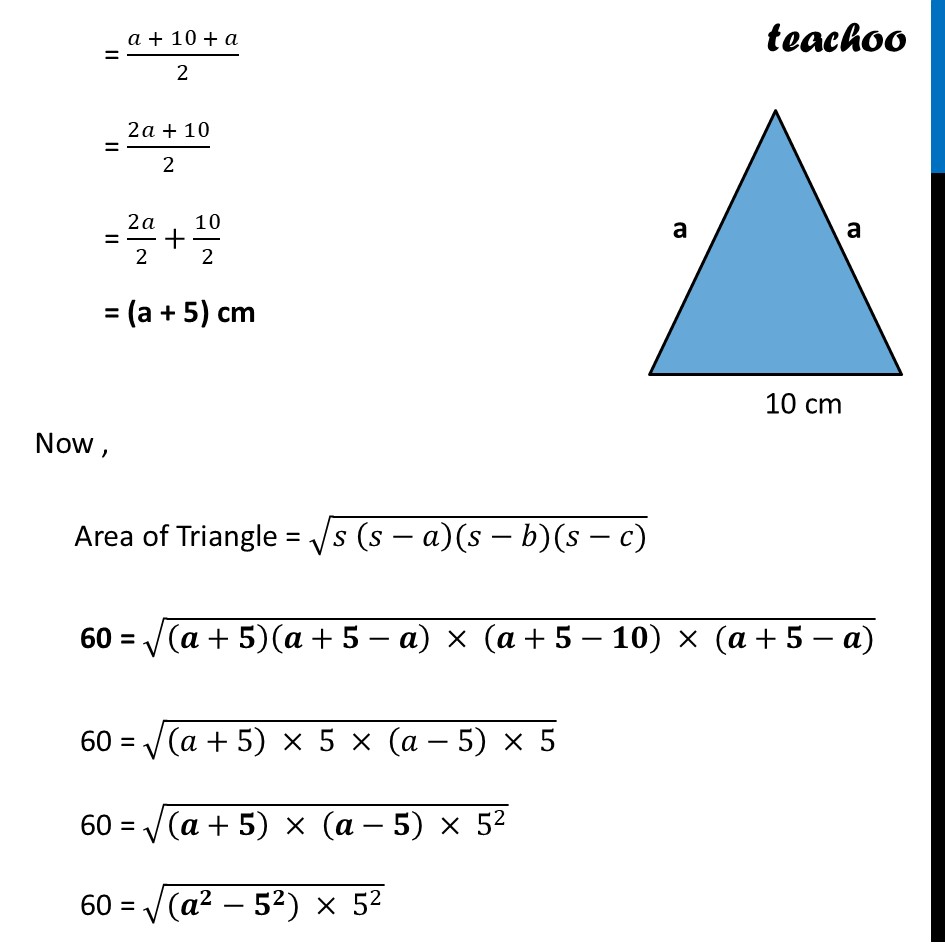
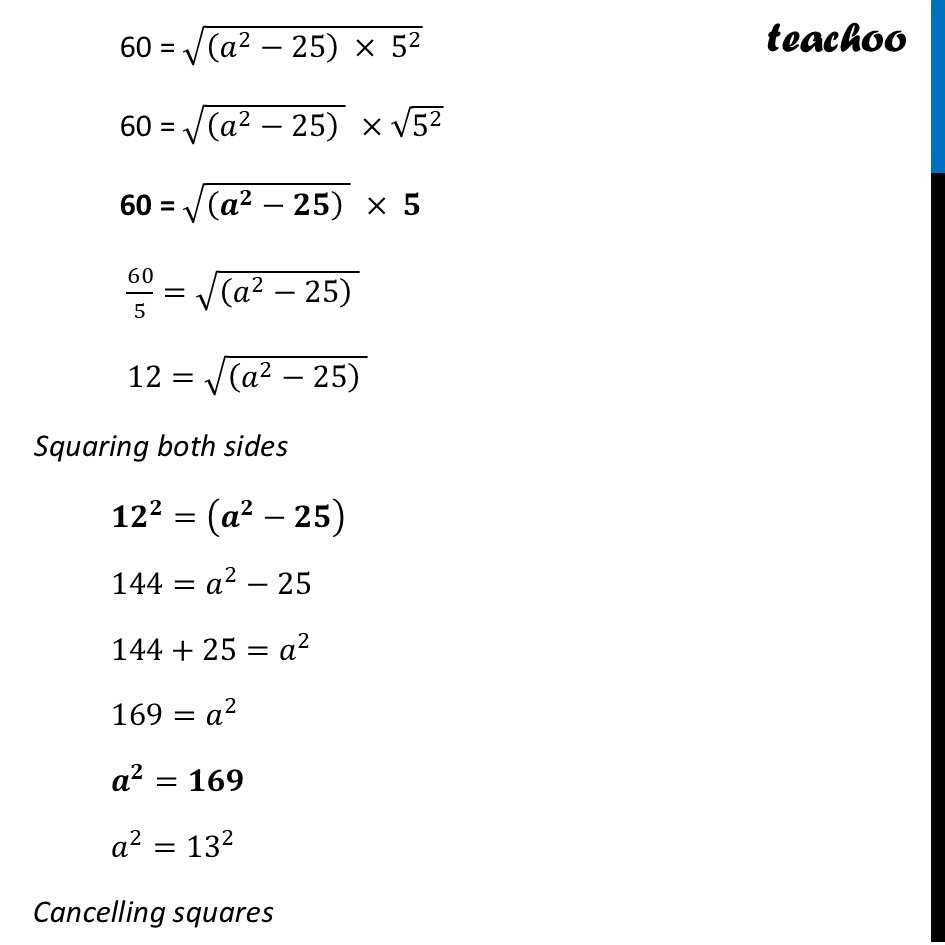
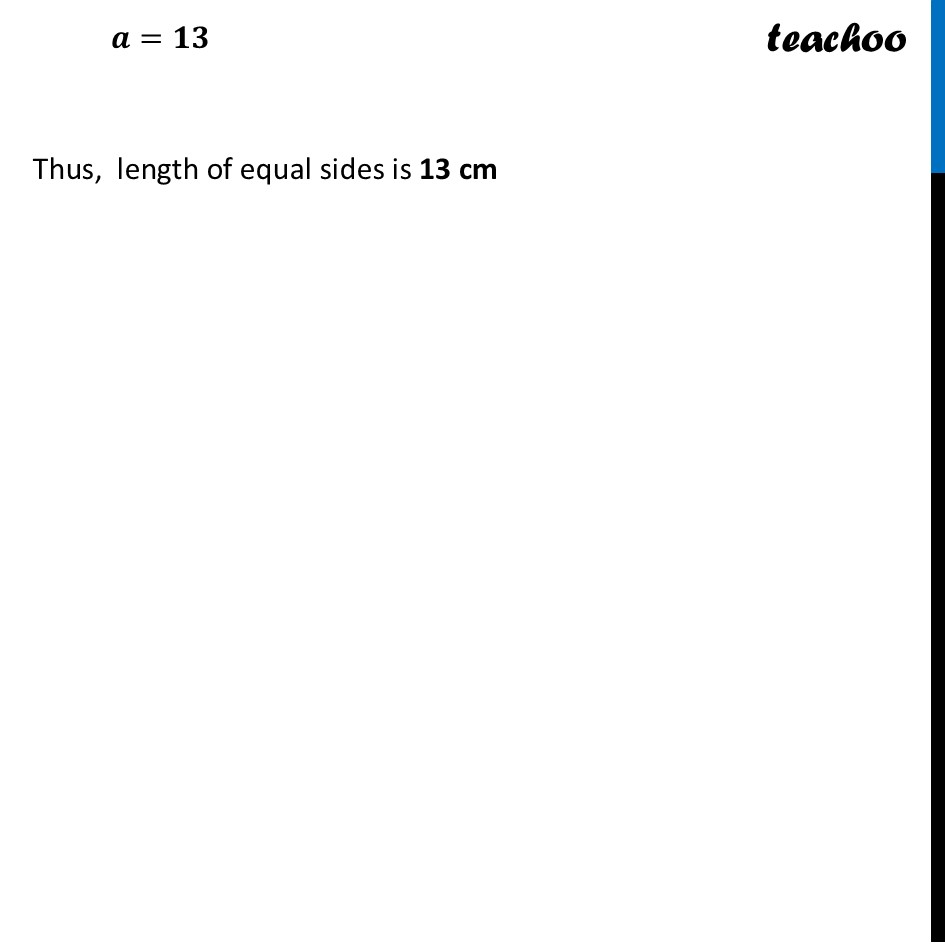
Question 3 An isosceles triangle has base 10 cm , and its area is 60〖" " cm〗^2. What are the lengths of the equal sides? Since two sides are equal Let the equal sides be a So, a = a, b = 10, c = a We find Area using Herons formula Area of Triangle = √(𝑠 (𝑠−𝑎)(𝑠−𝑏)(𝑠−𝑐)) Now, s = (𝒂 + 𝒃 + 𝒄)/𝟐 = (𝑎 + 10 + 𝑎)/2 = (2𝑎 + 10)/2 = 2𝑎/2+10/2 = (a + 5) cm Now , Area of Triangle = √(𝑠 (𝑠−𝑎)(𝑠−𝑏)(𝑠−𝑐)) 60 = √((𝒂+𝟓)(𝒂+𝟓−𝒂) × (𝒂+𝟓−𝟏𝟎) × (𝒂+𝟓−𝒂)) 60 = √((𝑎+5)(𝑎+5−𝑎) × (𝑎+5−10) × (𝑎+5−𝑎)) = (𝑎 + 10 + 𝑎)/2 = (2𝑎 + 10)/2 = 2𝑎/2+10/2 = (a + 5) cm Now , Area of Triangle = √(𝑠 (𝑠−𝑎)(𝑠−𝑏)(𝑠−𝑐)) 60 = √((𝒂+𝟓)(𝒂+𝟓−𝒂) × (𝒂+𝟓−𝟏𝟎) × (𝒂+𝟓−𝒂)) 60 = √((𝑎+5) × 5 × (𝑎−5) × 5) 60 = √((𝒂+𝟓) × (𝒂−𝟓) × 5^2 ) 60 = √((𝒂^𝟐−𝟓^𝟐) × 5^2 ) 60 = √((𝑎^2−25) × 5^2 ) 60 = √((𝑎^2−25) ) ×√(5^2 ) 60 = √((𝒂^𝟐−𝟐𝟓) ) × 𝟓 60/5=√((𝑎^2−25) ) 12=√((𝑎^2−25) ) Squaring both sides 𝟏𝟐^𝟐=(𝒂^𝟐−𝟐𝟓) 144=𝑎^2−25 144+25=𝑎^2 169=𝑎^2 𝒂^𝟐=𝟏𝟔𝟗 𝑎^2=13^2 Cancelling squares 𝒂=𝟏𝟑 Thus, length of equal sides is 13 cm