End-of-Chapter Exercises

 You are here
End-of-Chapter Exercises
Last updated at August 14, 2026 by Teachoo
Transcript
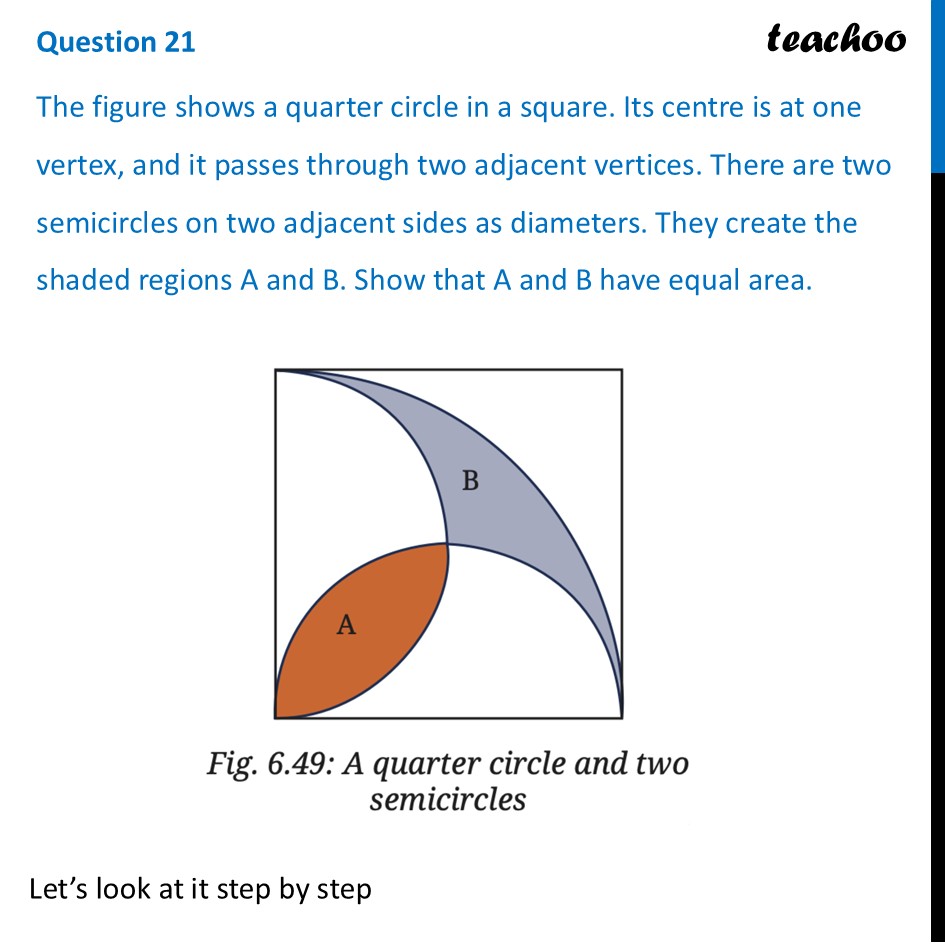
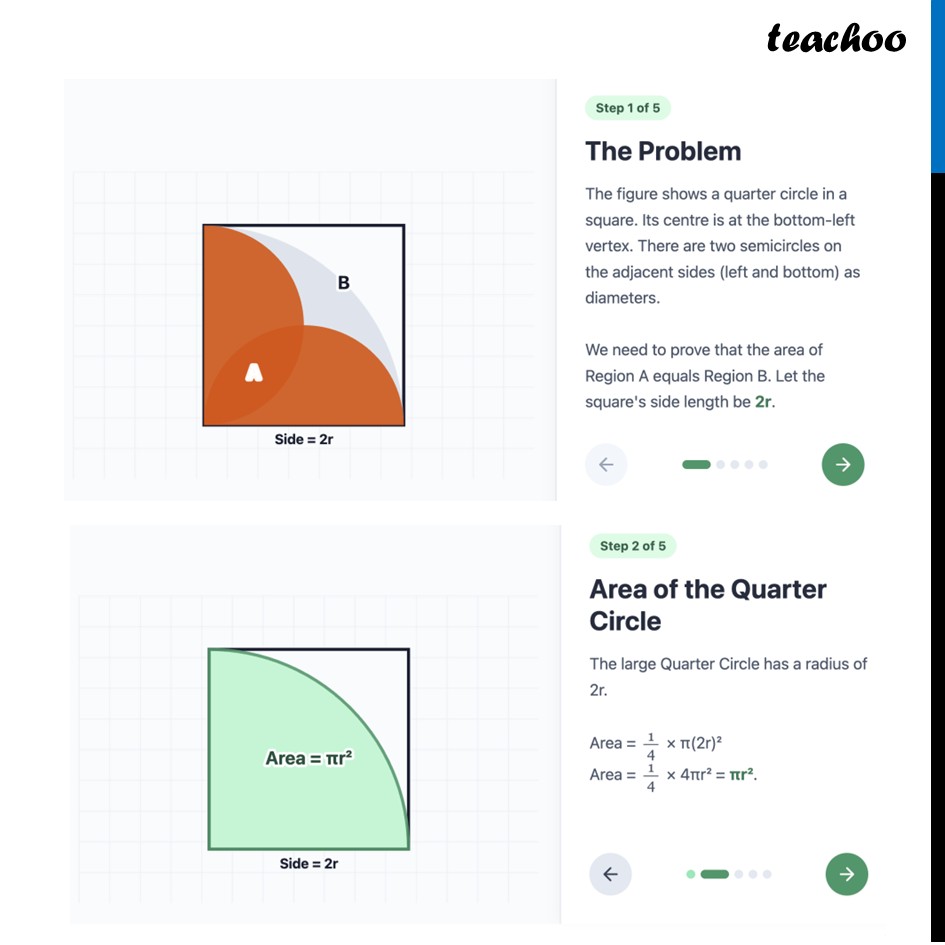
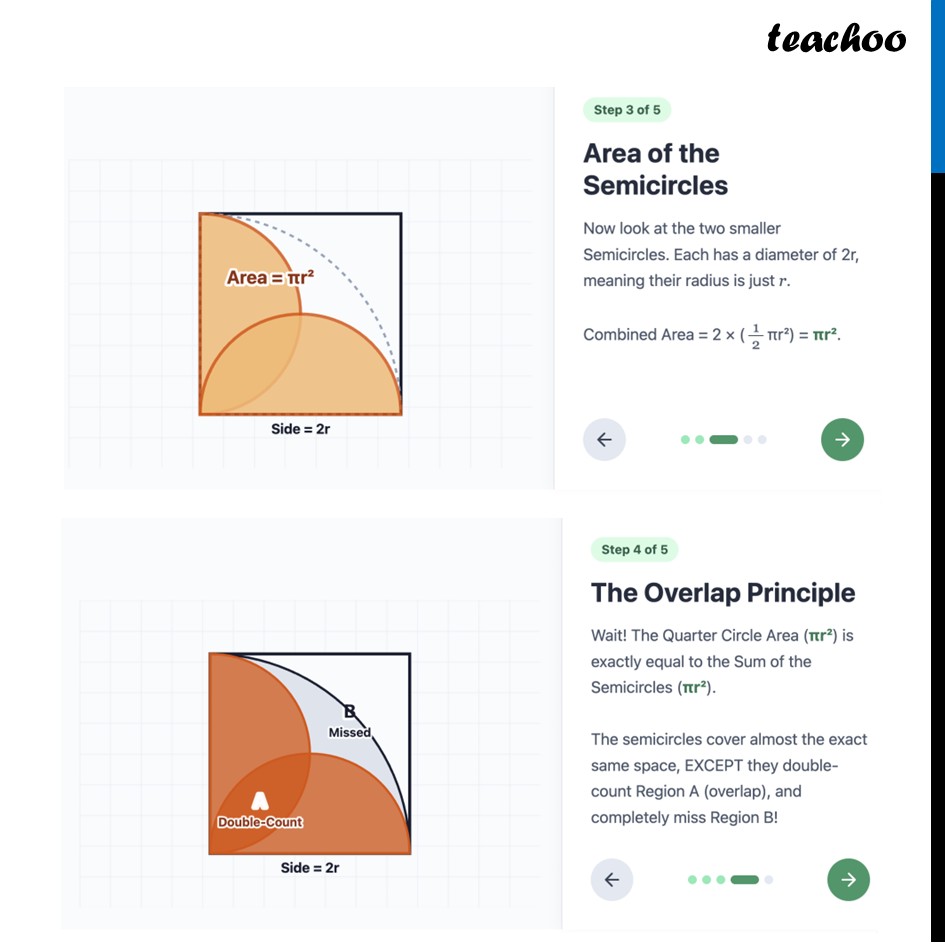
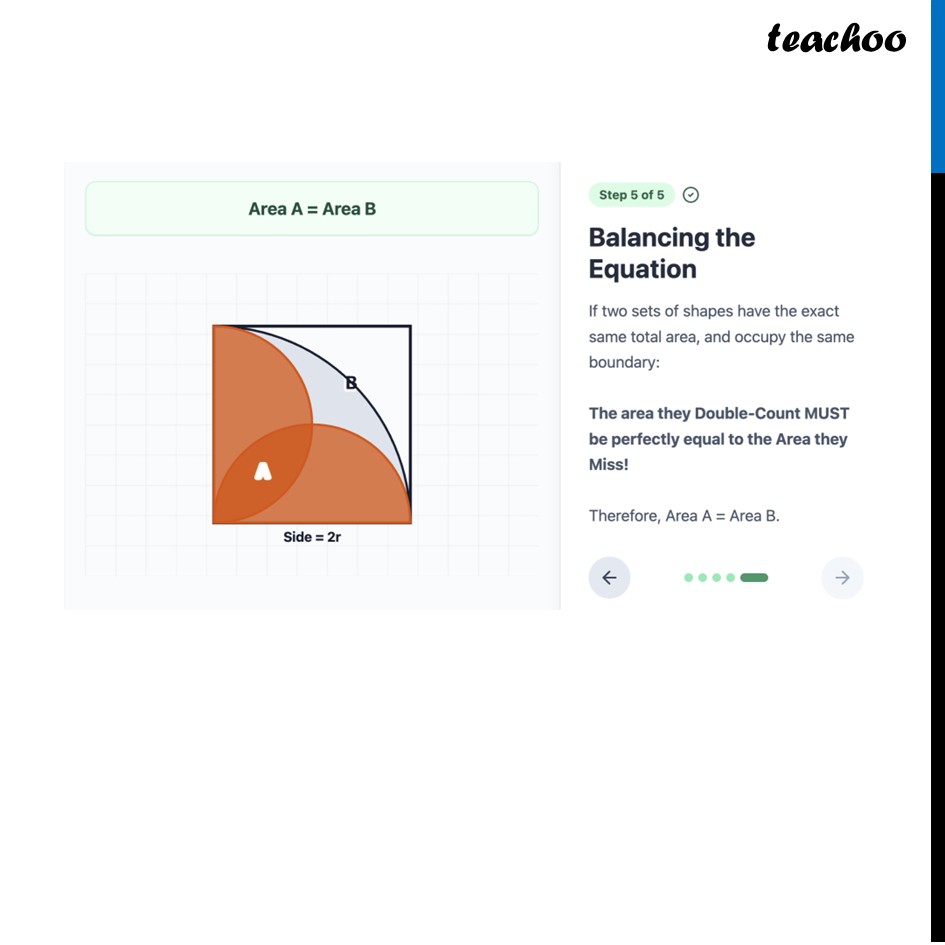
Question 21 The figure shows a quarter circle in a square. Its centre is at one vertex, and it passes through two adjacent vertices. There are two semicircles on two adjacent sides as diameters. They create the shaded regions A and B. Show that A and B have equal area. Let’s look at it step by step Step 1 of 5 The Problem The figure shows a quarter circle in a square. Its centre is at the bottom-left vertex. There are two semicircles on the adjacent sides (left and bottom) as diameters. We need to prove that the area of Region A equals Region B. Let the square's side length be 2r. Step 2 of 5 Area of the Quarter Circle The large Quarter Circle has a radius of 2 r . Area " =1/4×π(2r)^2 Area " =1/4×4πr^2=πr^2) Step 3 of 5 Area of the Semicircles Now look at the two smaller Semicircles. Each has a diameter of 2r, meaning their radius is just r. Combined Area =2×(1/2 πr^2 )=πr^2 Step 4 of 5 The Overlap Principle Wait! The Quarter Circle Area ( πr^2 ) is exactly equal to the Sum of the Semicircles ( πr^2 ). The semicircles cover almost the exact same space, EXCEPT they doublecount Region A (overlap), and completely miss Region B! tep 5 of 5 Balancing the Equation If two sets of shapes have the exact same total area, and occupy the same boundary: The area they Double-Count MUST be perfectly equal to the Area they Miss! Therefore, Area .