End-of-Chapter Exercises

 You are here
End-of-Chapter Exercises
Last updated at August 14, 2026 by Teachoo
Transcript
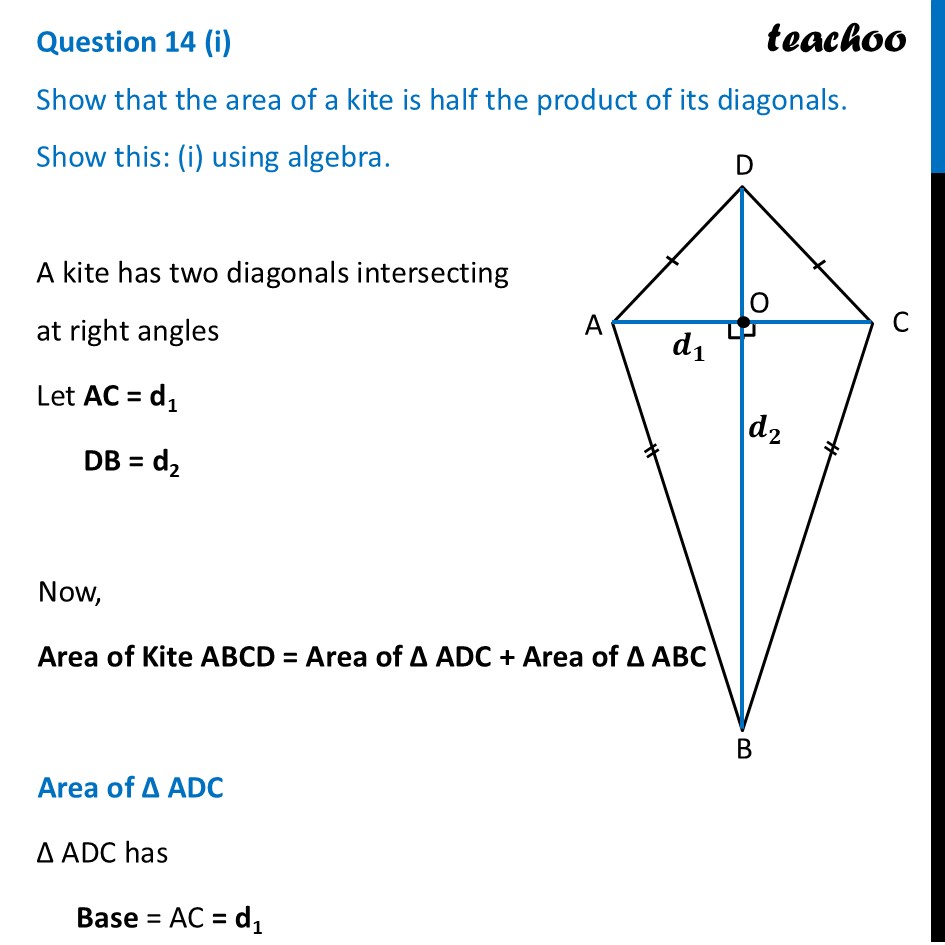
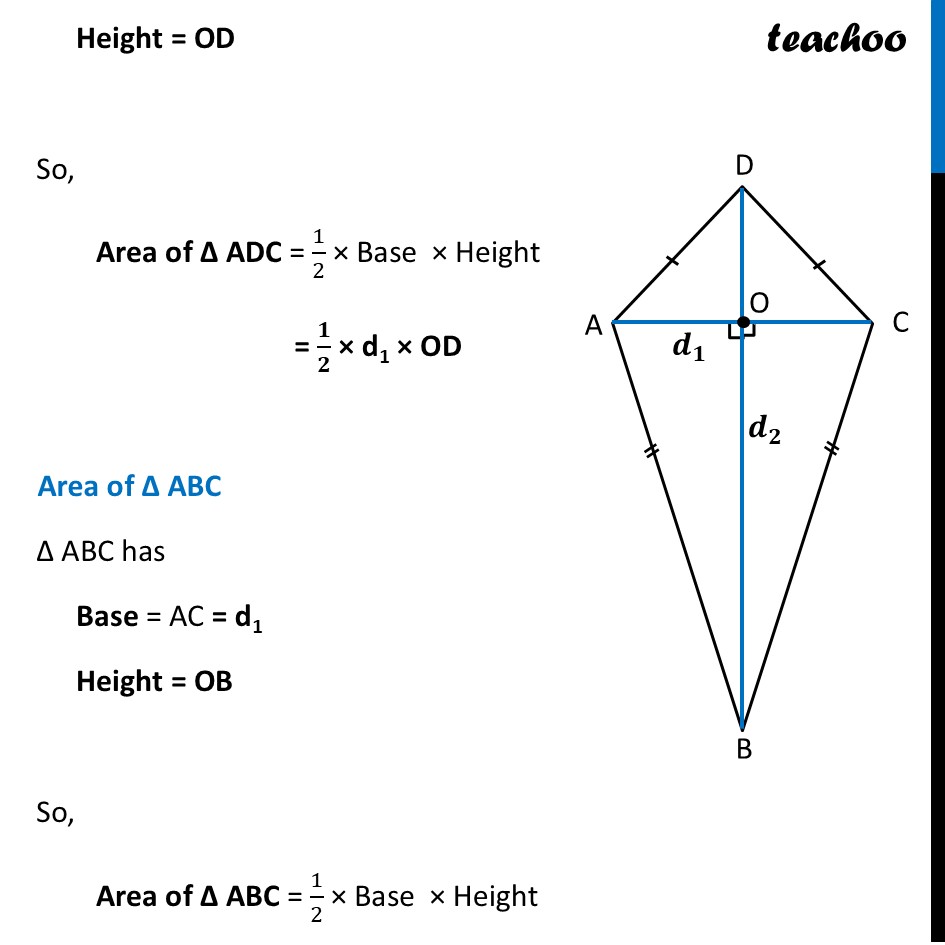
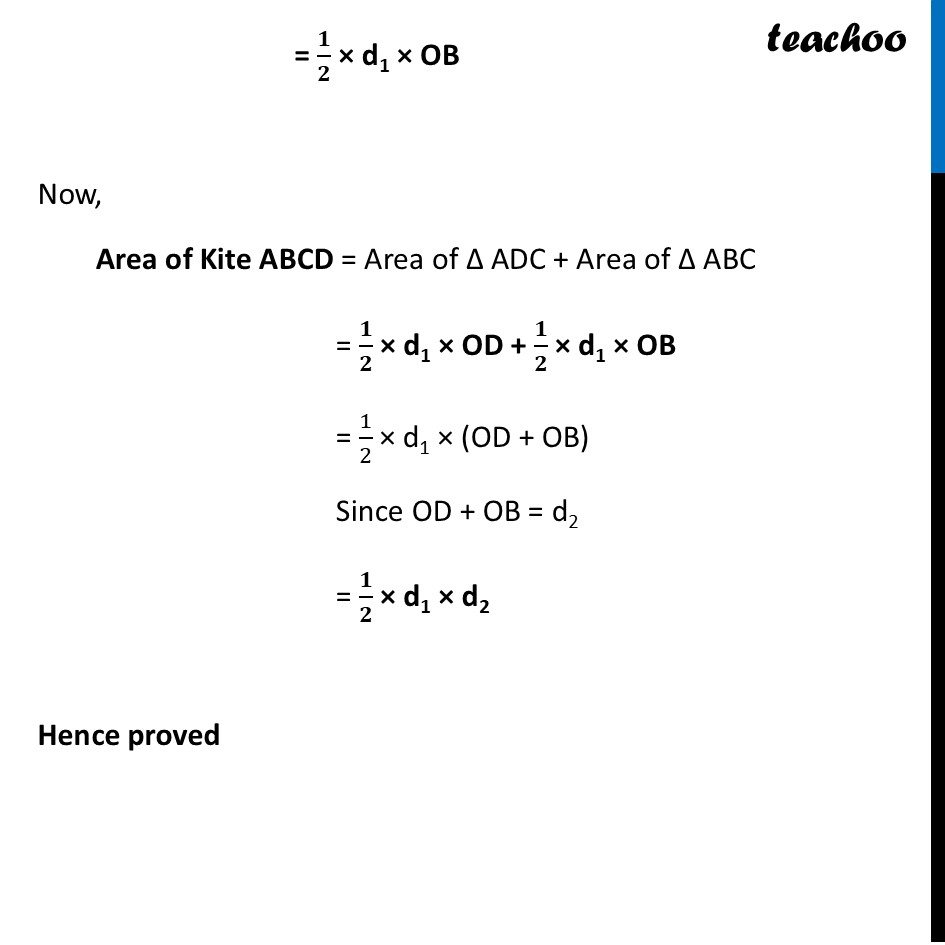
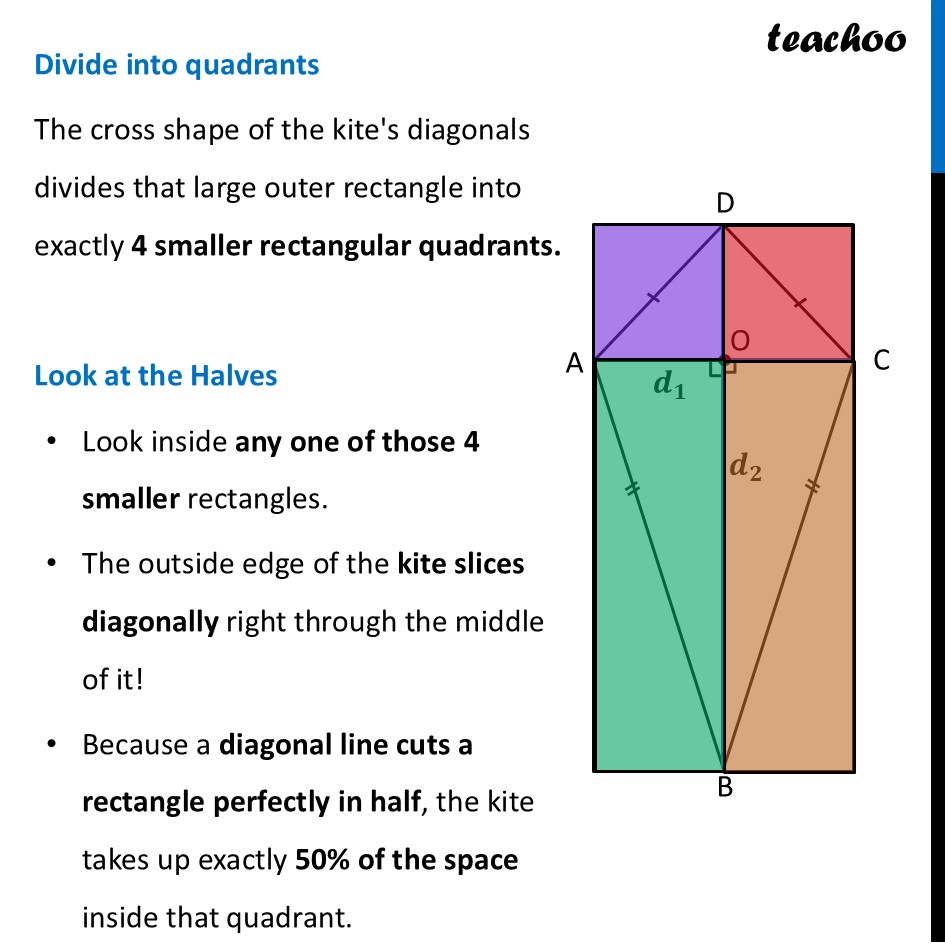
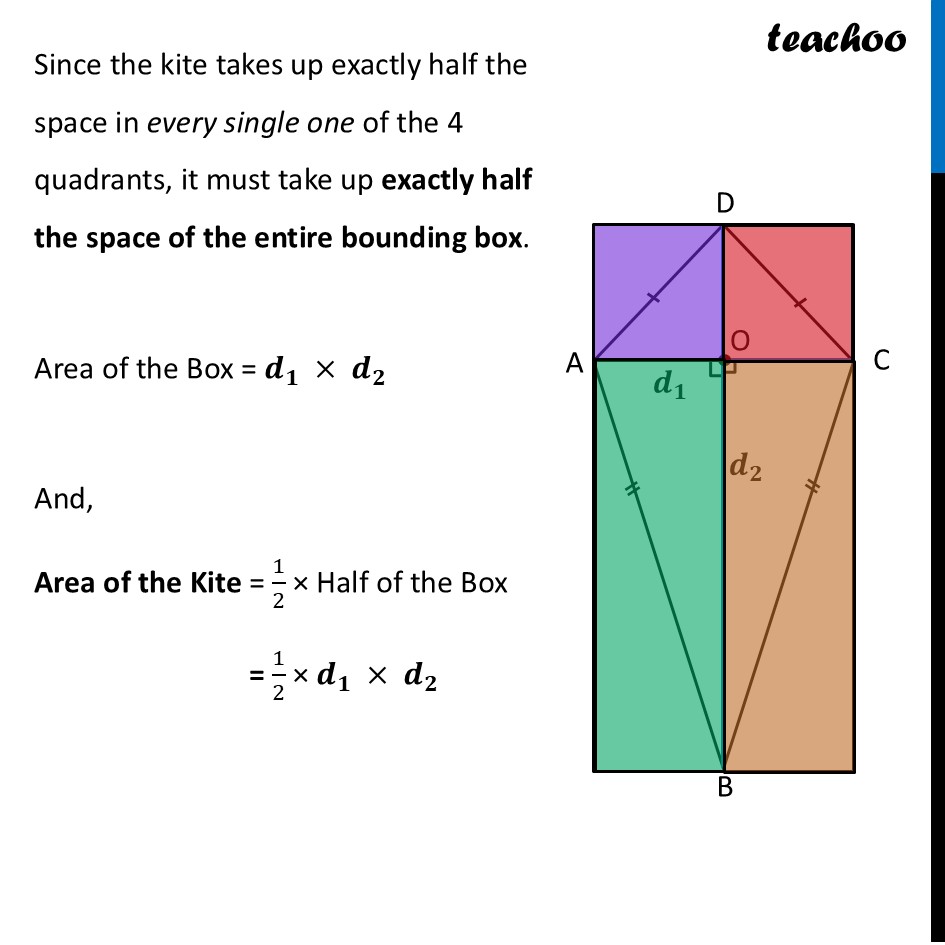
Question 14 (i) Show that the area of a kite is half the product of its diagonals. Show this: (i) using algebra. A kite has two diagonals intersecting at right angles Let AC = d1 DB = d2 Now, Area of Kite ABCD = Area of ∆ ADC + Area of ∆ ABC Area of ∆ ADC ∆ ADC has Base = AC = d1 Height = OD So, Area of ∆ ADC = 1/2 × Base × Height = 𝟏/𝟐 × d1 × OD Area of ∆ ABC ∆ ABC has Base = AC = d1 Height = OB So, Area of ∆ ABC = 1/2 × Base × Height = 𝟏/𝟐 × d1 × OB Now, Area of Kite ABCD = Area of ∆ ADC + Area of ∆ ABC = 𝟏/𝟐 × d1 × OD + 𝟏/𝟐 × d1 × OB = 1/2 × d1 × (OD + OB) Since OD + OB = d2 = 𝟏/𝟐 × d1 × d2 Hence proved Height = OD So, Area of ∆ ADC = 1/2 × Base × Height = 𝟏/𝟐 × d1 × OD Area of ∆ ABC ∆ ABC has Base = AC = d1 Height = OB So, Area of ∆ ABC = 1/2 × Base × Height = 𝟏/𝟐 × d1 × OB Now, Area of Kite ABCD = Area of ∆ ADC + Area of ∆ ABC = 𝟏/𝟐 × d1 × OD + 𝟏/𝟐 × d1 × OB = 1/2 × d1 × (OD + OB) Since OD + OB = d2 = 𝟏/𝟐 × d1 × d2 Hence proved