![End of Chapter Exercises - Chapter 6 Class 9 Ganita Manjari [+ Videos] - End-of-Chapter Exercises](https://cdn.teachoo.com/238562c0-cbfd-4ed8-aded-9f87069eed7e/slide56.jpg)
End-of-Chapter Exercises
 You are here

End-of-Chapter Exercises
Last updated at August 14, 2026 by Teachoo
Transcript
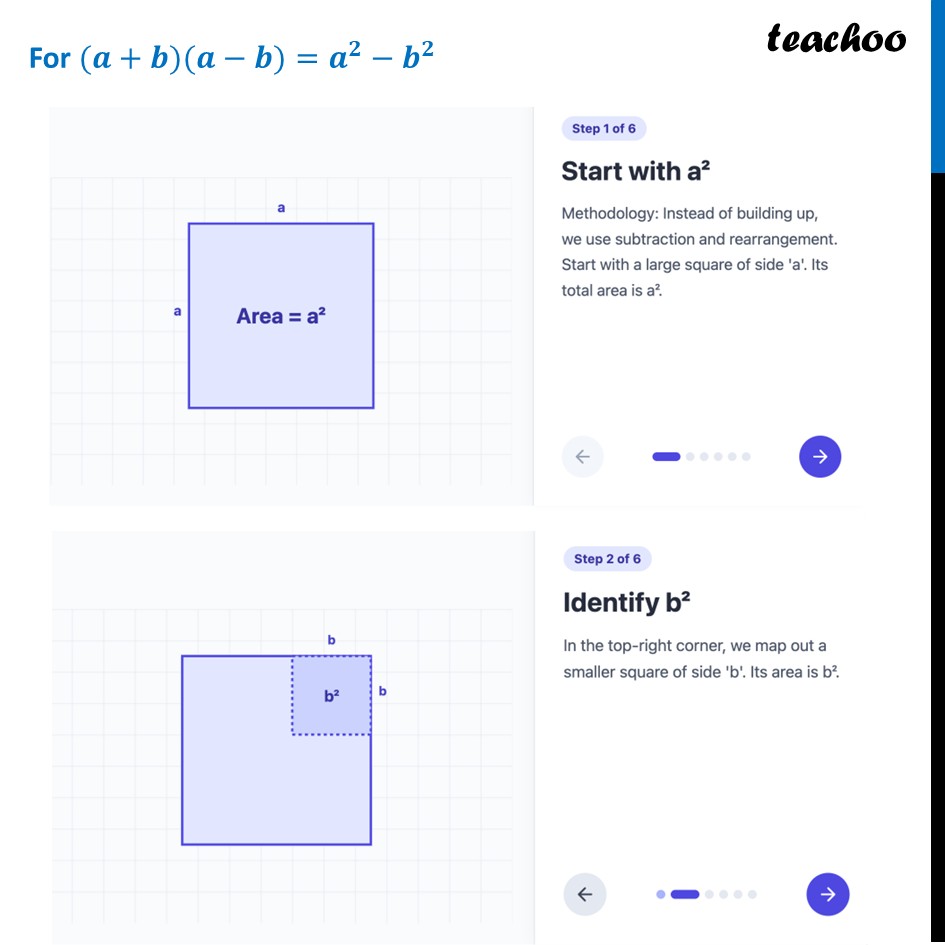
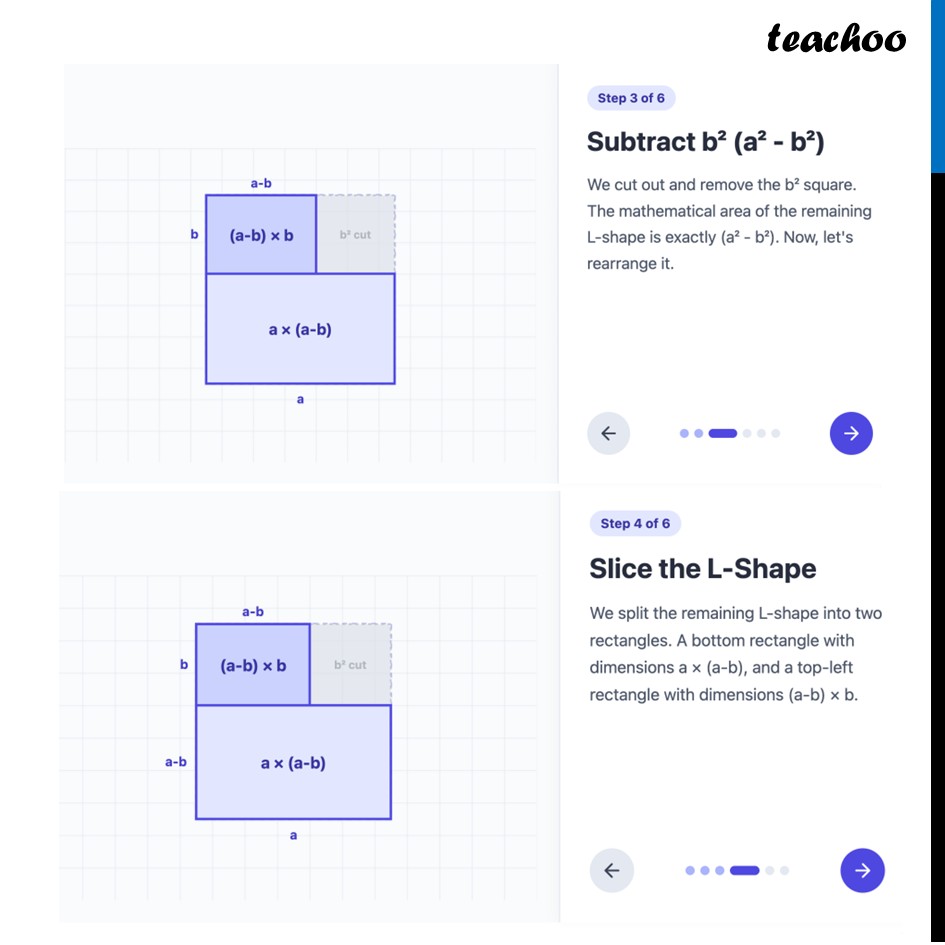
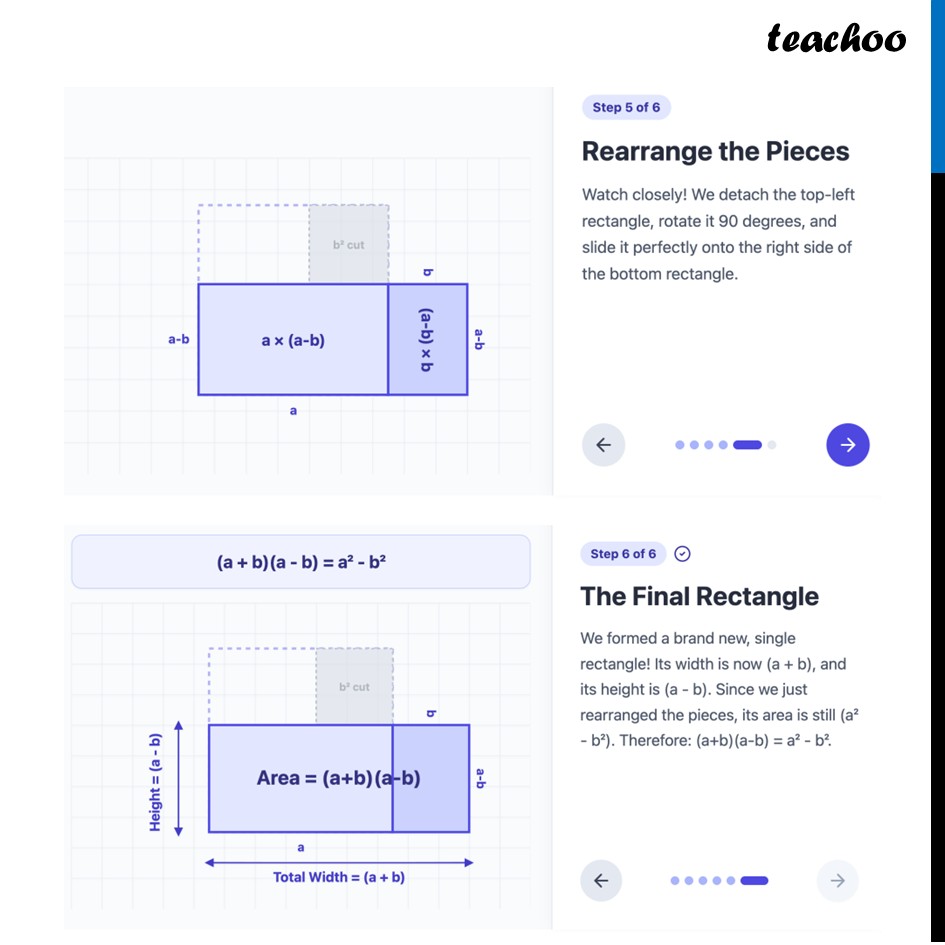
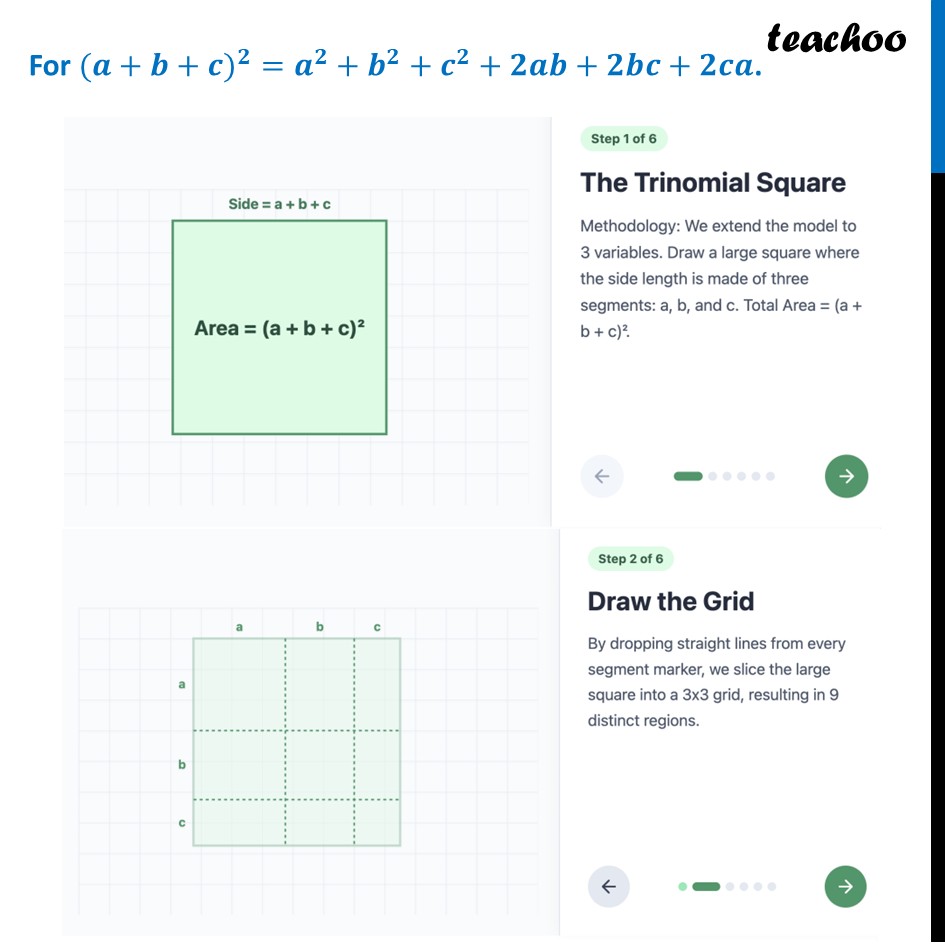
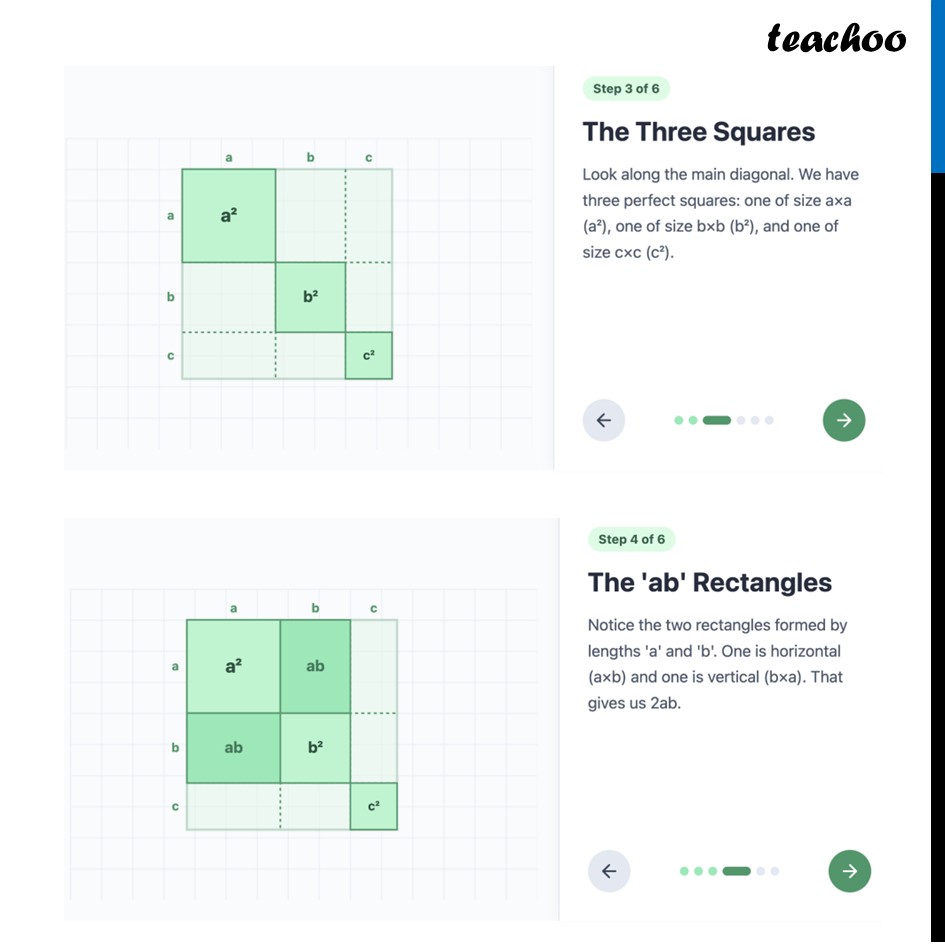
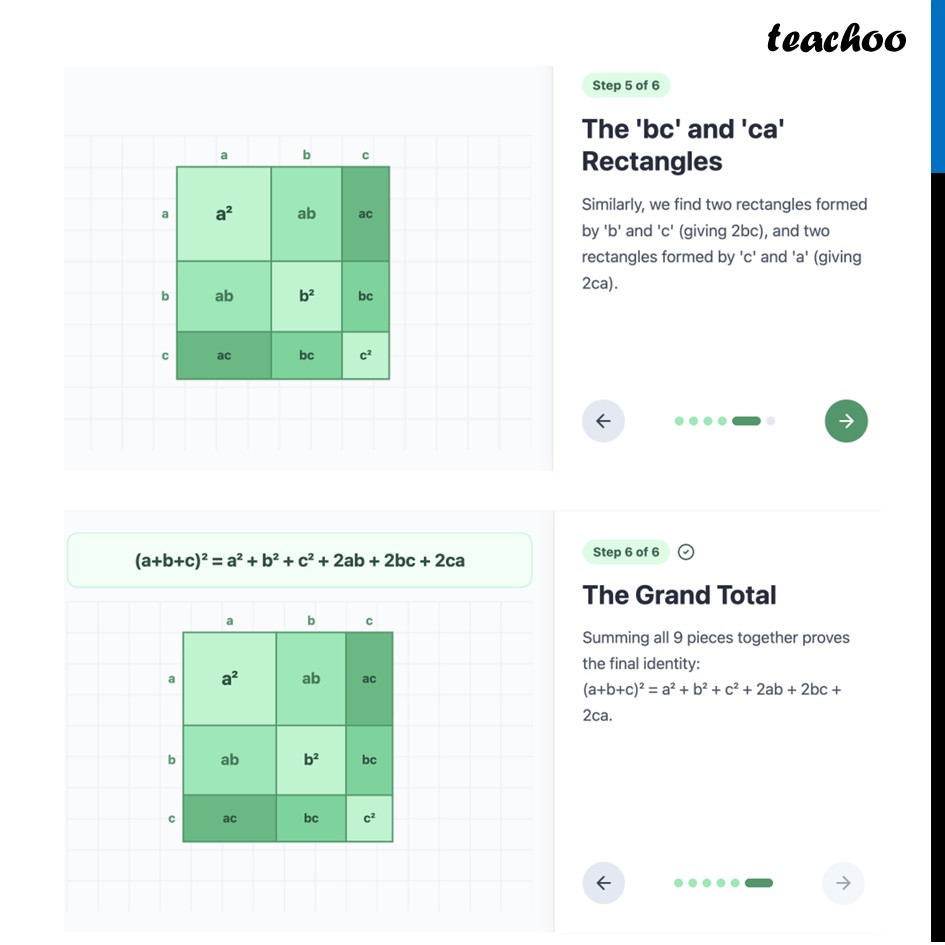
Question 1 Identities in algebra can sometimes be shown as area relationships. For example: The figure shown corresponds to the identity Draw figures corresponding to the identities (𝑎+𝑏)(𝑎−𝑏)=𝑎^2−𝑏^2 and (𝑎+𝑏+𝑐)^2=𝑎^2+𝑏^2+𝑐^2+2𝑎𝑏+2𝑏𝑐+2𝑐𝑎. We can prove this by assuming Rectangles or Squares of particular lengths, and then rearranging. Let’s do it For (𝒂+𝒃)(𝒂−𝒃)=𝒂^𝟐−𝒃^𝟐 Step Töć 6 Start with a^2 Methodology: Instead of building up, we use subtraction and rearrangement. Start with a large square of side ' a '. Its total area is a^2. Step 2 of 6 Identify b^2 In the top-right corner, we map out a smaller square of side ' b '. Its area is b^2. Step 3 of 6 Subtract b^2 (a^2-b^2 ) We cut out and remove the b^2 square. The mathematical area of the remaining L -shape is exactly (a^2-b^2 ). Now, let's rearrange it. Step 4 of 6 Slice the L-Shape We split the remaining L-shape into two rectangles. A bottom rectangle with dimensions a × (a-b), and a top-left rectangle with dimensions (a-b)×b Step 5 of 6 Rearrange the Pieces Watch closely! We detach the top-left rectangle, rotate it 90 degrees, and slide it perfectly onto the right side of the bottom rectangle. Step 6 of 6 The Final Rectangle We formed a brand new, single rectangle! Its width is now (a+b), and its height is (a-b). Since we just rearranged the pieces, its area is still ( a^2 ├ -b^2 ). Therefore: (a+b)(a-b)=a^2-b^2. For (𝒂+𝒃+𝒄)^𝟐=𝒂^𝟐+𝒃^𝟐+𝒄^𝟐+𝟐𝒂𝒃+𝟐𝒃𝒄+𝟐𝒄𝒂. Step 5 of 6 Rearrange the Pieces Watch closely! We detach the top-left rectangle, rotate it 90 degrees, and slide it perfectly onto the right side of the bottom rectangle Step 6 of 6 The Final Rectangle We formed a brand new, single rectangle! Its width is now (a+b), and its height is (a-b) Since we just rearranged the pieces, its area is still ( a^2 ├ -b^2 ). Therefore: (a+b)(a-b)=a^2-b^2.Step 3 of 6 The Three Squares Look along the main diagonal. We have three perfect squares: one of size axa (a^2 ), one of size b×b(b^2 ), and one of size cxc(c^2 ). Step 4 of 6 The 'ab' Rectangles Notice the two rectangles formed by lengths ' a ' and ' b '. One is horizontal (a×b) and one is vertical (b×a). That gives us 2ab Step 5 of 6 The 'bc' and 'ca' Rectangles Similarly, we find two rectangles formed by ' b ' and ' c ' (giving 2bc), and two rectangles formed by ' c ' and ' a ' (giving 2ca). Step 6 of 6 The Grand Total Summing all 9 pieces together proves the final identity: (a+b+c)^2=a^2+b^2+c^2+2ab+2bc+ 2ca.