![[Class 9 Ganita Manjari] How would you use following figure to justify - End-of-Chapter Exercises](https://cdn.teachoo.com/c59d5ab4-bde0-48b1-b046-26498ae52aed/slide102.jpg)





End-of-Chapter Exercises

 You are here
End-of-Chapter Exercises
Last updated at August 14, 2026 by Teachoo
Transcript
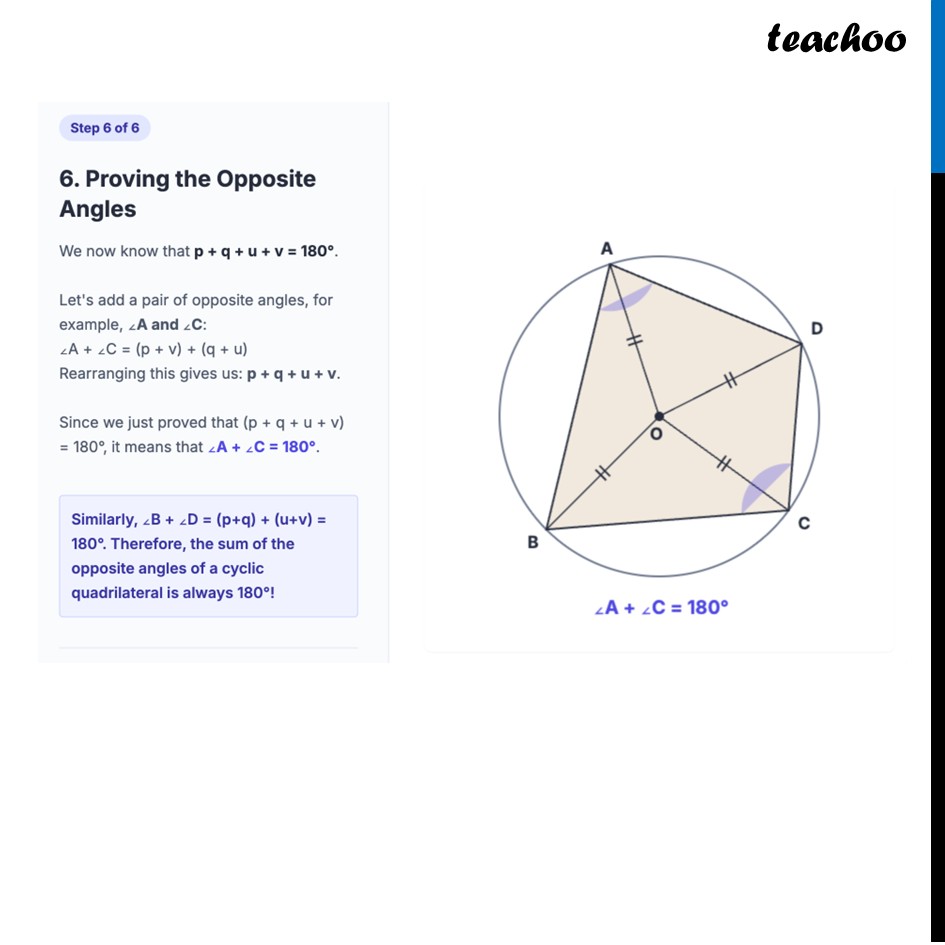
Question 26 How would you use the following figure to justify the statement that the sum of the opposite angles of a cyclic quadrilateral is 180^∘? Here, Each small triangle (eg: ∆ OBC) is an isosceles triangle And, angles opposite to equal sides are equal So, ∠ OCB = ∠ OBC = q Similarly, we can find all angles And, at the end we can use Angle sum property of Quadrilateral to prove opposite angles are supplementary Let’s do this step-by-step Step 1 of 6 The Setup & Radii We are given a cyclic quadrilateral with the center of its circumcircle at . Lines , and OD are drawn from the center to the vertices. Because they all connect the center to the edge of the same circle, they are all radii. Therefore, . This is marked by the double ticks on each line. Previous Next StepStep 2 of 6 2. Focus on Triangle OAB Let's focus on just one triangle first: . In this triangle, side OA equals side OB (since both are radii). This makes an isosceles triangle. A fundamental property of isosceles triangles is that the angles opposite the equal sides are also equal. Therefore, . Let's label both of these angles as . Previous Next StepStep 3 of 6 3. Triangle OBC Now let's move to the adjacent triangle: . Applying the exact same logic, side OB equals side OC (radii). This makes another isosceles triangle. Therefore, its base angles must be equal: . Let's label these as q. Previous Next StepStep 4 of 6 4. Generalizing the Remaining Triangles We can generalize this property for the remaining two triangles: In , since , the base angles are equal. Let's label them . In , since , the base angles are also equal. Let's label them . Previous Next StepStep 5 of 6 5. The Sum of All Angles Now let's look at the full interior angles of the quadrilateral : The sum of all interior angles in ANY quadrilateral is always . Previous Next StepStep 5 of 6 5. The Sum of All Angles Now let's look at the full interior angles of the quadrilateral : The sum of all interior angles in ANY quadrilateral is always . Previous Next Step Step 5 of 6 5. The Sum of All Angles Now let's look at the full interior angles of the quadrilateral : The sum of all interior angles in ANY quadrilateral is always . Previous Next StepStep 6 of 6 6. Proving the Opposite Angles We now know that . Let's add a pair of opposite angles, for example, and : Rearranging this gives us: . Since we just proved that ( ) , it means that . Similarly, . Therefore, the sum of the opposite angles of a cyclic quadrilateral is always !