You are here

![Use Baudhāyana–Pythagoras theorem to show why Theorem 6 [Class 9 Math] - Exercise Set 5.4](https://cdn.teachoo.com/ffc42c8e-99a4-44ff-8a90-5d8fc1520f62/slide23.jpg)
Exercise Set 5.4
Last updated at May 26, 2026 by Teachoo
Transcript
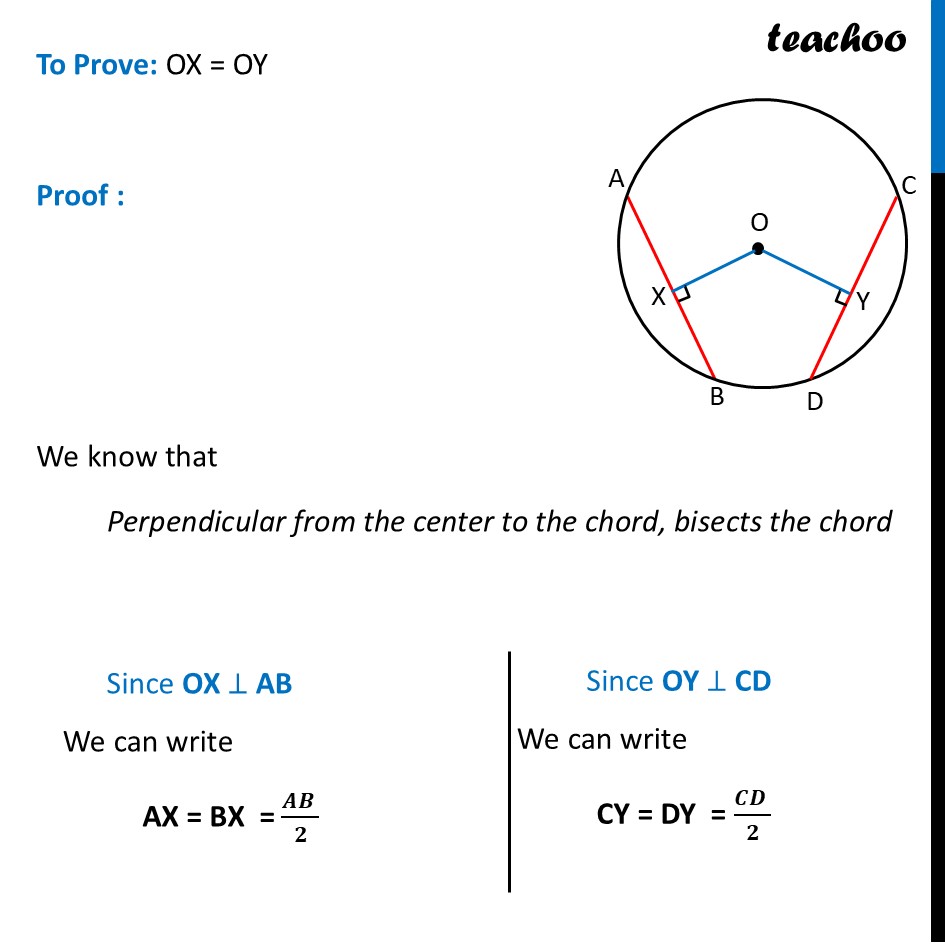
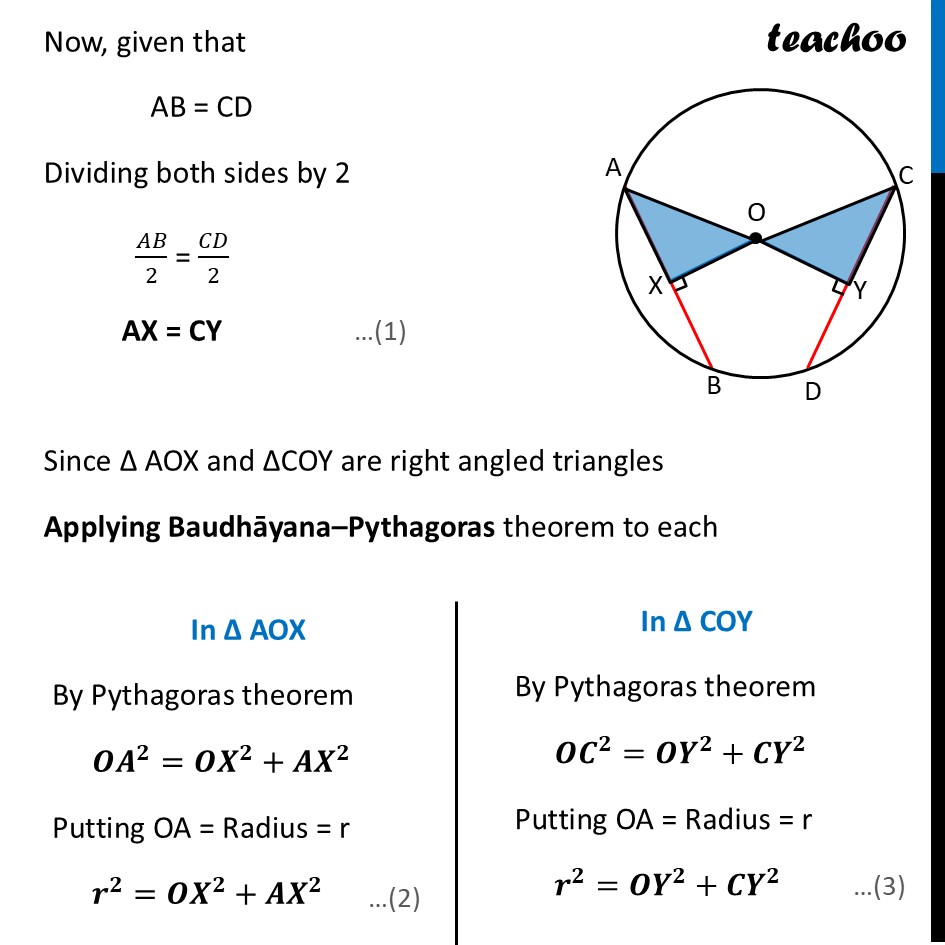
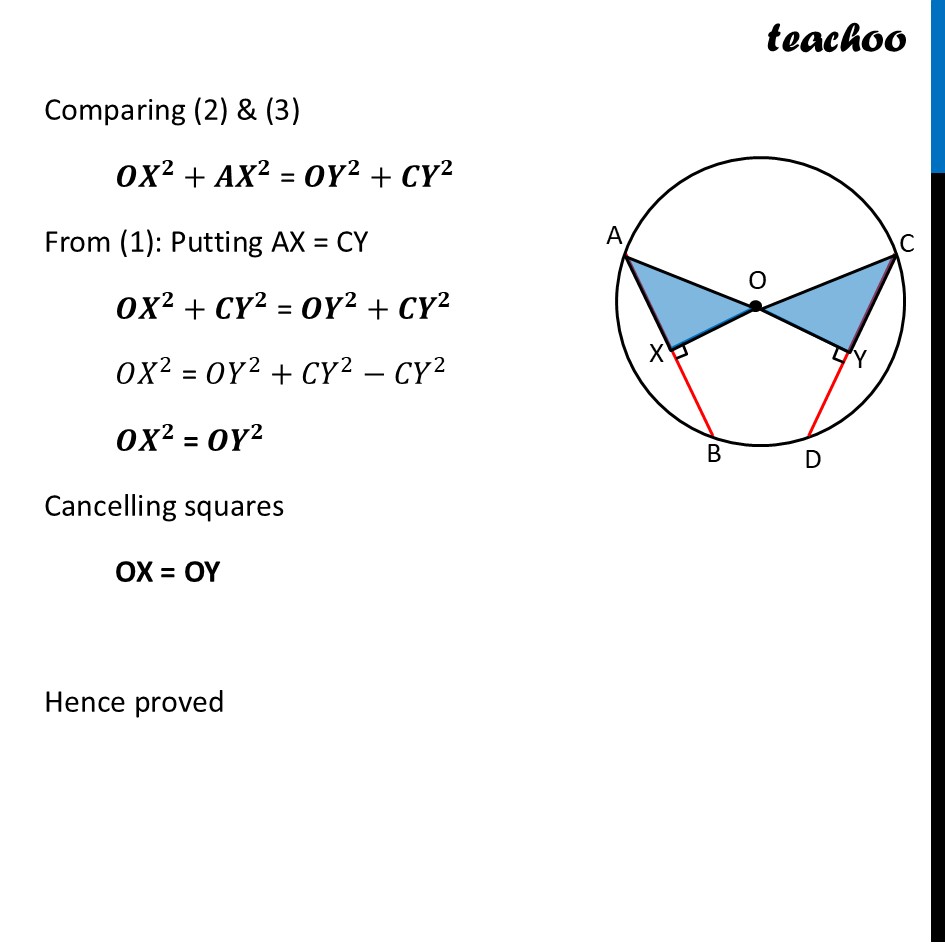
Ex 5.4, 1 Use the Baudhāyana–Pythagoras theorem to show why Theorem 6 must be true. Theorem 6 is Chords of a circle having the same length are all at the same distance from the centre of the circle Let’s first draw our diagram Given: A circle with center at O; AB and CD are two equal chords of circle i.e. AB = CD; OX & OY are perpendicular distance of AB & CD from center O respectively To Prove: OX = OY Proof : We know that Perpendicular from the center to the chord, bisects the chord Since OX ⊥ AB We can write AX = BX = (𝑨𝑩 )/𝟐 Since OY ⊥ CD We can write CY = DY = (𝑪𝑫 )/𝟐 Now, given that AB = CD Dividing both sides by 2 𝐴𝐵/2 = 𝐶𝐷/2 AX = CY Since ∆ AOX and ∆COY are right angled triangles Applying Baudhāyana–Pythagoras theorem to each In ∆ AOX By Pythagoras theorem 𝑶𝑨^𝟐=𝑶𝑿^𝟐+𝑨𝑿^𝟐 Putting OA = Radius = r 𝒓^𝟐=𝑶𝑿^𝟐+𝑨𝑿^𝟐 In ∆ COY By Pythagoras theorem 𝑶𝑪^𝟐=𝑶𝒀^𝟐+〖𝑪𝒀〗^𝟐 Putting OA = Radius = r 𝒓^𝟐=𝑶𝒀^𝟐+〖𝑪𝒀〗^𝟐 Comparing (2) & (3) 𝑶𝑿^𝟐+𝑨𝑿^𝟐 = 𝑶𝒀^𝟐+〖𝑪𝒀〗^𝟐 From (1): Putting AX = CY 𝑶𝑿^𝟐+〖𝑪𝒀〗^𝟐 = 𝑶𝒀^𝟐+〖𝑪𝒀〗^𝟐 𝑂𝑋^2 = 𝑂𝑌^2+〖𝐶𝑌〗^2−〖𝐶𝑌〗^2 𝑶𝑿^𝟐 = 𝑶𝒀^𝟐 Cancelling squares OX = OY Hence proved