





End-of-Chapter Exercises

 You are here
End-of-Chapter Exercises
Last updated at August 14, 2026 by Teachoo
Transcript
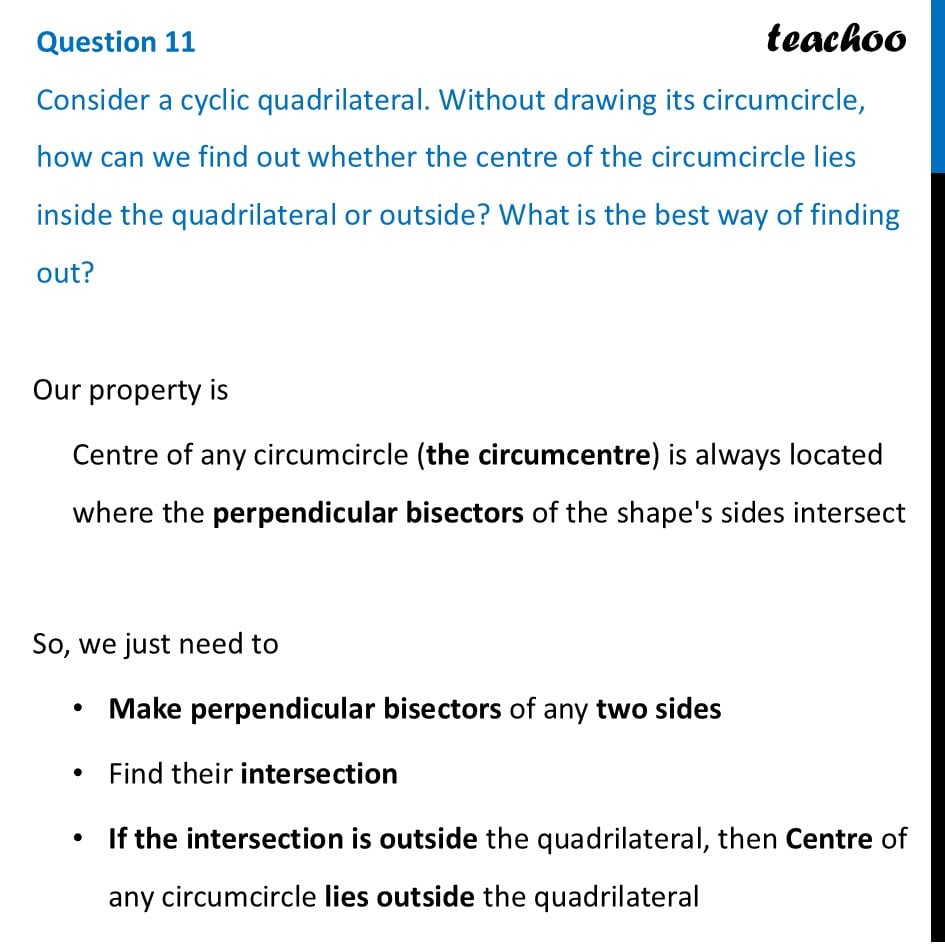
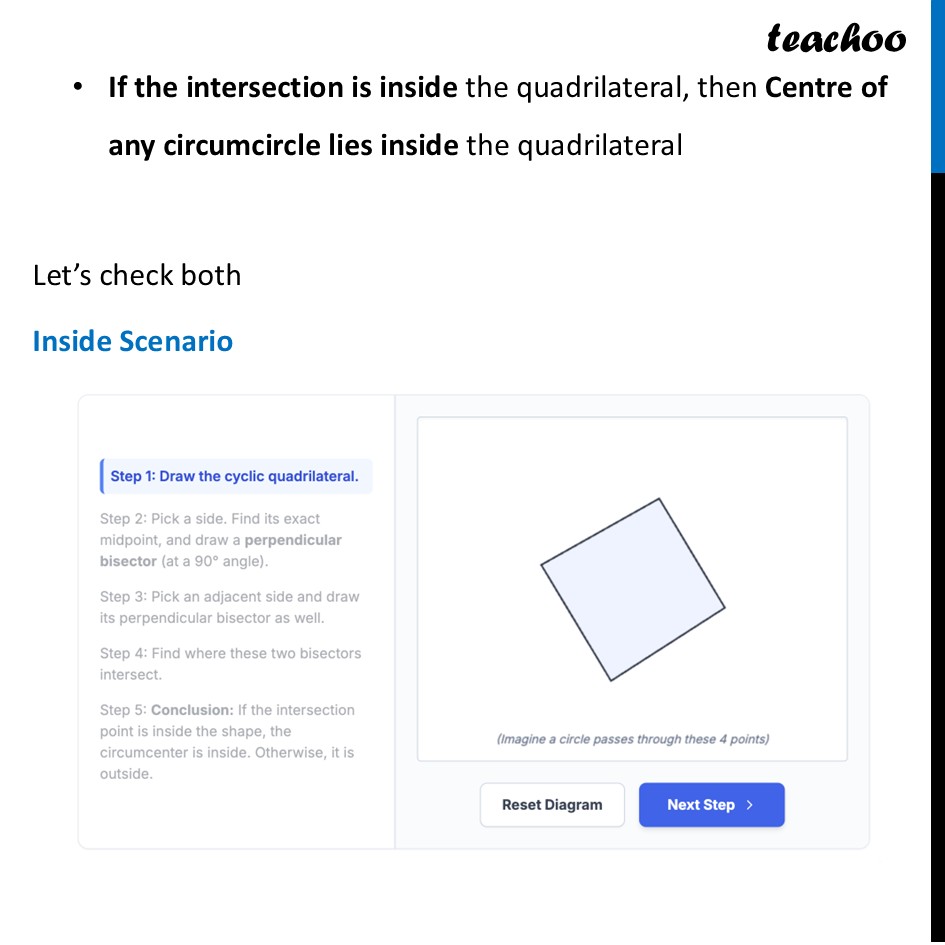
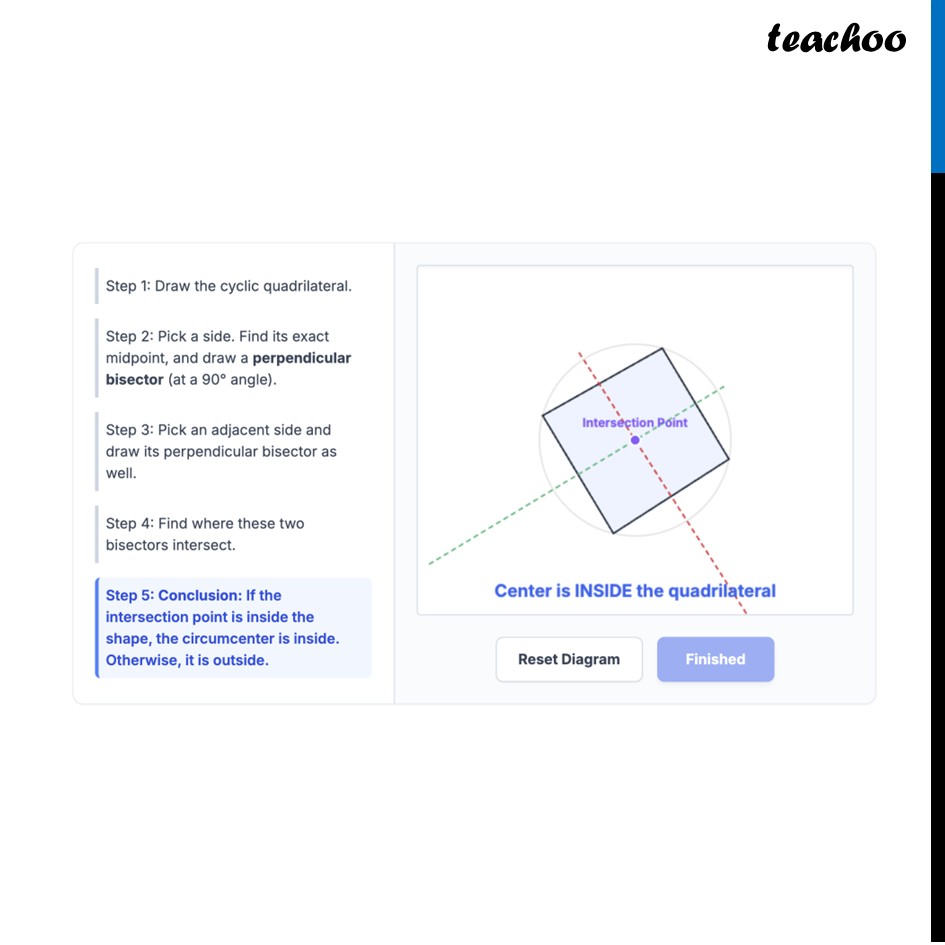
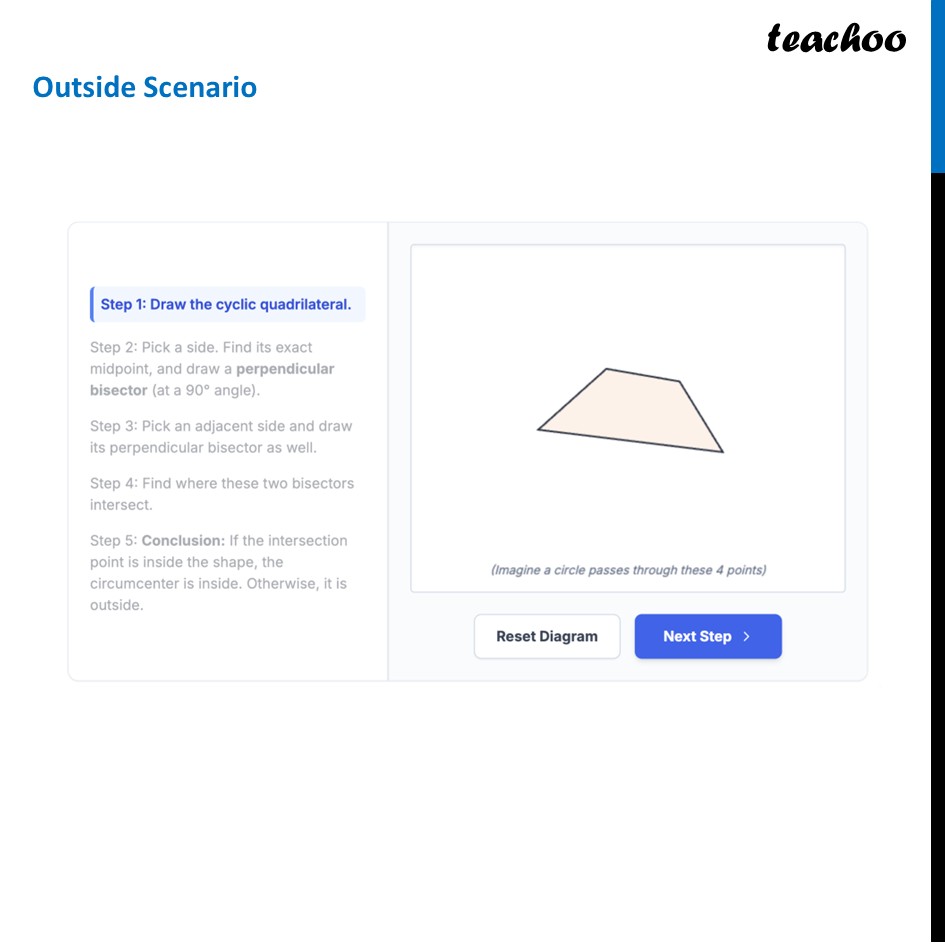
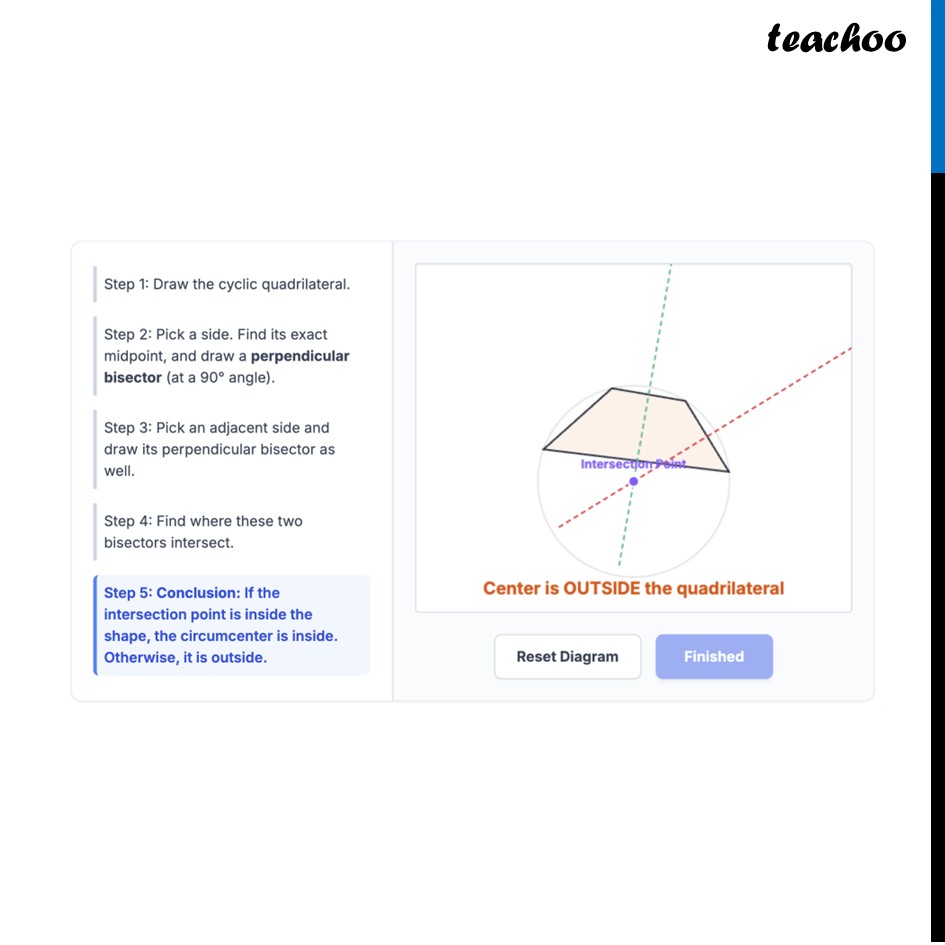
Question 11 Consider a cyclic quadrilateral. Without drawing its circumcircle, how can we find out whether the centre of the circumcircle lies inside the quadrilateral or outside? What is the best way of finding out? Our property is Centre of any circumcircle (the circumcentre) is always located where the perpendicular bisectors of the shape's sides intersect So, we just need to Make perpendicular bisectors of any two sides Find their intersection If the intersection is outside the quadrilateral, then Centre of any circumcircle lies outside the quadrilateral If the intersection is inside the quadrilateral, then Centre of any circumcircle lies inside the quadrilateral Let’s see figure Inside Scenario tep 1: Draw the cyclic quadrilateral. Step 2: Pick a side. Find its exact midpoint, and draw a perpendicular bisector (at a angle). Step 3: Pick an adjacent side and draw its perpendicular bisector as well. Step 4: Find where these two bisectors intersect. Step 5: Conclusion: If the intersection point is inside the shape, the circumcenter is inside. Otherwise, it is (Imagine a circle passes through these 4 points) outside. Reset Diagram Next StepPasses through midpoint at Step 1: Draw the cyclic quadrilateral. Step 2: Pick a side. Find its exact midpoint, and draw a perpendicular bisector (at a angle). Step 3: Pick an adjacent side and draw its perpendicular bisector as well. Step 4: Find where these two bisectors intersect. Step 5: Conclusion: If the intersection point is inside the shape, the circumcenter is inside. Otherwise, it is outside. Reset Diagram Next StepStep 1: Draw the cyclic quadrilateral. Step 2: Pick a side. Find its exact midpoint, and draw a perpendicular bisector (at a angle). Step 3: Pick an adjacent side and draw its perpendicular bisector as well. Step 4: Find where these two bisectors intersect. Step 5: Conclusion: If the intersection point is inside the shape, the circumcenter is inside. Otherwise, it is outside. Reset Diagram Next StepStep 1: Draw the cyclic quadrilateral. Step 2: Pick a side. Find its exact midpoint, and draw a perpendicular bisector (at a angle). Step 3: Pick an adjacent side and draw its perpendicular bisector as well. Step 4: Find where these two bisectors intersect. Step 5: Conclusion: If the intersection point is inside the shape, the circumcenter is inside. Otherwise, it is outside. Reset Diagram Next StepStep 1: Draw the cyclic quadrilateral. Step 2: Pick a side. Find its exact midpoint, and draw a perpendicular bisector (at a angle). Step 3: Pick an adjacent side and draw its perpendicular bisector as well. Step 4: Find where these two bisectors intersect. Step 5: Conclusion: If the intersection point is inside the shape, the circumcenter is inside. Otherwise, it is outside. Reset Diagram Next StepStep 1: Draw the cyclic quadrilateral. Step 2: Pick a side. Find its exact midpoint, and draw a perpendicular bisector (at a angle). Step 3: Pick an adjacent side and draw its perpendicular bisector as well. Step 4: Find where these two bisectors intersect. Step 5: Conclusion: If the intersection point is inside the shape, the circumcenter is inside. Otherwise, it is outside. Reset Diagram Next StepStep 1: Draw the cyclic quadrilateral. Step 2: Pick a side. Find its exact midpoint, and draw a perpendicular bisector (at a angle). Step 3: Pick an adjacent side and draw its perpendicular bisector as well. Step 4: Find where these two bisectors intersect. Step 5: Conclusion: If the intersection point is inside the shape, the circumcenter is inside. Otherwise, it is outside. Reset Diagram Next StepStep 1: Draw the cyclic quadrilateral. Step 2: Pick a side. Find its exact midpoint, and draw a perpendicular bisector (at a angle). Step 3: Pick an adjacent side and draw its perpendicular bisector as well. Step 4: Find where these two bisectors intersect. Step 5: Conclusion: If the intersection point is inside the shape, the circumcenter is inside. Otherwise, it is outside. Reset Diagram Next StepStep 1: Draw the cyclic quadrilateral. Step 2: Pick a side. Find its exact midpoint, and draw a perpendicular bisector (at a angle). Step 3: Pick an adjacent side and draw its perpendicular bisector as well. Step 4: Find where these two bisectors intersect. Step 5: Conclusion: If the intersection point is inside the shape, the circumcenter is inside. Otherwise, it is outside. Reset Diagram Next StepStep 1: Draw the cyclic quadrilateral. Step 2: Pick a side. Find its exact midpoint, and draw a perpendicular bisector (at a angle). Step 3: Pick an adjacent side and draw its perpendicular bisector as well. Step 4: Find where these two bisectors intersect. Step 5: Conclusion: If the intersection point is inside the shape, the circumcenter is inside. Otherwise, it is outside. Reset Diagram FinishedOutside Scenario Step 1: Draw the cyclic quadrilateral. Step 2: Pick a side. Find its exact midpoint, and draw a perpendicular bisector (at a angle). Step 3: Pick an adjacent side and draw its perpendicular bisector as well. Step 4: Find where these two bisectors intersect. Step 5: Conclusion: If the intersection point is inside the shape, the circumcenter is inside. Otherwise, it is outside. (Imagine a circle passes through these 4 points) Reset Diagram Next StepStep 1: Draw the cyclic quadrilateral. Step 2: Pick a side. Find its exact midpoint, and draw a perpendicular bisector (at a angle). Step 3: Pick an adjacent side and draw its perpendicular bisector as well. Step 4: Find where these two bisectors intersect. Step 5: Conclusion: If the intersection point is inside the shape, the circumcenter is inside. Otherwise, it is outside. Reset Diagram Next StepStep 1: Draw the cyclic quadrilateral. Step 2: Pick a side. Find its exact midpoint, and draw a perpendicular bisector (at a angle). Step 3: Pick an adjacent side and draw its perpendicular bisector as well. Step 4: Find where these two bisectors intersect. Step 5: Conclusion: If the intersection point is inside the shape, the circumcenter is inside. Otherwise, it is outside. Reset Diagram Next StepStep 1: Draw the cyclic quadrilateral. Step 2: Pick a side. Find its exact midpoint, and draw a perpendicular bisector (at a angle). Step 3: Pick an adjacent side and draw its perpendicular bisector as well. Step 4: Find where these two bisectors intersect. Step 5: Conclusion: If the intersection point is inside the shape, the circumcenter is inside. Otherwise, it is outside. Reset Diagram Next StepStep 1: Draw the cyclic quadrilateral. Step 2: Pick a side. Find its exact midpoint, and draw a perpendicular bisector (at a angle). Step 3: Pick an adjacent side and draw its perpendicular bisector as well. Step 4: Find where these two bisectors intersect. Step 5: Conclusion: If the intersection point is inside the shape, the circumcenter is inside. Otherwise, it is outside. Reset Diagram Next StepStep 1: Draw the cyclic quadrilateral. Step 2: Pick a side. Find its exact midpoint, and draw a perpendicular bisector (at a angle). Step 3: Pick an adjacent side and draw its perpendicular bisector as well. Step 4: Find where these two bisectors intersect. Step 5: Conclusion: If the intersection point is inside the shape, the circumcenter is inside. Otherwise, it is outside. Reset Diagram Next StepStep 1: Draw the cyclic quadrilateral. Step 2: Pick a side. Find its exact midpoint, and draw a perpendicular bisector (at a angle). Step 3: Pick an adjacent side and draw its perpendicular bisector as well. Step 4: Find where these two bisectors intersect. Step 5: Conclusion: If the intersection point is inside the shape, the circumcenter is inside. Otherwise, it is outside. Reset Diagram Next StepStep 1: Draw the cyclic quadrilateral. Step 2: Pick a side. Find its exact midpoint, and draw a perpendicular bisector (at a angle). Step 3: Pick an adjacent side and draw its perpendicular bisector as well. Step 4: Find where these two bisectors intersect. Step 5: Conclusion: If the intersection point is inside the shape, the circumcenter is inside. Otherwise, it is outside. Reset Diagram Next StepStep 1: Draw the cyclic quadrilateral. Step 2: Pick a side. Find its exact midpoint, and draw a perpendicular bisector (at a angle). Step 3: Pick an adjacent side and draw its perpendicular bisector as well. Step 4: Find where these two bisectors intersect. Step 5: Conclusion: If the intersection point is inside the shape, the circumcenter is inside. Otherwise, it is outside. Reset Diagram Next StepStep 1: Draw the cyclic quadrilateral. Step 2: Pick a side. Find its exact midpoint, and draw a perpendicular bisector (at a angle). Step 3: Pick an adjacent side and draw its perpendicular bisector as well. Step 4: Find where these two bisectors intersect. Step 5: Conclusion: If the intersection point is inside the shape, the circumcenter is inside. Otherwise, it is outside. Reset Diagram Next StepStep 1: Draw the cyclic quadrilateral. Step 2: Pick a side. Find its exact midpoint, and draw a perpendicular bisector (at a angle). Step 3: Pick an adjacent side and draw its perpendicular bisector as well. Step 4: Find where these two bisectors intersect. Step 5: Conclusion: If the intersection point is inside the shape, the circumcenter is inside. Otherwise, it is outside. Reset Diagram Next StepStep 1: Draw the cyclic quadrilateral. Step 2: Pick a side. Find its exact midpoint, and draw a perpendicular bisector (at a angle). Step 3: Pick an adjacent side and draw its perpendicular bisector as well. Step 4: Find where these two bisectors intersect. Step 5: Conclusion: If the intersection point is inside the shape, the circumcenter is inside. Otherwise, it is outside. Reset Diagram Next StepStep 1: Draw the cyclic quadrilateral. Step 2: Pick a side. Find its exact midpoint, and draw a perpendicular bisector (at a angle). Step 3: Pick an adjacent side and draw its perpendicular bisector as well. Step 4: Find where these two bisectors intersect. Step 5: Conclusion: If the intersection point is inside the shape, the circumcenter is inside. Otherwise, it is outside. Reset Diagram Next StepStep 1: Draw the cyclic quadrilateral. Step 2: Pick a side. Find its exact midpoint, and draw a perpendicular bisector (at a angle). Step 3: Pick an adjacent side and draw its perpendicular bisector as well. Step 4: Find where these two bisectors intersect. Step 5: Conclusion: If the intersection point is inside the shape, the circumcenter is inside. Otherwise, it is outside. Reset Diagram Next StepStep 1: Draw the cyclic quadrilateral. Step 2: Pick a side. Find its exact midpoint, and draw a perpendicular bisector (at a angle). Step 3: Pick an adjacent side and draw its perpendicular bisector as well. Step 4: Find where these two bisectors intersect. Step 5: Conclusion: If the intersection point is inside the shape, the circumcenter is inside. Otherwise, it is outside. Reset Diagram Next Step Step 1: Draw the cyclic quadrilateral. Step 2: Pick a side. Find its exact midpoint, and draw a perpendicular bisector (at a angle). Step 3: Pick an adjacent side and draw its perpendicular bisector as well. Step 4: Find where these two bisectors intersect. Step 5: Conclusion: If the intersection point is inside the shape, the circumcenter is inside. Otherwise, it is outside. Reset Diagram Next Step Step 1: Draw the cyclic quadrilateral. Step 2: Pick a side. Find its exact midpoint, and draw a perpendicular bisector (at a angle). Step 3: Pick an adjacent side and draw its perpendicular bisector as well. Step 4: Find where these two bisectors intersect. Step 5: Conclusion: If the Center is OUTSIDE the quadrilateral intersection point is inside the shape, the circumcenter is inside. Otherwise, it is outside. Reset Diagram Finished