



End-of-Chapter Exercises

 You are here
End-of-Chapter Exercises
Last updated at August 14, 2026 by Teachoo
Transcript
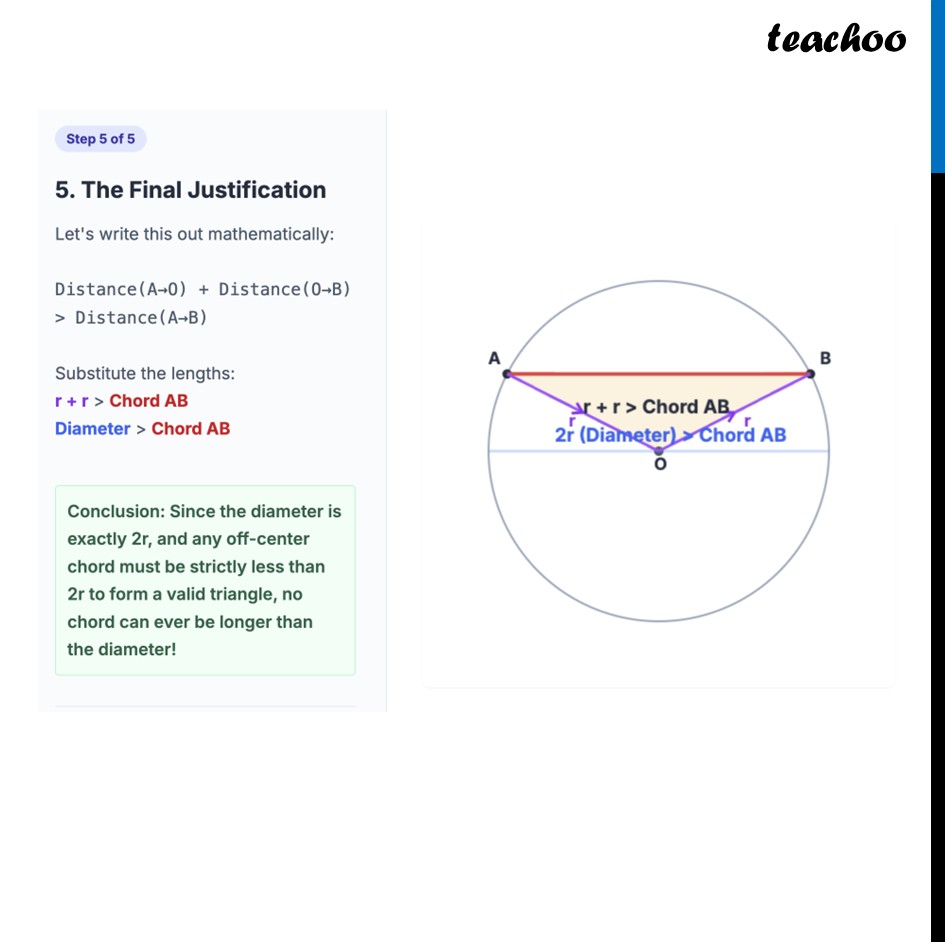
Question 22 There is no chord of a circle that is longer than its diameter." How do you justify this statement? Let’s do this step-by-step Step 1 of 5 The Diameter Let's start with a circle with center and a radius of . The diameter is a special chord that passes straight through the center. Its total length is exactly . Previous Next StepStep 2 of 5 2. A Random Chord Now, let's draw any other random chord, AB, that does not pass through the center. We want to prove that this red chord AB must be strictly shorter than the blue diameter. Previous Next StepStep 3 of 5 3. Forming a Triangle Draw a line from the center to point , and another from to . These are both radii of the circle, so their lengths are both exactly . Notice that we have now formed a triangle: . Previous Next StepStep 4 of 5 4. The Triangle Inequality A fundamental rule of geometry is the Triangle Inequality Theorem: The shortest distance between two points is a straight line. This means walking from A to B directly (the chord) is always shorter than taking the detour from A to O , and then O to B . Previous Next StepStep 5 of 5 5. The Final Justification Let's write this out mathematically: Distance Distance Distance Substitute the lengths: Chord AB Diameter Chord AB Conclusion: Since the diameter is exactly 2 r , and any off-center chord must be strictly less than 2 r to form a valid triangle, no chord can ever be longer than the diameter!