You are here
Theorems (and their Proofs)
Last updated at August 14, 2026 by Teachoo
Transcript
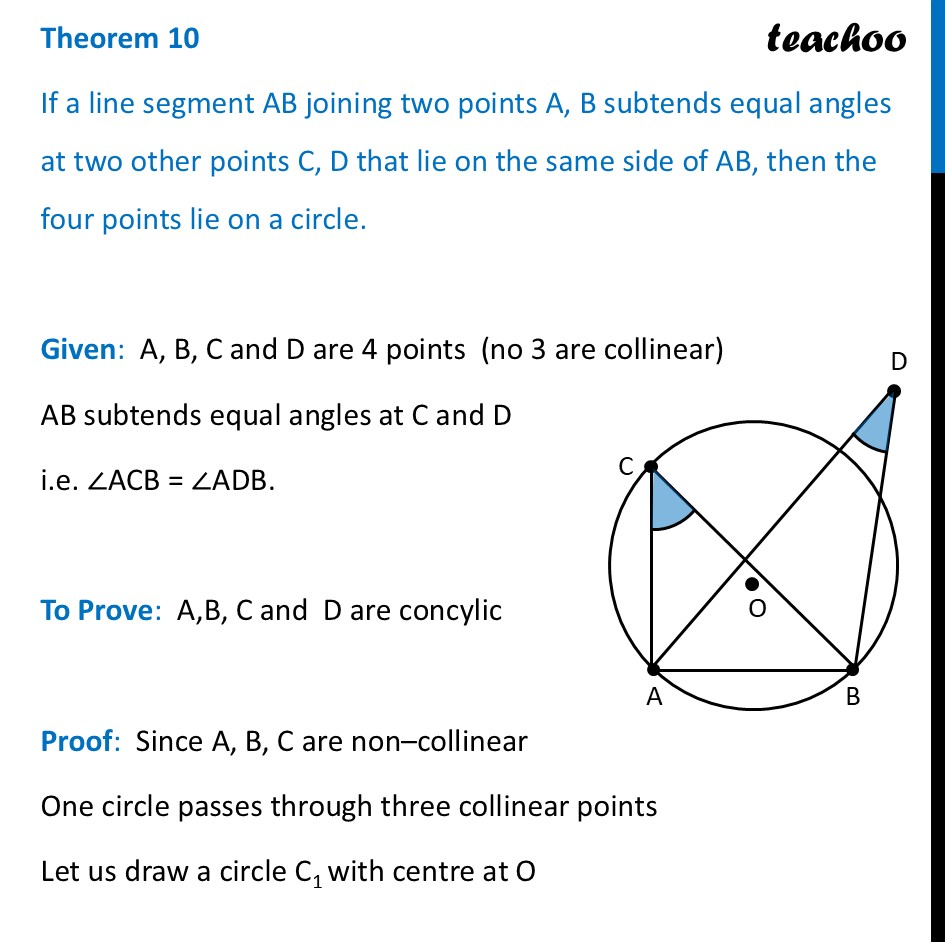
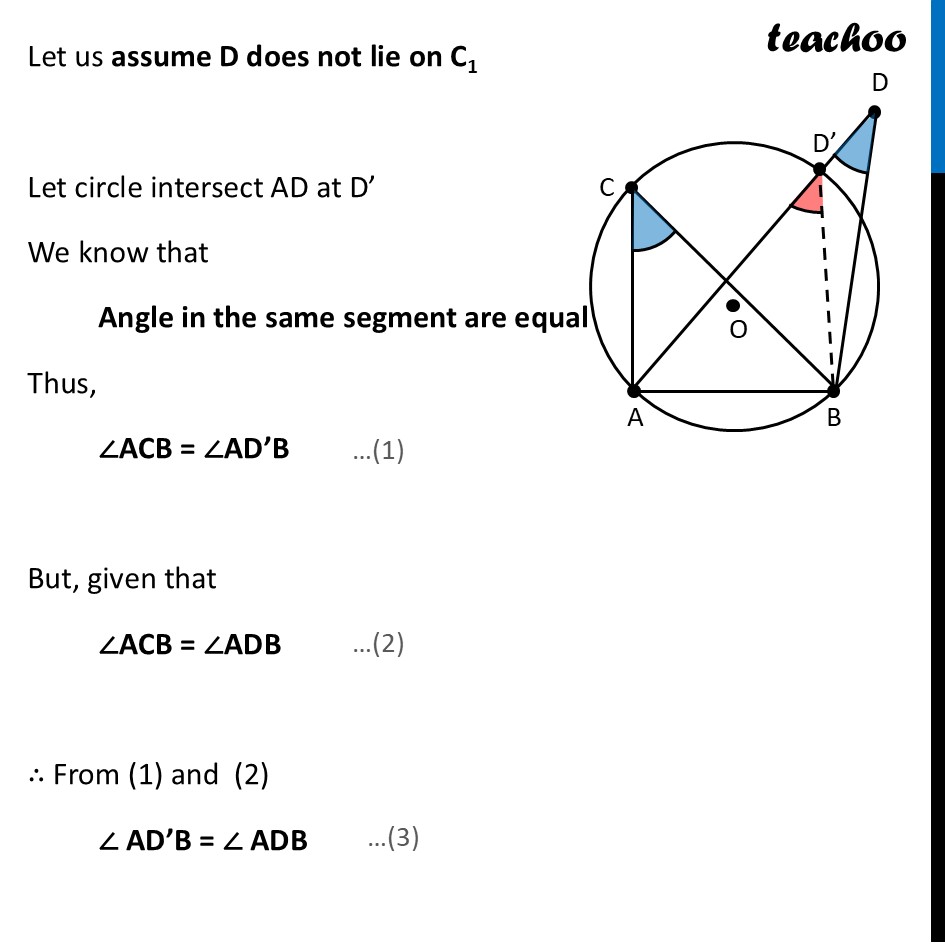
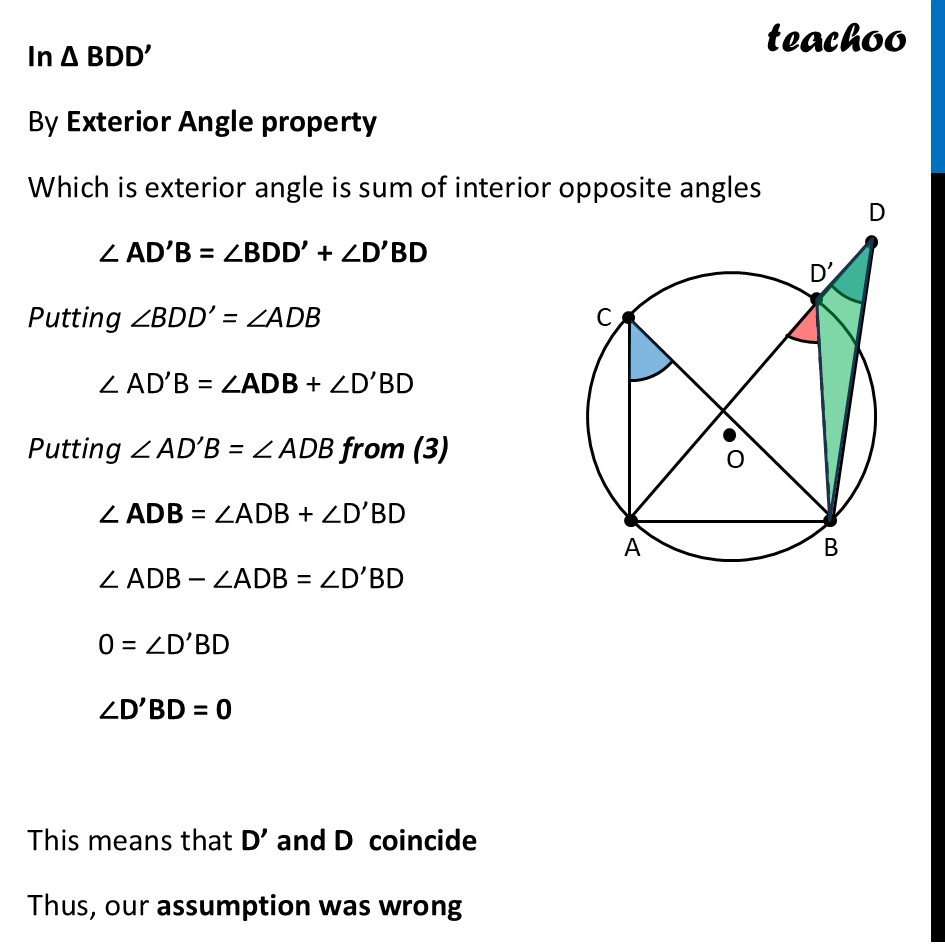
Theorem 10 If a line segment AB joining two points A, B subtends equal angles at two other points C, D that lie on the same side of AB, then the four points lie on a circle. Given: A, B, C and D are 4 points (no 3 are collinear) AB subtends equal angles at C and D i.e. ∠ACB = ∠ADB. To Prove: A,B, C and D are concylic Proof: Since A, B, C are non–collinear One circle passes through three collinear points Let us draw a circle C1 with centre at O Let us assume D does not lie on C1 Let circle intersect AD at D’ We know that Angle in the same segment are equal Thus, ∠ACB = ∠AD’B But, given that ∠ACB = ∠ADB ∴ From (1) and (2) ∠ AD’B = ∠ ADB In ∆ BDD’ By Exterior Angle property Which is exterior angle is sum of interior opposite angles ∠ AD’B = ∠BDD’ + ∠D’BD Putting ∠BDD’ = ∠ADB ∠ AD’B = ∠ADB + ∠D’BD Putting ∠ AD’B = ∠ ADB from (3) ∠ ADB = ∠ADB + ∠D’BD ∠ ADB – ∠ADB = ∠D’BD 0 = ∠D’BD ∠D’BD = 0 This means that D’ and D coincide Thus, our assumption was wrong So, Point D lies on circle ∴ A, B, C, D are concyclic. Hence proved