You are here



Theorems (and their Proofs)
Last updated at August 14, 2026 by Teachoo
Transcript
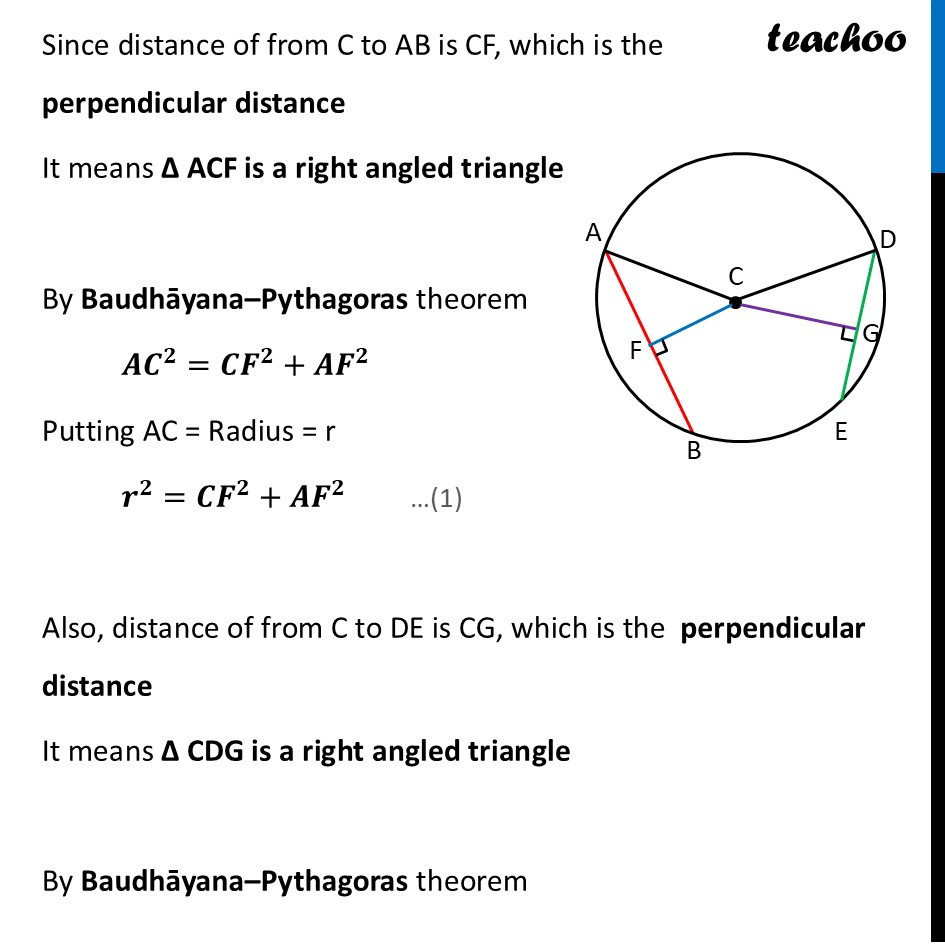
Theorem 8 Let AB and DE be two chords of a circle with centre C. Suppose AB > DE. Then the distance from C to AB is less than the distance from C to DE Given: A circle with center at C; AB and CD are two Chords of the circle where AB > DE To Prove: CF < CG Proof: Join AC and CD Now, AC = CD = Radius Since distance of from C to AB is CF, which is the perpendicular distance It means ∆ ACF is a right angled triangle By Baudhāyana–Pythagoras theorem 〖𝑨𝑪〗^𝟐=〖𝑪𝑭〗^𝟐+〖𝑨𝑭〗^𝟐 Putting AC = Radius = r 𝒓^𝟐=〖𝑪𝑭〗^𝟐+〖𝑨𝑭〗^𝟐 Also, distance of from C to DE is CG, which is the perpendicular distance It means ∆ CDG is a right angled triangle By Baudhāyana–Pythagoras theorem 〖𝑪𝑫〗^𝟐=〖𝑪𝑮〗^𝟐+〖𝑫𝑮〗^𝟐 Putting CD = Radius = r 𝒓^𝟐=〖𝑪𝑮〗^𝟐+〖𝑫𝑮〗^𝟐 Comparing (1) & (2) 〖𝑪𝑭〗^𝟐+〖𝑨𝑭〗^𝟐=〖𝑪𝑮〗^𝟐+〖𝑫𝑮〗^𝟐 We know that Perpendicular from the center to the chord, bisects the chord Since CF ⊥ AB We can write AF = BF = (𝑨𝑩 )/𝟐 Since CG ⊥ CD We can write DG = EG = (𝑫𝑬 )/𝟐 Putting AF = (𝑨𝑩 )/𝟐 & DG = (𝑫𝑬 )/𝟐 in (3) 〖𝐶𝐹〗^2+〖𝐴𝐹〗^2=〖𝐶𝐺〗^2+〖𝐷𝐺〗^2 〖𝑪𝑭〗^𝟐+(𝑨𝑩/𝟐)^𝟐=〖𝑪𝑮〗^𝟐+(𝑫𝑬/𝟐)^𝟐 Given that AB > DE So, for this 〖𝐶𝐹〗^2+(𝐴𝐵/2)^2=〖𝐶𝐺〗^2+(𝐷𝐸/2)^2 to be equal 〖𝐶𝐹〗^2<𝐶𝐺^2 CF < CG Hence proved