This question is similar to CBSE Class 12 Sample Paper for 2023 Boards
Please check the question here
https://www.teachoo.com/19114/4115/Question-8/category/CBSE-Class-12-Sample-Paper-for-2023-Boards/

.jpg)
CBSE Class 12 Sample Paper for 2025 Boards

 You are here
CBSE Class 12 Sample Paper for 2025 Boards
Last updated at August 14, 2026 by Teachoo
This question is similar to CBSE Class 12 Sample Paper for 2023 Boards
Please check the question here
https://www.teachoo.com/19114/4115/Question-8/category/CBSE-Class-12-Sample-Paper-for-2023-Boards/
Transcript
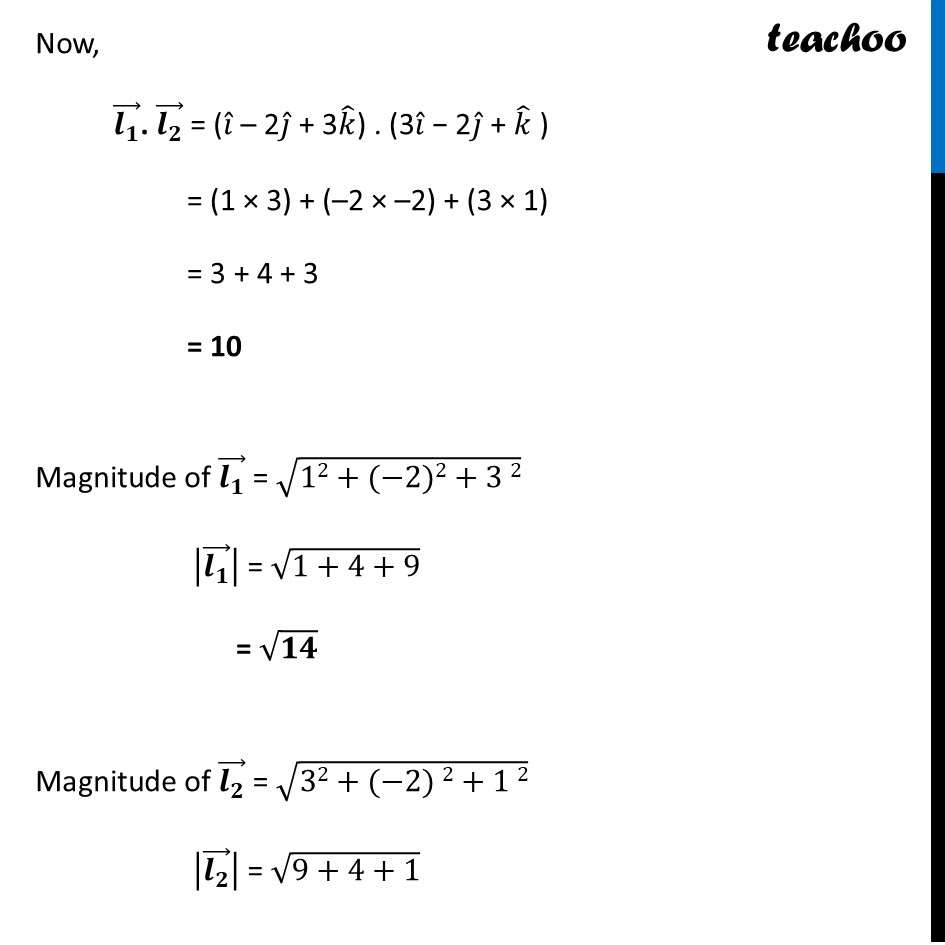
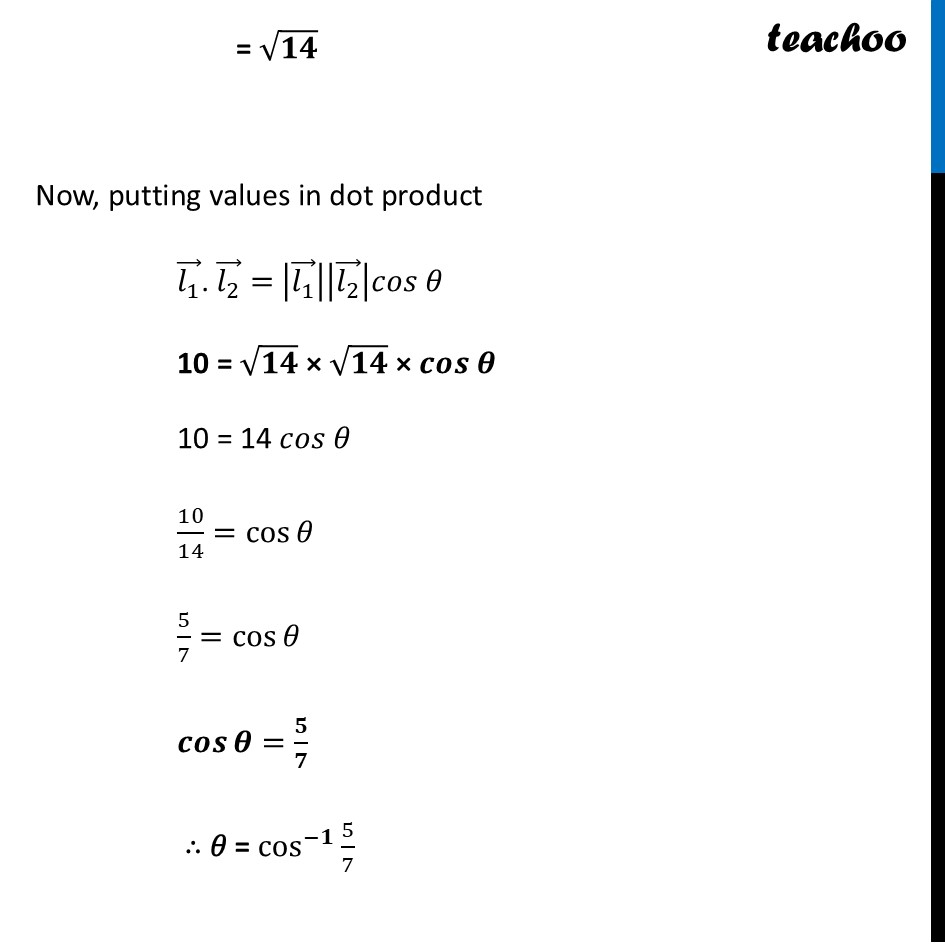
Question 28 (A) An ant is moving along the vector (𝑙_1 ) ⃗=ı ˆ−2ȷ ˆ+3𝑘 ˆ. Few sugar crystals are kept along the vector (𝑙_2 ) ⃗=3ı ˆ−2ȷ ˆ+𝑘 ˆ which is inclined at an angle 𝜽 with the vector (𝑙_1 ) ⃗. Then find the angle 𝜽. Also find the scalar projection of (𝑙_1 ) ⃗ on (𝑙_2 ) ⃗.To find angle, we first find dot product Now, (𝒍_𝟏 ) ⃗. (𝒍_𝟐 ) ⃗= |(𝒍_𝟏 ) ⃗ ||(𝒍_𝟐 ) ⃗ |𝒄𝒐𝒔 θ Finding dot product & magnitude separately Now, (𝒍_𝟏 ) ⃗. (𝒍_𝟐 ) ⃗ = (𝑖 ̂ – 2𝑗 ̂ + 3𝑘 ̂) . (3𝑖 ̂ − 2𝑗 ̂ + 𝑘 ̂ ) = (1 × 3) + (–2 × –2) + (3 × 1) = 3 + 4 + 3 = 10 Magnitude of (𝒍_𝟏 ) ⃗ = √(12+(−2)2+3 2) |(𝒍_𝟏 ) ⃗ | = √(1+4+9) = √𝟏𝟒 Magnitude of (𝒍_𝟐 ) ⃗ = √(32+(−2) 2+1 2) |(𝒍_𝟐 ) ⃗ | = √(9+4+1) Now, putting values in dot product (𝑙_1 ) ⃗. (𝑙_2 ) ⃗= |(𝑙_1 ) ⃗ ||(𝑙_2 ) ⃗ |𝑐𝑜𝑠 𝜃 7 = √14 × √14 × 𝑐𝑜𝑠 𝜃 Projection of 𝒂 ⃗ on 𝒃 ⃗ = 1/("|" 𝑏 ⃗"|" ) (𝑎 ⃗. 𝑏 ⃗) = 𝟕/√𝟏𝟒 So, the correct answer is (a) = √𝟏𝟒 Now, putting values in dot product (𝑙_1 ) ⃗. (𝑙_2 ) ⃗= |(𝑙_1 ) ⃗ ||(𝑙_2 ) ⃗ |𝑐𝑜𝑠 𝜃 10 = √𝟏𝟒 × √𝟏𝟒 × 𝒄𝒐𝒔 𝜽 10 = 14 𝑐𝑜𝑠 𝜃 10/14=cos𝜃 5/7=cos𝜃 𝒄𝒐𝒔𝜽=𝟓/𝟕 ∴ 𝜃 = cos^(−𝟏)〖5/7〗 So, angle between two vectors is 〖𝒄𝒐𝒔〗^(−𝟏)〖𝟓/𝟕〗 Now, We need to find scalar projection of (𝑙_1 ) ⃗ on (𝑙_2 ) ⃗. Projection of 𝒂 ⃗ on 𝒃 ⃗ = 1/("|" 𝑏 ⃗"|" ) (𝑎 ⃗. 𝑏 ⃗) = 𝟕/√𝟏𝟒 So, the correct answer is (a) So, angle between two vectors is 〖𝒄𝒐𝒔〗^(−𝟏)〖𝟓/𝟕〗 Now, We need to find scalar projection of (𝑙_1 ) ⃗ on (𝑙_2 ) ⃗. Now, Projection of (𝑙_1 ) ⃗ on (𝑙_2 ) ⃗ = ((𝒍_𝟏 ) ⃗ . (𝒍_𝟐 ) ⃗)/|(𝒍_𝟐 ) ⃗ | = 10/√𝟏𝟒