You are here
∫ (a + c)^(b + c) f(x) dx is equal to
(A) ∫ (a )^(b) f(x - c)
(B) ∫ (a )^(b) f(x + c) dx
(C) ∫(a )^(b) f(x) dx
(D) ∫ (a - c)^(b - c) (x) dx
This question is similar to Misc 43 (MCQ) - Chapter 7 Class 12 - Integrals
![[Integrals - MCQ] Intgeral ∫ 𝑏 + 𝑐 𝑎 + 𝑐 𝑓(𝑥) 𝑑𝑥 is equal to - NCERT Exemplar MCQ](https://cdn.teachoo.com/a19037a1-eeaf-48c2-b3b4-6b8fafaaf80a/slide8.jpg)
NCERT Exemplar MCQ
Last updated at August 18, 2026 by Teachoo
This question is similar to Misc 43 (MCQ) - Chapter 7 Class 12 - Integrals
Transcript
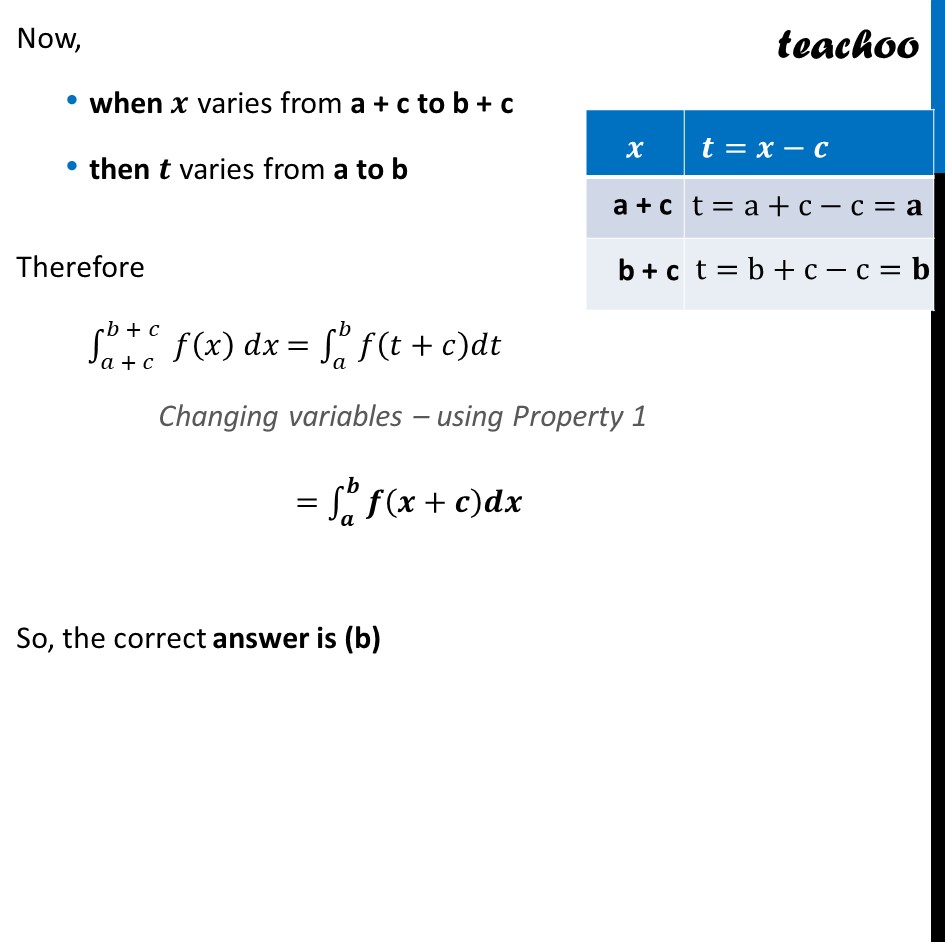
Question 4 ∫1_(𝑎 + 𝑐)^(𝑏 + 𝑐)▒〖 𝑓(𝑥) 𝑑𝑥〗 is equal to ∫1_(𝑎 )^(𝑏 )▒〖𝑓(𝑥−𝑐) 𝑑𝑥〗 (B) ∫1_(𝑎 )^(𝑏 )▒〖𝑓(𝑥+𝑐) 𝑑𝑥〗 (C) ∫1_(𝑎 )^(𝑏 )▒〖𝑓(𝑥) 𝑑𝑥〗 (D) ∫1_(𝑎 −𝑐)^(𝑏−𝑐 )▒〖𝑓(𝑥) 𝑑𝑥〗 ∫1_(𝑎 + 𝑐)^(𝑏 + 𝑐)▒〖 𝑓(𝑥) 𝑑𝑥〗 Putting 𝒙=𝒕+𝒄 Differentiating w.r.t. 𝑥 𝑑𝑥=𝑑𝑡 Now, when 𝒙 varies from a + c to b + c then 𝒕 varies from a to b Therefore ∫1_(𝑎 + 𝑐)^(𝑏 + 𝑐)▒〖 𝑓(𝑥) 𝑑𝑥〗 =∫_𝑎^𝑏▒𝑓(𝑡+𝑐)𝑑𝑡 Changing variables – using Property 1 =∫_𝒂^𝒃▒𝒇(𝒙+𝒄)𝒅𝒙 So, the correct answer is (b)