
CBSE Class 10 Sample Paper for 2027 Boards - Maths Standard

 You are here
CBSE Class 10 Sample Paper for 2027 Boards - Maths Standard
Last updated at October 9, 2026 by Teachoo
Transcript
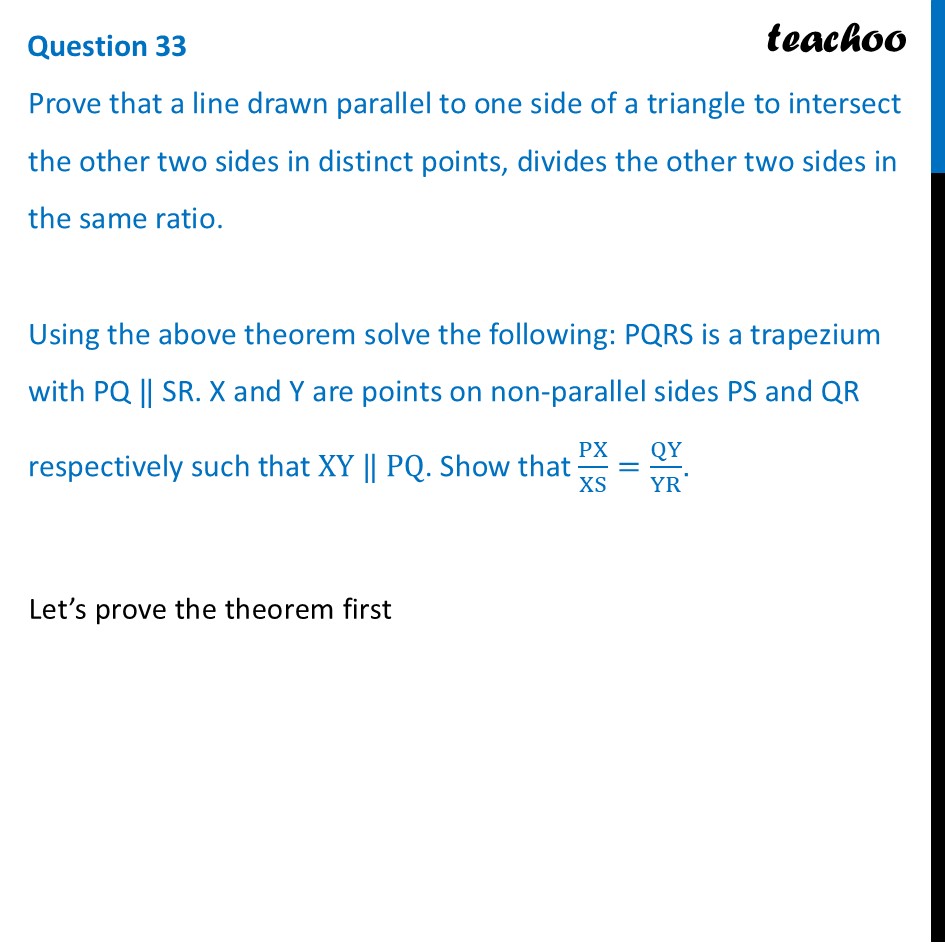
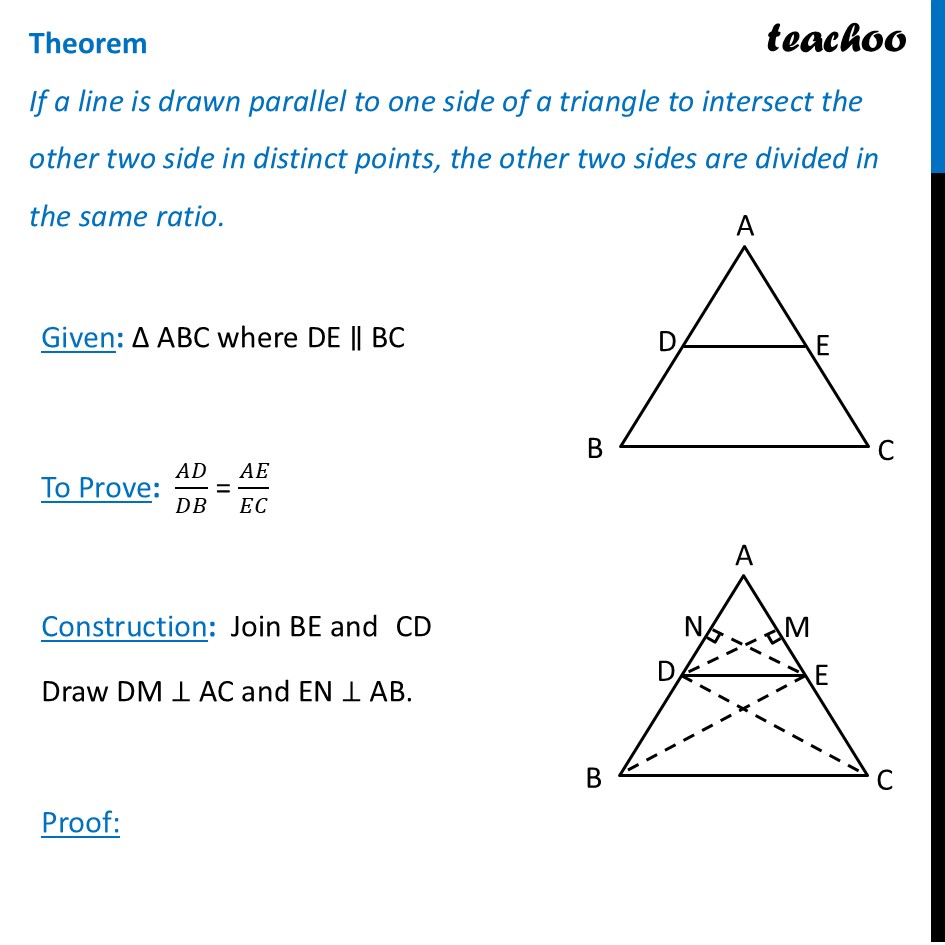
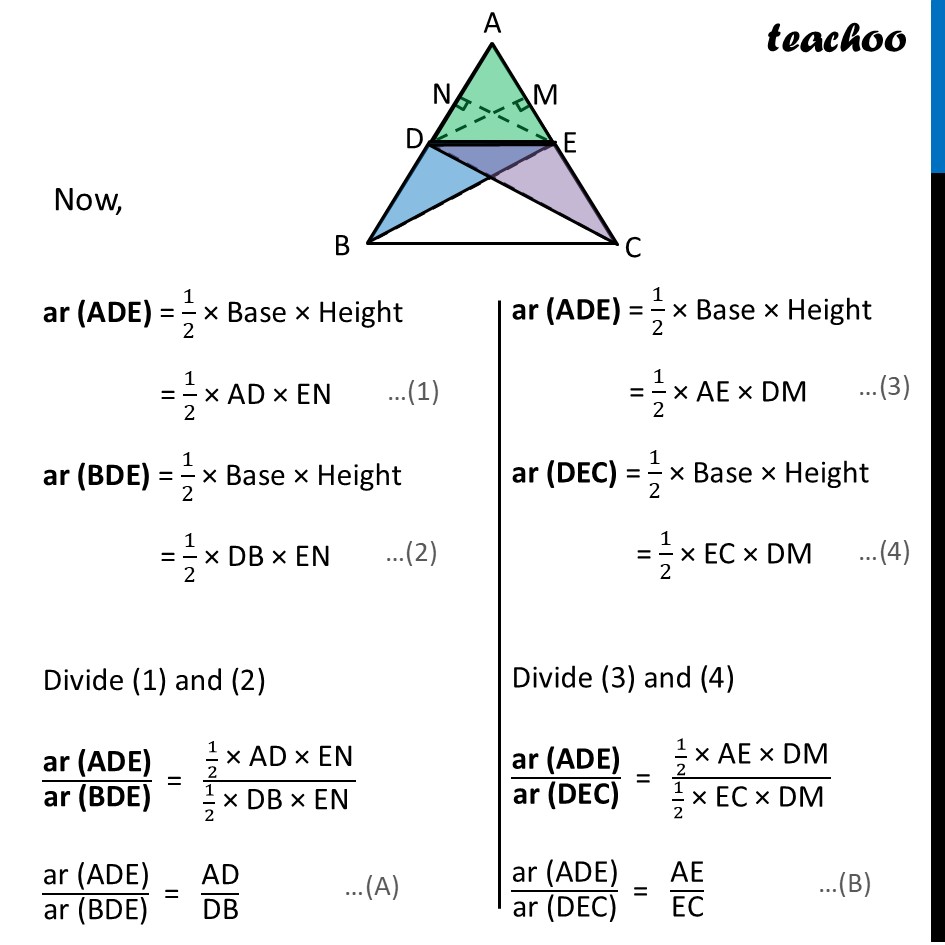
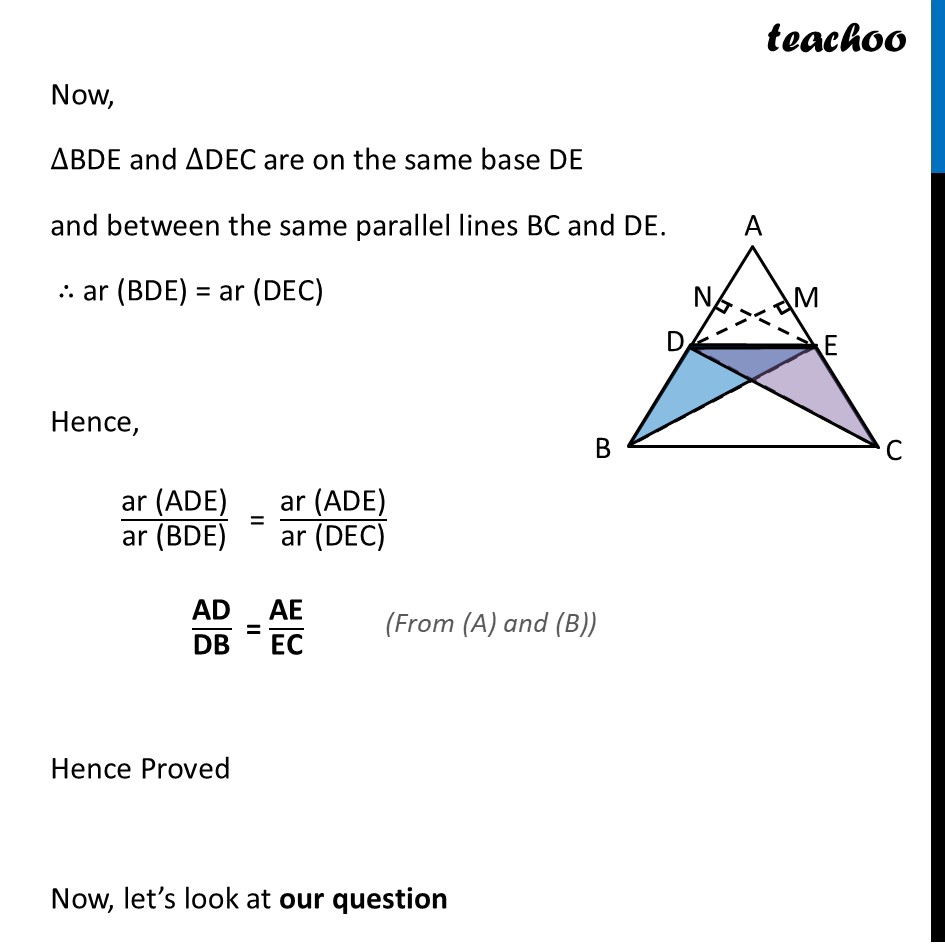
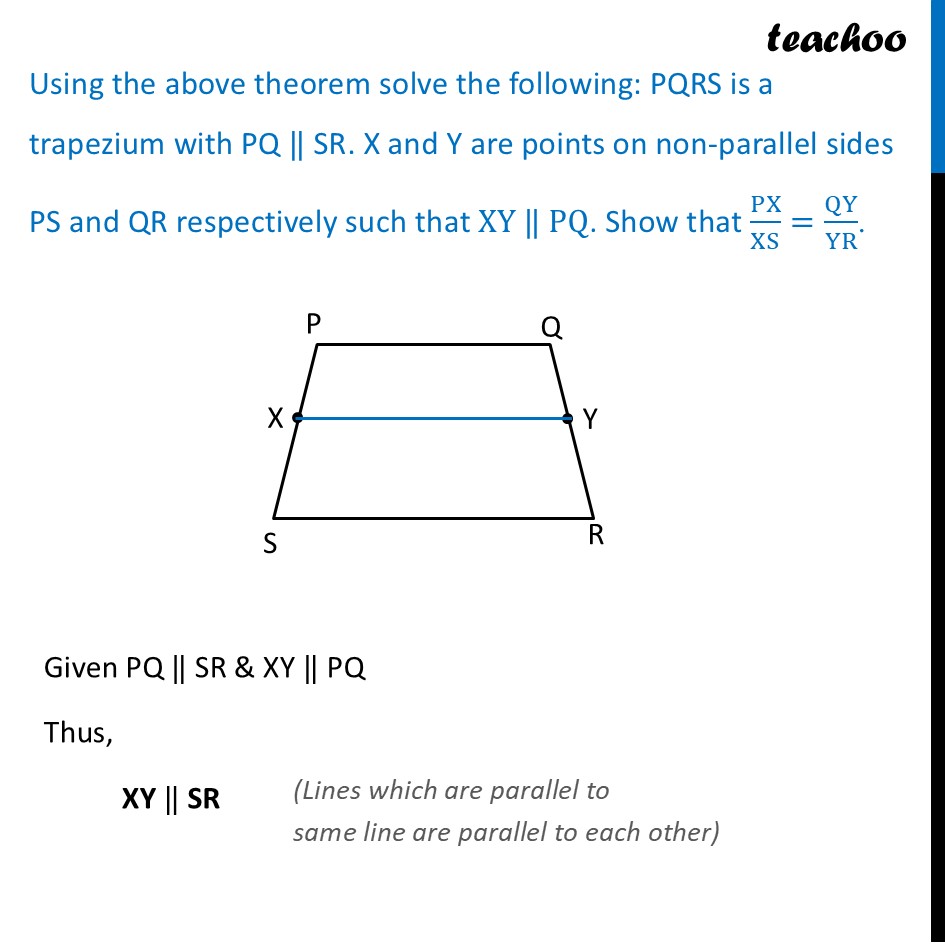
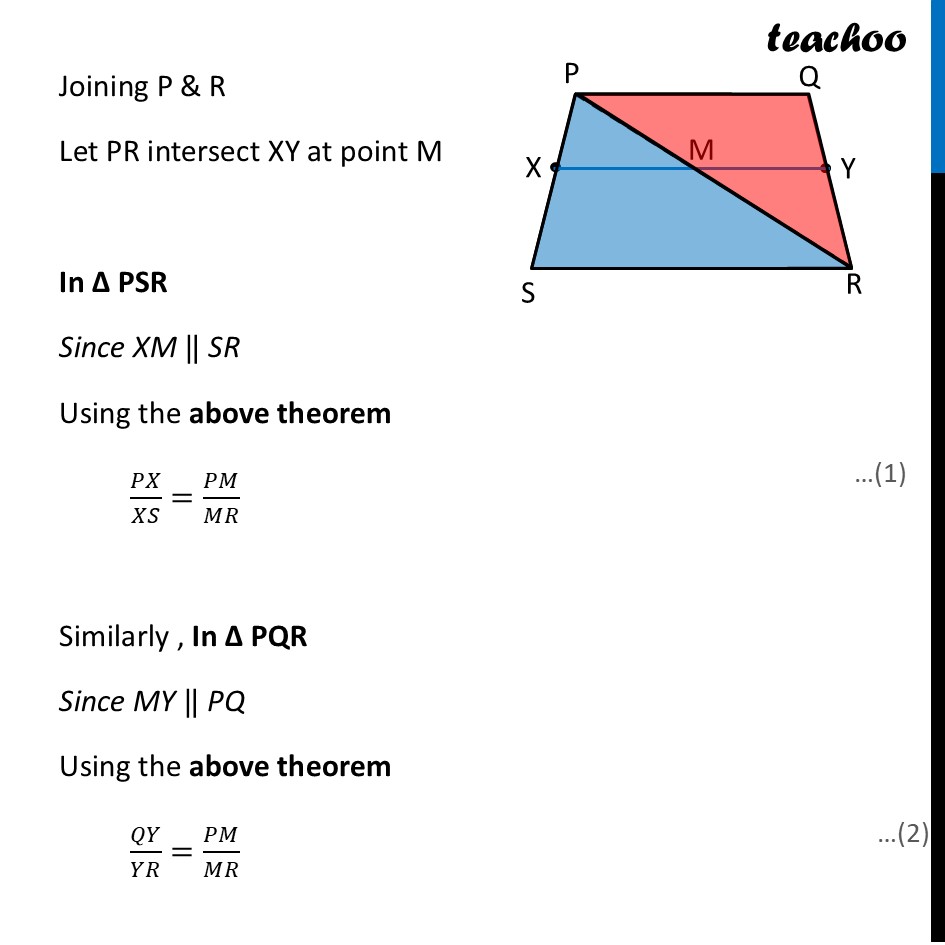
Question 33 Prove that a line drawn parallel to one side of a triangle to intersect the other two sides in distinct points, divides the other two sides in the same ratio. Using the above theorem solve the following: PQRS is a trapezium with PQ ‖ SR. X and Y are points on non-parallel sides PS and QR respectively such that XY ‖ PQ. Show that (PX)/(XS)=(QY)/(YR). Let’s prove the theorem first Theorem If a line is drawn parallel to one side of a triangle to intersect the other two side in distinct points, the other two sides are divided in the same ratio. Given: Δ ABC where DE ∥ BC To Prove: (𝐴𝐷)/(𝐷𝐵) = (𝐴𝐸)/(𝐸𝐶) Construction: Join BE and CD Draw DM ⊥ AC and EN ⊥ AB. Proof: A B C D E A B C D E M N Now, …(1) …(2) ar (ADE) = (1)/(2) × Base × Height = (1)/(2) × AD × EN ar (BDE) = (1)/(2) × Base × Height = (1)/(2) × DB × EN Divide (1) and (2) (ar (ADE))/(ar (BDE)) = ((1)/(2) × AD × EN)/((1)/(2) × DB × EN ) (ar (ADE))/(ar (BDE)) = (AD)/(DB) …(A) ar (ADE) = (1)/(2) × Base × Height = (1)/(2) × AE × DM ar (DEC) = (1)/(2) × Base × Height = (1)/(2) × EC × DM Divide (3) and (4) (ar (ADE))/(ar (DEC)) = ((1)/(2) × AE × DM)/((1)/(2) × EC × DM ) (ar (ADE))/(ar (DEC)) = (AE)/(EC) …(3) …(4) …(B) A B C D E M N Now, ∆BDE and ∆DEC are on the same base DE and between the same parallel lines BC and DE. ∴ ar (BDE) = ar (DEC) Hence, (ar (ADE))/(ar (BDE)) = (ar (ADE))/(ar (DEC)) (AD)/(DB) = (AE)/(EC) Hence Proved Now, let’s look at our question A B C D E M N (From (A) and (B)) Using the above theorem solve the following: PQRS is a trapezium with PQ ‖ SR. X and Y are points on non-parallel sides PS and QR respectively such that XY ‖ PQ. Show that (PX)/(XS)=(QY)/(YR). Given PQ ‖ SR & XY ‖ PQ Thus, XY ‖ SR P Q R S X Y (Lines which are parallel to same line are parallel to each other) Joining P & R Let PR intersect XY at point M In ∆ PSR Since XM ‖ SR Using the above theorem (𝑃𝑋)/(𝑋𝑆)=(𝑃𝑀)/(𝑀𝑅) Similarly , In ∆ PQR Since MY ‖ PQ Using the above theorem (𝑄𝑌)/(𝑌𝑅)=(𝑃𝑀)/(𝑀𝑅) …(1) …(2) M P Q R S X Y From (1) and (2) (𝑃𝑋)/(𝑋𝑆)=(𝑃𝑀)/(𝑀𝑅)=(𝑄𝑌)/(𝑌𝑅) Thus, (𝑷𝑿)/(𝑿𝑺)=(𝑸𝒀)/(𝒀𝑹) Hence Proved Similar https://www.teachoo.com/4284/1051/Theorem-6.1---Basic-Proportionality-Theorem/category/Theorems/ https://www.teachoo.com/1706/522/Example-2---ABCD-is-a-trapezium-with-AB----DC.-E---F-are/category/Examples/
