CBSE Class 10 Sample Paper for 2027 Boards - Maths Standard

 You are here
CBSE Class 10 Sample Paper for 2027 Boards - Maths Standard
Last updated at October 9, 2026 by Teachoo
Transcript
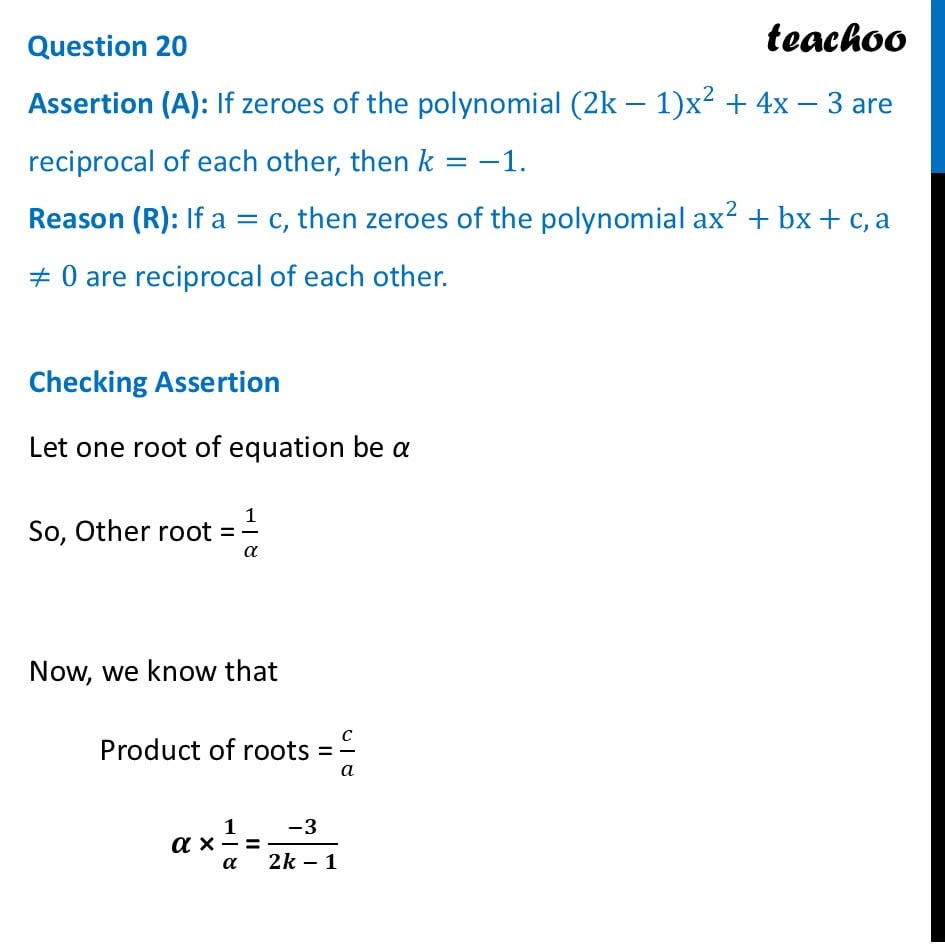
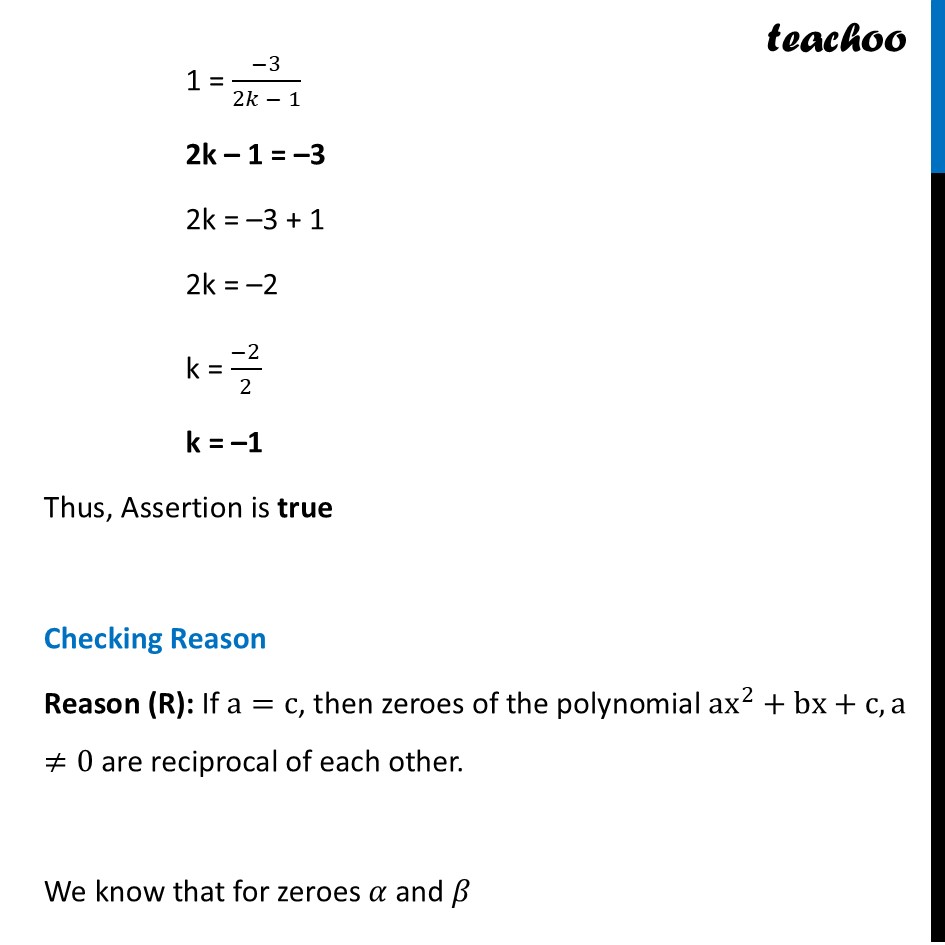
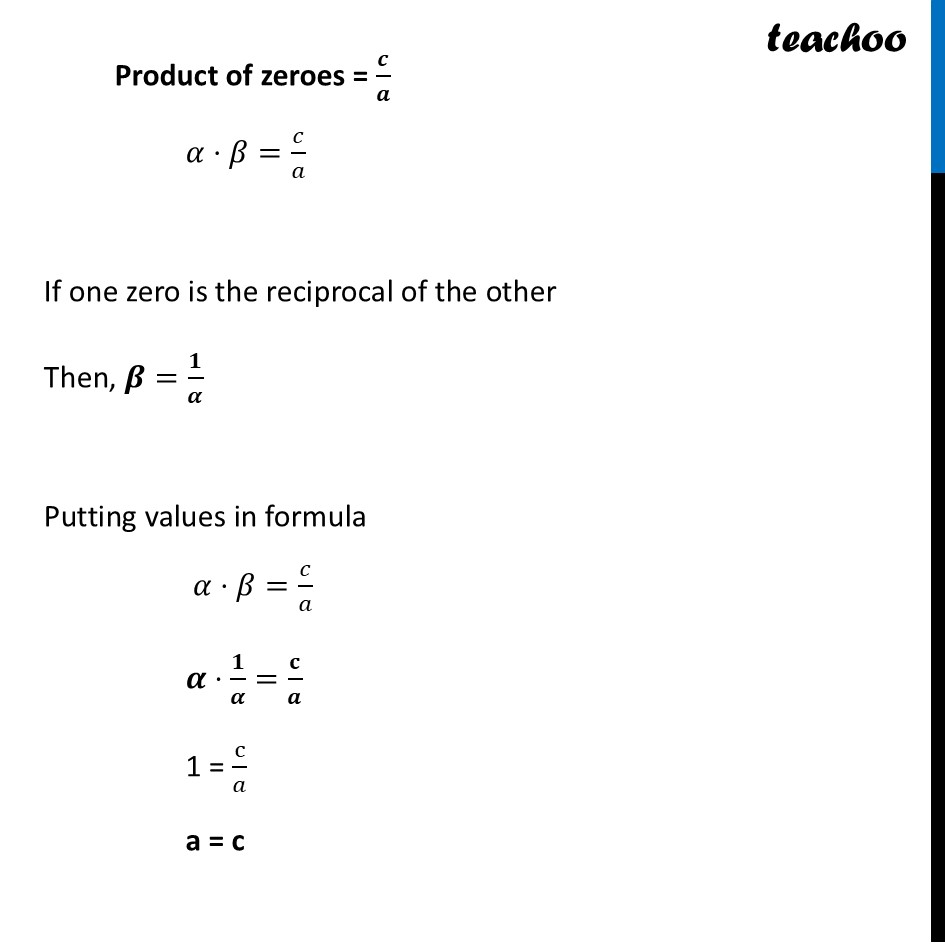
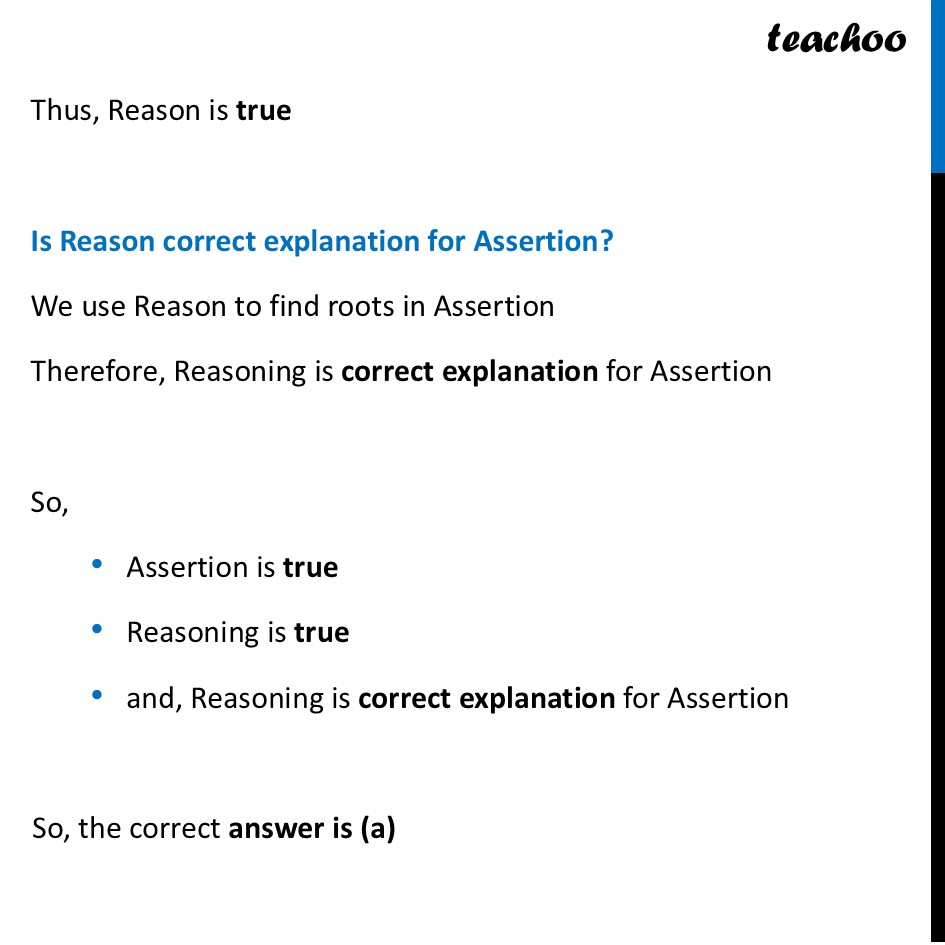
Question 20 Assertion (A): If zeroes of the polynomial (2k−1)x^(2)+4x−3 are reciprocal of each other, then 𝑘=−1. Reason (R): If a=c, then zeroes of the polynomial ax^(2)+bx+c,a≠0 are reciprocal of each other. Checking Assertion Let one root of equation be α So, Other root = (1)/(𝛼) Now, we know that Product of roots = (𝑐)/(𝑎) 𝜶 × (𝟏)/(𝜶) = (−𝟑)/(𝟐𝒌 − 𝟏) 1 = (−3)/(2𝑘 − 1) 2k – 1 = –3 2k = –3 + 1 2k = –2 k = (−2)/(2) k = –1 Thus, Assertion is true Checking Reason Reason (R): If a=c, then zeroes of the polynomial ax^(2)+bx+c,a≠0 are reciprocal of each other. We know that for zeroes 𝛼 and 𝛽 Product of zeroes = (𝒄)/(𝒂) 𝛼⋅𝛽=(𝑐)/(𝑎) If one zero is the reciprocal of the othe Then, 𝛽=(1)/(𝛼) Product of zeroes = (𝒄)/(𝒂) 𝛼⋅𝛽=(𝑐)/(𝑎) If one zero is the reciprocal of the other Then, 𝜷=(𝟏)/(𝜶) Putting values in formula 𝛼⋅𝛽=(𝑐)/(𝑎) 𝜶⋅(𝟏)/(𝜶)=(𝐜)/(𝒂) 1 = (c)/(𝑎) a = c Thus, Reason is true Is Reason correct explanation for Assertion? We use Reason to find roots in Assertion Therefore, Reasoning is correct explanation for Assertion So, Assertion is true Reasoning is true and, Reasoning is correct explanation for Assertion So, the correct answer is (a)
