CBSE Class 10 Sample Paper for 2027 Boards - Maths Standard

 You are here
CBSE Class 10 Sample Paper for 2027 Boards - Maths Standard
Last updated at October 9, 2026 by Teachoo
Transcript
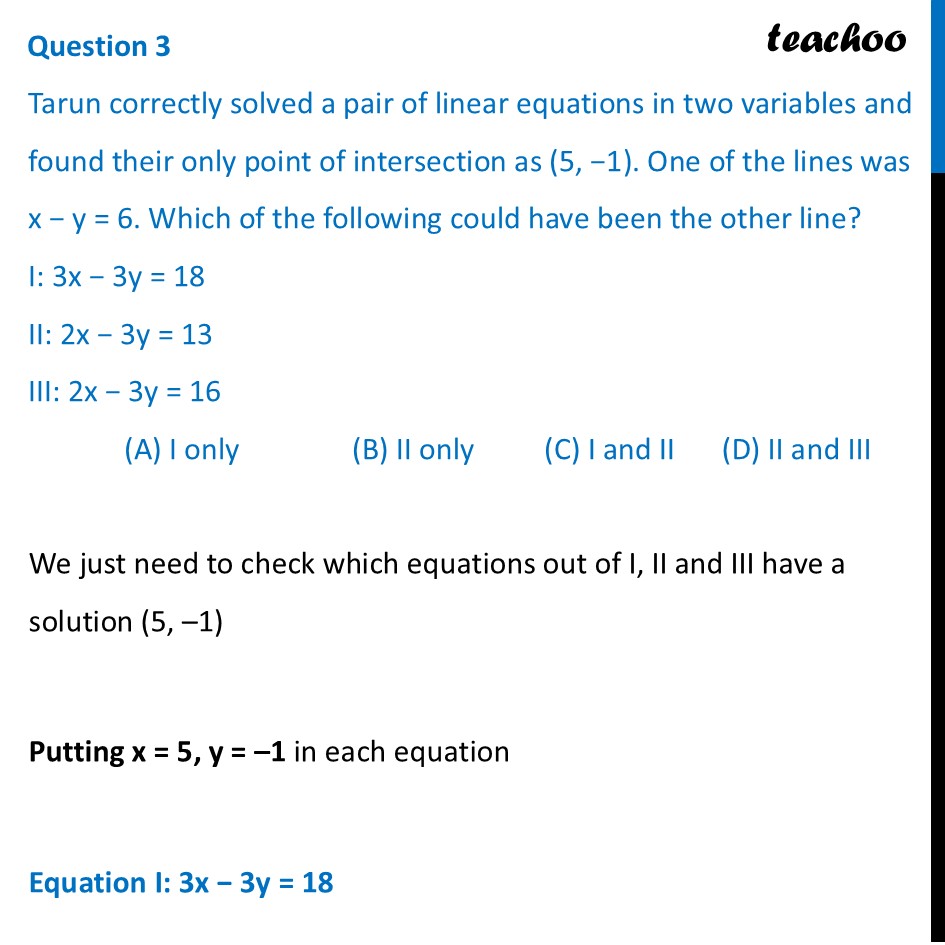
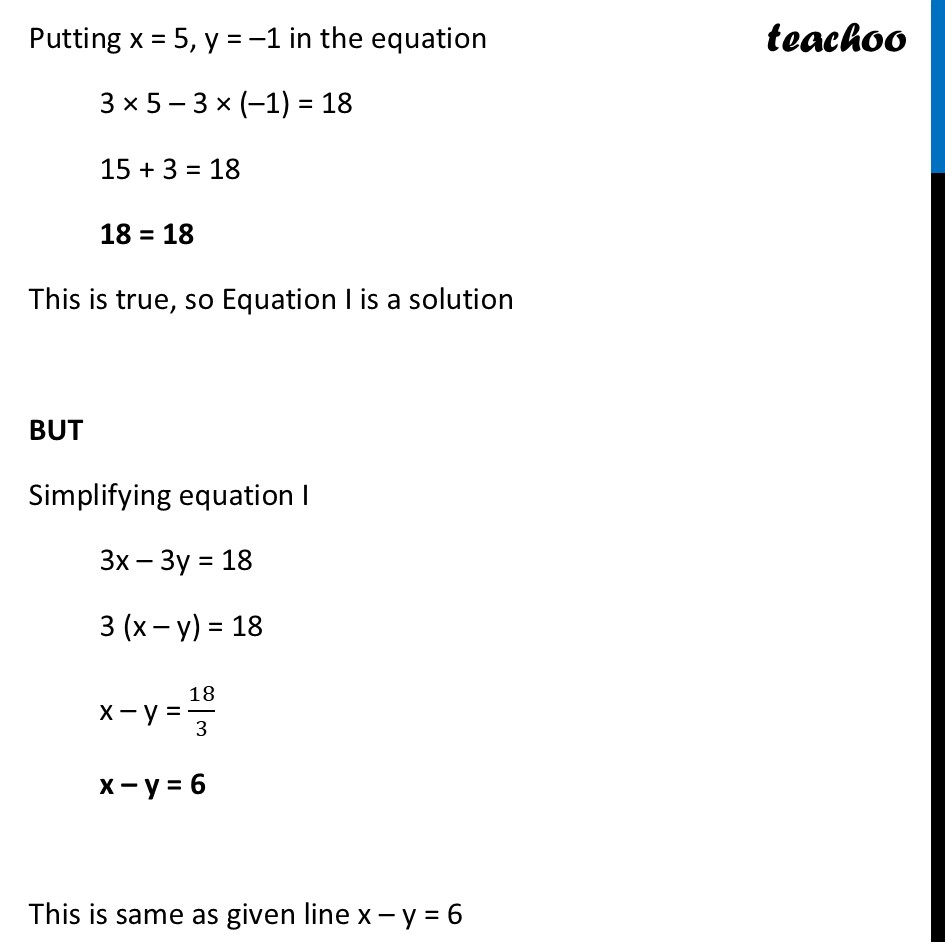
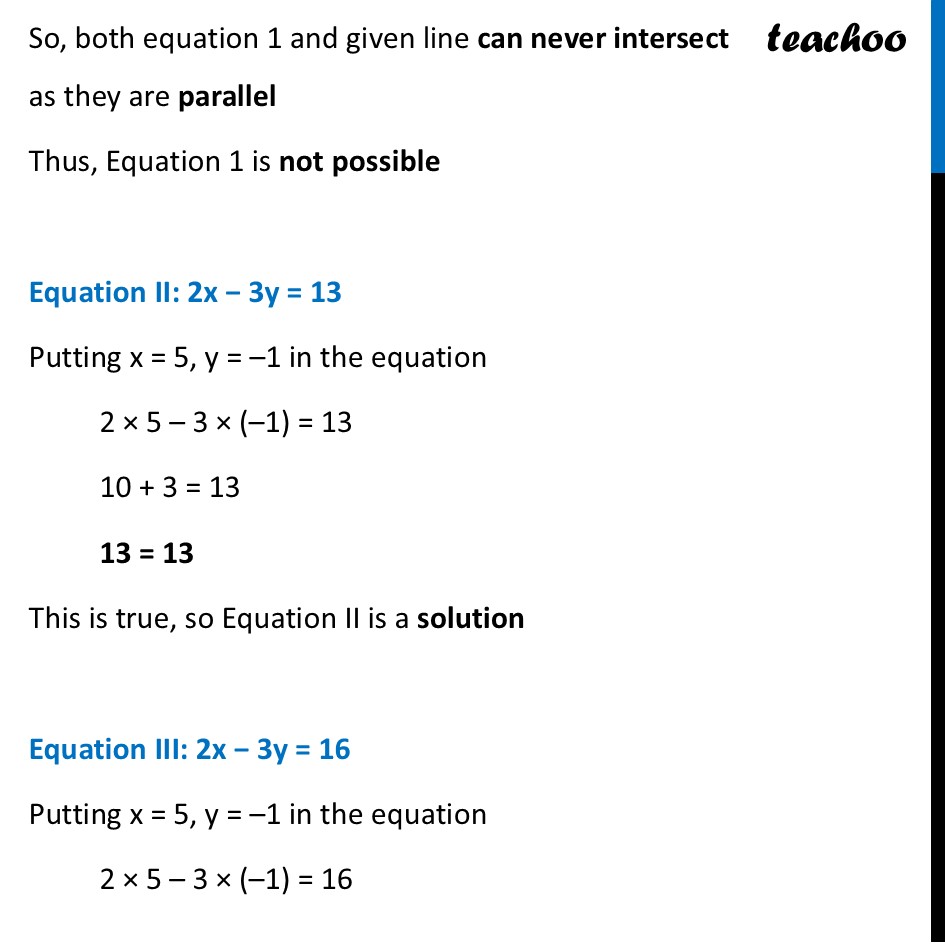
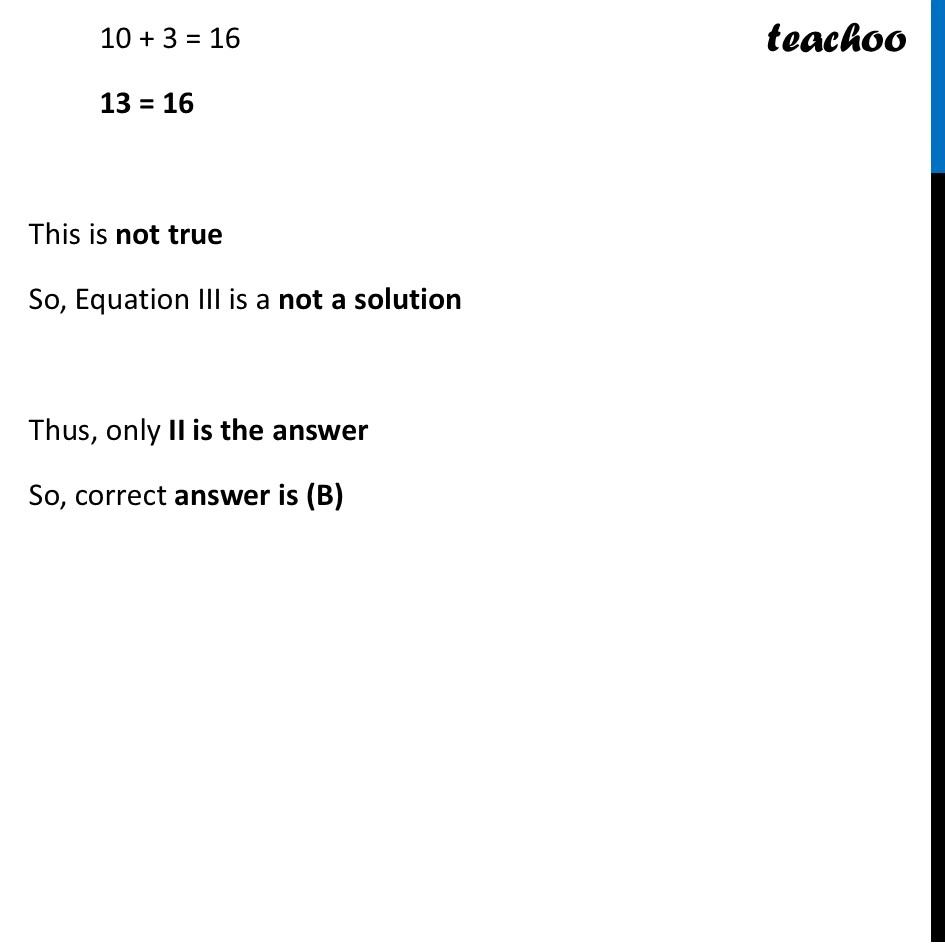
Question 3 Tarun correctly solved a pair of linear equations in two variables and found their only point of intersection as (5, −1). One of the lines was x − y = 6. Which of the following could have been the other line? I: 3x − 3y = 18 II: 2x − 3y = 13 III: 2x − 3y = 16 (A) I only (B) II only (C) I and II (D) II and III We just need to check which equations out of I, II and III have a solution (5, –1) Putting x = 5, y = –1 in each equation Equation I: 3x − 3y = 18 Putting x = 5, y = –1 in the equation 3 × 5 – 3 × (–1) = 18 15 + 3 = 18 18 = 18 This is true, so Equation I is a solution BUT Simplifying equation I 3x – 3y = 18 3 (x – y) = 18 x – y = (18)/(3) x – y = 6 This is same as given line x – y = 6 So, both equation 1 and given line can never intersect as they are parallel Thus, Equation 1 is not possible Equation II: 2x − 3y = 13 Putting x = 5, y = –1 in the equation 2 × 5 – 3 × (–1) = 13 10 + 3 = 13 13 = 13 This is true, so Equation II is a solution Equation III: 2x − 3y = 16 Putting x = 5, y = –1 in the equation 2 × 5 – 3 × (–1) = 16 10 + 3 = 16 13 = 16 This is not true So, Equation III is a not a solution Thus, only II is the answer So, correct answer is (B) So, both equation 1 and given line can never intersect as they are parallel Thus, Equation 1 is not possible Equation II: 2x − 3y = 13 Putting x = 5, y = –1 in the equation 2 × 5 – 3 × (–1) = 13 10 + 3 = 13 13 = 13 This is true, so Equation II is a solution Equation III: 2x − 3y = 16 Putting x = 5, y = –1 in the equation 2 × 5 – 3 × (–1) = 16 10 + 3 = 16 13 = 16 This is not true So, Equation III is a not a solution Thus, only II is the answer So, correct answer is (B)
