CBSE Class 10 Sample Paper for 2027 Boards - Maths Standard

 You are here
CBSE Class 10 Sample Paper for 2027 Boards - Maths Standard
Last updated at October 9, 2026 by Teachoo
Transcript
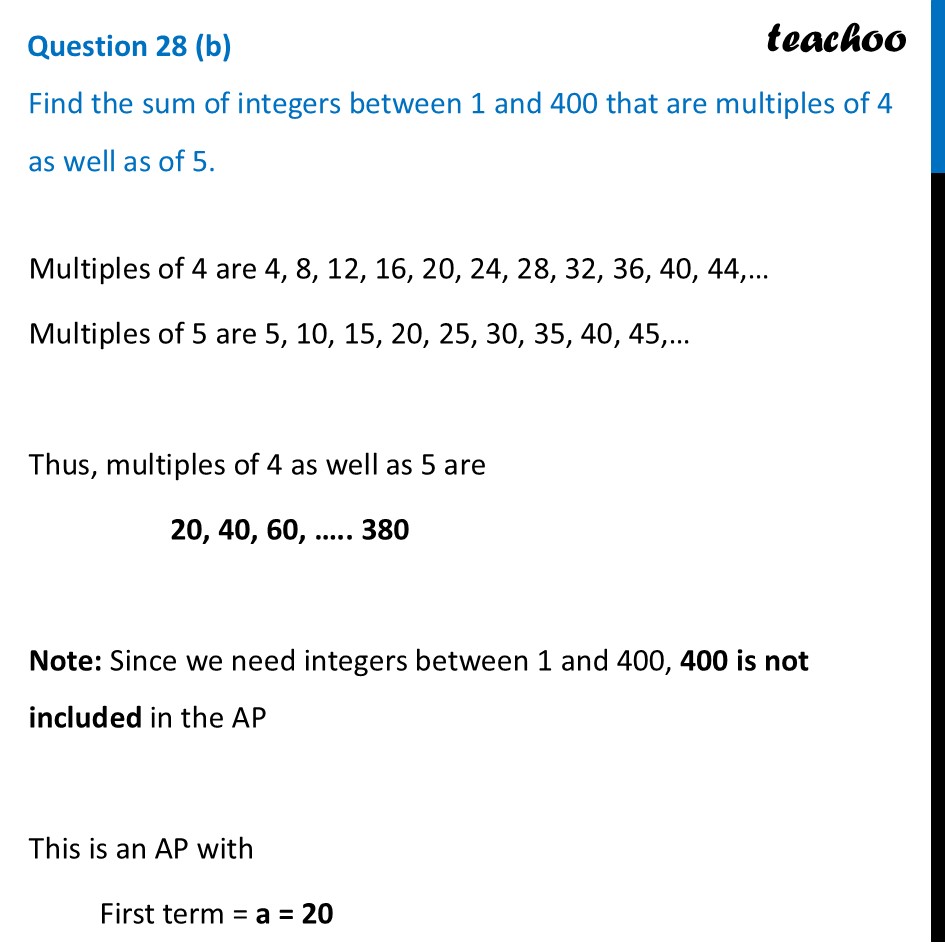
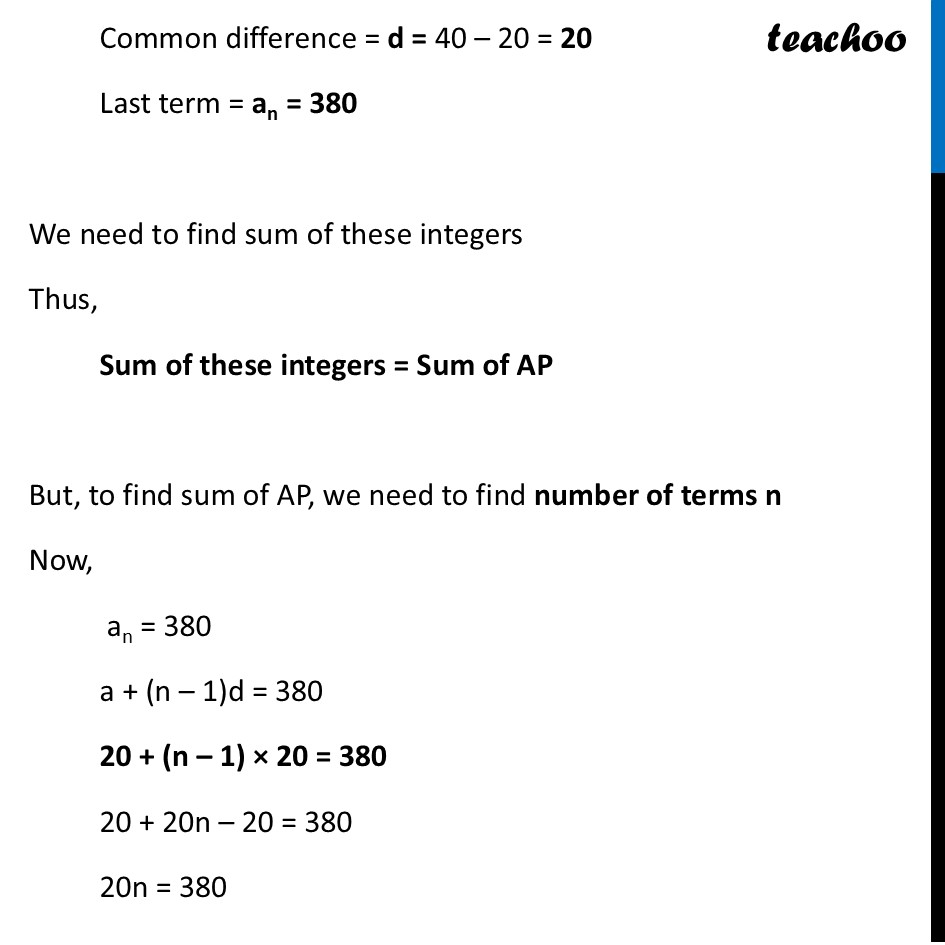
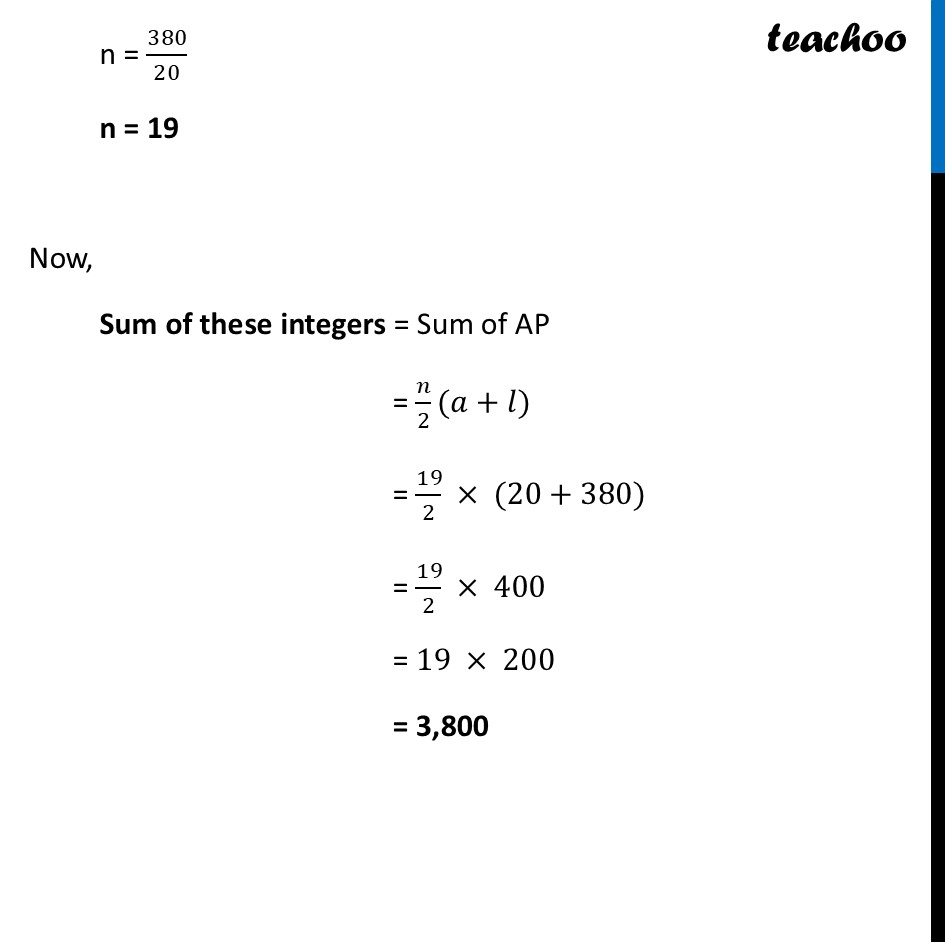
Question 28 (b) Find the sum of integers between 1 and 400 that are multiples of 4 as well as of 5. Multiples of 4 are 4, 8, 12, 16, 20, 24, 28, 32, 36, 40, 44,… Multiples of 5 are 5, 10, 15, 20, 25, 30, 35, 40, 45,… Thus, multiples of 4 as well as 5 are 20, 40, 60, ….. 380 Note: Since we need integers between 1 and 400, 400 is not included in the AP This is an AP with First term = a = 20 Common difference = d = 40 – 20 = 20 Last term = a_(n) = 380 We need to find sum of these integers Thus, Sum of these integers = Sum of AP But, to find sum of AP, we need to find number of terms n Now, a_(n) = 380 a + (n – 1)d = 380 20 + (n – 1) × 20 = 380 20 + 20n – 20 = 380 20n = 380 n = (380)/(20) n = 19 Now, Sum of these integers = Sum of AP = (𝑛)/(2)(𝑎+𝑙) = (19)/(2) × (20+380) = (19)/(2) × 400 = 19 × 200 = 3,800 Common difference = d = 40 – 20 = 20 Last term = a_(n) = 380 We need to find sum of these integers Thus, Sum of these integers = Sum of AP But, to find sum of AP, we need to find number of terms n Now, a_(n) = 380 a + (n – 1)d = 380 20 + (n – 1) × 20 = 380 20 + 20n – 20 = 380 20n = 380 n = (380)/(20) n = 19 Now, Sum of these integers = Sum of AP = (𝑛)/(2)(𝑎+𝑙) = (19)/(2) × (20+380) = (19)/(2) × 400 = 19 × 200 = 3,800 n = (380)/(20) n = 19 Now, Sum of these integers = Sum of AP = (𝑛)/(2)(𝑎+𝑙) = (19)/(2) × (20+380) = (19)/(2) × 400 = 19 × 200 = 3,800
