CBSE Class 10 Sample Paper for 2027 Boards - Maths Standard

 You are here
CBSE Class 10 Sample Paper for 2027 Boards - Maths Standard
Last updated at October 9, 2026 by Teachoo
Transcript
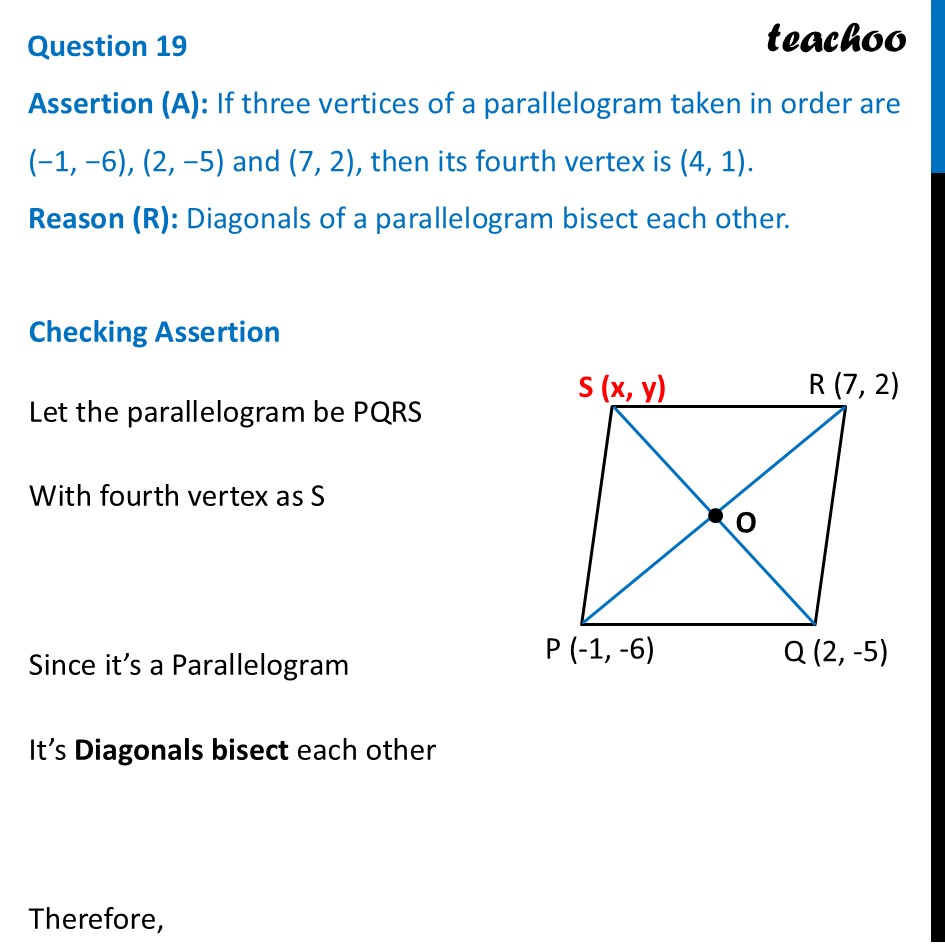
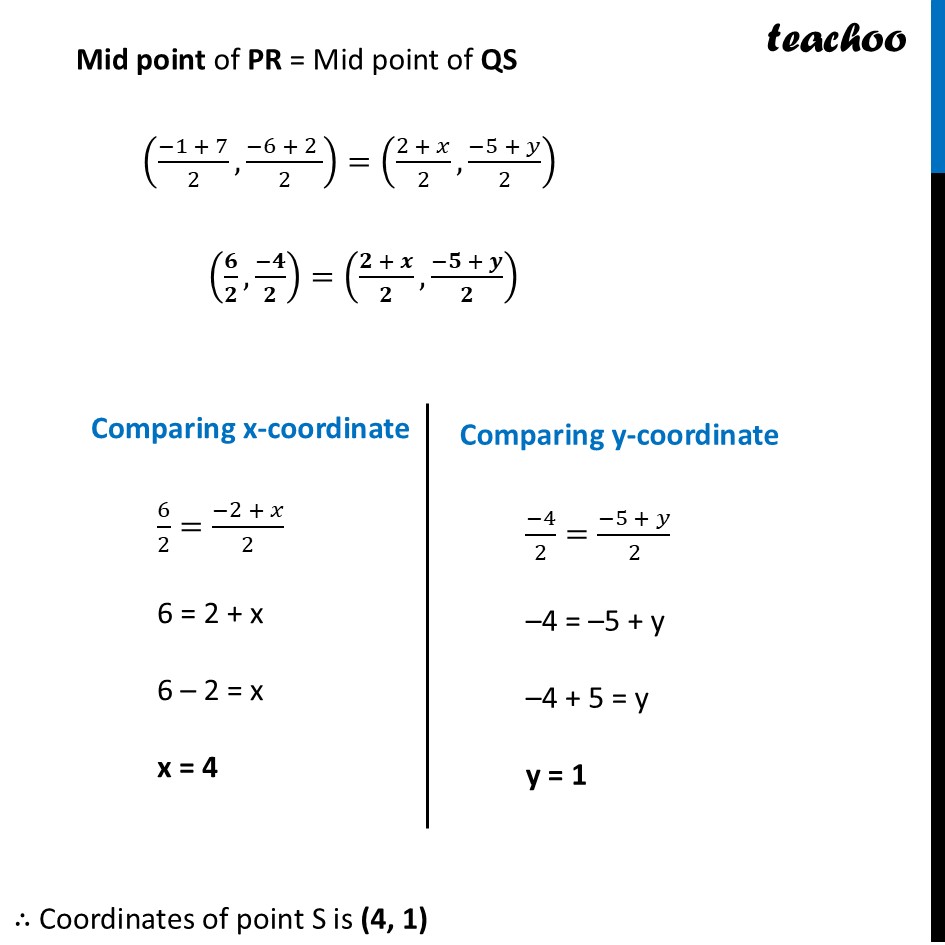
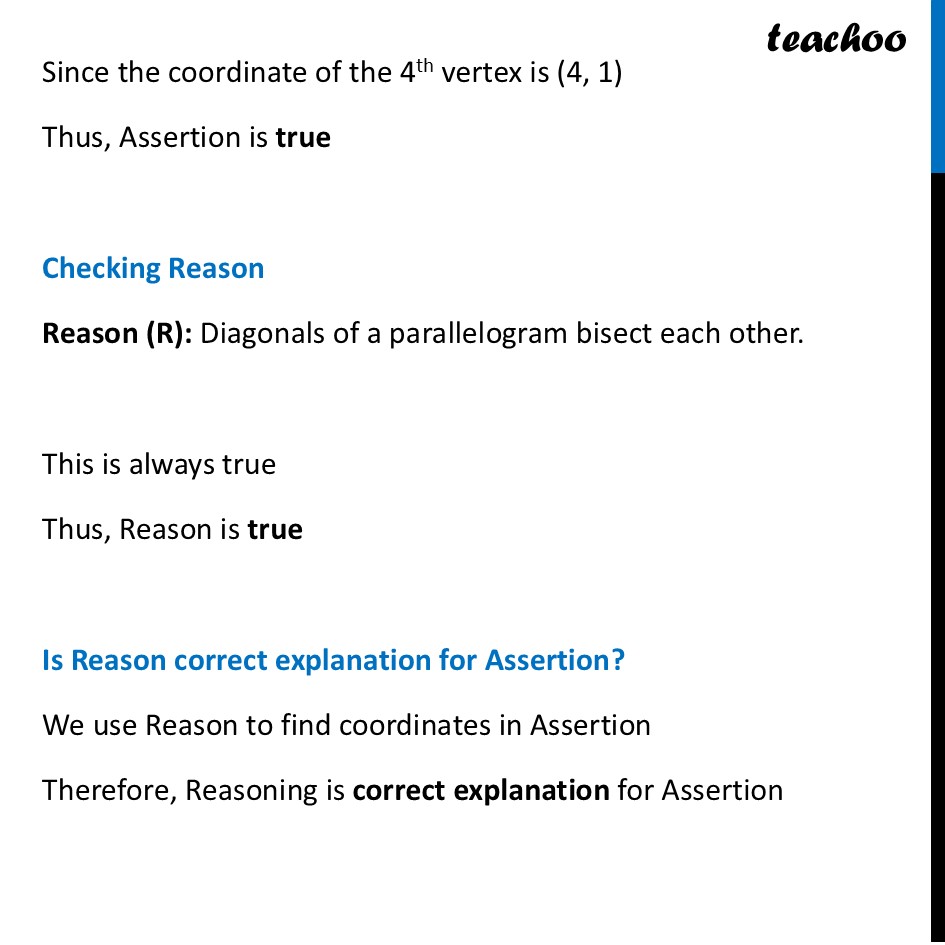
Question 19 Assertion (A): If three vertices of a parallelogram taken in order are (−1, −6), (2, −5) and (7, 2), then its fourth vertex is (4, 1). Reason (R): Diagonals of a parallelogram bisect each other. Checking Assertion Let the parallelogram be PQRS With fourth vertex as S Since it’s a Parallelogram It’s Diagonals bisect each other Therefore, P (-1, -6) Q (2, -5) R (7, 2) O S (x, y) Mid point of PR = Mid point of QS ((−1 + 7)/(2),(−6 + 2 )/(2))=((2 + 𝑥)/(2),(−5 + 𝑦)/(2)) ((𝟔)/(𝟐),(−𝟒)/(𝟐))=((𝟐 + 𝒙)/(𝟐),(−𝟓 + 𝒚)/(𝟐)) Comparing x-coordinate (6)/(2)=(−2 + 𝑥)/(2) 6 = 2 + x 6 – 2 = x x = 4 ∴ Coordinates of point S is (4, 1) Comparing y-coordinate (−4)/(2)=(−5 + 𝑦)/(2) –4 = –5 + y –4 + 5 = y y = 1 Since the coordinate of the 4^(th) vertex is (4, 1) Thus, Assertion is true Checking Reason Reason (R): Diagonals of a parallelogram bisect each other. This is always true Thus, Reason is true Is Reason correct explanation for Assertion? We use Reason to find coordinates in Assertion Therefore, Reasoning is correct explanation for Assertion So, Assertion is true Reasoning is true and, Reasoning is correct explanation for Assertion So, the correct answer is (a)
